通用人工智能(AGI)

Search documents
上海诞生的AI大模型上市公司:全球用户超过2亿,你可能也用过
Sou Hu Cai Jing· 2026-01-09 13:21
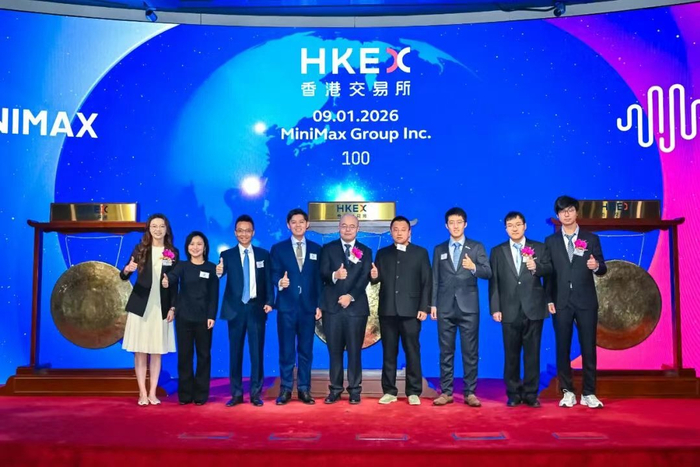
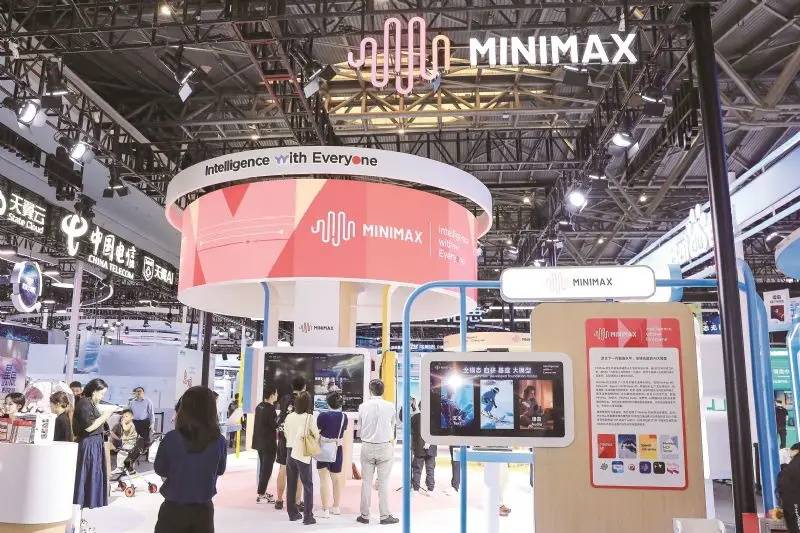
Core Viewpoint - MiniMax, a company focused on general artificial intelligence (AGI), successfully went public in Hong Kong, becoming the second AGI-based model company to do so globally and achieving a market valuation of 105.379 billion HKD [1] Company Overview - MiniMax was established in December 2021 and is recognized as one of the "Six Little Tigers" of China's large model sector, alongside other notable companies [3] - The company has completed seven rounds of financing, attracting investments from major firms such as Alibaba, Tencent, and Sequoia Capital, with a valuation reaching 4.24 billion USD (approximately 2.96 billion RMB) [3] Market Position - According to a report, MiniMax ranks tenth in the global model market with a market share of 0.3% [3][4] - The company is one of the few in the world to excel in text, video, audio, and music modalities, utilizing advanced architectures like Mixture of Experts (MoE) [7] Product Offerings - MiniMax has launched several consumer-oriented products, including MiniMax Agent, Hailuo AI, MiniMax Audio, and Talkie/Xingye, with significant user engagement [9] - Hailuo AI has helped create over 590 million videos, while Talkie/Xingye has reached 147 million users, with 11 million monthly active users from overseas [9] Financial Performance - MiniMax began generating revenue in 2023, with earnings of 3.46 million USD, which surged by 782% to 30.52 million USD in 2024, and reached 53.44 million USD in the first three quarters of 2025, reflecting a year-on-year growth of 174.68% [11] - The company’s revenue is primarily driven by AI-native products, which account for over 70% of total revenue, with a significant portion coming from subscription services [12] Losses and Investments - Despite revenue growth, MiniMax has not yet reached a profitability inflection point, with cumulative net losses amounting to 1.32 billion USD (approximately 9.22 billion RMB) from 2022 to the first three quarters of 2025 [12] - The company has invested approximately 450 million USD (about 3.14 billion RMB) in research and development as of September 2025 [12] Competitive Landscape - MiniMax faces competition from major internet companies like ByteDance, Alibaba, and Tencent, particularly in its consumer product offerings [13] - The company is also dealing with legal challenges, including a lawsuit from Disney regarding copyright infringement related to Hailuo AI [13]

北京跑出“全球大模型第一股”,中国AI初创企业是否要迎来“上市潮”?
AI研究所· 2026-01-09 11:18
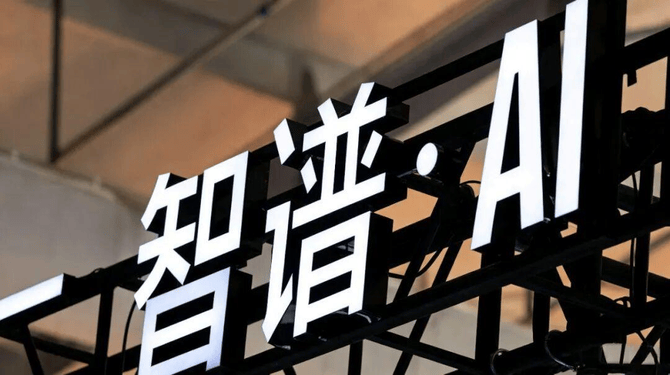
Core Viewpoint - Beijing Zhiyu Huazhang Technology Co., Ltd. (stock code: 02513.HK), known as "Zhiyu," has become the world's first publicly listed company focused on general artificial intelligence (AGI) models, marking a significant milestone for both the company and the Chinese AI industry [1][4]. Group 1: Company Overview - Zhiyu's stock price surged by a maximum of 16.18% after its debut, reaching a market capitalization of nearly 60 billion HKD [1]. - The company was established in 2019, leveraging technology from Tsinghua University's KEG laboratory, and aims to launch its GLM-4.7 model by the end of 2025, which is expected to surpass GPT-5.2 on global rankings [5][6]. Group 2: Business Model - Zhiyu's primary revenue model is based on "Model as a Service" (MaaS), allowing the company to monetize its large model capabilities through API interfaces and subscription services [8]. - In the first half of 2025, the MaaS business accounted for 84.8% of total revenue, with three main segments: localized deployment for high-security clients, API access for global developers, and a "model supermarket" for small and medium-sized clients [9]. Group 3: Financial Performance - Zhiyu's revenue grew from 57.4 million CNY in 2022 to 312 million CNY in 2024, with an average annual growth rate of 130%. In the first half of 2025, revenue reached 191 million CNY, a 325% increase year-over-year [12]. - The company's gross margin has remained stable at over 50%, and by June 2025, the model's token consumption reached 4.6 trillion times daily, indicating high-frequency usage in real production environments [12]. Group 4: Competitive Advantages - Zhiyu's core competitive advantage lies in its self-developed GLM series models, which utilize a unique "autoregressive fill-in-the-blank" pre-training method, enabling better information understanding and efficient content generation [14]. - The GLM-4.7 model has received recognition in global evaluations, outperforming GPT-5.2 in user blind tests and ranking first among open-source models in the AA Intelligence Index [15]. Group 5: Ecosystem Support - Zhiyu's growth is significantly supported by its location in Haidian, a hub for AI talent and resources, with a high concentration of universities and research institutions [17]. - The company has benefited from favorable policies and support from the Haidian district, which has facilitated its transition from laboratory technology to market products [19]. - In addition, the Zhangjiang area has provided capital and commercialization opportunities, with strategic investments and partnerships enhancing Zhiyu's market presence [23]. Group 6: Industry Implications - Zhiyu's successful IPO has opened the door for other Chinese AI companies to pursue capital markets, providing a reference model for future listings [26]. - The listing signifies a shift in the Chinese AI industry from pure technology competition to a comprehensive competition involving technology, capital, and ecosystem [27].

2026年,全球资产会迎来巨变
大胡子说房· 2026-01-09 10:28
Macro Situation - The macro situation has become increasingly uncertain following the U.S. arrest of Venezuela's president, leading to fluctuations in oil, commodities, gold, and silver prices [2] - Trump's potential military budget increase to $1.5 trillion for 2027 suggests a new arms race may be on the horizon [3][5] - The military-industrial sector in the U.S. has already seen a surge in stock prices [6] Military Industry - The military industry in China is expected to enter a new growth cycle during the 14th Five-Year Plan, focusing on high-quality defense modernization and national unification [6][7] - The geopolitical landscape indicates that the military sector will be a key area of investment and development [8] Energy Competition - The U.S. aims to control Venezuela's oil resources, which could impact global oil pricing and the use of alternative currencies for oil transactions [9][10] - Greenland's resources, including significant rare earth and oil reserves, are also a target for U.S. interests, which could lead to energy supply disruptions for China [12][13] AI and Power Demand - Elon Musk predicts an unprecedented demand for electricity due to the rise of artificial general intelligence (AGI), which will require exponentially more computational power [17][22] - The current electrical grid is not equipped to handle this surge, leading to a potential shortage of transformers, which are becoming a strategic resource [28][30] Infrastructure and Manufacturing - The demand for power infrastructure, particularly transformers, is expected to skyrocket, benefiting manufacturers and suppliers of raw materials like copper and silicon steel [31] - China's ability to rapidly build data centers and enhance its computing infrastructure positions it favorably in the global race for computational power [34][35] Space Energy Revolution - Musk advocates for space-based solar energy as a solution to Earth's energy limitations, with advancements in launch costs making such projects economically viable [42] - The commercial space industry and related technologies are poised for significant growth as nations compete for orbital resources [43][44] Workforce Transformation - AI is set to replace many white-collar jobs, leading to permanent job losses in sectors like customer service and content creation [49][50] - However, the demand for skilled individuals who can manage and utilize AI technologies will remain, emphasizing the need for adaptation [52][53]

“大模型之后,AI如何走向真正落地?”范式智能发布 Phanthy 平台,提出“垂直世界模型”新路径
Ge Long Hui· 2026-01-09 10:11
Core Viewpoint - The launch of the Phanthy platform by Paradigm Intelligence represents a significant shift in AI development, moving away from traditional large language models (LLMs) towards a more reliable and actionable form of artificial general intelligence (AGI) that emphasizes domain-specific expertise and causal reasoning [1][10]. Group 1: Phanthy Platform Overview - Phanthy is not just another large language model; it is an intelligent operating system composed of a generative coordination hub and multiple vertical world models [3][5]. - The platform aims to address the limitations of existing LLMs, which often fail in real-world applications due to their lack of causal understanding and accountability [3][5]. Group 2: Key Features of Phanthy - Phanthy possesses domain-specific causal reasoning capabilities, allowing it to simulate how macroeconomic variables affect corporate cash flows and predict dynamics in energy output [5]. - The platform supports closed-loop decision-making and feedback, enabling it to automatically adjust parameters in industrial settings based on real-time data [6]. - Phanthy embraces uncertainty by clearly indicating when it lacks confidence in its responses, contrasting with LLMs that may provide misleading information [7]. Group 3: Continuous Learning and Evolution - Each vertical world model within Phanthy is designed to learn continuously from real business processes, optimizing its logic based on feedback from users [8]. - This ongoing evolution allows Phanthy to adapt and improve its performance over time, rather than being static after initial training [8]. Group 4: Architectural Innovation - The architecture of Phanthy moves away from a single model approach to a collaborative system of specialized models, akin to an "expert council" [9]. - The operational logic involves breaking down complex tasks, coordinating various models, and producing structured reports with traceable conclusions [9]. Group 5: Open Collaboration and Ecosystem Development - Paradigm Intelligence is opening the Phanthy platform for collaboration across key industries such as finance, energy, manufacturing, transportation, and healthcare [11]. - The company aims to provide tools for vertical model development and knowledge integration, positioning itself as a foundational element in the AGI ecosystem [11]. Group 6: Conclusion - The emergence of Phanthy serves as a reminder that the true value of AI lies in its ability to solve real problems rather than merely engaging in conversation [12]. - The platform emphasizes depth of expertise over sheer scale, advocating for a collaborative approach to AI development [12].
智谱成功IPO,中国AI推出“全球大模型第一股”
Sou Hu Cai Jing· 2026-01-09 09:53
Core Viewpoint - The successful IPO of "Zhipu," one of the "Six Little Tigers" in China's AI sector, marks a significant milestone for the industry, raising approximately 4.348 billion HKD (around 38.985 billion RMB) and shifting global attention towards Hong Kong from Silicon Valley and London [1][3]. Company Overview - Zhipu, founded in 2019 from Tsinghua University's technology transfer, is a technology-driven unicorn and the world's first publicly listed company focused on self-developed general artificial intelligence (AGI) base models [3][4]. - The company ranks first among independent general model developers in China and second globally, with a market share of 6.6% and projected annual revenue of 312.4 million RMB in 2024 [4]. Financial Performance - Zhipu has invested approximately 4.4 billion RMB in R&D, with a projected R&D expenditure of 1.59 billion RMB in the first half of 2025, and 74% of its workforce dedicated to R&D [5]. - The company aims to allocate 70% of the IPO proceeds to the development of the next generation of general models [5]. Market Position and Challenges - The IPO signifies a transition from a technology idealism phase to a capitalized operational model, amidst increasing competition and pressure for profitability in the AI sector [6][7]. - Zhipu faces significant challenges, including the need to demonstrate a healthy and scalable economic model, manage high training and inference costs, and maintain technological leadership against global competitors [7][8]. Industry Impact - Zhipu's listing is a pivotal moment for China's AI industry, showcasing the capability of Chinese tech teams to reach world-class levels in core model development and engage in global capital and business dialogues [9]. - The company is expanding its international presence, establishing foundational infrastructure in countries like Malaysia, Singapore, UAE, and Saudi Arabia, and aims to increase its API business revenue share [9]. Competitive Landscape - Zhipu is not the only player in the market; its competitor MiniMax is also pursuing an IPO, highlighting the competitive dynamics within the Chinese AI sector [10][11]. - The emergence of Zhipu and MiniMax represents a shift towards a more transparent and competitive environment in the AI industry, where both companies are seen as leaders in the global AI landscape [11].
MiniMax,大涨
盐财经· 2026-01-09 09:41
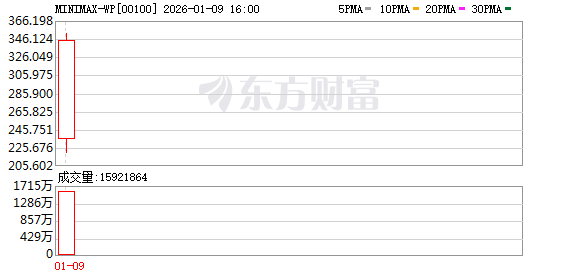
Core Insights - MiniMax, a leading global artificial intelligence (AGI) company, successfully listed on the Hong Kong Stock Exchange with an issue price set at the upper limit of the range, at HKD 165 per share. The stock opened with a gain of over 50% and closed with a total increase of 109.09%, reaching HKD 345 per share, with a trading volume of HKD 4 billion and a total market capitalization exceeding HKD 100 billion [2][4]. Company Overview - MiniMax, located in Shanghai, is recognized as one of the top four companies globally in the full-modal AI model sector. The company has developed a series of full-modal general models, including MiniMax M2.1, Hailuo 2.3, Speech 2.6, and Music 2.0 [4]. - As of September 2025, MiniMax has over 212 million individual users across more than 200 countries and regions, indicating a strong global presence [4]. Financial Performance - In the first nine months of 2025, MiniMax reported a revenue growth of over 170% year-on-year, with more than 70% of its revenue coming from international markets, showcasing its robust global market expansion capabilities and a healthy, diversified revenue structure [4]. Leadership Vision - The founder and CEO of MiniMax, Yan Junjie, emphasized that the true value of an AI company lies in its ability to continuously provide advanced intelligence for practical use, highlighting the company's commitment to contributing to social and economic development [4].

国产大模型企业MiniMax上市首日收涨约109% 总市值超1000亿港元
Zheng Quan Shi Bao Wang· 2026-01-09 09:32
Core Viewpoint - MiniMax, a leading AI model company, successfully listed on the Hong Kong Stock Exchange, with its stock price surging over 109% on the first day, achieving a market capitalization exceeding 100 billion HKD [1]. Company Overview - MiniMax specializes in general artificial intelligence (AGI) and has developed a foundational model architecture that includes text-to-visual, text-to-audio, and text-to-text modalities. The company has created several multimodal models, including MiniMax M2.1, Hailuo 2.3, Speech 2.6, and Music 2.0, positioning itself among the top four multimodal companies globally [1]. - The company has undergone seven rounds of financing, with early investors including prominent firms such as IDG and Tencent. Its latest funding round in August raised approximately 390 million USD, leading to a valuation exceeding 4.2 billion USD [2]. Financial Performance - As of September 2025, MiniMax has over 212 million individual users across more than 200 countries and regions. The company's revenue for the first nine months of 2025 increased by over 170% year-on-year, with over 70% of revenue coming from international markets [3]. - Research and development expenditures grew by 30% year-on-year, while sales and marketing expenses decreased by 26% during the same period [3]. Market Insights - The global large model market is in the early stages of commercialization, with projections indicating a growth from 10.7 billion USD in 2024 to 20.65 billion USD by 2029, reflecting a compound annual growth rate (CAGR) of 80.7% [3]. - The large model application market is expected to expand from 7.1 billion USD in 2024 to 151.5 billion USD by 2029, with a CAGR of 84.3%. Additionally, the large model as a service (MaaS) market is forecasted to grow from 3.6 billion USD to 55 billion USD during the same period, achieving a CAGR of 72.7% [3].
3个月亏掉105亿!英伟达和卡塔尔却抢着送钱让它烧
Xin Lang Cai Jing· 2026-01-09 09:27
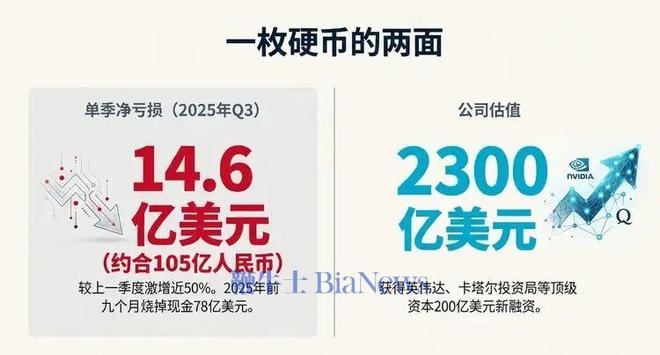
Core Insights - xAI, founded by Elon Musk, reported a staggering net loss of $1.46 billion (approximately 10.5 billion RMB) in Q3 2025, marking a nearly 50% increase from the previous quarter [1][5] - Despite these losses, xAI's valuation soared to $230 billion, with top investors like Nvidia and Qatar Investment Authority providing $20 billion in new funding [1][16] - The company is aggressively investing in infrastructure, including a supercomputer center in Tennessee and a $20 billion data center in Mississippi, aiming to create the world's largest supercomputer with a total computing power of 2 gigawatts [10][12] Financial Performance - In the first nine months of the year, xAI burned through $7.8 billion in cash, with quarterly losses averaging $1.46 billion [5][8] - Revenue for Q3 2025 nearly doubled to $107 million, although it still falls short of the company's annual target of $500 million [12][16] - Gross profit increased significantly from $14 million in Q2 to $63 million in Q3, indicating potential for future profitability [12] Strategic Vision - xAI aims to build a "self-sustaining AI" that will support humanoid robots like Tesla's Optimus, positioning itself as a key player in the future of AI-driven physical entities [14][16] - The integration of xAI with other Musk ventures, such as Tesla and SpaceX, creates a unique ecosystem that leverages data sharing and resource interconnectivity [19] Challenges and Controversies - The rapid expansion of xAI has raised ethical concerns, particularly regarding the misuse of its AI capabilities, as evidenced by incidents involving inappropriate content generated by its Grok chatbot [21][23] - Local communities have expressed concerns over the environmental and social impacts of xAI's infrastructure projects, leading to protests and petitions against the data center in Mississippi [24][26] Future Outlook - Analysts predict that xAI could achieve profitability by 2027, but this will require further investment and resolution of ongoing controversies [28] - The competitive landscape remains intense, with rivals like OpenAI and Google DeepMind continuing to advance in AI model capabilities, posing a challenge to xAI's growth strategy [30]

“全球大模型第一股”上市,市值近700亿!联合创始人毕业且曾任教于山西大学
Sou Hu Cai Jing· 2026-01-09 09:10
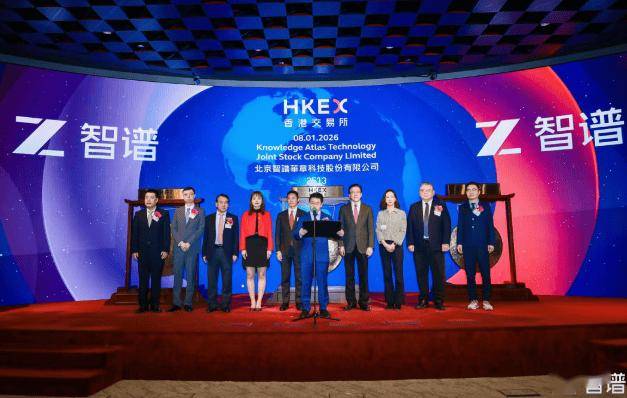
Core Viewpoint - Zhiyuan Huazhang Technology Co., Ltd. (referred to as "Zhiyuan") has become the world's first publicly listed company focused on general large models, marking a significant milestone in the AI industry [1][3]. Company Overview - Zhiyuan was established in 2019 and has quickly grown to become a leading AI company in China, focusing on the innovation of Artificial General Intelligence (AGI) [3]. - The company offers two main business segments: localized deployment for government and enterprise clients, and cloud deployment through API interfaces for independent developers [3]. - The founding team includes several members from Tsinghua University, highlighting a strong academic background [6][8]. Shareholding Structure - After a share transfer in 2021, the shareholding structure of Zhiyuan includes Beijing Chainpai (37.38%), Liu Debing (0.80%), Tang Jie (21.97%), and others [4]. Investment and Valuation - Since its inception, Zhiyuan has attracted significant capital, completing multiple funding rounds with investments from major companies like Meituan, Ant Group, Alibaba, Tencent, and Xiaomi [10]. - The total financing amount has exceeded 8.3 billion RMB, with the company's valuation increasing from 387 million RMB to approximately 24.38 billion RMB, a growth of about 63 times [11]. IPO Details - Zhiyuan went public on the Hong Kong Stock Exchange, issuing 37.42 million H-shares at 116.2 HKD each, raising a total of 4.348 billion HKD [13]. - On its first trading day, the stock price surged over 13.17%, reaching a market capitalization of 57.89 billion HKD, and increased to 69.8 billion HKD by the second day [13]. Market Potential - The Chinese AI market is projected to grow from 93.7 billion RMB in 2022 to 160.7 billion RMB in 2024, with a compound annual growth rate (CAGR) of 31.0% [14]. - Zhiyuan's revenue is expected to rise significantly, from 57.4 million RMB in 2022 to 312.4 million RMB in 2024, reflecting a CAGR of over 130% [14]. - Despite current losses due to substantial R&D investments, Zhiyuan has supported over 8,000 institutional clients and approximately 80 million devices [14].
MiniMax港交所上市市值破900亿港元,创中国AI最快IPO纪录
3 6 Ke· 2026-01-09 08:45
【MiniMax市值破 00亿港元,#中国AI最快IPO诞生# 】 据新浪财经消息,1月9日MiniMax正式登陆港交所,此次IPO发行价为165港元/股,开盘后大涨超70%, 市值一度突破900亿港元。其公开发售部分超额认购倍数高达1837倍,欧洲、美国、加拿大等多地的顶 级长线机构、主权基金均参与投资,市场热度显著。 明势创投是MiniMax的早期投资方之一,从2022年3月首笔投资开始,连续参与了六轮加注,是所有机 构投资人中参与轮次最多的机构。而在投资决策初期,明势创投正是看中了闫俊杰对AGI(通用人工智 能)的布局,以及团队的技术迭代能力。 在MiniMax的发展过程中,其曾在行业尚未形成共识时押注MoE架构预训练,并推出相关模型,开创了 大规模商业化部署的先例;同时通过技术优化,实现了以较低成本追近头部模型性能,打破了 "高性 能、低成本、商业盈利" 的不可能三角。 这家诞生于上海的AI企业,由前商汤高管闫俊杰在2022年创立,至此成为全球从成立到IPO用时最短的 AI独角兽之一。出生于1989年的闫俊杰,也成为中国AI新浪潮的标志性面孔之一。 ...