
粤港澳大湾区

Search documents
香港发展局:未来数年北部都会区可提供土地及房屋将以倍数上升
智通财经网· 2025-10-12 01:59
Core Viewpoint - The Hong Kong Development Bureau has reported significant progress in the Northern Metropolis development over the past two years, with four new development zones currently under construction, covering nearly 900 hectares of land [1] Group 1: Development Progress - The Northern Metropolis is expected to see a multiple increase in land and housing output in the coming years [1] - The planning for the Northern Metropolis has been largely finalized, with projects commencing to accelerate development and attract corporate investment [1] Group 2: Policy Initiatives - The government plans to introduce a "package of incentives" to promote industry and investment in the Northern Metropolis, aiming to facilitate business establishment in Hong Kong [1] - The Chief Executive's Policy Address includes proposals to simplify administrative procedures and establish dedicated legislation for the Northern Metropolis to expedite its development and attract industries [1] Group 3: Strategic Focus - The Northern Metropolis will provide over 3,000 hectares of new development land, leveraging its geographical proximity to Guangdong Province [1] - The focus will be on developing innovation technology, education, and high-end industries, positioning the Northern Metropolis as a platform for deepening cooperation with other cities in the Guangdong-Hong Kong-Macao Greater Bay Area [1]
城市24小时 | 坐标中国最南端,这条跨海高铁又动了?
Mei Ri Jing Ji Xin Wen· 2025-10-10 16:05
Group 1 - The core viewpoint of the news is the establishment of an expert group to evaluate the feasibility of the new high-speed railway project from Zhanjiang to Haikou, which is crucial for enhancing transportation capabilities and supporting the development of Hainan as a free trade port [1][2] - The Zhanjiang to Haikou high-speed railway is part of the "Eight Vertical and Eight Horizontal" railway network and is included in the Medium and Long-term Railway Network Plan, highlighting its significance for external connectivity [1][2] - The expert group will analyze various aspects of the project, including functional positioning, construction plans, technical standards, investment, and economic benefits, to provide technical support for the National Railway Administration [1] Group 2 - The Zhanjiang to Haikou high-speed railway aims to address the increasing demand for transportation between Hainan and other provinces, especially in light of the rapid development of the Guangdong-Hong Kong-Macao Greater Bay Area and Hainan's free trade port [2] - The project has been discussed since 2014, with recent developments indicating a strong push for its construction, including government reports emphasizing the need for resilient infrastructure [2] - The railway will utilize a ferry system to cross the Qiongzhou Strait, with a ferry distance of 23 kilometers, and will include new ferry stations [3] Group 3 - The Qiongzhou Strait is a critical transportation route for Hainan's development, with significant passenger and vehicle traffic recorded in 2024 [3] - The Zhanjiang to Haikou high-speed railway will be the first high-speed railway in China designed to operate at a speed of 350 km/h across a sea route, drawing on successful examples from other regions [3] - The feasibility of constructing a bridge across the Qiongzhou Strait remains under study due to complex geological and environmental conditions [3]

粤港澳大湾区城市群进阶:迈向创新经济
2 1 Shi Ji Jing Ji Bao Dao· 2025-10-10 13:12
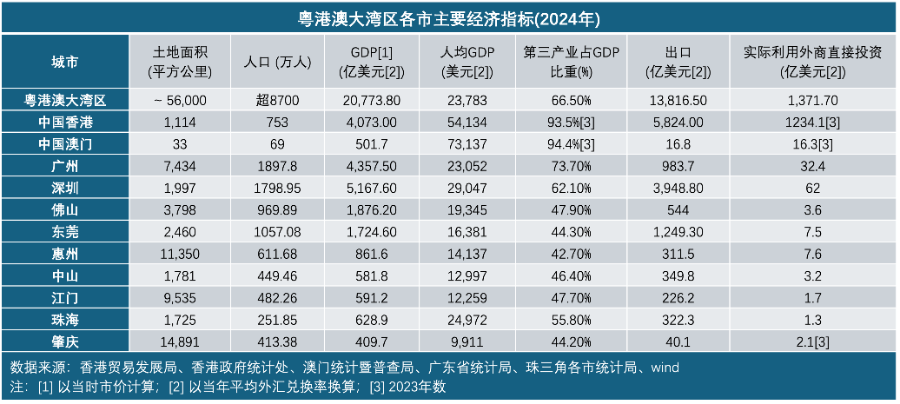
Core Insights - The development of the Guangdong-Hong Kong-Macao Greater Bay Area (GBA) is transitioning from a port-based economy to an innovation-driven economy, with a focus on technological integration and collaboration among cities [5][10][11] - The GBA is projected to surpass New York and San Francisco in economic output by 2024, with an estimated GDP of approximately 14.79 trillion yuan and a per capita GDP of about 170,200 yuan [9][12] - The GBA's urban cluster model is evolving, with a shift from reliance on traditional gateway cities like Hong Kong and Guangzhou to innovation hubs like Shenzhen [3][11] Economic Indicators - The GBA's total land area is approximately 56,000 square kilometers, with a population exceeding 87 million [4] - Key economic indicators for 2024 include: - Total GDP: 20,773.80 billion USD - Per capita GDP: 23,783 USD - Tertiary industry contribution to GDP: 66.50% [4] - Individual city GDPs for 2024 are projected as follows: - Shenzhen: 3.68 trillion yuan - Guangzhou: 3.10 trillion yuan - Hong Kong: 3.18 trillion HKD [12] Talent and Investment Flow - Talent mobility within the GBA has increased by 25% over the past three years, with external exchanges growing by 30% [6] - As of May 2024, the GBA has seen 115,571 participants in the "cross-border wealth management connect," with a total cross-border remittance amounting to 59.061 billion yuan [6][8] - The GBA has attracted over 300 research projects with a total funding exceeding 300 million yuan, highlighting its capacity for innovation and collaboration [8] Strategic Development - The GBA is positioned as a critical hub for linking Southeast Asian markets, leveraging its geographical and market advantages [14][15] - The region is expected to play a significant role in the "dual circulation" strategy, enhancing its function as a key node in both domestic and international supply chains [14][16] - Future development will focus on integrating industry, finance, and innovation to strengthen the GBA's global competitiveness [16]

粤港澳大湾区内地9市高新技术企业超7.1万家
Zhong Guo Xin Wen Wang· 2025-10-10 06:23
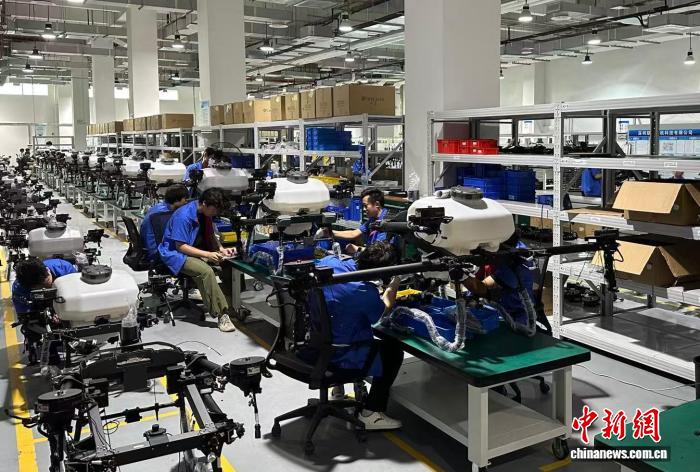
Core Insights - The Guangdong-Hong Kong-Macao Greater Bay Area (GBA) is projected to have over 71,000 high-tech enterprises by the end of 2024, with 190 national manufacturing champions and 2,089 "specialized, refined, and innovative" small giants [1][2] - The GBA's economic output is approximately $1.89 trillion in 2023, ranking second among the world's four major bay areas, closely following the Tokyo Bay Area [2] - The GBA's nine inland cities have seen their GDP grow from 8.04 trillion RMB in 2018 to 11.5 trillion RMB in 2024, representing a significant economic concentration with only 0.58% of the country's land and 5.6% of its population [2][3] Economic Development - The GBA's central cities, Shenzhen and Guangzhou, are expected to rank 3rd and 5th in GDP among Chinese cities in 2024, maintaining over 5% of the national GDP share in recent years [2] - By 2025, 18 companies from the GBA's nine inland cities are projected to be listed in the Fortune Global 500, with Shenzhen contributing 9 and Guangzhou 6, accounting for 83% of Guangdong's total [2] Industry Clusters - Guangdong has established nine trillion-yuan-level industrial clusters, including new-generation electronic information, green petrochemicals, smart home appliances, automotive, and new energy sectors [3] - The GBA's nine inland cities host eight national advanced manufacturing clusters, representing 10% of the national total, and six national strategic emerging industry clusters, accounting for 9.1% of the national total [3] - Emerging industries in the GBA, such as new energy and artificial intelligence, are on par or leading compared to developed countries, with one in three industrial robots globally being produced in Guangdong [3]
开出一条新路来(记者手记)
Ren Min Ri Bao· 2025-10-05 21:52
Core Insights - The Guangdong-Hong Kong-Macao Greater Bay Area (GBA) is recognized as one of the highest quality and most valuable regions for economic development in China, showcasing strong economic vitality and innovation [1] Group 1: Economic Development - The GBA has made significant progress over the past six years, driven by a combination of top-level design and practical experimentation [1] - Continuous reforms and openness have been pivotal in enhancing the role of innovation as the primary driving force for development in the region [1] Group 2: Regional Characteristics - The GBA comprises the vibrant cities of the Pearl River Delta, along with the stable economies of Hong Kong and Macao, reflecting the region's growth and its role in constructing a new development pattern [1]
工程“进度条”不断刷新!致敬坚守岗位奋战一线的建设者
Yang Shi Xin Wen Ke Hu Duan· 2025-10-04 07:15
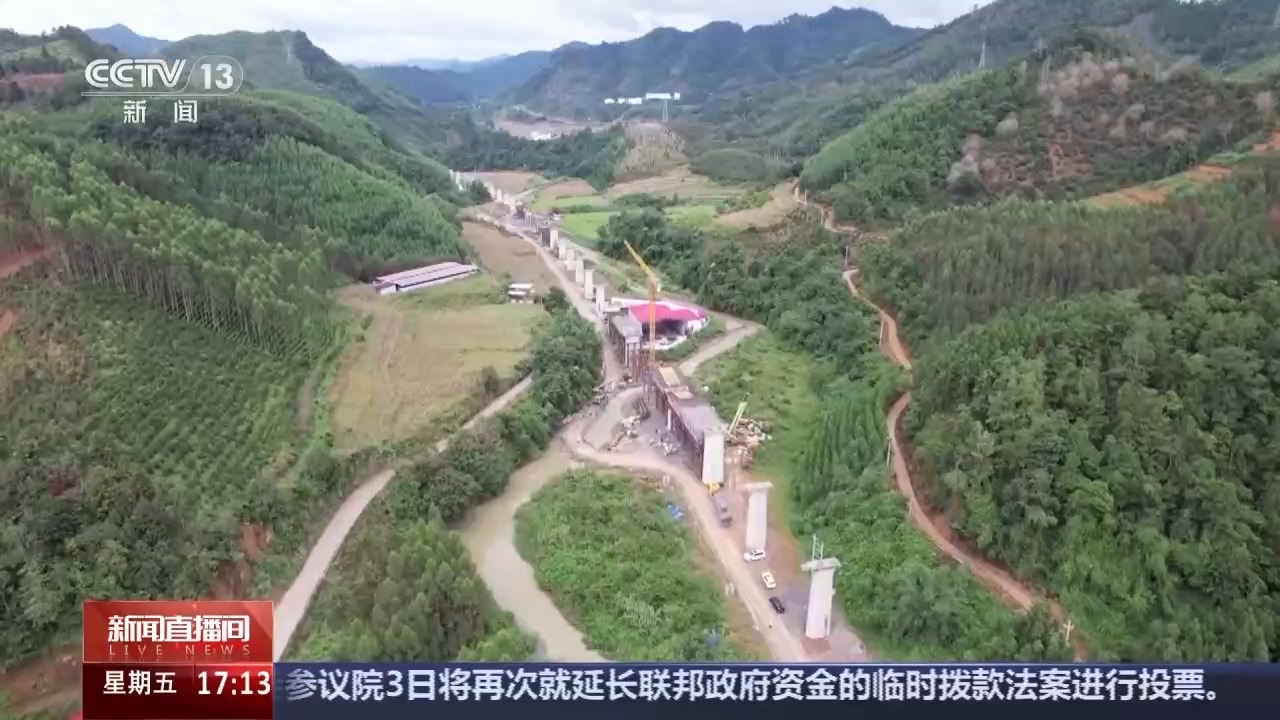
Group 1 - The Huangbai Railway's Guangxi section is under accelerated construction, part of the Western Land-Sea New Corridor, which is crucial for enhancing regional railway network layout and overall transport capacity [1][3] - The Makou Hanjiang Grand Bridge in Hubei is expected to be completed in November, significantly reducing travel time from Wuhan to Tianmen from over 2 hours to about 1 hour [3][5] - The Changjiu High-Speed Railway in Jiangxi is progressing with 84 construction sites operating simultaneously, expected to be completed by 2027, enhancing connectivity with the Guangdong-Hong Kong-Macao Greater Bay Area [5][7] Group 2 - Over 10,000 builders are working in Xiong'an New Area, focusing on high-quality construction, with a 500 kV substation expected to be operational by the end of November, improving clean energy supply to over 95% in the core area [7][8]
大健康国际(02211.HK)年度收益7.1亿元 同比减少34.7%
Ge Long Hui· 2025-09-30 13:23
Core Viewpoint - The company reported a significant decline in revenue and an increase in losses for the fiscal year ending June 30, 2025, primarily due to the impact of new healthcare policies in China [1] Financial Performance - The company recorded revenue of RMB 710 million, a year-on-year decrease of 34.7% [1] - The loss attributable to shareholders was RMB 26 million, compared to a profit of RMB 400,000 in 2024 [1] - Earnings per share were RMB -0.3246, a decline from an adjusted profit of RMB 0.0062 per share in 2024 [1] Market and Operational Challenges - Revenue decline was attributed to the new healthcare policies in China and a decrease in the number of active customers within the national distribution network [1] - The company is actively participating in alliance activities to enhance its industry influence and brand product development [1] Strategic Initiatives - The company is focusing on national strategic initiatives such as "Healthy China," "Beautiful China," "Belt and Road," "Guangdong-Hong Kong-Macao Greater Bay Area," and "Hainan Free Trade Port" to guide its business transformation and upgrade [1] - The company aims to leverage industry experience and focus on technological innovation to explore further business transformation directions [1]
全球粤商齐聚广州 共谋高品质合作 共促高质量发展
Nan Fang Ri Bao Wang Luo Ban· 2025-09-30 08:04
Group 1 - The 2025 World Cantonese Business Conference was held in Guangzhou, focusing on high-quality development in Guangdong and uniting global Cantonese business representatives [1] - Participants expressed commitment to support and invest in Guangdong's modernization efforts, emphasizing the importance of collaboration among Cantonese businesses [1] Group 2 - The top 100 private enterprises in Guangdong were announced, highlighting the province's strong private economy and the significant contributions of local entrepreneurs [2] - Among the 100 recognized builders, 78 are leaders of medium to large enterprises, with 38 awarded for their charitable contributions, including 26 companies donating over 10 million yuan [2] Group 3 - The 2025 Guangdong Private Enterprises 100 Strong list was based on voluntary applications and 2024 revenue, with a threshold of 12.332 billion yuan for inclusion [3] - Notable companies include Huawei, BYD, Tencent, and Midea, with Shenzhen having the highest representation of 40 companies on the list [3] Group 4 - Discussions at the conference centered on how Cantonese businesses can seize opportunities in the Greater Bay Area, which is becoming a major global economic center [4] - Guangdong's manufacturing sector is highlighted for its comprehensive industrial system and strong government support for technology initiatives [4] Group 5 - The Greater Bay Area is recognized for its research institutions, technology application capabilities, and robust financial services, indicating significant growth potential [5] - A collaborative initiative was launched, urging global Cantonese businesses to contribute to the development of the Greater Bay Area and enhance cooperation [5]
美新科技涨0.15%,成交额4094.85万元,今日主力净流入290.19万
Xin Lang Cai Jing· 2025-09-30 07:53
Core Viewpoint - The company, Meixin Technology, is benefiting from the depreciation of the RMB and its significant overseas revenue, which accounts for 97.08% of its total revenue [2]. Company Overview - Meixin Technology Co., Ltd. is located in Huizhou, Guangdong Province, and was established on June 16, 2004. It was listed on March 13, 2024. The company primarily engages in the research, production, and sales of wood-plastic composite materials and products [3][7]. - The main revenue composition includes wall panels (55.37%), outdoor flooring (44.17%), and other products (0.46%) [7]. - As of September 19, the number of shareholders is 7,158, a decrease of 8.45% from the previous period, while the average circulating shares per person increased by 9.23% to 10,248 shares [7]. Financial Performance - For the first half of 2025, Meixin Technology achieved operating revenue of 446 million yuan, a year-on-year increase of 2.36%. However, the net profit attributable to the parent company was 22.35 million yuan, reflecting a year-on-year decrease of 33.34% [7]. - The company has distributed a total of 39.23 million yuan in dividends since its A-share listing [8]. Market Activity - On September 30, Meixin Technology's stock rose by 0.15%, with a trading volume of 40.95 million yuan and a turnover rate of 2.69%, resulting in a total market capitalization of 2.451 billion yuan [1]. - The stock's average trading cost is 20.56 yuan, and it is currently near a resistance level of 21.10 yuan, indicating potential for upward movement if this level is breached [6]. Capital Flow Analysis - The net inflow of main funds today was 2.90 million yuan, accounting for 0.07% of the total, with the industry ranking at 14 out of 75. This marks the second consecutive day of increased main fund positions [4][5]. - The main funds have been decreasing in the industry for three consecutive days, with a total outflow of 31.67 million yuan [5].
盐田港跌0.23%,成交额5226.94万元,近5日主力净流入-4189.17万
Xin Lang Cai Jing· 2025-09-30 07:05
Core Viewpoint - Shenzhen Yantian Port Co., Ltd. is a key player in the port industry, benefiting from the development of the Guangdong-Hong Kong-Macao Greater Bay Area and the national economic landscape, with significant expectations for overall listing in the market [2][4]. Company Overview - Shenzhen Yantian Port Co., Ltd. was established on July 21, 1997, and listed on July 28, 1997. The company is located in Yantian District, Shenzhen, Guangdong Province [7]. - The main business activities include port investment and operation, terminal construction project management, toll highway operation management, customs supervision warehouses, and other port-related warehousing operations [7]. - The revenue composition of the company is as follows: port cargo handling and transportation (59.49%), highway tolls (30.11%), and warehousing and other services (10.41%) [7]. Business Dynamics - The company operates in the port industry, which is closely linked to the national and regional economic trade development. The port serves as a crucial hub connecting domestic and international markets, enhancing the value of logistics, capital, trade, and data [2][4]. - In May 2022, Kunshan Zhongpin Cold Chain Logistics Co., Ltd. became a wholly-owned subsidiary of Yantian Port Cold Chain Investment Holdings Co., Ltd. [2]. Financial Performance - As of June 30, 2025, Yantian Port achieved an operating income of 389 million yuan, a year-on-year decrease of 4.49%, while the net profit attributable to shareholders increased by 4.07% to 653 million yuan [8]. - The company has distributed a total of 7 billion yuan in dividends since its A-share listing, with 1.557 billion yuan distributed over the past three years [8]. Market Position - Yantian Port is recognized as one of the highest single-port container throughput terminals globally and is expected to benefit from the development of the Greater Bay Area [2][3]. - The company is controlled by the State-owned Assets Supervision and Administration Commission of the Shenzhen Municipal People's Government [3]. Shareholder Dynamics - As of June 30, 2025, the number of shareholders reached 65,000, an increase of 14.09% from the previous period, with an average of 48,673 circulating shares per person, up by 23.26% [8].
