
通胀率

Search documents
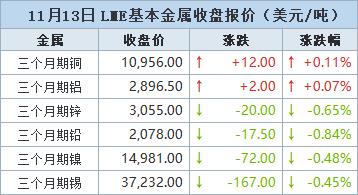
金属全线下跌 投资者谨慎看待美国政府重开 【11月13日LME收盘】
Wen Hua Cai Jing· 2025-11-14 00:39
Core Viewpoint - The London Metal Exchange (LME) copper prices increased slightly, while other base metals mostly declined, reflecting cautious market sentiment regarding the reopening of the U.S. government [1][4]. Group 1: Copper Market - On November 13, LME three-month copper rose by $12, or 0.11%, closing at $10,956 per ton [2]. - During the trading session, copper prices briefly surpassed the psychological threshold of $11,000, reaching $11,018 per ton for the first time this month before retracting [1]. Group 2: Other Base Metals - Three-month aluminum increased by $2, or 0.07%, closing at $2,896.50 per ton [2]. - In contrast, three-month zinc decreased by $20, or 0.65%, to $3,055.00 per ton, and three-month lead fell by $17.50, or 0.84%, to $2,078.00 per ton [2]. Group 3: Market Sentiment and Economic Indicators - Analysts emphasize that strong demand, particularly from major consumer countries, is crucial for sustaining price increases [4]. - Investors are awaiting key economic data from China, including new home prices, retail sales, and industrial output [5]. - The Minneapolis Federal Reserve President noted mixed economic signals, with inflation around 3% and pressures in certain labor market sectors [5]. Group 4: Aluminum Price Forecast - ANZ raised its short-term aluminum price target from $2,700 to $2,900 per ton due to strong demand from manufacturing, construction, and automotive sectors [5]. - The bank forecasts aluminum prices could reach $3,000 per ton by June 2026, driven by tightening supply against rising demand [5].

受食品价格因素推动,巴西消费者价格指数保持积极走势
Shang Wu Bu Wang Zhan· 2025-11-13 16:29
Core Insights - Brazil's inflation rate dropped to its lowest level since 1998, driven by adjustments in energy prices and the prices of food and daily necessities [1][2] - The consumer price index (IPCA) showed a positive trend, with a monthly inflation rate of 0.09% in October, down from 0.48% in September, and below the forecast by "Valor Econômico" [2] - Over the past 12 months, the cumulative increase in the consumer price index was 4.68% [2] Price Category Analysis - Among nine surveyed categories, only three experienced accelerated price increases: food and beverages (from -0.26% to 0.01%), transportation (from 0.01% to 0.11%), and health and personal care (from 0.17% to 0.41%) [2] - Prices in housing, clothing, personal spending, and education categories saw declines [2] - Notably, food prices showed surprising results, with rice prices decreasing by 2.49% and shelf-stable milk by 1.88%, while meat prices remained stable contrary to expectations of significant increases [2]
10月巴西通胀率下降
Shang Wu Bu Wang Zhan· 2025-11-13 16:29
Core Insights - Brazil's inflation rate decreased significantly in October, dropping from 0.48% in September to 0.09%, with the annual inflation rate falling from 5.17% to 4.68% [1] Economic Indicators - The Central Bank of Brazil's monetary policy committee indicated that the current benchmark interest rate of 15% is sufficient to guide inflation towards the target level, aiming for an annual inflation rate below 4.5% by the first quarter of 2026 [1]
美联储的卡什卡利:通胀率过高,就业市场的某些领域面临压力。
Sou Hu Cai Jing· 2025-11-13 15:56
Core Viewpoint - The Federal Reserve's Kashkari indicates that inflation rates are too high and certain areas of the job market are under pressure [1] Group 1 - Inflation rates are currently elevated, which poses challenges for the economy [1] - Certain sectors within the job market are experiencing stress due to these inflationary pressures [1]
英央行维持4%基准利率不变
Shang Wu Bu Wang Zhan· 2025-11-13 05:40
Core Viewpoint - The Bank of England decided to maintain the benchmark interest rate at 4%, with increasing market expectations for a potential rate cut in December [1] Group 1: Monetary Policy Decision - The Monetary Policy Committee voted 5 to 4 to keep the interest rate unchanged, with Governor Bailey supporting this decision [1] - Bailey emphasized the importance of waiting for more economic data before making further decisions, indicating a critical moment for inflation outlook [1] Group 2: Economic Indicators - Current inflation rate in the UK stands at 3.8%, the highest among the G7 countries, while the UK benchmark rate is double that of the European Central Bank, posing challenges for the UK government to boost the economy [1] - Unexpected stability in inflation was observed in September, and recent employment data suggests a reduction in price pressures [1] Group 3: Future Projections - The Bank of England predicts that inflation will remain above the 2% target until at least Q2 2027 [1] - Economic growth is forecasted at 1.5% for 2025, an increase from the previous estimate of 1.25%, while growth for 2026 is expected to remain stable at 1.2% [1]
【环球财经】德国10月通胀率回落至2.3%
Xin Hua She· 2025-11-12 13:32
Core Insights - Germany's inflation rate decreased to 2.3% in October, down from a peak of 2.4% in September, influenced by falling energy prices and a slowdown in food price increases [1] - Food prices in Germany rose by 1.3% year-on-year in October, showing a significant deceleration compared to previous months, while energy prices fell by 0.9% [1] - The core inflation rate, excluding food and energy, was recorded at 2.8%, with service prices increasing by 3.5%, marking the largest rise in six months [1] Economic Indicators - The October inflation rate in Germany reflects a slight decline after two consecutive months of increases, with service prices continuing to rise at a rate above the average, serving as a primary support for inflation [1] - The Eurozone's inflation rate for October was reported at 2.1%, down from 2.2% in September, remaining above the European Central Bank's medium-term target level [1]
德国10月通胀率回落至2.3%
Xin Hua She· 2025-11-12 13:01
Core Insights - Germany's inflation rate decreased to 2.3% in October, down from a peak of 2.4% in September, influenced by falling energy prices and a slowdown in food price increases [1] Group 1 - The decline in inflation is attributed to a decrease in energy prices [1] - Food price growth has also slowed, contributing to the overall reduction in inflation [1]
肯10月份通胀率同比稳定在4.6%
Shang Wu Bu Wang Zhan· 2025-11-07 16:11
Core Insights - Kenya's inflation rate for October 2025 stands at 4.6% year-on-year, unchanged from September, with a month-on-month inflation rate of 0.2% [1] - The government's medium-term inflation target range is set between 2.5% and 7.5% [1] - The Central Bank of Kenya has reduced the benchmark lending rate from 9.50% to 9.25% in October, indicating room for further monetary policy easing as inflation remains within the target range [1]
加纳10月份通胀率放缓至8%
Shang Wu Bu Wang Zhan· 2025-11-07 16:11
Core Insights - Ghana's overall inflation rate decreased to 8.0% in October 2025, marking the lowest level since June 2021 and the tenth consecutive month of decline [1] - This figure represents a drop from 9.4% in September, indicating improvements in currency stability, reduced fuel prices, and better national food supply conditions [1] Economic Indicators - The inflation rate of 8.0% is the lowest since June 2021, reflecting a significant improvement in economic conditions [1] - The decline from 9.4% in September to 8.0% in October shows a notable reduction in inflationary pressures [1] Contributing Factors - The stability of the Ghanaian currency has played a crucial role in the reduction of inflation [1] - Decreased fuel prices have contributed to the overall decline in inflation rates [1] - Improvements in the national food supply situation have also positively impacted inflation [1]
欧洲央行管委Boris Vujcic重申:货币政策“处于良好状态”,但需警惕市场风险
智通财经网· 2025-11-07 03:55
Core Viewpoint - The European Central Bank (ECB) maintains that its current monetary policy is effective in controlling inflation without causing economic recession, with key deposit rates held steady at 2% after a series of rate cuts since June 2024 [1][2]. Monetary Policy - ECB's key deposit rate has been held at 2% for three consecutive meetings, following a total reduction of 2 percentage points from a historical high of 4% starting in June 2024 [1]. - The ECB's recent policy decisions are aligned with the eurozone's inflation rate reaching the target of 2%, supported by stronger-than-expected GDP growth in Q3 [1][4]. Economic Indicators - The eurozone's inflation rate slightly increased to 2.2% in September, primarily driven by rising service prices, but overall inflation remains manageable [4]. - The HCOB Eurozone Composite PMI rose from 51.2 in September to 52.5 in October, marking the highest level in 29 months and indicating robust economic expansion [4][5]. Employment Trends - Employment growth in the eurozone accelerated to its highest level in 16 months, driven by increased hiring in the service sector, despite ongoing layoffs in manufacturing [5]. Risks and Uncertainties - The ECB acknowledges uncertainties in the economic outlook, including global trade disputes and geopolitical tensions, which could impact future inflation forecasts [2][3].