
数字孪生

Search documents
捷安高科涨2.07%,成交额3857.62万元,主力资金净流出11.14万元
Xin Lang Zheng Quan· 2026-01-08 05:48
Core Viewpoint - The stock price of Jiaan High-Tech has shown a slight increase of 0.80% year-to-date, with fluctuations in the short term, indicating a mixed performance in the market [2]. Group 1: Stock Performance - On January 8, Jiaan High-Tech's stock rose by 2.07%, reaching a price of 11.36 CNY per share, with a trading volume of 38.58 million CNY and a turnover rate of 2.38% [1]. - The stock has increased by 2.43% over the last five trading days, but has decreased by 2.66% over the past 20 days, and increased by 4.41% over the last 60 days [2]. Group 2: Company Overview - Jiaan High-Tech, established on June 3, 2002, and listed on July 3, 2020, is located in Zhengzhou, Henan Province, and specializes in computer simulation training systems for rail transit, safety operations, shipping, and military sectors [2]. - The company's revenue composition includes 73.41% from rail transit simulation training systems, 18.22% from safety operation simulation training systems, 4.03% from technical services, 3.58% from other simulation products, and 0.76% from other sources [2]. Group 3: Financial Performance - For the period from January to September 2025, Jiaan High-Tech reported a revenue of 157 million CNY, reflecting a year-on-year growth of 1.97%, while the net profit attributable to shareholders decreased by 61.19% to 3.45 million CNY [2]. - The company has distributed a total of 183 million CNY in dividends since its A-share listing, with 100 million CNY distributed over the past three years [3]. Group 4: Shareholder Information - As of September 30, Jiaan High-Tech had 17,800 shareholders, a decrease of 1.07% from the previous period, with an average of 8,048 circulating shares per shareholder, which is an increase of 1.63% [2].

威士顿涨2.06%,成交额2.51亿元,主力资金净流出453.73万元
Xin Lang Zheng Quan· 2026-01-08 05:36
Group 1 - The core viewpoint of the news is that 威士顿's stock has shown significant fluctuations in price and trading volume, with a notable increase in the past few days despite a decrease over the past 20 days [1] - As of January 8, 威士顿's stock price increased by 2.06% to 61.84 CNY per share, with a total market capitalization of 5.442 billion CNY [1] - The company has a diverse revenue structure, with software development accounting for 43.04%, operation and maintenance services 24.89%, software product sales and services 19.63%, system integration 10.75%, and other services 1.69% [1] Group 2 - 威士顿 operates in the computer software development sector, specifically in horizontal general software, and is involved in concepts such as digital twins, digital economy, AI agents, ERP concepts, and artificial intelligence [2] - As of November 30, 威士顿 had 18,000 shareholders, a decrease of 4.37% from the previous period, with an average of 2,054 circulating shares per shareholder, an increase of 4.56% [2] - For the period from January to September 2025, 威士顿 reported a revenue of 122 million CNY, a year-on-year decrease of 32.34%, and a net profit attributable to shareholders of 21.49 million CNY, down 28.30% year-on-year [2] Group 3 - 威士顿 has distributed a total of 66 million CNY in dividends since its A-share listing [3]
竞业达涨2.00%,成交额5377.74万元,主力资金净流入275.28万元
Xin Lang Cai Jing· 2026-01-08 05:33
Group 1 - The core viewpoint of the news is that Jingyeda's stock has shown fluctuations in price and trading volume, with a recent increase in share price and a notable market capitalization of 4.834 billion yuan [1] - As of January 8, Jingyeda's stock price increased by 2.00% to 20.89 yuan per share, with a trading volume of 53.77 million yuan and a turnover rate of 2.05% [1] - The company has experienced a year-to-date stock price increase of 2.45%, with a 4.19% increase over the last five trading days, but a decline of 11.14% over the last 60 days [1] Group 2 - For the fiscal year ending December 31, Jingyeda reported a revenue of 191 million yuan, a year-on-year decrease of 36.79%, and a net profit attributable to shareholders of -33.61 million yuan, a decrease of 238.08% [2] - The company has distributed a total of 122 million yuan in dividends since its A-share listing, with 52.89 million yuan distributed over the past three years [3] - As of September 30, 2025, the number of shareholders decreased by 0.86% to 31,300, while the average number of circulating shares per person increased by 0.87% to 4,055 shares [2]

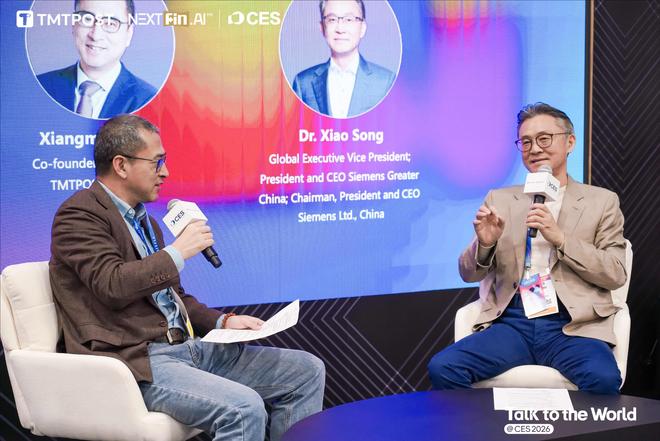
对话西门子中国董事长肖松:重塑产业新范式,AI的真正价值将在工业端充分释放|CES 2026
Tai Mei Ti A P P· 2026-01-08 05:24
Core Insights - The role of AI is evolving from mere model competition to practical applications in various industries, focusing on "last mile" implementations, with consumer AI targeting individual users and industrial AI emphasizing reliability and foundational skills [1][3] - Industrial AI is seen as a significant value driver, but it is still in its early stages, with increasing customer acceptance and potential for China to lead in application [3][4] - Siemens is recognized as a key partner in the industrial AI space, leveraging its extensive industry knowledge and data to drive transformation [6][11] Group 1: AI Evolution and Industrial Applications - AI is transitioning to become a true collaborative entity, focusing on practical applications rather than just model performance [1] - The true value of AI is expected to be realized in the industrial sector, with current applications still in the early stages of development [3][4] - Siemens emphasizes the importance of digital twin technology, which allows for the creation of virtual models that can enhance production efficiency and quality [5][9] Group 2: Siemens' Strategic Positioning - Siemens plans to invest €1 billion over the next three years to expand its industrial AI ecosystem, focusing on creating foundational models and collaborating with partners [6][14] - The company aims to leverage its historical expertise and high-quality data to lead the industrial AI revolution, addressing complex industry needs [6][11] - Siemens' digital twin composer is a significant innovation that integrates real-time data with virtual models, enhancing operational efficiency [5][9] Group 3: Market Trends and Future Outlook - The industrial AI market is characterized by its complexity and the need for tailored applications across different sectors, with Siemens advocating for a focus on application rather than just model parameters [14][15] - The company believes that AI will not replace human expertise but will enhance it, allowing experienced workers to define and make decisions rather than just operate [4][23] - The future of AI in industrial applications is expected to see incremental breakthroughs rather than radical changes, with a focus on quality improvement and cost reduction [24][27]

黄仁勋、杨元庆官宣合作:推出“人工智能云超级工厂”;智元发布开源仿真平台Genie Sim 3.0丨AIGC日报
创业邦· 2026-01-08 04:34
Group 1 - Lenovo and NVIDIA announced a collaboration to launch the "Lenovo AI Cloud Super Factory," which aims to significantly reduce the "time to first token" for AI deployment and scale up to 100,000 GPUs to support trillion-parameter AI models [2] - Datong Technology is advancing partnerships in the autonomous driving sector, showcasing a smart charging robot capable of automated charging tasks, and introducing a new generation of intelligent charging network systems at CES 2026 [2] - Zhiyuan Robotics released the Genie Sim 3.0, an open-source simulation platform driven by a large language model, which integrates 3D reconstruction and visual generation, allowing for rapid scene generation and a comprehensive evaluation system covering over 100,000 scenarios [2] Group 2 - Roborock, a Chinese vacuum cleaner manufacturer, unveiled the Saros Rover, a stair-climbing vacuum cleaner equipped with AI and motion sensors, demonstrating its ability to navigate stairs and uneven surfaces [2]




《经济学人》:制造业的“ChatGPT时刻”已经到来
美股IPO· 2026-01-08 04:15
Core Insights - The article discusses the transformative potential of artificial intelligence in manufacturing, marking a significant shift akin to the "ChatGPT moment" for the industry [1] Group 1: Automation and Robotics - The International Federation of Robotics (IFR) projects that by 2024, approximately 4.7 million industrial robots will be in use globally, with an average of 177 robots per 10,000 manufacturing workers [3] - The annual installation of industrial robots is expected to rise to 619,000 units in 2026, reflecting a recovery in demand for automation equipment [5] - Advances in industrial software are helping to overcome previous challenges in production automation, with generative AI technology poised to revolutionize manufacturing processes [5][11] Group 2: Market Trends and Economic Factors - The market for factory automation equipment has faced challenges due to a slowdown in manufacturing, particularly in Europe, but is expected to see growth driven by structural factors such as subsidies and tariffs encouraging domestic manufacturing [4][5] - Analysts predict that the growth rate of industrial automation equipment sales will increase from 1-2% in 2025 to 3-4% in 2026, maintaining a 6-7% growth rate over the next decade [5] Group 3: Future of Manufacturing - The concept of "smart factories" is emerging, where machines can predict demand and adjust production processes autonomously, reducing reliance on human intervention [12] - The design of factories may shift from large assembly lines to smaller, decentralized production networks, allowing for greater flexibility and reduced risk of crisis from factory failures [13] - Companies like Siemens are investing heavily in AI technologies to enhance manufacturing efficiency and adaptability, indicating a trend towards integrating AI as the "brain" of factories [12][9]
CES 2026:西门子宣布与英伟达共同打造工业 AI 操作系统
Huan Qiu Wang· 2026-01-08 03:47
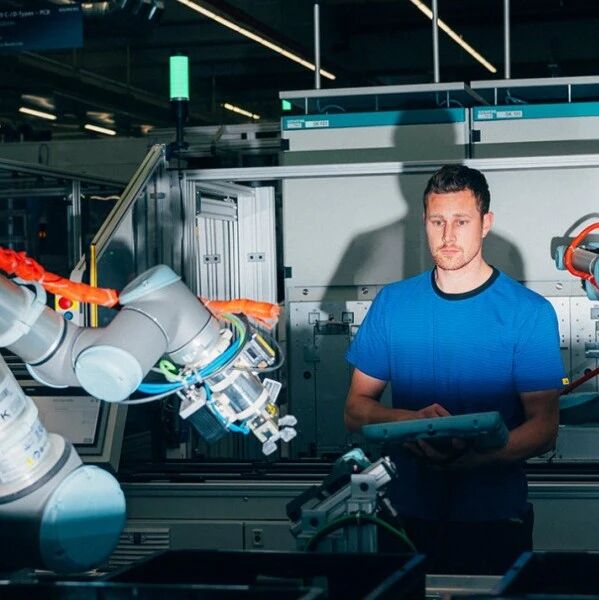
Group 1 - Siemens and NVIDIA are expanding their long-term collaboration to develop an industrial AI operating system aimed at transforming the design, engineering, and operational methods of physical systems [1] - The partnership will focus on creating AI-accelerated industrial solutions throughout the entire product and production lifecycle, enabling faster innovation, continuous optimization, and more resilient and sustainable manufacturing models [1] - The first fully AI-driven adaptive manufacturing facility will be launched in 2026 at Siemens' factory in Erlangen, Germany, supported by NVIDIA's AI infrastructure and Siemens' industrial AI experts [1] Group 2 - Siemens will integrate NVIDIA's NIM and Nemotron open-source AI models into its EDA software portfolio, enhancing design accuracy in the semiconductor and PCB design sectors while significantly reducing operational costs [2] - The CEO of Siemens emphasized that industrial AI is a key force reshaping the future of industrial forms, enabling end-to-end intelligent integration into design, engineering, and operations [2] - The company aims to leverage digital twins and AI-enabled hardware to help clients anticipate issues, accelerate innovation, and lower costs, thus transforming technological advancements into measurable outcomes [2] Group 3 - NVIDIA's CEO highlighted that generative AI and accelerated computing are driving a new industrial revolution, bridging the gap between creative concepts and real-world applications [4] - Siemens introduced the Digital Twin Composer at CES 2026, which integrates comprehensive digital twin capabilities with real-time engineering data, set to launch on the Siemens Xcelerator Marketplace in mid-2026 [4] - The company also showcased an autonomous driving experience project featuring the PAVE360 automotive technology, demonstrating the application value of system-level digital twins in automotive development [4]

两分钟即可完成“全身体检” 三峡大坝安全再升级
Xin Lang Cai Jing· 2026-01-08 03:30
本网讯(向珊 刘勇军)近日,随着三峡水利枢纽安全监测自动化系统二期项目(以下简称"项目")进入试运行,部署在三峡大坝的8000多个安全监测点实 现全自动化数据采集,获取耗时从"小时级"跨越至"百秒级"。这意味着,仅需约2分钟,这座"国之重器"就能完成一次覆盖拦河大坝、通航建筑物、边坡、 厂房等所有枢纽建筑物的"全身体检",标志着三峡工程安全监测迈入数智化新阶段。 此外,项目还融合了测量机器人、视频巡检等新型感知手段,构建了立体化监测网络,解决了传统监测中"设备多、管理难、状态不可知"的难点,真正实现 设备运维从"被动响应"到"主动预警"的转变。 "此次升级不仅是技术的迭代,更是安全管理模式的革新。"赵鹏表示,作为三峡集团推进数字孪生与智慧流域建设的重要实践,该系统为我国重大水利基础 设施的全生命周期智能管控提供了可复制、可推广的解决方案。未来,随着数据持续积累与人工智能模型建设应用,该项目将为守护长江安澜和流域高质量 发展提供更加坚强的技术支撑。 编辑:李雷 卢西奥 ▲ 三峡工程全景 摄影:汤伟 自1994年三峡大坝浇筑第一方混凝土起,监测仪器便如同"神经末梢"被埋入坝体,实时感知工程运行状况。30多年来,三 ...

荣联科技涨2.04%,成交额7515.91万元,主力资金净流入619.74万元
Xin Lang Cai Jing· 2026-01-08 03:15
Group 1 - The core viewpoint of the news is that Ronglian Technology's stock has shown a modest increase in price and trading activity, indicating potential investor interest and market movement [1][2]. - As of January 8, Ronglian Technology's stock price rose by 2.04% to 8.50 CNY per share, with a total market capitalization of 5.623 billion CNY [1]. - The company has experienced a year-to-date stock price increase of 2.78%, with a 4.81% rise over the last five trading days, while showing a decline of 3.63% over the past 60 days [2]. Group 2 - Ronglian Technology's main business involves providing comprehensive solutions and professional services for data centers, with revenue contributions from system integration (60.67%), technical development and services (26.76%), system products (11.83%), and others (0.75%) [2]. - As of September 30, the number of shareholders increased by 34.69% to 101,700, while the average circulating shares per person decreased by 25.75% to 6,505 shares [2]. - For the period from January to September 2025, Ronglian Technology reported a revenue of 1.056 billion CNY, a year-on-year decrease of 23.14%, and a net profit attributable to shareholders of 6.404 million CNY, down 38.87% year-on-year [2]. Group 3 - Since its A-share listing, Ronglian Technology has distributed a total of 157 million CNY in dividends, with no dividends paid in the last three years [3]. - Among the top ten circulating shareholders, Huabao Zhongzheng Financial Technology Theme ETF holds 8.294 million shares, an increase of 3.9904 million shares compared to the previous period [3]. - Hong Kong Central Clearing Limited is the ninth largest circulating shareholder, holding 2.621 million shares, which is a decrease of 430,300 shares from the previous period [3].

AI赋能 拓展医疗新领域
Huan Qiu Wang Zi Xun· 2026-01-08 03:14
Group 1: Russia's Health Project and AI Development - Russia has launched a national health project called "New Technologies for Health Protection," with a budget of 37.5 billion rubles planned for 2025-2027, focusing on enhancing medical research efficiency and ensuring technological sovereignty [1] - The project supports clinical trials for 8 original drugs targeting cancer and cardiovascular diseases, the development of 12 original medical devices, and 8 technologies for treating neurodegenerative diseases [1] - Yandex, Russia's largest search engine, has developed a pediatric MRI analysis tool, marking it as one of the first AI medical products specifically for children, adhering to strict data security standards [1] Group 2: Advances in Neurodegenerative Disease Research - The Peter the Great St. Petersburg Polytechnic University has made progress in neurodegenerative disease research, completing preclinical trials of a compound named C20, which reduces amyloid plaque in Alzheimer's disease model mice without affecting survival or genomic stability [2] Group 3: AI and Digital Health in Germany - The German Cancer Research Center (DKFZ) has released an AI-based cancer imaging analysis tool that identifies early tumor characteristics with unprecedented speed and accuracy [11] - The Fraunhofer Society is developing new biosensors and AI algorithms for real-time monitoring of chronic disease patients, aiming to translate research into practical digital health products [11] - Munich University and other institutions are advancing the development of "digital twins" of the human body to simulate drug metabolism and disease progression, potentially accelerating virtual clinical trials [11] Group 4: Synthetic Biology Legislation in South Korea - South Korea's National Assembly has passed the "Synthetic Biology Promotion Act," establishing synthetic biology as a core national technology and aiming to enhance global competitiveness in this field [14] - The act mandates the Ministry of Science and ICT to develop a national plan every five years, creating a collaborative innovation system among government, research, and industry [14] - The government plans to invest 126.3 billion won in a national "biomanufacturing factory," which will automate the design, construction, and testing of biological components using AI technology [14] Group 5: Vaccine Development and Public Health in South Africa - Biovac has received regulatory approval to begin clinical trials for an oral cholera vaccine, marking the first locally produced vaccine in South Africa in over fifty years [16] - The University of Cape Town's South African Tuberculosis Vaccine Initiative has completed a Phase II clinical trial for a new tuberculosis vaccine candidate, achieving a 54% efficacy rate [16] - South African researchers have discovered broadly neutralizing antibodies effective against multiple HIV strains prevalent in Southern Africa, collaborating with the NIH to initiate Africa's first long-acting injectable antiretroviral drug trial for young women [16]