
新型电力系统

Search documents
电网设备ETF、电网ETF涨超5%,有机构认为2026年或为电网投资大年
Ge Long Hui A P P· 2026-01-19 04:56
Core Viewpoint - The A-share market for smart grid stocks has shown strong performance, with the Electric Grid Equipment ETF and Electric Grid ETF both rising over 5% [1] Group 1: Market Performance - The Electric Grid Equipment ETF increased by 5.27% and has a year-to-date growth of 19.97%, with a trading volume of 1.921 billion [2] - The Electric Grid ETF rose by 5.13% with a year-to-date increase of 18.20%, and a trading volume of 2.76 billion [2] - The Electric Grid Equipment ETF is the only product tracking the CSI Electric Grid Equipment Theme Index, with a high weight of 64% in ultra-high voltage stocks [2][5] Group 2: Investment Outlook - The State Grid Corporation of China plans to invest 4 trillion yuan during the 14th Five-Year Plan, a 40% increase compared to the previous plan, with an average annual investment of 800 billion yuan [3][5] - The investment will focus on building a new power system and enhancing cross-regional transmission capacity by over 30% compared to the end of the previous plan [3][4] - The demand for electric grid equipment is expected to grow significantly due to the aging infrastructure in North America and Europe, as well as the rising electricity needs from AI data centers [4][8] Group 3: Industry Trends - The 14th Five-Year Plan is expected to initiate a new cycle of investment in the electric grid, driven by the high annual increase in renewable energy installations [4][7] - The construction of new transmission channels and the reinforcement of weak grids in the western regions are anticipated to maintain a high growth rate in investment [4][7] - The export of transformers, high-voltage switches, and cables from China has shown strong growth, with increases of 35.3%, 29.4%, and 22.9% respectively from January to November 2025 [3][6]


电网ETF(561380)涨超5%,国家电网公司固定资产投资预计达到4万亿元
Mei Ri Jing Ji Xin Wen· 2026-01-19 04:34
每日经济新闻 (责任编辑:张晓波 ) 中泰证券指出,国家电网公司表示,"十五五"期间,国家电网公司固定资产投资预计达到4万亿 元,较"十四五"投资增长40%,以扩大有效投资带动新型电力系统产业链供应链高质量发展。公司将聚 焦绿色转型,筑牢能源革命根基,服务风光新能源装机容量年均新增2亿千瓦左右。同时,将提升系统 调节能力,支持新型储能规模化发展,提高新能源运行支撑和并网消纳水平。此外,将做强电网平台, 构建新型电力系统,加快特高压直流外送通道建设,跨区跨省输电能力较"十四五"末提升超过30%,并 加快推进城市、农村、边远地区配网建设。 电网ETF(561380)跟踪的是恒生A股电网设备指数(HSCAUPG),该指数从A股市场中精选主营 业务涉及电力传输、配电系统及相关设备制造的上市公司证券作为指数样本,以反映电网设备行业相关 上市公司证券的整体表现。指数成分股覆盖电力网络建设与技术升级等关键领域,具有鲜明的行业代表 性及专业聚焦性。 风险提示:提及个股仅用于行业事件分析,不构成任何个股推荐或投资建议。指数等短期涨跌仅供 参考,不代表其未来表现,亦不构成对基金业绩的承诺或保证。观点可能随市场环境变化而调整,不构 ...
A股异动丨智能电网股集体强势,中国西电等多股涨停
Ge Long Hui A P P· 2026-01-19 04:01
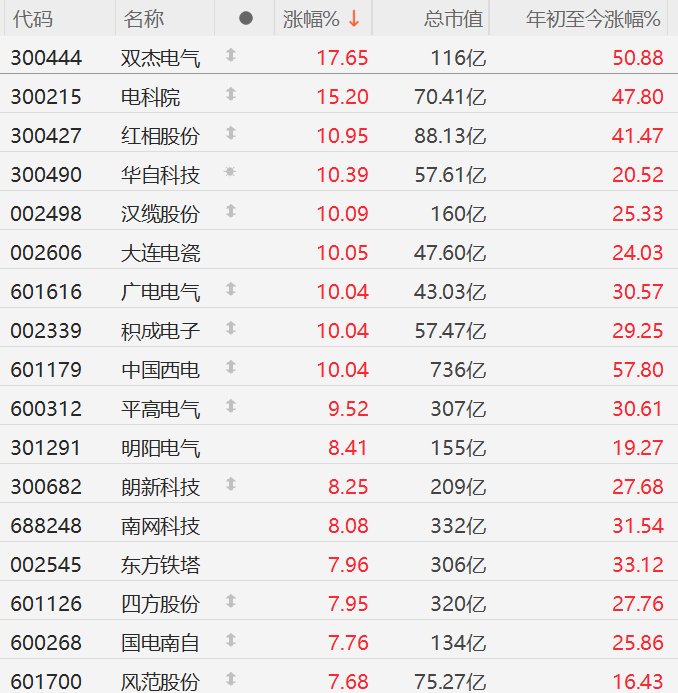
Core Viewpoint - The A-share market for smart grid stocks has shown significant strength, with multiple companies experiencing substantial gains following the announcement of a major investment plan by the State Grid Corporation of China [1] Group 1: Market Performance - Smart grid stocks collectively surged, with notable gains including: - Shuangjie Electric up over 17% - Electric Power Research Institute up over 15% - Hongxiang Co., Huasu Technology up over 10% - Several other companies including Hanlan Co., Dalian Electric Porcelain, and others hitting the daily limit up [1] - The overall market sentiment is positive, driven by strong investment forecasts and demand in the sector [1] Group 2: Investment Outlook - The State Grid Corporation has projected a fixed asset investment of 4 trillion yuan during the 14th Five-Year Plan, a 40% increase compared to the previous plan, with an average annual investment of 800 billion yuan, indicating a compound annual growth rate (CAGR) approaching double digits [1] - Investment will focus on the construction of a new power system, aiming to enhance cross-regional and cross-provincial transmission capacity by over 30% compared to the end of the previous plan [1] Group 3: Export Growth - The North American market is experiencing a surge in demand for power equipment driven by aging infrastructure and increased electricity needs from AI data centers, leading to a significant rise in delivery times for transformers and high-voltage cables [1] - From January to November 2025, China's exports of transformers, high-voltage switches, and wires and cables are expected to grow by 35.3%, 29.4%, and 22.9% year-on-year, respectively, indicating a strong international market presence [1]




10万亿度电炸响!电网设备再迎“强风口”
Sou Hu Cai Jing· 2026-01-19 03:57
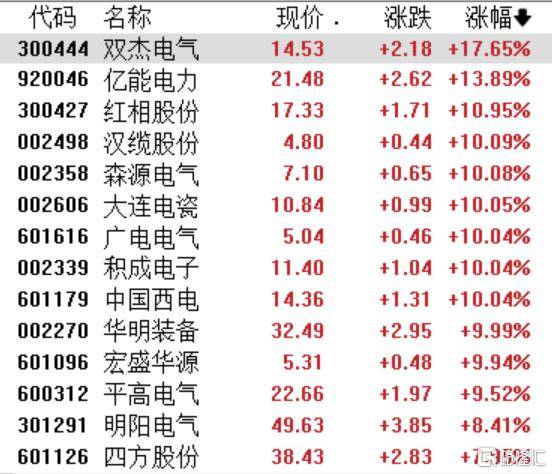
A股市场再次上演"电力狂欢"! 在三大指数涨跌不一的背景下,电网设备、特高压、智能电网板块逆势爆发。 截至午间收盘,双杰电气涨超17%,亿能电力涨近14%,中国西电、大连电瓷、广电电气、积成电子等 多股涨停。 板块内超百只个股飘红,赚钱效应席卷全场。 1月17日,国家能源局发布年度"用电成绩单"。 2025年中国全社会用电量103682亿千瓦时,首次突破10万亿度,同比增长5%。 更震撼的是,103682亿千瓦时相当于美国全年用电量的两倍多,甚至超过欧盟、俄罗斯、印度、日本四 个经济体的年用电量总和。 其中, 美国约4.1万亿度, 欧盟27国 约2.6万亿度, 俄罗斯 约1.1万亿度, 日本 约0.95万亿 度, 印度约1.8万亿度。 我国用电量的飙升,主要源自于三大动力。 首先,作为制造业大国,工业生产是用电基本盘,2025年第二产业用电量6.64万亿千瓦时,占比达到 64%,其中高端制造业成为新增长点,风电设备制造、新能源车产业用电量增速超20%和30%。 其次,数字经济与新型基建的爆发式增长一样关键,充换电服务业用电量增速近50%,5G基站、大数 据中心带动信息传输行业用电增长17%。 此外,居民电气化 ...
电网投资加速,看好跨区建设和电网保护
China Post Securities· 2026-01-19 03:07
| 收盘点位 | | 10679.07 | | --- | --- | --- | | 52 | 周最高 | 10950.05 | | 52 | 周最低 | 6107.84 | 行业相对指数表现(相对值) 2025-01 2025-03 2025-06 2025-08 2025-11 2026-01 -11% -4% 3% 10% 17% 24% 31% 38% 45% 52% 59% 电力设备 沪深300 资料来源:聚源,中邮证券研究所 研究所 证券研究报告:电力设备|点评报告 行业投资评级 强于大市 |维持 行业基本情况 分析师:苏千叶 SAC 登记编号:S1340525110004 Email:suqianye@cnpsec.com 分析师:杨帅波 SAC 登记编号:S1340524070002 Email:yangshuaibo@cnpsec.com 分析师:盛炜 SAC 登记编号:S1340525120008 Email:shengwei@cnpsec.com 近期研究报告 《核电产业报告 1: ——全球核电复兴 下的 4 代核电的投资机会》 - 2026.01.06 电网投资加速,看好跨区建设和电 ...
公用事业行业周报(20260118):25年全社会用电量同比提升5%,重视电力数字化板块机会-20260119
EBSCN· 2026-01-19 03:07
Investment Rating - The report maintains a "Buy" rating for the public utility sector [6] Core Insights - The report highlights a 5% year-on-year increase in total electricity consumption for 2025, with significant growth in various sectors, including a 9.9% increase in the primary industry and an 8.2% increase in the tertiary industry [2][11] - The National Grid announced a fixed asset investment plan of 4 trillion yuan for the "14th Five-Year Plan" period, marking a 40% increase compared to the previous plan, aimed at building a new power system [3][11] - The report emphasizes the importance of digitalization in the power sector and suggests focusing on companies involved in power digitalization, such as State Grid Information Communication and Longxin Group [3] Summary by Sections Market Overview - The SW public utility sector rose by 0.06% this week, ranking 13th among 31 SW primary sectors, while the sub-sectors showed mixed performance with thermal power up by 0.35% and hydropower down by 1.76% [30] - Domestic and imported coal prices showed divergent trends, with domestic coal prices rising and imported coal prices declining [12][19] Key Events - The National Energy Administration released data indicating a 5% year-on-year increase in total electricity consumption for 2025, with notable contributions from the tertiary sector and urban residents [2][11] - The report notes that the average electricity price in Guangdong and Shanxi has increased year-on-year, while the monthly agent purchase electricity costs are on the rise due to increased capacity prices [13][14] Investment Opportunities - The report suggests that the results of annual long-term contracts for thermal power are expected to be reasonable, with significant improvements in profitability for national thermal power operators [4] - The green electricity sector is anticipated to undergo valuation recovery due to policy support and increased subsidies, with recommendations to focus on companies like Longyuan Power and Datang Renewable [4] - The report indicates that while the electricity supply-demand situation remains loose, there is still a need for thermal and green power investments to match overall investment returns [4]
《电力中长期市场基本规则》解读:绘制电力市场中长期交易新蓝图
Zhong Guo Dian Li Bao· 2026-01-19 02:38
Core Viewpoint - The newly issued "Basic Rules for Long-term Electricity Market" represents a systematic and forward-looking top-level design aimed at promoting the healthy, orderly, and efficient development of the long-term electricity market in alignment with the dual carbon goals [1] Group 1: Systematic Restructuring - The name change from "Basic Rules for Long-term Electricity Trading" to "Rules" signifies a qualitative change in content [3] - The old document focused more on specific trading behaviors, while the new rules establish a complete market ecosystem, including market participants, risk prevention, and legal responsibilities [4] - This shift reflects a transition from managing specific transactions to constructing a market governance system, providing a solid institutional guarantee for a standardized, transparent, and reliable market operation [4] Group 2: Conceptual Innovation - The new rules explicitly define new types of operating entities, including virtual power plants, load aggregators, smart microgrids, distributed photovoltaics, and energy storage [5] - The previous document lacked clear definitions and regulations for these entities, but the new rules clarify their rights and obligations, particularly regarding participation in green electricity trading [6] - This recognition of distributed resources and flexibility resource aggregators as legitimate market participants is a crucial step in building a new electricity system [6] Group 3: Mechanism Deepening - Green electricity trading has been integrated into the main rules rather than remaining an independent document, enhancing its market status [8] - The new rules incorporate green electricity trading as a core trading category, aligning it with conventional long-term trading in terms of pricing mechanisms, contract management, and settlement rules [8] - This integration promotes the marketization of green electricity trading and ensures that environmental values are effectively transmitted and realized through market mechanisms [8] Group 4: Technical Enhancements - The new rules emphasize continuous daily operations and standardization, raising the operational foundation of the market [9] - The previous document had vague requirements regarding trading frequency and system continuity, while the new rules specify daily continuous operation requirements for trading platforms [10][11] - High-frequency and continuous trading is essential for price discovery and risk management, and the new rules lay a solid foundation for seamless integration with the spot market [11]
《电力中长期市场基本规则》解读:推动电力用户从被动用电向主动参与转型
Zhong Guo Dian Li Bao· 2026-01-19 02:31
Core Viewpoint - The newly issued "Basic Rules for the Medium and Long-term Electricity Market" aims to transform electricity users from passive consumers to active participants, promoting a more efficient, stable, inclusive, and sustainable electricity market, which serves as a foundational framework for a unified national electricity market and a new power system [1][2][3][4] Group 1: Market Mechanism and User Stability - The rules encourage long-term power purchase agreements (PPA) and promote daily trading within the month, providing users with stable electricity supply and cost management, thus reducing risks associated with electricity price volatility [1] - By extending trading cycles and shortening trading frequencies, the rules aim to lock in long-term electricity plans and costs, enhancing the long-term balance of supply and demand [1] Group 2: Resource Optimization and Competition - The rules establish a unified technical support system for electricity trading platforms, facilitating nationwide data integration and breaking down inter-provincial barriers to optimize electricity resource allocation [2] - The introduction of cross-regional trading mechanisms allows electricity to flow from resource-rich areas to load centers, addressing the imbalance between energy distribution and concentrated demand [2] Group 3: New Entity Integration and Carbon Goals - The rules incorporate new business entities into the medium and long-term market, allowing for innovative trading methods that address the challenges of small and decentralized new entities [3] - By requiring green electricity transactions to be traceable and linked to green certificates, the rules enhance the market appeal of renewable energy sources like wind and solar power, supporting users in achieving sustainability goals [3] Group 4: Risk Management Framework - The rules implement a comprehensive risk management system through a three-tiered approach: safety verification, deviation assessment, and credit risk prevention, ensuring stable electricity supply for users [4] - The first line of defense involves safety checks by electricity dispatch agencies to prevent excessive trading that could lead to grid congestion, while the second line focuses on assessing discrepancies between actual and contracted electricity usage [4]
十五五-国网投资出台-电力设备再迎景气周期
2026-01-19 02:29
Summary of Conference Call Notes Industry Overview - The conference call discusses the investment plans of the State Grid Corporation of China, indicating a significant increase in investment, which is expected to usher in a new high-intensity construction cycle focused on ultra-high voltage (UHV) construction, benefiting core equipment suppliers like Pinggao Electric and China Western Power [1][2]. Key Points and Arguments Investment Goals - The core goal of the State Grid's investment in 2026 is to build a new power system that aligns with renewable energy and carbon neutrality targets. The investment plan amounts to 4 trillion yuan, a significant increase from 2.85 trillion yuan during the previous five-year period, marking the start of a new high-intensity construction cycle [2]. Strengthening the Power Grid Platform - Specific measures to strengthen the power grid platform include UHV construction and investment in main network equipment. UHV construction is crucial for supporting the development of wind and solar resources in the western regions and hydropower projects in the southwest. Key equipment includes transformers, GIS switchgear, and converters, with companies like Pinggao Electric and China Western Power having significant advantages in these areas [3]. Enhancing Regulation Capabilities - Enhancing regulation capabilities focuses on improving source-side and composite-side regulation. This includes attention to energy storage applications and the prediction of unstable renewable energy generation, such as solar power. The demand for power software and virtual power plants is increasing, necessitating customized development [5]. Strengthening Technological Empowerment - The State Grid is actively adopting emerging technologies such as drone inspections and AI to enhance operational efficiency and automation. These technologies are applied in inspection robots and online monitoring systems, with major technological projects promoting the widespread application of new technologies in society [6]. Investment Focus on Distribution Network - Investment in the distribution network emphasizes digital upgrades, including the integration of primary and secondary systems, smart terminals, distribution automation, and smart meters. Companies like Oriental Electronics lead in distribution automation, while Sanxin Medical and Haixing Electric are prominent in the smart meter sector [7]. Development Trends in New Energy Storage Equipment - New energy storage equipment is focused on enhancing peak regulation capabilities, with independent storage business models becoming clearer due to capacity pricing policies. The domestic market is expected to maintain good growth through 2026, with companies like Sungrow, CATL, and EVE Energy being competitive in system integration and battery cell fields [8]. Opportunities in Power IT and Software - The power IT and software sector requires robust software platforms to support digital transformation, including scheduling, marketing, and asset management. Companies like Yuan Guang Software are deeply integrated with State Grid clients and are expected to benefit from future upgrades [9]. Global Market Impact on Chinese Enterprises - The global market significantly impacts Chinese enterprises, as they possess strong global competitiveness in power equipment. The demand for maintenance and construction in North America, Southeast Asia, Europe, and the Americas presents new opportunities for Chinese companies [10]. Investment Logic in Space Photovoltaics - The space photovoltaic sector has three main investment logics: reduced launch costs due to commercial space initiatives, increased power capacity of satellites, and the potential rise of perovskite technology. These factors are expected to drive future demand in space power applications [12]. Companies to Watch in Space Photovoltaics - Investment in space photovoltaics can be categorized into three tiers: - Tier 1 includes companies like Junda, Oriental Sunrise, and Shanghai Port, which have been early movers in the sector. - Tier 2 includes companies like Mingyang Smart Energy and Tianhe Solar, which have existing or potential layouts in space photovoltaics. - Tier 3 consists of membrane companies and potential equipment manufacturers that may benefit from the sector's growth [13]. AIDC Market Outlook - The AIDC market outlook is positive, with the U.S. government promoting technology companies to bid for long-term power supply contracts to address electricity supply issues. The average retail electricity price in the U.S. is expected to rise by 7.4% in 2026, driven by increased demand from data centers [14]. Current Thematic Investment Opportunities - Current market themes include the recent rollout of grid investment plans, which may drive clear market trends. The space photovoltaic sector, AIDC power supply, and solid-state batteries are identified as areas with significant thematic investment opportunities [15].
我国用电量首次突破10万亿千瓦时
Sou Hu Cai Jing· 2026-01-19 01:13
Core Insights - China's total electricity consumption is projected to exceed 10 trillion kilowatt-hours by 2025, reaching 10.4 trillion kilowatt-hours, representing a year-on-year growth of 5% [1][5] - This milestone is unprecedented for a single country, equating to more than double the annual electricity consumption of the United States and surpassing the combined annual consumption of the EU, Russia, India, and Japan [6] Group 1: Factors Driving Electricity Consumption Growth - The growth in electricity consumption is driven by a stable macroeconomic environment and increased demand for residential electricity due to high temperatures and enhanced electrification [2][7] - Notably, it took China just over a decade to increase its annual electricity consumption from 5 trillion to 10 trillion kilowatt-hours, a growth rate unmatched by other major economies [2][7] Group 2: Sectoral Contributions to Electricity Demand - High-end manufacturing is becoming a key driver of electricity consumption growth, with electricity usage in the new energy vehicle and wind power equipment manufacturing sectors expected to grow by over 20% and 30%, respectively [3][8] - The rapid development of the digital economy and emerging technologies is creating new electricity demand points, with internet services and related sectors seeing over 30% growth, and the charging and swapping industry approaching a 50% increase in electricity consumption [3][8] Group 3: Electricity Supply and Infrastructure - A robust electricity supply system has been established, focusing on collaboration between power generation, grid management, and demand-side management [3][8] - On the generation side, coal, hydro, nuclear, and thermal power are working together to ensure a stable supply, while renewable energy sources are being rapidly deployed to manage fluctuations [3][8] - The construction of a unified national electricity market is accelerating, with policies like time-of-use pricing being implemented to align electricity demand with supply [3][8] Group 4: Trends in High Energy-Consuming Industries - While electricity consumption in emerging industries is rising, the overall growth rate in high energy-consuming sectors is declining, with specific industries like black metal smelting and non-metal mineral products experiencing decreases [4][9] - The shift towards energy efficiency and the exit of outdated production capacities are contributing to a continuous decline in energy consumption per unit of GDP, indicating a greener economic trajectory [4][9]