风险管理

Search documents
基金研究系列之一:缓冲型ETF国内实践探索
NORTHEAST SECURITIES· 2025-12-30 11:23
Report Industry Investment Rating - Not provided in the given content Core Viewpoints - The report systematically evaluates the product design, implementation, risks, and governance of buffered ETFs, aiming to offer a set of auditable pilot suggestions for fund managers, channels, and regulators. Buffered ETFs use a four - leg option strategy to limit downside and cap upside, with their key being a dynamic reinvestment path determined by market snapshots, option pricing, and execution on reset days [1][3]. - In China, a gradual pilot strategy for buffered ETFs is recommended, starting with "quasi - buffered" products based on broad - based ETFs or futures, and large public funds with market - making and hedging capabilities should take the lead. The long - term value of buffered ETFs depends on the issuer's hedging ability, market - maker sustainability, and regulatory cooperation [3]. Summary by Directory 1. Introduction - Traditional "60/40" stock - bond portfolios failed in 2022, leading investors to seek a "third - type asset". The report focuses on buffered ETFs, aiming to explore their localization in the Chinese ETF market and provide decision - making references for relevant parties [10]. - Buffered ETFs use derivatives to limit downside and upside in each outcome period. The report will detail key engineering issues such as the four - leg option strategy, reset days, and the difference between price return and total return [11]. 1.1 Product Design Goals and Constraints - "Spot" in buffered ETFs and similar products can be various assets. The difference between price return and total return affects dividend handling, liquidity, and tax treatment, and should be clearly disclosed [12][13]. 1.2 Buffered ETF Four - Leg Strategy - A typical buffered ETF consists of four option positions: buying deep in - the - money calls, buying at - the - money puts, selling out - of - the - money puts, and selling out - of - the - money calls. Each leg has its own engineering purpose, Greek - letter characteristics, and practical points [14][17]. 1.3 Pricing Balance Formula and Cap's Endogeneity - The design of buffered ETFs requires a "zero - cost structure". The formula for premium balance is Premium(Short OTM Call)=Premium(Long ATM Put)−Premium(Short OTM Put). The Cap is determined by market variables such as implied volatility, volatility skew, interest rates, etc., and is an endogenous result of market conditions [18]. 1.4 Product's Reset Day - The reset day is crucial. FLEX options, which allow customization of contract elements, are used. Key factors to consider on the reset day include contract specifications, settlement and underlying types, market - making and liquidity risks, pricing sources and model assumptions, margin and cash requirements, execution strategies, and scenario - based backtesting [25][27]. 1.5 Impact of Price Return Index - Option pricing and settlement in buffered ETFs are often based on price return indexes, not total return indexes. This means investors forgo dividend cash - flows, which can significantly drag down long - term returns. The net long - term drag can be calculated as Net Long - Term Drag ≈ Expense Ratio + Dividend Yield − Net Option Carry [28][31]. 1.6 Scenario - Based Stress Testing - Stress testing is essential for buffered ETFs due to their high dependence on reset - day market conditions, non - linearity in tail events, and potential margin and liquidity risks. Different types of stress - testing scenarios include historical replay, parametric scenarios, stochastic Monte Carlo simulation, and reverse stress testing [32][35]. 2. Outcome Period Mechanism and Intra - Period Trading Path 2.1 Outcome Period and Reset - Buffered ETFs have a defined outcome period, and the Buffer and Cap are locked at the start of each period. The length of the period affects cash - flow, hedging, and investor exposure. The reset process involves market snapshots, option selection, and contract settlement. Only buying on the first day of the period and holding to maturity can ensure the promised returns [39][42]. 2.2 Intra - Period Trading Complexity - Intra - period trading in buffered ETFs is complex, with returns determined by option layouts and Greek - letter exposures. To reduce risks, measures such as pre - trading visualization, setting hedging frequencies, formulating liquidity and execution strategies, and providing clear disclosures are recommended [43][46]. 3. Overseas Market Competition and Product Line Differentiation 3.1 Mainstream Issuer Strategy Comparison - Major issuers in the overseas market have different strategies. Innovator ETFs is a pioneer with a full product line; First Trust is a channel giant; AllianzIM focuses on innovative reset periods; Pacer ETFs combines trends with buffering; and iShares is a price - cutter [49][52]. 3.2 Tabular Stratification of Buffer Depth and Product Line - Products are classified into different buffer - depth categories: moderate buffer, deep buffer, and principal protection, each with typical parameters, target investors, use scenarios, and risk - control points [53][55]. 3.3 Strategy Comparison, Stratification Logic, and Issuance Suggestions - Issuers should consider their capabilities, channels, and regulatory compliance when designing products. In China, large public funds, comprehensive brokerage asset managers, and small technology - driven asset managers are likely candidates to issue buffered ETFs, and a step - by - step pilot strategy is recommended [56][58]. 4. Buffered ETF Market Analysis - In the US, the rise of buffered ETFs is due to macro - environment, market infrastructure, distribution networks, and tax and regulatory factors. In China, there is demand for such products, but implementation faces challenges, and a gradual pilot approach is needed [59][62]. 5. Comparison of Buffered ETFs and Snowball - Type Structured Products - Buffered ETFs and snowball - type products differ in terms of issuance, structure and counter - party risk, liquidity, transparency, return and cost, and investor suitability. Buffered ETFs are more suitable for institutional and retail clients seeking transparency and tradability, while snowball - type products are for high - net - worth individuals [63][67]. 6. Conclusion - Buffered ETFs transform institutional risk - management techniques into standardized products, offering downside protection at the cost of giving up potential high - end returns. They are suitable for investors who understand their complexity but may be a long - term wealth drag for those blindly seeking "capital preservation" [68].
申银万国期货携手SYC:以创新服务破局 为上海国际贸易中心添彩
Qi Huo Ri Bao· 2025-12-30 01:00
Core Viewpoint - Shanghai is actively promoting the construction of an international trade center, with the futures market playing a crucial role in driving industrial transformation and upgrading [1] Group 1: Collaboration and Innovation - SYC New Materials Group, a leading company in the casting aluminum alloy industry, faces significant price volatility pressures and requires professional risk management tools [1] - Shenyin Wanguo Futures has established a deep collaboration with SYC, leveraging the listing of aluminum alloy futures to explore innovative applications of futures and derivatives in the industry [1] - The collaboration aims to help SYC effectively hedge price volatility risks, innovate trade pricing models, and promote coordinated development within the industry [1] Group 2: Service Solutions and Process - Shenyin Wanguo Futures has developed a comprehensive, multi-dimensional futures service plan for SYC, achieving three major innovations in operational mechanisms, collaboration models, and industry participation [2] - The company organized a professional service team to guide SYC in participating in the first-day trading of aluminum alloy futures, allowing SYC to quickly familiarize itself with the trading mechanisms and market characteristics [2] Group 3: Pricing Model and Trade Optimization - A new trade model combining "futures pricing + agreed premium/discount" was launched to address uncertainties in traditional spot trading caused by price fluctuations [3] - This model enhances transaction transparency and fairness, effectively mitigating profit losses from price volatility while improving trading efficiency [3] Group 4: Industry Participation and Ecosystem Integration - Shenyin Wanguo Futures is assisting SYC in initiating three core applications: futures industry base application, hedging quota application, and warehouse receipt registration application [4] - These initiatives aim to enhance the participation of upstream and downstream enterprises in the futures market and improve the overall risk management level of the industry [4] Group 5: Project Outcomes and Industry Impact - The innovative application of futures tools has allowed SYC to stabilize its production operations and avoid profit losses during significant market price fluctuations [5] - The new pricing model has gained widespread recognition among customers, leading to an increase in the number of cooperative clients and trading volume, significantly enhancing SYC's market competitiveness [5] - SYC's practices have been widely reported by industry associations and mainstream media, encouraging more enterprises in the industry chain to engage with the futures market [5] Group 6: Replicability and Broader Application - The project employs a clear process of "first-day trading participation + futures pricing + multi-dimensional applications," making it suitable for leading enterprises in the bulk commodity industry to replicate [7] - This model can be extended beyond aluminum alloys to other metal raw materials and bulk commodities, such as chemicals and agricultural products [7] - The collaboration model of "futures company + entity enterprise + risk management company" achieves precise matching of financial resources and industrial needs, providing a replicable cooperation paradigm for serving the real economy [7] Group 7: Leading Industry Development - The successful implementation of this project not only brings tangible benefits to SYC but also upgrades the risk management concepts across the entire casting aluminum alloy industry chain [8] - SYC is leading the formation of a trade ecosystem characterized by "shared risks and shared benefits" among upstream and downstream enterprises, injecting financial innovation into Shanghai's international trade center [8] - Shenyin Wanguo Futures plans to continue deepening its collaboration with SYC and promote the successful experiences of this case to more real enterprises, contributing to the high-quality development of the industry [8]
“保险+期货”守护漫漫养殖路
Qi Huo Ri Bao Wang· 2025-12-30 00:59
Core Viewpoint - The article highlights the journey of a pig farmer, Wang Ruyi, who has navigated the challenges of the pig farming industry for over 20 years, including the impacts of African swine fever and price fluctuations, and how the introduction of the "insurance + futures" project has transformed his business operations and risk management strategies [1][4][7]. Group 1: Background and Experience - Wang Ruyi graduated in 1998 and initially worked as a technical manager in a pig farm before starting his own business in 2011, gradually increasing his pig output from a few hundred to over 2,000 pigs annually [2][3]. - His experience includes dealing with the severe impacts of African swine fever, which resulted in significant financial losses, and navigating the volatile pig price market, where prices fluctuated from highs of 18 yuan/kg to lows below 6 yuan/kg [3][4]. Group 2: Introduction of "Insurance + Futures" - The "insurance + futures" project was introduced in 2021, allowing farmers to mitigate risks associated with price volatility. Wang Ruyi became one of the first participants, initially skeptical but later benefiting significantly from the program [4][5]. - After his first experience with the project, Wang received over 70,000 yuan in compensation, which exceeded his initial investment in insurance premiums, leading to increased interest in the program [4][6]. Group 3: Ongoing Participation and Strategy - Wang has actively participated in the "insurance + futures" project from 2022 to 2025, recognizing its role in stabilizing his business despite not always receiving high compensation [5][6]. - He has developed a deeper understanding of the project, focusing on risk management rather than profit maximization, and has adjusted his approach to proactively engage with the program based on market conditions [6][7]. Group 4: Future Outlook - Wang plans to maintain a conservative approach to his farming operations, controlling the scale of production and considering the potential for future growth only when conditions improve, particularly with the availability of vaccines against swine fever [8]. - He remains committed to utilizing the "insurance + futures" program as a safety net for his business, even if pig prices rise to more favorable levels [8].
贯彻金融强国战略 以高质量发展服务中国式现代化大局
Shang Hai Zheng Quan Bao· 2025-12-29 19:06
Group 1 - The company emphasizes the integration of political construction and corporate governance, enhancing the role of the party committee in guiding high-quality development [1] - The company strengthens its financial services in key national strategies and sectors, focusing on technology finance, green finance, inclusive finance, pension finance, and digital finance [1] - The company aims to improve investor experience through education and service, while also enhancing its product offerings in various financial sectors [1] Group 2 - The company focuses on combining macro strategic analysis with micro industry analysis to identify investment opportunities aligned with national development [2] - The company is committed to enhancing its risk management capabilities to ensure stable business development and prevent major risk events [2] - The company aims to build a comprehensive risk management system that is proactive, collaborative, and intelligent [2] Group 3 - The company will align its operations with the spirit of the 20th National Congress, focusing on industrial upgrading and innovation to contribute to the construction of a financial strong nation [3]
从伦敦金融城到多哈天际线:ATFX如何让权威与市场双认可
Xin Lang Cai Jing· 2025-12-29 09:54
Core Insights - ATFX participated as a diamond sponsor in the Money Expo Qatar 2025, showcasing its strong brand presence and innovative financial solutions [1][12] - The company received the "Best Broker in MENA" award, highlighting its commitment to excellence in the Middle East and North Africa market [4][14] - ATFX has previously won multiple awards, including "Best MT4 Broker in Asia-Pacific" and "Best B2B Liquidity Provider in Asia-Pacific," demonstrating its competitive edge in both retail and institutional sectors [5][14] Event Participation - The Money Expo Qatar 2025 attracted global financial institutions, brokers, investors, and industry leaders, emphasizing the event's significance in exploring financial opportunities [1][12] - ATFX's strategic exhibition space allowed for comprehensive presentations of its diverse financial products, including contracts for difference, stocks, futures, and fintech solutions [12] Awards and Recognition - The awards received by ATFX are based on rigorous evaluations by industry authorities, covering technical strength, service quality, innovation, compliance, customer experience, and social responsibility [7][16] - The recognition serves as a "trust endorsement," enhancing ATFX's reputation as a reliable and innovative brand in the financial sector [7][16] Engagement and Services - ATFX's booth became a hub for industry discussions, with traders and partners engaging in strategy talks and collaboration opportunities [7][16] - Mohammed Shanti, ATFX's Middle East and North Africa market research and analysis head, participated in a forum on risk management in volatile markets, discussing the company's proprietary risk control system [8][16] Customer-Centric Approach - The ATFX Middle East team focused on a service philosophy of "professional empowerment + precise response," creating a closed-loop service system addressing participant needs [10][19] - The team provided tailored solutions for liquidity management, compliance risk control, and technical adaptation, demonstrating a commitment to enhancing customer experience [11][20] Future Outlook - ATFX aims to continue evolving in the dynamic global financial market, striving to win the long-term trust of investors through competitive products and superior service experiences [20]


国家金融监督管理总局:规范融资租赁强服务防风险
Jing Ji Ri Bao· 2025-12-29 06:00
专家表示,《办法》加强对与租赁物相关业务的管理要求,旨在树立鲜明导向,引导金融租赁公司紧紧 围绕企业设备资产需求,贴近产业、服务产业、深耕产业,逐步形成产业特色突出的金融服务模式。 为规范售后回租业务经营行为,防范租赁物权属瑕疵、估值虚高等问题与风险,《办法》要求,在尽职 调查阶段,金融租赁公司须核实承租人对租赁物的所有权,做好租赁物价值评估管理,严禁低值高估; 在审查审批阶段,要求售后回租业务金额不得高于租赁物价值,并做好对租赁物适格性、所有权转移真 实性、承租人融资和租赁物使用需求真实性、合法性和合理性审查;在合同执行阶段,要求金融租赁公 司重点做好资金用途监测和管理,防止资金挪用等问题。 中国社会科学院金融研究所银行研究室主任李广子认为,融资租赁将融资和融物有机结合,能够有效缓 解资金供求双方的信息不对称,降低金融风险;同时,通过将融资和融物相结合,融资租赁能够确保金 融服务融入生产经营真实场景,防止资金在金融体系空转,提高服务实体经济效率。 近期,国家金融监督管理总局发布《金融租赁公司融资租赁业务管理办法》(以下简称《办法》)。 《办法》有利于引导金融租赁公司发挥"融资+融物"独特功能,专注主业,做精 ...
期货技术分析周报:2025年第53周-20251229
Dong Zheng Qi Huo· 2025-12-29 02:43
1. Report Industry Investment Rating No specific industry investment rating is provided in the report. 2. Core View of the Report The report analyzes the futures market in the 53rd week of 2025 through technical indicators, showing that different sectors have different trends, with some showing bullish signals, some bearish, and others in a volatile state. The overall market has obvious structural characteristics, and it is recommended to track key indicators and pay attention to position management [1][2]. 3. Summary by Relevant Catalogs 3.1有色及贵金属板块 - The gold in the precious metals sector shows a bullish signal, while the rest are volatile. In the non - ferrous metals sector, aluminum, alumina, zinc, lead, industrial silicon, and lithium carbonate show bullish signals, and polysilicon shows a bearish signal, with the remaining varieties mainly volatile [8]. - The main contract of Shanghai copper has a strong upward trend. The weekly and monthly trends resonate, and the short - term possibility of a sharp correction is low [12]. 3.2黑色及航运板块 - Hot - rolled coils, iron ore, and coking coal show bullish signals, the rest of the black varieties are volatile, and European line container shipping shows a bearish signal [20]. - The price of the main rebar contract mainly consolidates, with insufficient technical momentum and is expected to continue to consolidate in the short term [24]. 3.3能化板块 - Fuel oil, low - sulfur fuel oil, and LPG in the energy sector show bullish signals, and the rest are volatile. In the chemical sector, polypropylene, pure benzene, caustic soda, etc. show bullish signals, and the rest are volatile [29]. - The PTA main contract has short - term upward repair momentum. If it breaks through the resistance, the medium - term target can be higher [32]. 3.4农产品板块 - Soybean meal, palm oil, rapeseed meal, sugar, corn, etc. show bullish signals, and the rest are volatile. The sugar main contract needs to pay attention to the risk of decline, and the short - term rebound is difficult to reverse the downward trend [38][42]. 3.5股指期货板块 - The Shanghai 50 Index futures, CSI 500 Index futures, CSI 1000 Index futures, and SSE Composite 300 Index futures all show a volatile pattern. The IC CSI 500 Index futures are expected to fluctuate next week with upward momentum, and attention should be paid to whether there are reversal signals [49][52]. 3.6国债期货板块 - The 10 - year and 30 - year treasury bond futures show bullish signals, while the 2 - year and 5 - year treasury bond futures are volatile. The T 10 - year treasury bond futures are mainly volatile, with upward repair power in the short term but also pressure [55][61].
大商所举办宣讲座谈会 赋能华南塑料产业风险管理
Qi Huo Ri Bao Wang· 2025-12-29 01:31
Core Viewpoint - The Dalian Commodity Exchange (DCE) is promoting the application of innovative risk management tools, particularly focusing on monthly average futures and options to enhance the effectiveness of the futures market in serving the real economy [1][3]. Group 1: Event Overview - A seminar on monthly average futures and commodity options was held in Guangzhou, organized by DCE and Jin Yuan Futures, with participation from 22 representatives of plastic chemical industry associations and companies in South China [1]. - DCE personnel presented the design principles, application scenarios, and market performance of linear low-density polyethylene, polyvinyl chloride (PVC), and polypropylene monthly average futures, along with an explanation of commodity options business rules [1]. Group 2: Industry Feedback - Representatives acknowledged the monthly average futures from DCE, noting that large enterprises in the PVC industry use monthly averages as a reference for key performance indicators (KPIs), alleviating pricing pressure for traders and enhancing sales flexibility [2]. - The increasing competition in the PVC export market has led to profit compression for traders; the application of monthly averages in international trade can stabilize pricing and mitigate harmful price competition, promoting healthy industry development [2]. Group 3: Options Tool Application - Companies participating in the options market view options as a crucial supplement to futures, significantly enhancing risk management capabilities [2]. - A manager shared experiences on using PVC options for inventory hedging and profit enhancement, highlighting the unique advantages of options in risk control [2]. Group 4: Future Directions - DCE plans to optimize contract rules, enhance the cultivation of the monthly average futures market, and enrich the supply of options tools to better serve the South China market [3]. - The exchange aims to improve the ability of industry enterprises to apply derivative tools, assisting in cost reduction and efficiency enhancement for high-quality development of the chemical industry in South China [3].
实现国企套保“破冰” 筑牢产业链风险屏障
Qi Huo Ri Bao Wang· 2025-12-29 01:03
Core Viewpoint - Anhui Huishang Group Material Co., Ltd. is facing significant challenges in its traditional trading model due to severe fluctuations in commodity prices, necessitating the use of financial tools to mitigate market risks [1] Group 1: Challenges and Solutions - State-owned enterprises like Anhui Huishang face obstacles in futures trading due to a lack of institutional frameworks and talent [2] - The Huishang Futures collaborative service team has been established to assist Anhui Huishang in building a risk management system from scratch, optimizing resource allocation, and promoting regional economic development [1][2] Group 2: Risk Management Framework - A comprehensive risk management system has been designed, ensuring clear responsibilities among decision-making, execution, and supervision [3] - The collaborative service team has developed a detailed set of management regulations and operational guidelines for hedging, covering aspects such as organizational structure, business processes, and internal controls [3][4] Group 3: Professional Training - Targeted training programs have been implemented to enhance the professional capabilities of Anhui Huishang's personnel in derivatives operations, significantly reducing potential risks during business execution [4][5] Group 4: Implementation and Results - The initial hedging operations have been successfully executed, with the first five sell hedging transactions in the ethylene glycol project yielding slight profits and receiving project subsidies from the exchange [5] - The company has effectively utilized the futures market to reduce operational risks and enhance pricing competitiveness, achieving a floating profit exceeding 3 million yuan from hedging operations in rebar and hot-rolled products [6] Group 5: Future Prospects - The collaborative service team's experience with Anhui Huishang has laid a solid foundation for serving other state-owned enterprises in Anhui, validating the sustainability and replicability of this service model [7]
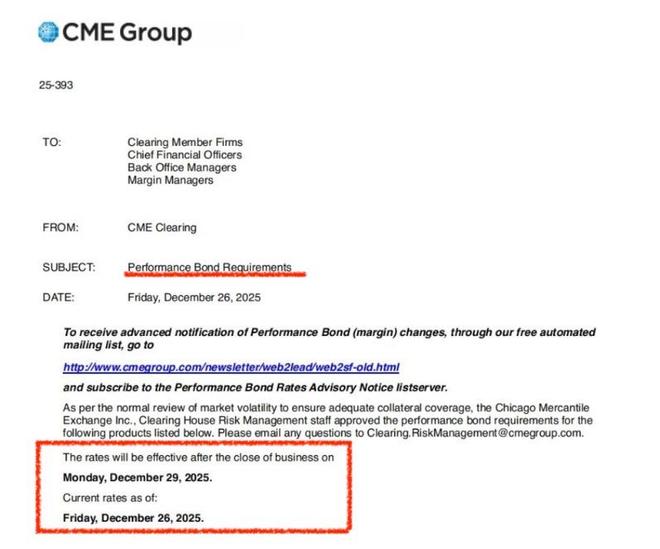
芝商所出手!上调金属品种履约保证金
Xin Lang Cai Jing· 2025-12-28 23:09
Core Viewpoint - The recent adjustments in margin requirements by domestic and international futures exchanges reflect concerns over increased volatility in the metals market as the New Year holiday approaches and global market fluctuations intensify [1][2]. Group 1: Margin Adjustments - CME Group announced a significant increase in margin requirements for various metal futures, including gold, silver, and lithium, effective after market close on December 29 [2][5]. - The adjustments are based on the CME SPAN system, which assesses potential maximum losses in adverse market conditions, leading to differentiated margin standards for various products [5]. - Initial margin for COMEX 100-ounce gold futures will rise from $20,000 and $22,000 to $22,000 and $24,200, representing a 10% increase, while silver futures will see an increase of over 13% [6]. Group 2: Market Analysis - The current volatility in the metals market is attributed to complex factors, with systemic and long-term risks being more pronounced compared to past crises [6]. - The demand structure for metals, particularly silver, has shifted due to significant needs in new economies like photovoltaic energy, necessitating a reevaluation of traditional risk assessment models [6]. - The highest margin increase of 20% is observed in palladium futures, attributed to its poor liquidity and significant supply gaps [6]. Group 3: Risk Management Recommendations - Professionals emphasize the importance of risk management in light of the margin increases, advising traders to consider reducing their positions [7]. - Companies engaged in hedging should assess their risk exposure and ensure adequate cash reserves for margin requirements to avoid forced liquidations [7][8]. - Investment institutions are encouraged to lower their positions and prepare for potential volatility during the holiday period, particularly from January 1 to January 5 [7].