
产业转型

Search documents
设立30亿元新兴产业母基金 聚焦省际9市协同发展徐州广发“英雄帖”打造区域人才高地
Xin Hua Ri Bao· 2025-11-08 23:35
Core Insights - The 2025 Huaihai Talent Development Conference in Xuzhou aims to attract high-level talents and promote the city's development strategy [1] - Xuzhou is transforming from an old industrial base to a "trillion-yuan city" by focusing on talent as a key element for growth [1][2] - The establishment of various talent institutions and funding initiatives reflects Xuzhou's commitment to creating a comprehensive talent service system [2][3] Group 1 - The conference gathered over 300 high-level talents and leaders, emphasizing Xuzhou's determination to attract and utilize talent [1] - Xuzhou has implemented the "Pengcheng Talent Plan" with a total of 1 billion yuan in policy funds to support talent development [2] - The city has established a talent group and a 370 million yuan industry fund to create a supportive environment for talent [2] Group 2 - A new 30 billion yuan special fund for emerging industries was announced to enhance capital support for talent development [3] - The signing of a regional talent cooperation agreement with nine surrounding cities marks a new phase in collaborative talent development [3] - By the end of the 14th Five-Year Plan, Xuzhou's talent resources are expected to reach 1.96 million, with 168,000 high-level talents [4][5]
2025山西省重点产业并购投资对接会在沪举办
Zhong Zheng Wang· 2025-11-07 08:32
Core Insights - The event "Jin-Shanghai Hand in Hand: Mergers and Acquisitions Future" was held in Shanghai, focusing on promoting industrial transformation and upgrading in Shanxi Province through mergers and acquisitions [1] - The event aimed to connect Shanxi's industries with national capital, showcasing the government's service-oriented approach to empower industrial development [1][2] - A new online project database was launched to facilitate year-round connections between local financing enterprises and national buyers, creating a continuous investment platform for Shanxi [2][3] Group 1 - The event was organized by various Shanxi government bodies, emphasizing the importance of policy interpretation, platform promotion, project release, and roadshow evaluations [1] - Liu Wei, Deputy Director of Shanxi Investment Promotion Bureau, highlighted the strategic layout for industrial transformation and the core value of linking resources between Shanxi and Shanghai [1] - The event featured a diverse range of quality projects across nine sectors, including new energy vehicles, smart mining, and artificial intelligence robotics [3] Group 2 - The CEO of Morning Watch Group, Wang Yunfan, discussed leveraging digital tools to break geographical barriers and enhance project matching for Shanxi enterprises [2] - The Shanxi Financial Management Bureau presented the latest developments in the financial sector and support measures for industrial transformation, showcasing a multi-layered financial service system [2] - The innovative "island-style" venue layout facilitated effective matching between projects and investors, ensuring ongoing collaboration beyond the event [3]
江苏最小地级市,强到让人“吃醋”
3 6 Ke· 2025-11-07 03:01
Core Insights - Zhenjiang, a small city in Jiangsu province, has a GDP of 554 billion yuan in 2024, surpassing several provincial capitals and ranking 17th nationally in per capita GDP at 171,700 yuan [1][2] Group 1: Historical and Cultural Significance - Zhenjiang is a national historical and cultural city with a strategic location at the intersection of the Yangtze River and the Grand Canal, historically serving as a transportation hub and military stronghold [2] - The city has a rich cultural heritage, with notable historical events and literary milestones occurring there, including the construction of the Iron Jar City during the Three Kingdoms period and the creation of significant literary works [2] Group 2: Industrial Development - Zhenjiang is characterized as a "hardcore manufacturing city," with a focus on high-end equipment, new materials, and aerospace industries, despite its low public visibility [3][4] - Major enterprises, such as Harbin Electric Group and State Grid New Energy, have established significant projects in Zhenjiang, contributing to its reputation as a manufacturing hub [3][4] Group 3: Economic Structure and Strategy - The city's economic strategy is defined by the "Four Groups and Eight Chains" framework, focusing on high-end equipment manufacturing, life sciences, digital economy, and new materials [5][6] - Zhenjiang's geographical advantages, including its deep-water port and location in the Yangtze River Delta, facilitate its industrial growth and logistics capabilities [5] Group 4: Quality of Life and Innovation - Zhenjiang combines natural beauty and historical culture, making it an attractive place to live and work, with significant ecological resources and cultural sites [7][9] - The city is known for its innovative spirit, exemplified by its famous vinegar production and the local culinary culture, which reflects a blend of tradition and modernity [10][12][13]
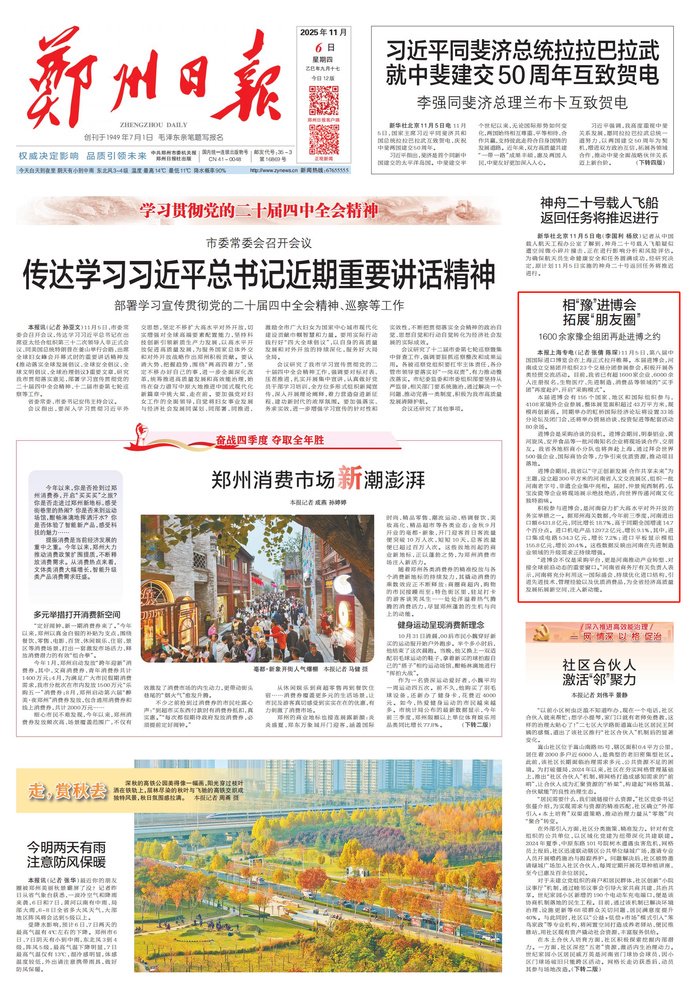
1600余家豫企组团再赴进博之约
Zheng Zhou Ri Bao· 2025-11-06 02:24
Core Points - The eighth China International Import Expo (CIIE) has commenced in Shanghai, with over 1,600 enterprises from Henan participating, showcasing a strong commitment to expanding international trade relationships [1][2] - The event features participation from 155 countries and regions, with 4,108 foreign enterprises exhibiting, marking a record scale with an exhibition area exceeding 430,000 square meters [1] - Henan's import and export value reached 643.18 billion yuan in the first three quarters of this year, reflecting an 18.7% year-on-year increase, surpassing the national growth rate of 14.7% [2] Group 1: Event Participation - Henan has organized 23 trade sub-groups to attend the CIIE, focusing on sectors such as biomedicine, advanced manufacturing, and consumer goods [1] - The province aims to attract high-quality resources by engaging with Fortune 500 companies and international business associations during the expo [1] Group 2: Economic Impact - The import of electromechanical products in Henan reached 129.72 billion yuan, with a growth of 9.1%, including integrated circuits at 53.43 billion yuan (up 7.2%) and flat panel display modules at 15.58 billion yuan (up 20.4%) [2] - The CIIE serves as a platform for Henan to promote industrial transformation and connect with global trends, enhancing the province's economic development [2]

奋进的河南 决胜“十四五”·濮阳篇丨油城焕新
He Nan Ri Bao· 2025-11-06 01:35
Group 1 - The city of Puyang is undergoing a transformation from a resource-dependent economy to a diversified industrial structure, moving from "one industry dominant" to "multiple industries revitalized" [3][4] - Puyang is leveraging its oil resources to extend its industrial chain, with companies like Shengyuan Group transitioning from oil transportation to producing high-value new materials, such as bio-based PC materials [3] - The city is also innovating by integrating new technologies, exemplified by Junheng Biotechnology's conversion of waste cooking oil into bio-aviation fuel, achieving a production capacity of 300,000 tons annually, the largest in the country [3][4] Group 2 - Puyang is transforming industrial wastelands into urban landmarks, such as the "Mushroom Lighting" project in Zhaojiacun, which combines ecological restoration with local mushroom production, attracting tourism [5] - The city has developed the largest strategic gas storage facility in China, utilizing the geological conditions created by oil extraction, ensuring energy security for a population of 400 million [5] - The transformation of industrial ruins into vibrant urban spaces reflects Puyang's strategic planning and the dynamic shift in its industrial landscape [5] Group 3 - In 2024, Puyang's GDP is projected to exceed 200 billion yuan, with industrial added value increasing by 11.5%, leading the province in growth rates [6] - The city's budget allocation shows a strong focus on public welfare, with 76.5% of expenditures directed towards improving residents' quality of life [6] - Puyang's transition from "black GDP" to "green new momentum" illustrates its successful shift towards sustainable development during the 14th Five-Year Plan period [6]

华泰证券:预计中国2026年出口仍有望保持较高增长
Xin Lang Cai Jing· 2025-11-05 23:23
Core Viewpoint - China's exports have shown strong resilience in 2023, with a year-on-year growth of 6% in Q2, despite the U.S. imposing tariffs as high as 145% [1] Group 1: Export Performance - Exports accelerated in Q3, and the high base in Q4 is not expected to hinder continued high growth [1] - The resilience of Chinese exports is attributed to macroeconomic and industrial cycles, as well as structural support from seven years of industrial transformation and upgrading since 2018 [1] Group 2: Future Outlook - China's exports are expected to maintain high growth through 2026, even in a globally high inflation environment, with exceptional profitability in the export chain [1] - The successful transformation and upgrading of China's manufacturing and export industries are key factors in maintaining confidence against U.S. tariff adjustments [1]

【铜川】人与城,共赴闪耀未来
Shan Xi Ri Bao· 2025-11-05 23:15
Core Points - Tongchuan is attracting talent with its unique charm, boasting 60 cultural venues, 108 new cultural spaces, and a green coverage rate of 42.62%, earning the title of "China's Most Livable City" for four consecutive years [1] - The city has implemented a talent strategy called "Wutong Attracting Phoenix," creating various talent work brands and forming a multi-layered talent structure [1][4] Talent Attraction and Services - In Tongchuan, talent not only has a place to live but also opportunities to utilize their skills [2] - The city has developed the "Tongxinban" talent service brand, recognizing 530 high-level talents and providing personalized services in 14 areas, including housing and education [4] - The "One Enterprise, One Policy, One Special Team" mechanism was quickly initiated to support businesses like Junmei Jingwei Circuit Co., which is expected to generate over 100 million yuan in output this year [3][4] Research and Innovation - Tongchuan is enhancing its research capabilities by establishing a provincial-level postdoctoral innovation base at Tongchuan People's Hospital, facilitating talent exchange and research strength [7] - The city is also attracting flexible talent through initiatives like "Weekend Engineers," allowing external experts to provide services without altering their existing employment relationships [8] Industry Development - Tongchuan is home to three major industrial clusters: energy resources, advanced manufacturing, and emerging industries, providing ample opportunities for talent [13] - The city regularly publishes talent demand directories and hosts "Tongchuan Talent Week" events to deepen talent system innovation [13]
*ST东易2025年11月5日涨停分析:重整进展+亏损收窄+产业转型
Xin Lang Cai Jing· 2025-11-05 01:41
Core Viewpoint - *ST Dongyi's stock reached the daily limit with a price of 12.55 yuan, reflecting a 5.02% increase, driven by significant progress in restructuring, reduced losses, and potential for industrial transformation [1][2]. Group 1: Restructuring Progress - The company has made substantial progress in its restructuring efforts, having signed agreements with industrial and financial investors, and received a guarantee deposit of 184 million yuan [2]. - A total of 11 financial investors have collectively provided 1.412 billion yuan in funding support, which has alleviated debt pressure by reducing short-term loans by 60% to 98.91 million yuan [2]. - The full repayment of small debts has also protected the interests of minor creditors, enhancing market confidence in the company's restructuring success [2]. Group 2: Financial Performance - The company's net loss for the first half of 2025 significantly narrowed from 537 million yuan to 52.03 million yuan, representing a year-on-year improvement of 90.47% [2]. - The net profit attributable to shareholders for the third quarter of 2025 increased by 89.98% year-on-year, indicating a positive trend in financial performance [2]. Group 3: Market Activity and Technical Indicators - On October 31, *ST Dongyi was included in the stock trading leaderboard, with a trading volume of 365 million yuan and a notable inflow of 92.82 million yuan [2]. - Other stocks in the decoration and renovation sector have also shown active performance recently, contributing to a sector-wide momentum [2]. - Technical analysis suggests that short-term moving averages may indicate a bullish trend, attracting more investor attention [2].

连云港:加快构建各具特色的县域产业体系
Zhong Guo Jin Rong Xin Xi Wang· 2025-11-04 06:57
Core Insights - Lianyungang has demonstrated a diversified and balanced economic development in recent years, with significant achievements in various industries, including crystal, themed apparel, and mushroom production [1] Group 1: East China County Developments - Donghai County is renowned for its crystal resources, achieving a crystal transaction value of 39 billion yuan from January to August, a year-on-year increase of 27.8%, with expectations to exceed 60 billion yuan for the entire year [2] - The county has established a development framework centered around "one city, two museums, and three parks," with over 30,000 workers in the crystal industry and more than 3,500 processing enterprises, producing 450 million crystal products annually [2] - E-commerce is a significant growth driver, with over 40,000 e-commerce entities expected in 2024, generating a transaction value of 32 billion yuan [2][3] Group 2: Industrial Transformation in Guanyun County - Guanyun County has shifted from a "small chemical" industry to a focus on larger industrial projects, closing non-compliant chemical enterprises and freeing up nearly 10,000 acres for new developments [4] - The county has established a leading biobased aviation fuel project with an annual capacity of 500,000 tons, utilizing waste oil as raw material, achieving a product conversion rate of 74% [4] - The GDP of Guanyun County has grown from 38.16 billion yuan in 2020 to 49.17 billion yuan in 2024, with an average annual growth rate of 6.5% [4] Group 3: Advancements in Ganyu District - Ganyu District has focused on high-quality development of the marine economy, with a projected marine fishery output value of 15.598 billion yuan in 2024 [5] - The district has promoted seafood e-commerce, achieving a sales figure of over 10 billion yuan, and has over 60,000 employees in the e-commerce sector [5] - Ganyu is advancing its marine fishery from nearshore to offshore, establishing a comprehensive aquaculture model [6] Group 4: Lianyun District's Industrial Cluster Development - Lianyun District is leveraging natural resources to create a diversified industrial development model, focusing on renewable energy and new materials [7] - The district is developing a well-known renewable energy base, with the Tianwan Nuclear Power Base achieving over 500 billion kilowatt-hours of safe power generation [7] - A high-performance carbon fiber project with a total investment of 6 billion yuan is underway, expected to produce 30,000 tons annually, showcasing rapid project implementation [7]

破局与新生:重点省份化债进度观察与区域发展转型探索
Lian He Zi Xin· 2025-11-04 05:27
Group 1: Report Industry Investment Rating - Not provided in the given content Group 2: Core Viewpoints of the Report - Since 2023, the implementation of the "package debt resolution plan" has achieved phased results. In December 2024, Document 99 provided a clear path for key provinces to exit. Inner Mongolia has publicly exited, while other provinces are at different stages of debt resolution [6][7][68]. - Key provinces face dual tasks of debt resolution and development. To achieve sustainable development, they need to establish a long - term risk supervision mechanism, promote the transformation of financing platforms, and shift from traditional investment - driven growth to "industry - driven" growth [3][69][70]. - In the "post - key province period", key provinces may face risks such as debt risk rebound, resolution of operating debts, transformation of urban investment platforms, and restoration of market confidence. They should rely on their own resource endowments and strategic positions to develop characteristic industries [69][70]. Group 3: Summary by Relevant Catalogs I. Introduction - In July 2023, the new round of debt resolution cycle began. Relevant policies such as Document 35 and Document 47 were issued, proposing the principle of "classified measures" for debt resolution. In November 2024, the "6 + 4+2" incremental debt resolution measures accelerated the resolution of local stock debts [5]. - In December 2024, Document 99, as the 6th supplementary document of Document 35, clarified the exit criteria and path for key provinces and explained the exit progress and subsequent requirements of financing platforms [6]. II. Analysis of Debt Resolution Progress and Achievements in Key Provinces (1) Exit Criteria for Key Provinces - Document 99 proposed 2 quantitative indicators, 1 qualitative indicator, and requirements for the exit progress of financing platforms. The quantitative indicators include a cap on the implicit debt ratio and the ratio of local financial debt to GDP. The qualitative indicator assesses the ability of local governments to prevent and resolve debt risks independently. The financing platform exit progress requires a certain reduction in the number of financing platforms by specific time points [11][12]. (2) Debt Resolution Achievements in Key Provinces - **Implicit Debt Resolution**: By the end of 2024, the implicit debt balance and implicit debt ratio of key provinces decreased. Most provinces met the implicit debt ratio requirement, with Ningxia and Qinghai having an implicit debt ratio below 30% [15][16]. - **Local Financial Debt**: Except for Jilin, the ratio of the interest - bearing debt scale of bond - issuing urban investment enterprises to GDP in other key provinces decreased to varying degrees. As of the end of 2024, only Inner Mongolia, Heilongjiang, Liaoning, and Qinghai met the 10% standard [17][19]. - **Financing Platform Exit**: From August 2023 to September 2025, 916 enterprises announced their exit from the financing platform list. Among key provinces, Chongqing had the most exits. As of September 2025, the national financing platform quantity and stock operating financial debt scale decreased significantly compared to March 2023 [29][32][33]. - **Regional Public Opinion**: The debt risk control ability of local governments was reflected by regional public opinion. From 2023 to September 2025, Shandong, Yunnan, Guizhou, and Henan had relatively high frequencies of bill overdue risks among urban investment enterprises [34]. (3) Exit Process of Key Provinces - Inner Mongolia has exited the list of key provinces, serving as a model for other provinces. The remaining 11 key provinces can be divided into three types: fast - exit type (Qinghai, Ningxia, etc.), bottleneck - tackling type (Gansu, Guangxi, etc.), and continuously - pressured type (Guizhou, Yunnan) [37][41][44]. III. Exploration and Analysis of Development Transformation in Key Provinces (1) Consolidating Debt Resolution Achievements - After financing platforms exit, local governments should cut off the source of new implicit debts, promote the transformation of urban investment enterprises, and make them a driving force for debt resolution. They should match resources and transformation paths accurately and prevent the spread of enterprise crises to regional risks [50][52][53]. (2) Investment Transformation - Key provinces should shift investment from traditional infrastructure to industries and livelihood areas in line with national strategies. The investment policy focuses on "precise drip - irrigation" and "structural optimization". The investment of bond - issuing urban investment enterprises is gradually shifting from traditional infrastructure to equity and fund investment [54][55]. (3) Industrial Transformation - Key provinces should focus on resource endowments and strategic advantages, avoid homogeneous competition, and achieve industrial value - added through energy complementarity, industrial collaboration, and open linkage. Each province has its own characteristic industrial transformation directions [64][65]. IV. Summary and Outlook - The implementation of the debt resolution plan has achieved phased results. Key provinces are at different stages of debt resolution and face challenges such as debt risk rebound and platform transformation in the "post - key province period" [68][69]. - To achieve sustainable development, key provinces should establish a long - term risk supervision mechanism, promote financing platform transformation, and shift to "industry - driven" growth [69][70].