
生成式AI

Search documents
腾讯研究院AI速递 20260212
腾讯研究院· 2026-02-11 16:08
Group 1: Google Chrome and WebMCP Protocol - Google Chrome team has released the WebMCP (Web Model Context Protocol), allowing AI agents to interact directly with website kernels via the navigator.modelContext API, bypassing human user interfaces [1] - WebMCP addresses the high costs and low stability issues of traditional agent screenshot recognition, marking a transition from "visual simulation" to "logical direct connection," referred to as "API in UI" [1] - This standard is being jointly promoted by Google and Microsoft, indicating a potential future division of the internet into UI layers for humans and tool layers for agents, heralding the arrival of the "Agentic UI" era [1] Group 2: Runway's Financing and Model Development - Video generation unicorn Runway has secured $315 million in Series E funding, achieving a valuation of $5.3 billion, with participation from Nvidia, AMD, and Adobe, bringing total funding to $815 million [2] - Runway's Gen-4.5 ranks third in the AI-generated video leaderboard, surpassing models like Google Veo 3 and OpenAI Sora 2 Pro [2] - The new funding will be used to train the next generation of world models, having already launched the general world model GWM-1, which includes variants for explorative environments, dialogue characters, and robotic operations [2] Group 3: xAI Leadership Changes - xAI co-founders Jimmy Ba and Wu Yuhua announced their departures within 48 hours, with 6 out of 12 founding team members having left, including 5 in the past year [3] - Responsibilities of the departing co-founders have been redistributed among other co-founders, and SpaceX's acquisition of xAI has been completed, with an IPO plan set to advance in the coming months [3] - xAI's flagship product Grok has recently exhibited strange behaviors, and the talent loss poses challenges for the upcoming IPO [3] Group 4: DeepSeek's New Model - DeepSeek has quietly launched a new model supporting a 1 million token context window, with knowledge cutoff in May 2025, capable of processing content equivalent to the entire "Three-Body Problem" trilogy [4] - This model remains a pure text model, unable to view images directly but capable of reading text from images and documents, with enhanced Agentic Coding capabilities [4] - The industry trend is shifting from LLM reasoning to Agentic reasoning, as indicated by the latest models from Anthropic and OpenAI, suggesting humans will act as architects directing AI teams in software development [4] Group 5: Zhiyu's GLM-5 Model - Zhiyu has confirmed that the mysterious model "Pony Alpha," which topped the OpenRouter popularity chart, is its new model GLM-5, achieving state-of-the-art performance in coding and agent capabilities [5] - GLM-5's performance in real programming scenarios closely approaches that of Claude Opus 4.5, excelling in complex systems engineering and long-range agent tasks with high tool invocation accuracy [5] Group 6: Ant Group's Omni Model - Ant Group has open-sourced the full-modal model Ming-flash-omni 2.0, the first in the industry to generate voice, environmental sound effects, and music simultaneously on the same audio track [7] - This model excels in visual language understanding, controllable speech generation, and image editing, surpassing capabilities of Gemini 2.5 Pro and Qwen3-Omini-30B-A3B-Instruct [7] - The model employs a unified architecture for deep multi-modal integration, supporting zero-shot voice cloning and fine attribute control, and has been open-sourced on platforms like HuggingFace [7] Group 7: iFlytek's Starfire X2 Model - iFlytek has released the Starfire X2 model, trained on entirely domestic computing power, with overall capabilities matching international top levels, particularly in mathematics, reasoning, and agent tasks [8] - Starfire X2 utilizes a 293 billion MoE sparse architecture, improving inference performance by 50% compared to X1.5, and continues to enhance capabilities in over 130 languages, maintaining industry leadership in key languages for Latin America and ASEAN [8] - Industry applications have been significantly upgraded, with medical capabilities passing authoritative evaluations and educational applications achieving personalized learning through error analysis [8] Group 8: Meituan's LongCat Research Agent - Meituan's LongCat has launched a "deep research" feature, scoring 73.1 in the BrowseComp evaluation, approaching top closed-source models, supporting up to 400 interactions and 256K context [9] - Leveraging Meituan's native capabilities in local life, it creates a real training environment and employs a Rubrics-as-Reward mechanism to address AI hallucination issues, ensuring all recommendations are verifiable [9] - The model utilizes a multi-agent specialized division of labor, automating the entire process from information gathering to research analysis and visualization, capable of generating professional reports for restaurant recommendations and travel planning [9] Group 9: ByteDance's Protenix-v1 Model - ByteDance's Seed team has released Protenix-v1, an open-source model that matches the performance of AlphaFold 3 under strict training data and model size constraints [10] - This model successfully unlocks scaling capabilities during inference, with the prediction success rate for antibody-antigen complexes increasing from 36% with a single seed to 47.68% with 80 seeds [10] - The team has adopted a dual-version strategy, with the standard version aligning with academic benchmarks and the extended version utilizing data from June 2025 for practical drug discovery applications, along with the launch of the PXMeter evaluation toolkit [10]


中国已错过“星链”,不可再错过太空算力
虎嗅APP· 2026-02-11 13:59
Core Viewpoint - The article discusses the emerging competition in space computing, particularly focusing on the integration of AI and satellite technology, highlighting the strategic importance of energy supply and system architecture in the development of space-based computing capabilities [4][10][12]. Group 1: Space Computing and AI Integration - Elon Musk's push for SpaceX to acquire xAI and the application for deploying 1 million low-Earth orbit satellites indicates a significant shift towards establishing a new framework for space computing [4][5]. - The concept of "space computing" is not merely about chip performance but fundamentally revolves around energy supply, system structure, and long-term cost considerations [10][12]. Group 2: Energy Supply and Structural Advantages - China is projected to have its electricity consumption exceed 10 trillion kilowatt-hours by 2025, establishing a robust energy supply system that supports high-intensity computing loads [11]. - The energy structure in China is diversifying, with solar power expected to surpass coal power by 2026, indicating a shift towards a more flexible and multi-source energy system [11]. Group 3: Challenges in Space Computing - The primary challenges in space computing include heat dissipation and data throughput, which cannot be solved solely by improving chip performance [16][18]. - In space, heat must be dissipated through radiation, which imposes significant engineering constraints on the design of computing systems [17]. Group 4: Demand for Space Computing - The rapid expansion of satellite constellations necessitates on-orbit computing capabilities to manage complex systems autonomously, as traditional ground-based processing may not suffice [28]. - The increasing volume of raw data from space missions requires on-orbit processing to alleviate communication bottlenecks, making space computing essential for efficient data management [29]. Group 5: Strategic Importance of "Sky Computing" - The urgency for "sky computing" arises from the need for autonomous systems that can operate with minimal human intervention, particularly in remote environments like space [30]. - Major companies like NVIDIA and Amazon are entering the "sky computing" arena, indicating a significant shift in the industry towards leveraging space for advanced computing capabilities [32]. Conclusion - The year 2026 is poised to be pivotal for China's space endeavors, as it seeks to catch up with established frameworks like SpaceX's Starlink while also exploring its own "sky computing" initiatives [34][35].

艾奥特通讯CCAS业务增长显著,2025年Q3收入同比增长14%
Jing Ji Guan Cha Wang· 2026-02-11 13:41
Core Insights - The company is experiencing significant growth in its Cybersecurity as a Service (CCAS) business, with a 60% year-over-year increase in revenue for Q3 2025, reaching $7.3 million, which constitutes 28% of total quarterly revenue [2] - The company has launched a new product, Offnet Secure, aimed at extending security protections to users outside the operator's network, and has already secured its first customer [2] - The company has raised its full-year revenue guidance to between $100 million and $103 million, reflecting a 14% year-over-year increase in total revenue for Q3 2025, amounting to $26.4 million [3] Business Progress - The CCAS business is expected to account for 30% of total revenue by the end of 2025, with management projecting a more than 60% year-over-year growth in Annual Recurring Revenue (ARR) [2] - The company is investing in technology upgrades, including products like Terra3, to strengthen its competitive advantage through generative AI and network intelligence [2] Financial Performance - The company reported a non-GAAP net profit of $4.6 million for Q3 2025, with earnings per share of $0.10 [3] - As of September 30, 2025, the company had cash and investments totaling $81 million, with no debt and positive operating cash flow for three consecutive quarters [3] Future Development - The company anticipates continued acceleration in CCAS business growth in 2026, driven by a "cybersecurity-first" strategy and increasing market penetration [4] - The demand for network intelligence and security is closely linked to advancements in 5G, AI computing power, and the Internet of Things [4]
英伟达抛弃+谷歌降维打击,游戏业黄昏将至?
美股研究社· 2026-02-11 11:06
Core Viewpoint - Nvidia's indefinite postponement of new gaming GPU development due to memory supply constraints has triggered an unprecedented crisis in the global gaming industry, which is now facing dual threats from both hardware limitations and the rapid rise of generative AI technology [6][8][10]. Group 1: Nvidia's Shift in Focus - Nvidia has shifted its focus away from gaming GPUs, with data center business contributing 90% of its revenue in Q3 2026, while gaming only accounted for 7.5% [14][15]. - The RTX 50 series has been indefinitely shelved, and the RTX 60 series production has been delayed until 2028, leading to a technology vacuum for gamers [11][12]. - The gaming business has become a marginal segment for Nvidia, which is now prioritizing data center profits over gaming hardware [17][20]. Group 2: Memory Supply Crisis - The memory supply crisis is exacerbated by TSMC's tight wafer capacity and major memory manufacturers shifting focus to data centers, causing memory prices to soar [19][24]. - Nvidia's need for high-bandwidth memory (HBM) is critical, as it requires three times the silicon of traditional DRAM, further complicating supply issues [22]. - The overall supply chain is experiencing a shift, with major players like Micron and Samsung prioritizing data center orders, leading to a significant increase in DRAM prices [25][26]. Group 3: Impact of Generative AI - The rise of generative AI poses a significant threat to traditional game development, as AI can rapidly generate game assets and content, leading to fears of obsolescence among game developers [8][34]. - The launch of Google's Project Genie, which can create interactive 3D worlds in minutes, caused a significant drop in stock prices for major gaming companies, highlighting the market's anxiety over AI's capabilities [37][38]. - AI is already transforming various aspects of game development, including art asset generation, NPC dialogue, level design, and sound production, which could drastically reduce development costs and time [40][49]. Group 4: The Uniqueness of Human Creativity - Despite the advancements in AI, the gaming industry's true value lies in elements that AI cannot replicate, such as IP value, narrative depth, gameplay innovation, and cultural significance [51][55]. - The emotional connection players have with established IPs, like Nintendo's Mario, cannot be generated by AI, emphasizing the importance of human creativity in game development [53][54]. - The gaming industry is at a crossroads, where the integration of AI as a tool alongside human creativity is essential for producing meaningful and impactful games [69][70].



透过ASML 2025全年财报,看增长背后的结构变化
半导体芯闻· 2026-02-11 10:59
Core Viewpoint - The semiconductor industry is transitioning from a traditional cycle dominated by mobile and PC devices to a multi-driven evolution represented by "AI computing infrastructure" as of early 2026 [1] Group 1: ASML's Financial Performance - In 2025, ASML achieved a record net sales of approximately €32.7 billion, a gross margin of about 52.8%, and a net profit of around €9.6 billion [4] - ASML's order backlog reached approximately €38.8 billion by the end of 2025, providing high visibility for revenue growth in 2026 and beyond [4] - The sales of ASML's EUV (Extreme Ultraviolet) systems reached €11.6 billion in 2025, a year-on-year increase of 39%, with EUV accounting for 48% of the company's system revenue [4] Group 2: Equipment Demand Dynamics - EUV systems are becoming the core production tool for advanced processes, while DUV (Deep Ultraviolet) systems remain essential in the semiconductor manufacturing ecosystem [7] - DUV systems are expected to continue playing a major role in the industry, with significant demand for ArFi, ArF Dry, KrF, and i-line systems [7] - DUV's application boundaries are expanding from "front-end wafer manufacturing" to "advanced packaging and 3D integration" [8] Group 3: Market Resilience in China - ASML's net system sales in the Chinese market accounted for 33% of total sales in 2025, exceeding previous expectations [9] - The strong demand in China is driven by the growth of mature processes (28nm and above) and the urgent need for domestic chip production [10] - AI's demand is creating a "spillover effect," with many supporting chips being produced using DUV processes [11] Group 4: Advanced Packaging and System Performance - The acceleration of 2.5D/3D packaging production lines in China is driving ASML's growth in advanced packaging equipment [12] - ASML expects its revenue share from China to stabilize around 20% in 2026, reflecting a return to "normalization" rather than a decline in demand [12] Group 5: Transition to a Platform Company - ASML is evolving from a "cyclical equipment vendor" to a "structural platform company," providing comprehensive solutions around lithography [14] - The company's measurement and inspection systems saw a 28% year-on-year increase in sales, reaching €825 million in 2025 [15] - ASML's installed base revenue reached approximately €8.2 billion in 2025, growing over 25% year-on-year, indicating a shift towards a balanced revenue structure [15] Group 6: Future Growth Projections - ASML projects net sales for 2026 to be between €34 billion and €39 billion, with a gross margin maintained at 51%-53% [18] - The company aims to reach total revenue of €44 billion to €60 billion by 2030, with AI as a key driver of future growth [18] - A €12 billion stock buyback plan has been announced, reflecting management's confidence in future cash flow strength [19]


全球硅晶圆,重要转折
半导体芯闻· 2026-02-11 10:59
Core Insights - The global silicon wafer shipment is projected to grow by 5.8% annually, reaching 12,973 million square inches (MSI) by 2025, while revenue is expected to decline by 1.2% to $11.4 billion [1] - The demand for advanced epitaxial wafers for logic chips and polished wafers for high bandwidth memory (HBM) is expected to drive the overall shipment growth, particularly due to AI applications [1] - Revenue growth is limited due to insufficient recovery momentum in traditional semiconductor applications, with market demand and pricing conditions not showing significant improvement [1] Group 1 - The silicon wafer market from 2025 to 2026 is showing divergent developments across different process nodes, with strong demand for 300mm wafers in advanced applications, especially in AI-driven logic chips and HBM [4] - The introduction of 3nm process technology is benefiting the demand for advanced wafers, highlighting the importance of advanced material solutions as market requirements for wafer quality and consistency increase [4] - Continuous investment in data centers and generative AI is stabilizing the demand for high performance and high reliability in advanced processes [4] Group 2 - The mature process semiconductor market is gradually showing signs of stabilization, with automotive, industrial, and consumer electronics applications returning to normal inventory levels after prolonged adjustments [5] - Although supply and demand conditions are improving quarter by quarter, the overall recovery pace remains moderate, heavily influenced by the macroeconomic environment and dynamics of end markets [5] - The overall market outlook presents a dual-track development, with advanced processes maintaining robust growth and technological advancement, while mature processes exhibit cautious and gradual demand recovery [5]

业绩指引不及预期,英伟达软件供应商股价重挫20%!
Hua Er Jie Jian Wen· 2026-02-11 10:09
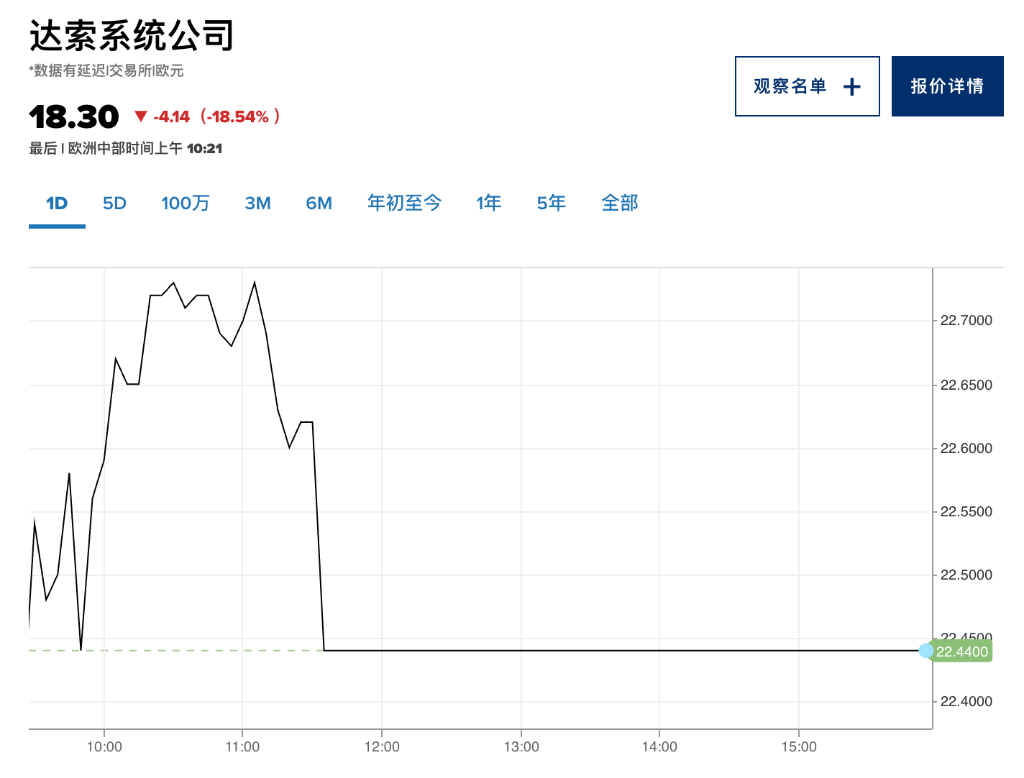
Core Viewpoint - Dassault Systemes SE experienced a significant stock decline of up to 21% due to disappointing Q4 results and a weak outlook for 2026, raising concerns about its traditional software business being replaced by emerging AI tools [1][3]. Financial Performance - Q4 revenue was €1.68 billion (approximately $2 billion), a 4.1% year-over-year decline, falling short of the market expectation of €1.74 billion [3]. - The company's total revenue for the year remained flat at €6.24 billion (approximately $7.43 billion), below the market expectation of €6.3 billion [4][5]. - Software revenue for the year was recorded at €5.64 billion, indicating ongoing growth challenges [4]. Future Outlook - The company projected a non-IFRS revenue growth of 3% to 5% for 2026, which did not meet analyst expectations [3]. - The 2026 revenue forecast is estimated to be between €6.29 billion and €6.41 billion, with earnings per share expected to be between €1.30 and €1.34, both below market expectations [5]. Industry Context - The decline in demand from key sectors such as automotive and pharmaceuticals contributed to the disappointing performance [6]. - The company introduced an Annual Recurring Revenue (ARR) metric, which showed only a 6% growth since Q4 2023, raising concerns in a market shifting towards subscription models [6]. - The stock price drop reflects broader market fears regarding the SaaS industry, particularly in light of competition from new AI tools [6].
美国3D设计软件公司欧特克起诉谷歌侵权
Xin Lang Cai Jing· 2026-02-11 09:28
Core Viewpoint - Autodesk has filed a lawsuit against Google, alleging trademark infringement regarding the "Flow" brand, which could confuse consumers about the products of both companies [1][2]. Group 1: Company Background - Autodesk, founded in 1982 and headquartered in San Francisco, California, is a leading global provider of 2D and 3D design, engineering, and entertainment software [1]. - In 2022, Autodesk launched the "Flow" brand, targeting film creators with a cloud platform and products like Flow Studio, which uses AI to convert live-action footage into 3D scenes [1]. Group 2: Product Comparison - Google's AI video creation tool, Flow, is set to be released on May 21, 2025, and utilizes generative AI to create visual content from scratch, incorporating technologies from Google's AI video, image generation, and language models [1]. - In contrast, Autodesk's Flow Studio focuses on computer vision and motion capture to enhance the post-production process of existing footage [1]. Group 3: Legal Allegations - Autodesk claims that Google previously stated it would not commercialize the "Flow" name but later applied for the trademark in Tonga, a country with limited public trademark application information [2]. - Autodesk argues that Google's trademark application in Tonga was a strategic move, as Google could leverage its scale to undermine Autodesk's product and trademark rights despite the success of Flow Studio [2]. - The company asserts that there has been actual confusion among users, with many mistakenly referring to Google's product as "Flow Studio" [2].

甲骨文们的指引一个比一个炸裂,但历史泼了一盆冷水
Hua Er Jie Jian Wen· 2026-02-11 08:42
Core Insights - The report emphasizes the rapid investment in AI infrastructure following the rise of generative AI, particularly highlighting the significant capital expenditures in hardware and data centers, which are nearing historical investment waves in the U.S. [1] - It questions the feasibility of revenue projections for companies like OpenAI and Oracle, suggesting that such high growth rates have never been achieved by similar companies in the past [3][4][15] Group 1: Revenue Projections - OpenAI's projected revenue growth from $3.7 billion in 2024 to $145 billion by 2029 implies a compound annual growth rate (CAGR) of 108%, which is unprecedented in the historical sample of U.S. public companies [3][4] - Oracle's cloud business is expected to grow from $10 billion in FY2025 to $166 billion by FY2030, reflecting a 75% CAGR, but the report indicates that similar growth has not been achieved historically [10][15] Group 2: Infrastructure Challenges - Building AI infrastructure is complex and involves significant risks, including budget overruns and delays, which are common in large projects [3][16] - The report cites data showing that only 8.5% of large projects are completed on time and within budget, raising concerns about the feasibility of AI infrastructure projects [16] Group 3: Market Dynamics and Competition - The report suggests that recent investments may serve as a strategic signal to competitors, indicating a preemptive strategy to deter potential entrants into the market [19] - It highlights the disparity in financing capabilities between established tech giants and startups, noting that while capital is currently available, this situation may change [19] Group 4: Financial Realities - The report stresses that revenue growth does not equate to value creation, emphasizing the importance of cash flow and capital structure in determining shareholder returns [9] - OpenAI is projected to have significant negative free cash flow, necessitating ongoing external financing to support its growth strategy [12] Group 5: User Growth and Market Penetration - ChatGPT achieved 100 million users in just two months, a record pace compared to other platforms, but the report cautions that user numbers do not directly translate to revenue [11] - The projected revenue for OpenAI in 2025 is approximately $13 billion, with a year-over-year growth rate of about 250%, significantly higher than the average CAGR over five years [11]

专访丨中国在人工智能领域展现出大规模部署的卓越能力——访瑞士智能工厂负责人戈雷基
Xin Hua She· 2026-02-11 04:50
Core Insights - China has demonstrated exceptional capabilities in large-scale deployment of artificial intelligence (AI) technology, transitioning from prototypes to widespread implementation [1][2] - The country aims to become a leader in robotics by leveraging a strong industrial ecosystem, rapid iteration cycles, and large-scale deployment [1] Group 1: China's AI Development - China possesses unique advantages in execution and system integration, tightly combining hardware, manufacturing, and AI technology [1] - The focus on cost-effective open-source model development, such as the DeepSeek open-source model, allows China to achieve performance comparable to top models at lower computational costs [1] Group 2: Global AI Landscape - The United States focuses on proprietary foundational models, maintaining dominance in many commercial digital platforms due to its software platforms and scale advantages [2] - Europe excels in engineering technology and sustainability, but faces challenges in commercializing and scaling AI innovations [2] - A more comprehensive framework is needed in Europe to convert digital innovations into large-scale market success [2] Group 3: Future Trends in AI - AI is undergoing a significant transformation from analytical AI to generative AI that integrates into daily life [2] - Future AI agents will increasingly be able to act autonomously, follow goals, and adjust strategies in real-time [2] - Embodied intelligence, including humanoid robots, quadrupedal robots, and drones, will become the next frontier in AI development [2]