软件定义汽车

Search documents
嘴硬“不放弃燃油车”的丰田,也扛不住了
3 6 Ke· 2025-08-18 07:49
Group 1 - Toyota's net profit for the fiscal year 2025 is expected to plummet by 44% to 2.66 trillion yen, indicating a severe decline in financial performance [1][3] - The company's operating profit is projected to decrease by 20.8%, with net profit down by 34.9%, reflecting a more significant drop than previously anticipated [1][3] - The financial report attributes losses to U.S. government auto tariffs, which are expected to reduce operating profit by 1.4 trillion yen, and the appreciation of the yen, which will decrease profits by 725 billion yen [3][5] Group 2 - The appreciation of the yen has led to a significant reduction in revenue from overseas operations when converted back to yen, exacerbating the financial challenges faced by Toyota [5][7] - The company's reliance on Japanese suppliers for critical components has intensified the negative impact of U.S. trade policies, particularly high tariffs [10][12] - Toyota's North American production, which accounts for 13% of global output, has been hampered by supply chain issues, leading to increased costs and operational challenges [10][12] Group 3 - Toyota's slow response to the shift towards electric vehicles (EVs) has left it vulnerable to competitors like Tesla, which have rapidly advanced in the EV market [15][20] - The company's conservative approach to innovation and reliance on hybrid technology has hindered its ability to compete effectively in the evolving automotive landscape [20][23] - Recent financial results indicate a decline in profitability across various markets, with North America showing a direct loss of 21.1 billion yen despite a revenue increase of 6.2% [14][32] Group 4 - Toyota's cost-cutting measures have led to a decline in product quality and brand perception, as evidenced by frequent recalls and a shift towards cheaper materials [29][30] - The company's strategy of using common parts across models has resulted in product homogenization, diminishing brand differentiation and consumer value [32][33] - Shareholder dissatisfaction is evident, with declining support for leadership amid concerns over the company's direction in embracing electric vehicles [34][36] Group 5 - The narrative of blaming external factors such as currency fluctuations and tariffs fails to address deeper strategic missteps and technological stagnation within the company [38] - The financial crisis reflects a broader issue of strategic misalignment and a failure to adapt to market changes, reminiscent of past industry disruptions [38]


嘴硬“不放弃燃油车”的丰田,也扛不住了
凤凰网财经· 2025-08-18 05:30
Core Viewpoint - Toyota's projected net profit for the fiscal year 2025 is expected to plummet by 44% to 2.66 trillion yen, indicating a severe decline in financial performance and strategic missteps [1][41]. Group 1: Financial Performance and Challenges - Toyota's operating profit is anticipated to decrease by 1.4 trillion yen due to U.S. government auto tariffs, with an additional 725 billion yen loss attributed to yen appreciation [4][6]. - The company's financial results reveal a stark contrast in performance across regions, with North America showing a revenue increase of 6.2% but suffering a direct loss of 211 billion yen, a 124.8% decline year-on-year [17][33]. - The overall financial outlook for Toyota is grim, with significant profit declines across various markets, including a 26.8% drop in Japan and a 22.2% decrease in Europe [17][41]. Group 2: Strategic Misalignment and Market Position - Toyota's delayed response to the shift towards electric vehicles (EVs) has left it vulnerable, as competitors like Tesla rapidly advance in the EV market while Toyota remains focused on hybrid technology [18][25]. - The company's reliance on traditional manufacturing practices and a conservative approach to innovation have hindered its ability to adapt to the evolving automotive landscape [21][37]. - Despite the challenges, Toyota's leadership continues to downplay the impact of strategic misjudgments, attributing losses primarily to external factors such as tariffs and currency fluctuations [38][41]. Group 3: Production and Supply Chain Issues - Toyota's North American production strategy has been slow to localize, with a significant portion of its supply chain still dependent on imports from Japan and other countries, exacerbating the impact of U.S. tariffs [14][16]. - The company's cost-cutting measures have led to a decline in product quality and increased recalls, raising concerns about the long-term sustainability of its manufacturing practices [30][34]. - Recent recalls affecting over a million vehicles highlight systemic risks associated with Toyota's strategy of component standardization and cost reduction [31][32]. Group 4: Leadership and Future Outlook - Shareholder dissatisfaction is growing, with concerns about the leadership's ability to navigate the transition to electric vehicles and the company's overall strategic direction [36][41]. - The historical context of Toyota's challenges, including past crises and the current competitive landscape, suggests that failure to innovate could lead to a significant decline in market position [11][42]. - The ongoing struggle to balance traditional manufacturing strengths with the need for rapid innovation in the EV sector poses a critical challenge for Toyota's future viability [18][41].

大陆集团拆分汽车业务,“欧摩威”9月独立运营并筹备上市
Jing Ji Guan Cha Bao· 2025-08-17 02:35
Core Viewpoint - Continental Group is restructuring its automotive business by spinning off its subsidiary under the new brand "AUMOVIO" to operate independently starting September 1, 2025, in response to market pressures and to enhance its competitive positioning in the automotive technology sector [1][2]. Group 1: Company Strategy - The spin-off of AUMOVIO is a significant structural reform for Continental Group, aimed at addressing the dual pressures of global supply chain disruptions and increasing competition from Chinese firms in smart driving and software-defined vehicles [1][2]. - AUMOVIO will focus on a full-stack business model encompassing electronic and electrical architecture, smart cockpits, braking and chassis systems, autonomous driving, and software platforms [1]. Group 2: Financial Goals - AUMOVIO plans to achieve an independent listing by September 2025, with a target of maintaining an adjusted profit margin of 6% to 8% while scaling its operations [2]. - The restructuring is also a response to market skepticism regarding Continental Group's profitability, as the company aims to prepare for future industry competition [2]. Group 3: Market Challenges - The success of AUMOVIO's listing and its financial performance will depend on the recovery of global capital market valuations for automotive technology companies and the competitive pressure from domestic Tier 1 companies in China [2][3]. - Continental Group is gradually divesting non-core assets and focusing on its dual main businesses of tires and automotive technology, making AUMOVIO a potential growth engine for the next decade [3].
光庭信息: 2025年半年度报告
Zheng Quan Zhi Xing· 2025-08-15 16:14
Core Viewpoint - Wuhan Kotei Informatics Co., Ltd. reported significant growth in revenue and net profit for the first half of 2025, driven by advancements in AI technology and the demand for intelligent connected vehicles [4][19]. Financial Performance - The company's revenue for the reporting period reached approximately 275.41 million yuan, representing a 26.88% increase compared to the same period last year [4]. - The net profit attributable to shareholders was approximately 42.92 million yuan, a substantial increase of 420.44% year-on-year [4]. - The net cash flow from operating activities was approximately 92.61 million yuan, up 226.79% from the previous year [4]. - Basic earnings per share increased to 0.4633 yuan, compared to a loss of 0.1446 yuan in the same period last year [4]. Business Overview - The company focuses on AI technology integration to provide automotive electronic software development and technical services, covering intelligent cockpits, intelligent driving, and intelligent control systems [6][12]. - Key products include the A?OS operating system, which supports collaborative development across various automotive domains, enhancing software delivery efficiency and product reliability [6][12]. Market Trends - The global intelligent connected vehicle market is experiencing strong growth, with sales expected to rise from 41.2 million units in 2020 to 65.7 million units by 2024 [20]. - The shift towards "software-defined vehicles" is driving the automotive industry to transition from traditional electronic architectures to centralized domain-based architectures, improving data processing efficiency and reducing costs [21]. Strategic Initiatives - The company emphasizes collaboration with major clients, maintaining stable relationships with global manufacturers such as Denso, Nissan, and Geely [19]. - The introduction of SDW (Super Software Workshop) aims to standardize and modularize development processes, reducing manufacturing costs and creating new revenue opportunities through OTA upgrades and subscription services [19]. R&D and Innovation - The company invested approximately 34.38 million yuan in R&D during the first half of 2025, an increase of 8.35% year-on-year, focusing on projects aligned with its "AI + automotive software" strategy [18]. - The establishment of a two-tier R&D system aims to enhance the development of advanced technologies and improve service quality across various business units [18].
不出海,就出局?每年新增100万辆!汽车出口的春天来了?
电动车公社· 2025-08-15 16:06
Core Viewpoint - The article discusses the challenges and strategies for the Chinese automotive industry as it seeks to expand into international markets amidst rising trade barriers and competition from established global brands [3][4][5]. Group 1: Current Market Dynamics - In recent years, China has become the world's largest automobile exporter, surpassing Germany and Japan, with an export volume of 3.473 million vehicles in the first half of 2023 [9][10]. - The growth in exports is attributed to improvements in vehicle aesthetics, technology, and features, but the primary driver is competitive pricing [10][12]. - Trade barriers have been increasing globally, with the U.S. imposing a 100% tariff on Chinese electric vehicles and Europe implementing anti-subsidy taxes ranging from 17% to 36.3% [3][4]. Group 2: Challenges in International Expansion - The path to exporting Chinese vehicles is fraught with challenges, including the need to navigate new tariffs and local regulations [18][19]. - Companies must establish local manufacturing, brand recognition, and sales channels in foreign markets, which requires significant investment [18][19]. - The recent legal case involving Volkswagen highlights the complexities of pricing and brand protection in international markets, as the court ruled against parallel imports that undercut local pricing [12][14][17]. Group 3: Understanding Local Markets - Successful international expansion requires a deep understanding of local market dynamics, including competition, target customers, and the need for localization [22][35]. - Different models may face unexpected competition in foreign markets due to significant price differences, necessitating a reevaluation of product positioning [24][28]. - Consumer preferences vary widely across regions, impacting how vehicles are marketed and designed for different demographics [30][34]. Group 4: Localization and Policy Adaptation - Localization is critical, as seen in examples from India and Japan, where vehicles are designed to meet specific local regulations and consumer needs [36][41]. - Understanding local policies, such as tax incentives for smaller vehicles in India, can significantly influence product development strategies [36][39]. Group 5: Future Directions - The article emphasizes the importance of building a solid product foundation and brand identity to survive in a competitive market [61][62]. - Companies are encouraged to explore less competitive markets while also focusing on understanding consumer psychology and competitor strategies in traditional markets [63][64]. - The shift towards software-defined vehicles necessitates a comprehensive approach to product development that considers global market demands and technological advancements [66][67].


大众持续“爱的供养”,小鹏利润曲线再获保障?
Jing Ji Guan Cha Bao· 2025-08-15 07:02
Core Insights - XPeng Motors and Volkswagen Group have expanded their strategic cooperation on electronic and electrical architecture (E/E architecture), marking a significant upgrade since their initial agreement in July 2024 [1][2] - This collaboration integrates XPeng's architecture capabilities into Volkswagen's product lineup in China, which is a rare occurrence in the partnership history between multinational automakers and Chinese new energy vehicle companies [2] Financial Performance - In Q1 2025, XPeng delivered 94,008 vehicles, representing a year-on-year increase of 330.8%, with total revenue reaching 15.81 billion yuan and a gross margin of 15.6% [2] - Revenue from "services and others" amounted to 1.44 billion yuan, accounting for 9.1% of total revenue, with a high gross margin of 66.4% [2] - The revenue includes collaboration with Volkswagen in the E/E architecture, although the exact contribution from Volkswagen is not disclosed [2] Strategic Implications - The partnership with Volkswagen not only provides revenue and profit but also serves as an industry endorsement, enhancing XPeng's credibility in the market [3] - However, the reliance on Volkswagen for technology output poses a risk; any changes in Volkswagen's strategy or collaboration terms could impact XPeng's high-margin income [3][4] Future Outlook - XPeng's ability to maintain high-margin technology services is crucial for sustaining profitability amid ongoing price competition in the domestic new energy vehicle market [4] - The future success of this "invisible engine" depends on XPeng's continued leadership in architecture and software, as well as its ability to establish a broader network of technology clients beyond Volkswagen [4]

小鹏汽车与大众汽车重磅宣布!何小鹏最新发声
Mei Ri Jing Ji Xin Wen· 2025-08-15 05:10
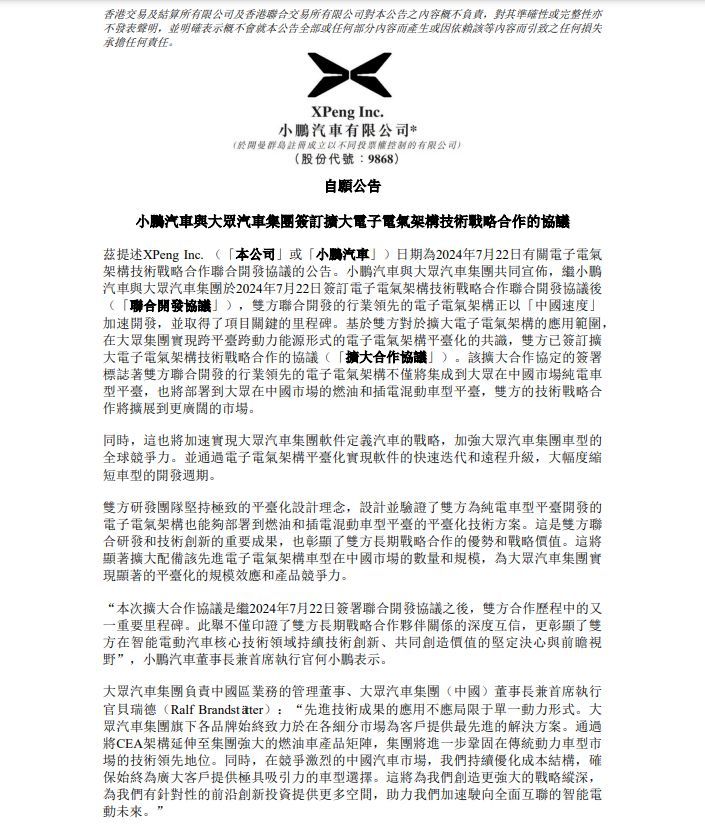
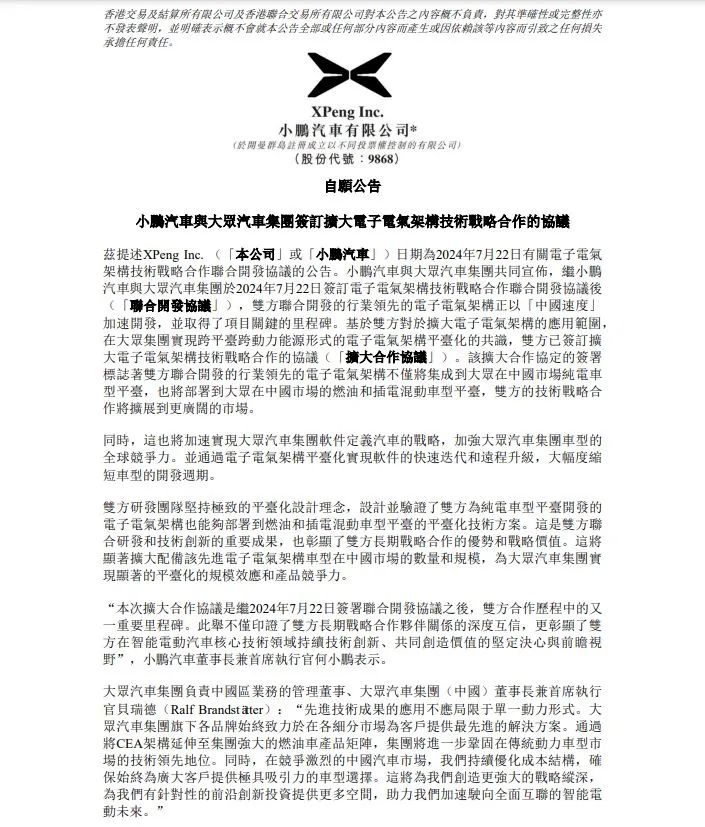
每经编辑|程鹏 杜宇 8月15日早间,小鹏汽车(HK09868)在港交所公告,公司与大众汽车集团共同宣布,继双方于2024年7月22日签订电子电气架构技术战略合作联合开发协 议后,基于双方对于扩大电子电气架构的应用范围,在大众集团实现跨平台跨动力能源形式的电子电气架构平台化的共识,双方已签订扩大电子电气架构 技术战略合作的协议。 小鹏汽车称,该扩大合作协定的签署标志着双方联合开发的行业领先的电子电气架构不仅将集成到大众在中国市场纯电车型平台,也将部署到大众在中国 市场的燃油和插电混动车型平台,双方的技术战略合作将扩展到更广阔的市场。 据小鹏汽车官微消息,小鹏汽车称,同时,这也将加速实现大众汽车集团软件定义汽车的战略,加强大众汽车集团车型的全球竞争力。并通过电子电气架 构平台化实现软件的快速迭代和远程升级,大幅度缩短车型的开发周期。 双方研发团队坚持极致的平台化设计理念,设计并验证了双方为纯电车型平台开发的电子电气架构也能够部署到燃油和插电混动车型平台的平台化技术方 案。这是双方联合研发和技术创新的重要成果,也彰显了双方长期战略合作的优势和战略价值。这将显著扩大配备该先进电子电气架构车型在中国市场的 数量和规模 ...
小鹏大众深化合作!从纯电车型拓展至燃油及混合动力车型
Zhong Guo Zheng Quan Bao· 2025-08-15 04:28
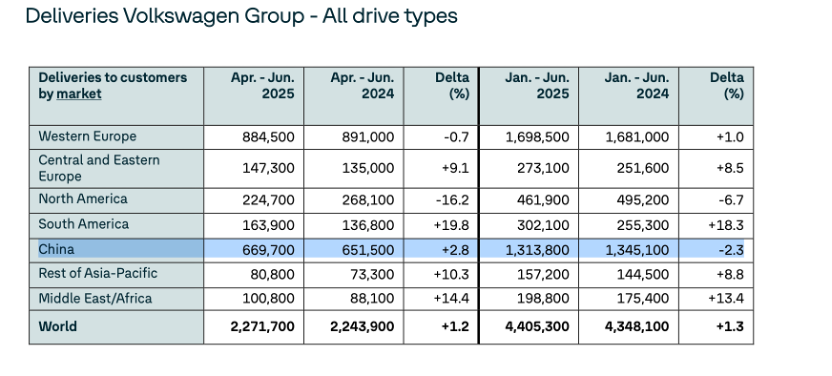
Core Viewpoint - XPeng Motors and Volkswagen Group have signed an expanded strategic cooperation agreement to develop an electronic and electrical architecture that will be integrated into both electric and internal combustion engine vehicles in the Chinese market [1][2]. Group 1: Expanded Cooperation Agreement - The expanded cooperation agreement signifies a milestone in the joint development of electronic and electrical architecture, which will now extend to Volkswagen's fuel and hybrid vehicle platforms in China starting from 2027 [1][2]. - The collaboration aims to enhance Volkswagen's global competitiveness by accelerating the development of software-defined vehicles and enabling rapid software iteration and remote upgrades [2]. - XPeng Motors' Chairman, He Xiaopeng, emphasized the importance of this agreement as a continuation of their commitment to technological innovation in the smart electric vehicle sector [2]. Group 2: Market Performance - Volkswagen Group's sales in China have seen a year-on-year decline of 2.3% in the first half of the year, reflecting increased competition in the Chinese automotive market [3]. - In the second quarter of 2025, Volkswagen delivered 669,700 vehicles in China, a 2.8% increase compared to the same period in 2024 [4]. Group 3: Local Development and Innovation - Volkswagen Group is committed to strengthening its local R&D resources and has established a new R&D and innovation center in Hefei, China, to better integrate into the local technology ecosystem [5][6]. - The company plans to launch 30 electric models in China by 2027, with the first locally developed models set to debut at the 2025 Shanghai Auto Show [6]. - Volkswagen aims to deliver over 2 million vehicles to the Chinese market in 2024, with nearly 90% being internal combustion engine models, while the expanded electronic architecture is expected to enhance operational efficiency and competitiveness [6].
扩大电子电气架构技术合作!小鹏汽车与大众汽车集团官宣
Zhong Guo Jin Rong Xin Xi Wang· 2025-08-15 02:48
转自:新华财经 "本次扩大合作协议是继2024年7月22日签署联合开发协议之后,双方合作历程中的又一重要里程碑。此 举不仅印证了双方长期战略合作伙伴关系的深度互信,更彰显了双方在智能电动汽车核心技术领域持续 技术创新、共同创造价值的坚定决心与前瞻视野。"小鹏汽车董事长兼首席执行官何小鹏表示。 大众汽车集团负责中国区业务的管理董事、大众汽车集团(中国)董事长兼首席执行官贝瑞德(Ralf Brandstätter)表示:"先进技术成果的应用不应局限于单一动力形式。大众汽车集团旗下各品牌始终致 力于在各细分市场为客户提供最先进的解决方案。通过将CEA架构延伸至集团强大的燃油车产品矩阵, 集团将进一步巩固在传统动力车型市场的技术领先地位。同时,在竞争激烈的中国汽车市场,我们持续 优化成本结构,确保始终为广大客户提供极具吸引力的车型选择。这将为我们创造更强大的战略纵深, 为我们有针对性的前沿创新投资提供更多空间,助力我们加速驶向全面互联的智能电动未来。" 新华财经上海8月15日电 8月15日,小鹏汽车在港交所发布公告,与大众汽车集团签订扩大电子电气架 构技术战略合作的协议。公告称,该扩大合作协议的签署标志着双方联合开发 ...
重要公告!小鹏汽车与大众汽车集团共同宣布
Mei Ri Jing Ji Xin Wen· 2025-08-15 01:36
8月15日早间,小鹏汽车(HK09868)在港交所公告,公司与大众汽车集团共同宣布,继双方于2024年7月22日签订电子电气架构技术战略合作联合开发协议 后,基于双方对于扩大电子电气架构的应用范围,在大众集团实现跨平台跨动力能源形式的电子电气架构平台化的共识,双方已签订扩大电子电气架构技术 战略合作的协议。 小鹏汽车称,该扩大合作协定的签署标志着双方联合开发的行业领先的电子电气架构不仅将集成到大众在中国市场纯电车型平台,也将部署到大众在中国市 场的燃油和插电混动车型平台,双方的技术战略合作将扩展到更广阔的市场。 据小鹏汽车官微消息,小鹏汽车称,同时,这也将加速实现大众汽车集团软件定义汽车的战略,加强大众汽车集团车型的全球竞争力。并通过电子电气架构 平台化实现软件的快速迭代和远程升级,大幅度缩短车型的开发周期。 双方研发团队坚持极致的平台化设计理念,设计并验证了双方为纯电车型平台开发的电子电气架构也能够部署到燃油和插电混动车型平台的平台化技术方 案。这是双方联合研发和技术创新的重要成果,也彰显了双方长期战略合作的优势和战略价值。这将显著扩大配备该先进电子电气架构车型在中国市场的数 量和规模,为大众汽车集团实现显 ...