
长钱长投

Search documents
更好发挥险资长期资本耐心资本作用
Jin Rong Shi Bao· 2025-08-08 08:01
Core Viewpoint - The Ministry of Finance issued a notification to guide insurance funds towards long-term stable investments, adjusting the assessment mechanism for state-owned commercial insurance companies to enhance their investment management capabilities and support national development goals [1][2]. Group 1: Assessment Mechanism Changes - The assessment method for "return on net assets" has been changed from a combination of "3-year cycle + current year" to "current year + 3-year cycle + 5-year cycle," with respective weights of 30%, 50%, and 20% [2][3]. - The adjustment aims to alleviate the "short money long investment" issue, providing a more stable framework for capital market development [1][4]. Group 2: Long-term Investment Strategy - The new assessment mechanism encourages state-owned insurance companies to focus on long-term investment opportunities rather than short-term market fluctuations, promoting a shift towards value investing [3][4]. - Insurance companies are expected to enhance their asset allocation capabilities and invest more in equity markets, particularly in high-quality stocks based on a long-term perspective [3][8]. Group 3: Policy Support and Market Impact - The total balance of funds utilized by insurance companies reached 34.93 trillion yuan, with significant room for increasing equity investments, as current allocations are 8.43% for life insurance and 7.56% for property insurance [6]. - The government has implemented a series of policies to encourage long-term investments, including lowering risk factors for stock investments and promoting a structured approach to capital allocation [6][7]. Group 4: Investment Behavior and Asset Management - The notification emphasizes the need for improved asset-liability management, ensuring that insurance companies align their investment strategies with long-term stability and risk control [8][9]. - Companies like China Life and China Re have outlined their commitment to long-term, stable investment strategies, focusing on absolute returns and risk balance [9].



险资再出手 200亿新基金来了
Zhong Guo Zheng Quan Bao· 2025-08-08 07:26
Core Viewpoint - Xinhua Insurance plans to invest up to 10 billion yuan in a private equity fund named Guofeng Xinghua Honghu Zhi Yuan Phase II, which has a total scale of 20 billion yuan, focusing on large listed companies in the CSI A500 index [1][3]. Investment Fund Details - The fund will adopt a long-term investment strategy, utilizing low-frequency trading and long-term holding to achieve stable dividend income [2]. - Both Xinhua Insurance and China Life will contribute 10 billion yuan each to the fund, which has a duration of 10 years and can be extended [3]. - The fund will primarily invest in large A+H shares that meet specific criteria, including good corporate governance, stable operations, and relatively stable dividends [3]. - If there are idle funds, the private equity fund may invest in cash management products such as money market funds, bank deposits, and treasury reverse repos [3]. - The fund management fee is set at 0.1% per year, while the custody fee is 0.002% per year [3]. Long-term Investment Strategy - The Honghu Fund is seen as a significant innovation in long-term stock investment by insurance capital, with a focus on high-quality listed companies with good governance and stable operations [4]. - The first phase of the fund, with an investment of 50 billion yuan, has already been fully deployed, achieving performance that is lower in risk and higher in returns than the benchmark [4]. - The fund aims to combine long-term investment with active capital market participation, contributing to the experience of insurance capital in long-term and value investing [4]. Industry Trends - The Honghu Fund is part of a broader initiative to reform long-term investment by insurance capital, adapting to new accounting standards and reducing the impact of short-term stock price fluctuations [5]. - A total of 60 billion yuan has been allocated for long-term investment reform trials by five insurance companies, which is expected to provide medium to long-term incremental funds to the capital market [6]. - The focus of these investments is on companies with stable fundamentals, clear business models, and strong dividend expectations, which may lead to reduced stock price volatility [6].

基本养老保险基金为资本市场注入稳定“长钱”
Zheng Quan Ri Bao· 2025-08-08 07:05
Core Viewpoint - The Ministry of Human Resources and Social Security is promoting the expansion of the entrusted investment scale of the basic pension insurance fund, which is expected to inject stable long-term capital into the capital market [1][2]. Group 1: Investment Scale and Opportunities - The entrusted investment scale of the basic pension insurance fund currently represents only 26.83% of the cumulative fund balance, indicating significant room for growth in future investments [2][3]. - The basic pension insurance fund's investment operation scale reached 2.55 trillion yuan by the end of June, reflecting a year-on-year increase of 34.21% [3]. - Increasing the entrusted investment scale can potentially bring trillions of yuan in long-term funds to the capital market, enhancing market stability and supporting sustainable economic development [3][4]. Group 2: Long-Cycle Assessment Mechanism - The implementation of a long-cycle assessment mechanism for public funds, state-owned commercial insurance companies, and basic pension insurance funds is a key focus of the recent policy initiatives [4][5]. - The assessment will include performance evaluations over three to five years, which aims to address the mismatch between long-term funds and short-term investments [5][6]. - Establishing this mechanism is expected to reduce market volatility, elevate valuation levels, and strengthen corporate governance by encouraging long-term investment behaviors [5][6]. Group 3: Policy Measures and Market Confidence - Various government departments have introduced measures to enhance liquidity in the stock market, including increasing the investment limits for insurance companies in equity assets [7][8]. - The recent policies have been positively received by investment institutions, boosting market confidence and promoting long-term stability in the capital market [7][8]. - Key strategies for attracting long-term funds include optimizing market structure, improving the quality of listed companies, and enhancing investor return and protection mechanisms [8].
“长钱长投”资金入市步伐不断加快 新质生产力领域成热点
Yang Shi Wang· 2025-08-08 02:23
Group 1 - The A-share market in July showed steady progress, attracting investor attention towards public fund products, with many fund companies actively launching new products focused on China's sci-tech sector [1][3] - In July, a total of 20 new public fund products were launched, with 10 of them being sci-tech bond index funds, indicating a strong interest in the sci-tech theme [3] - Insurance capital is increasingly entering the market, with three private equity funds registered in July, one of which has a scale of 22.5 billion [4][5] Group 2 - By the end of July, over 10 insurance companies, including China Life and Ping An, have established or increased their private equity securities investment funds, targeting a total investment scale exceeding 200 billion [7] - Insurance institutions are setting up private equity funds with the aim of long-term holdings in listed companies, which will inject more stable and long-term capital into the market [9] - The focus of these investments is aligned with national development strategies, particularly in high-end manufacturing, artificial intelligence, and biomedicine, supporting the long-term development of the real economy [9]


上证指数站稳3500点 7月A股成交量创年内新高
Yang Shi Xin Wen· 2025-08-08 00:00
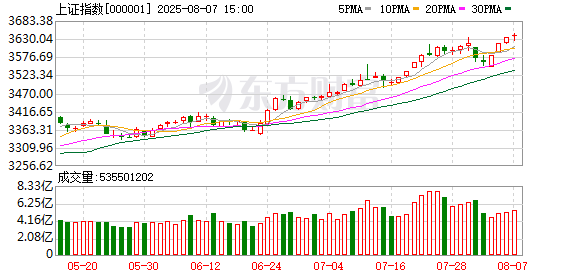
Group 1 - In July, the Shanghai Composite Index stabilized above 3500 points, with multiple sectors reaching new highs, indicating a steady improvement in the capital market [2] - The trading volume in July reached a new high for the year, with the Shanghai market exceeding 15.6 trillion yuan and the Shenzhen market exceeding 21.4 trillion yuan, both showing a month-on-month increase of over 30% [2] - The number of new A-share accounts opened in July reached 1.96 million, a month-on-month increase of over 19% and a year-on-year increase of 71%, significantly surpassing last year's levels [2] Group 2 - Public fund products have gained investor attention, with many fund companies actively launching new products focused on the Chinese technology innovation sector [3] - In July, 20 new public fund products were launched, with 10 of them being focused on technology innovation bonds, indicating a strong interest in sectors like robotics, innovative pharmaceuticals, and aerospace [3] Group 3 - Insurance capital is increasingly entering the market, with three private equity funds registered in July, one of which has a scale of 22.5 billion yuan [5] - Over 10 insurance companies, including China Life and Ping An, have established or increased private equity funds with a total target investment scale exceeding 200 billion yuan, reflecting a trend towards long-term investment strategies [5] - Insurance institutions are focusing on long-term holdings of listed company stocks, which will inject more stable and long-term capital into the market, supporting sectors aligned with national development strategies such as high-end manufacturing and artificial intelligence [5]
中国养老金专题:长钱长投,企业年金的过去、现在与未来
Hua Yuan Zheng Quan· 2025-08-04 09:51
1. Report Industry Investment Rating The provided content does not mention the industry investment rating. 2. Core Viewpoints of the Report - The enterprise annuity market has witnessed continuous scale expansion but suffers from insufficient coverage and prominent structural contradictions. Future policy may lower the participation threshold for small and medium - sized enterprises through automatic enrollment mechanisms and simplified collective plans [3]. - The institutional landscape is becoming more concentrated, and different capabilities may be the key to competition. The focus of future competition may shift to differentiated services [3]. - The investment performance of enterprise annuities is stable but shows differentiation. The long - cycle assessment mechanism may drive the optimization of asset allocation and increase the proportion of equity investment [3]. - In the future, with the expansion of coverage, optimization of equity allocation, and integration of the three - pillar pension system, enterprise annuities are expected to improve the retirement income replacement rate of employees in small and medium - sized enterprises and become a key support in addressing the challenges of an aging population [2]. 3. Summary by Directory 3.1 Historical Evolution: Coexistence of Systemic Dividend Release and Deep - seated Contradictions 3.1.1 From Non - marketization to Marketization - Non - market operation stage (1991 - 2004): It was a crucial foundation - laying period for China's supplementary pension system, featuring administrative leadership and decentralized management. The key contradiction was the lack of unified national regulations and the risk of fund safety. This ultimately led to the introduction of policies in 2004 to start the market - oriented transfer [14][15]. - Market operation stage (since 2004): Marked by the promulgation of relevant regulations, it established the trust - based management model. The market has experienced a rapid development period (2007 - 2016) and a mature and in - depth development period (since 2017), with continuous improvement in the system and investment quality [16]. 3.1.2 What are the Enterprise Annuity Management Institutions? - The enterprise annuity management institutions are characterized by a highly concentrated market and specialized division of labor. There are four types of management institutions, with different distributions of qualifications. Some large institutions can provide integrated services, while the custody function is independently undertaken by commercial banks [27]. - In the trustee market, insurance institutions dominate, and bank - affiliated institutions are rising rapidly. The market shows a significant head - concentration effect. In the investment management market, public funds and insurance institutions play important roles [30][54]. 3.1.3 Enterprise Annuity Plans and Annuity Pension Products - Enterprise annuity plans mainly include single plans and collective plans. Single plans are suitable for large enterprises, while collective plans have advantages such as high efficiency, low cost, and scale benefits [60][63]. - Annuity pension products are standard investment portfolios issued by enterprise annuity fund investment managers and sold to specific pension funds. After more than a decade of development, their investment scope has gradually expanded [66]. 3.2 Current Situation Analysis of Enterprise Annuities 3.2.1 Coverage and Regional Characteristics of Enterprise Annuities - The number of employees participating in enterprise annuities has been increasing, but the coverage rate has not improved significantly. The participation rate in China is far lower than that of OECD countries [67]. - The asset amount of enterprise annuities in the central government - owned enterprises and economically developed regions dominates, and the overall pattern has remained stable in recent years [73]. 3.2.2 How is the Performance of Enterprise Annuities? - The overall performance of enterprise annuities has been growing steadily in the long term. In the past three years (2022Q1 - 2025Q1), the cumulative return reached 7.46%. Asset allocation shows differentiation, with fixed - income portfolios performing better than equity - containing portfolios in the past three years. The policy orientation is shifting towards long - cycle assessment [78][91]. 3.2.3 What are the Scale and Performance of Different Investment Managers? - As of 2025Q1, the enterprise annuity investment management institution market shows two core trends: the strengthening of the head - effect and the shift of the assessment mechanism towards long - term orientation. Public fund companies have strong equity investment capabilities, while insurance - based institutions are stronger in fixed - income investment [94][95]. 3.2.4 Annuity Pension Products - As of 2025Q1, there are 649 registered pension products and 573 actually operating products. The top three types in terms of the number of actually operating products are ordinary stock - type, hybrid - type, and ordinary fixed - income - type [100]. - The number of registered pension products has remained stable since 2021, while the number of actually operating products has decreased year by year. The scale has shown a slight upward trend [102]. 3.3 How might Enterprise Annuities Develop in the Future? - The coverage may expand. The automatic enrollment mechanism may solve the problem of low participation of small and medium - sized enterprises [105]. - The trustee and investment management institutions may continue to be concentrated. The "Matthew effect" in the trustee market may intensify, and the head - effect in the investment management market may continue [105]. - The investment management of single plans and collective plans may undergo structural adjustments. The long - cycle assessment mechanism may be implemented soon, and the proportion of equity investment may increase [106]. - In the next decade, enterprise annuities are expected to improve the retirement income replacement rate of employees in small and medium - sized enterprises and become a key support in addressing the challenges of an aging population [109].
中国养老金专题:长钱长投:企业年金的过去、现在与未来
Hua Yuan Zheng Quan· 2025-08-04 07:01
1. Report Industry Investment Rating - The report does not provide a specific industry investment rating. 2. Core Viewpoints of the Report - China's pension system is undergoing profound changes due to the acceleration of population aging. The enterprise annuity, as an important part of the second - pillar pension, has significant development potential. In the future, through measures such as expanding coverage, optimizing equity allocation, and integrating the three - pillar pension system, it is expected to enhance the retirement income replacement rate of employees in small and medium - sized enterprises and become a key support in addressing the challenges of aging [1]. - The enterprise annuity is transitioning from "short - term investment of long - term funds" to "long - term investment of long - term funds". With the implementation of the "automatic enrollment + voluntary withdrawal" mechanism, the establishment of a long - term assessment mechanism, and the integration of the three - pillar pension system, the enterprise annuity's role in the pension system will be further strengthened [1]. 3. Summary by Relevant Catalogs 3.1 Historical Evolution - **Non - marketization to Marketization**: From 1991 - 2004, it was the non - marketization operation stage, including the exploration period (1991 - 2000) and the pilot transformation period (2000 - 2004). After 2004, it entered the market operation stage, with the rapid development period from 2007 - 2016 and the mature deepening period from 2017 to the present. During this process, policy dividends continuously promoted scale expansion, but there were also deep - seated contradictions such as system design and investment performance fluctuations [8][9][10]. - **Enterprise Annuity Management Institutions**: The market shows characteristics of high concentration and professional division of labor. There are four types of management institutions, with different numbers and types of institutions in each category. The insurance - based institutions dominate the trustee market, and the public - offering fund companies play an important role in the investment management field [16]. - **Enterprise Annuity Plans and Pension Products**: There are single plans and collective plans. Single plans are suitable for large enterprises, while collective plans have advantages such as high efficiency and low cost. Pension products have gradually expanded their investment scope over the years [39][41][44]. 3.2 Current Situation of Enterprise Annuity - **Coverage and Regional Characteristics**: The number of participating employees in enterprise annuities is increasing, but the coverage rate has not improved significantly. The participation rate is far lower than that of OECD countries. In terms of regional distribution, central enterprises and economically developed regions dominate [45][50]. - **Investment Performance**: The overall performance of enterprise annuities has been growing steadily in the long - term. In the past three years (2022Q1 - 2025Q1), the cumulative return reached 7.46%. Asset allocation is significantly differentiated, with fixed - income products performing better in the past three years. The performance also varies between different plans and investment managers [55][65][71]. - **Different Investment Managers**: The market shows a trend of strengthening the leading position of top - tier institutions. The assessment mechanism is shifting towards long - term orientation. Different types of institutions have different investment capabilities in equity and fixed - income products [71][72]. - **Annuity Pension Products**: As of 2025Q1, there are 649 registered pension products and 573 actually operating products. The top three in terms of the number of actually operating products are common stock - type, hybrid, and common fixed - income products [75]. 3.3 Future Development of Enterprise Annuity - **Coverage Expansion**: The "automatic enrollment + voluntary withdrawal" mechanism may be promoted to reduce the participation threshold for small and medium - sized enterprises and expand the coverage [1][82]. - **Head - Concentration of Institutions**: The "Matthew effect" in the trustee and investment management markets may intensify, with insurance - based institutions continuing to dominate, and the proportion of large state - owned banks may increase [82]. - **Structural Adjustment of Investment Management**: There may be a two - way evolution in the investment management of single and collective plans. The long - term assessment mechanism may be implemented soon, and the equity allocation ratio may increase [83].
政治局会议定调全面深化改革 增强资本市场吸引力与包容性
Huan Qiu Wang· 2025-07-31 03:37
Group 1 - The core viewpoint emphasizes the need to enhance the attractiveness and inclusivity of the domestic capital market, consolidating the positive momentum of market recovery [1] - The capital market has shown resilience against unexpected external shocks since 2025, with improved mechanisms for stability and a stronger strategic force for market stabilization [1][2] - The focus on long-term investment and value enhancement for listed companies is crucial for the stability and attractiveness of the capital market [4] Group 2 - There is a pressing need to stimulate market vitality and improve the quality of services for technological innovation in the next phase of capital market reform [2] - The regulatory authorities are working to strengthen the awareness and capability of listed companies to enhance returns for investors, while also improving the convenience of various market value management methods [4] - Long-term capital is identified as a stabilizing factor for the capital market, with ongoing efforts to promote long-term investment strategies and optimize the incentive mechanisms for investment institutions [4] Group 3 - The capital market is seen as a "incubator" and "accelerator" for technological innovation, necessitating the establishment of a new institutional framework that aligns with the characteristics of innovative enterprises [5] - Regulatory bodies are pushing for the implementation of reforms in the Sci-Tech Innovation Board and are expected to introduce comprehensive measures for the reform of the Growth Enterprise Market [5] - Despite the complex internal and external environment, stable economic fundamentals and proactive macro-control are expected to clarify the underlying logic of market stability and attractiveness driven by institutional reforms [5]

中证报评论员:不断增强资本市场吸引力包容性
Zhong Guo Zheng Quan Bao· 2025-07-31 00:28
Core Viewpoint - The Central Political Bureau of the Communist Party of China emphasizes enhancing the attractiveness and inclusiveness of the domestic capital market, aiming to consolidate the positive momentum of market stabilization and improvement [1] Group 1: Market Stability and Resilience - The capital market has demonstrated significant resilience against unexpected external shocks this year, with improved mechanisms for stability and asset price stabilization being integrated into monetary policy [1][2] - The role of the Central Huijin Investment Ltd. is highlighted as it acts similarly to a "stabilization fund," strengthening the strategic efforts to stabilize the market [1] Group 2: Long-term Investment and Market Ecology - There is a strong focus on enhancing the investment value of listed companies, which are considered the cornerstone of the capital market, to ensure stability and attractiveness [2] - Regulatory bodies are working to expand the pool of quality listed companies and enhance their ability to return value to investors through various market management techniques [2] Group 3: Long-term Capital and Investment Coordination - Long-term capital is identified as a "stabilizer" for the capital market, with ongoing efforts to promote long-term investment strategies and improve the policy framework [3] - The importance of creating a conducive environment for long-term capital to enter, remain, and thrive in the market is emphasized as a key indicator of high-quality market development [3] Group 4: Support for Technological Innovation - The capital market is positioned as a "incubator" and "accelerator" for technological innovation, necessitating the establishment of a new institutional framework that aligns with the characteristics of innovative enterprises [3] - Regulatory authorities are actively promoting reforms in the Sci-Tech Innovation Board and plan to introduce comprehensive measures for the reform of the Growth Enterprise Market [3] Group 5: Ongoing Reforms and Challenges - Despite the complex internal and external environment, the steady economic fundamentals and proactive macro-control measures provide a clearer underlying logic for enhancing market stability and attractiveness through institutional reforms [4]
不断增强资本市场吸引力包容性
Zhong Guo Zheng Quan Bao· 2025-07-30 21:08
●本报评论员 7月30日召开的中共中央政治局会议提出,增强国内资本市场的吸引力和包容性,巩固资本市场回稳向 好势头。这为下一阶段资本市场改革发展明确了方向和重点。在围绕"稳"与"活"综合发力的基础上,聚 焦提升上市公司投资价值、优化"长钱长投"市场生态、增强对科技创新的制度包容性,资本市场全面深 化改革将持续加力。 今年以来,资本市场经受住了超预期的外部冲击,市场韧性明显增强。"稳"的机制更加完善,资产价格 稳定被纳入货币政策视野,资本市场在宏观政策取向一致性评估框架中分量更重,中央汇金公司发挥 类"平准基金"作用,稳市战略力量不断壮大;"活"的基础更加扎实,以投资者为本的资本市场建设方向 更加清晰,力促"长钱长投"、鼓励上市公司加强市值管理、推动公募基金与投资者利益深度绑定等投资 端改革深入推进。这些着眼中长期的改革举措推动市场发展更多依靠业绩驱动、制度变革驱动。市场运 行逻辑的深刻变化为巩固市场回稳向好势头、增强市场吸引力和包容性奠定了良好基础。 当前,国际经济环境依然严峻复杂,不确定性风险因素依然较多,巩固资本市场回稳向好势头仍不可掉 以轻心。更重要的是,科技变革大潮澎湃,科技竞争愈发激烈,对资本市场加 ...