高性能计算

Search documents
诺瓦星云(301589) - 2025年9月12日投资者关系活动记录表
2025-09-12 10:27
Group 1: LED Display Industry Outlook - The global LED display market is projected to reach $7.971 billion by 2025 and $10.236 billion by 2028, with a CAGR of 7% from 2023 to 2028 [3] - Mini LED is identified as a new growth point, with a forecasted market size of $3.3 billion by 2028 and a CAGR of approximately 40% from 2024 to 2028 [3] - The company has strategically positioned itself in the MLED sector, collaborating closely with key clients to develop core detection equipment and integrated circuits [3] Group 2: Ultra HD Video Industry Trends - The ultra HD video industry is transitioning from 2K to 4K, with 8K just beginning and significant growth potential towards 16K resolution [4] - The Chinese ultra HD video industry is expected to exceed 7 trillion yuan by 2025, driven by collaborative efforts among government and industry stakeholders [4] - Future applications of ultra HD technology will integrate with AI, high-performance computing, and VR/AR across various sectors [4] Group 3: Smart City Collaborations - The company's products are applicable in various fields, including smart cities, with ongoing collaboration projects [5] - Continuous monitoring of smart city industry developments is planned to identify suitable partnership opportunities [5] Group 4: Sales Strategy - The company employs a sales strategy that primarily focuses on direct sales, supplemented by distributors [6] - Different cooperation strategies are implemented based on customer needs and technical understanding [6] - Strategic partnerships are formed with strong and trustworthy distributors to enhance market position [6]
华勤技术股价涨5.05%,嘉实基金旗下1只基金重仓,持有11.91万股浮盈赚取55.38万元
Xin Lang Cai Jing· 2025-09-12 08:53
Group 1 - HuaQin Technology's stock increased by 5.05%, reaching 96.81 yuan per share, with a trading volume of 1.7 billion yuan and a turnover rate of 3.21%, resulting in a total market capitalization of 98.335 billion yuan [1] - The company, established on August 29, 2005, specializes in the research, design, production, and operation services of smart hardware products, with revenue composition as follows: high-performance computing 60.32%, smart terminals 31.93%, AIOT and others 3.95%, others 2.56%, and automotive and industrial products 1.24% [1] Group 2 - According to data, one fund under Jiashi Fund holds a significant position in HuaQin Technology, with Jiashi Emerging Technology 100 ETF (515860) owning 119,100 shares, accounting for 5.16% of the fund's net value, making it the fourth-largest holding [2] - The Jiashi Emerging Technology 100 ETF (515860) was established on September 26, 2019, with a latest scale of 186 million yuan, achieving a year-to-date return of 44.56% and a one-year return of 88.47% [2] Group 3 - The fund manager of Jiashi Emerging Technology 100 ETF (515860) is Shang Ke, who has been in the position for 1 year and 246 days, managing total assets of 1.499 billion yuan, with the best fund return during the tenure being 83.45% [3]

是石科技完成近亿元Pre-A轮融资 BV百度风投领投
Sou Hu Cai Jing· 2025-09-12 06:03
Core Viewpoint - The leading company in the domestic HPC (High-Performance Computing) and AI infrastructure sector, Shishi Technology (Pinghu) Co., Ltd., has completed nearly 100 million yuan in Pre-A round financing, aiming to strengthen its position in the industry and promote intelligent and industrial upgrades across various sectors [1]. Group 1 - The financing round was led by BV Baidu Venture and followed by Yudao Venture Capital, with Gojie Capital serving as the exclusive financial advisor [1]. - The funds raised will primarily be used for the development of the HAI unified computing platform, iterative development of industry expert model services, market expansion, and recruitment of top technical talent [1]. - The company's goal is to consolidate its leading position in the field and empower various industries with intelligent and industrial upgrades [1].

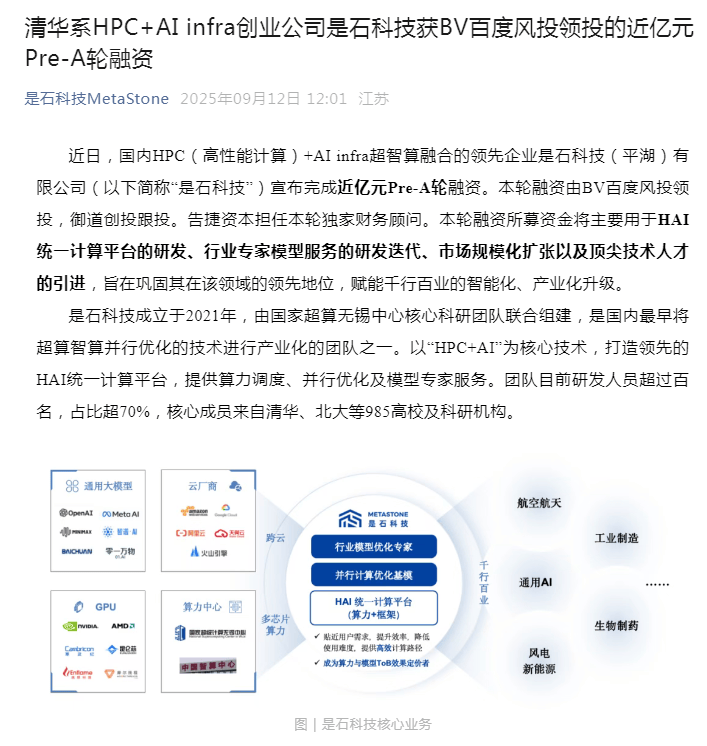
是石科技获BV百度风投领投的近亿元Pre-A轮融资
Xin Lang Cai Jing· 2025-09-12 05:47
Group 1 - The core point of the article is that Shishi Technology has completed nearly 100 million yuan in Pre-A round financing, led by BV Baidu Venture Capital and followed by Yudao Venture Capital [1] - The funds raised in this round will primarily be used for the development of the HAI unified computing platform, iterative development of industry expert model services, market expansion, and recruitment of top technical talent [1]
InfiniBand,如临大敌
半导体行业观察· 2025-09-11 01:47
Core Viewpoint - The article discusses the emergence and significance of Ultra Ethernet (UE) in high-performance computing (HPC) and artificial intelligence (AI) sectors, highlighting its advantages over traditional InfiniBand networks, particularly in large-scale deployments [1][27]. Group 1: Ultra Ethernet Overview - Ultra Ethernet Consortium (UEC) was established in July 2023, comprising major companies like AMD, Intel, and Microsoft, aiming to develop an open standard for high-performance Ethernet [2]. - The UE specification 1.0 is set to be released in June 2025, with over 100 member companies expected by the end of 2024 [2]. Group 2: Compatibility and Scalability - UE is designed to be compatible with existing Ethernet infrastructures, allowing for easy deployment without the need to dismantle current systems [3]. - It supports massive scalability, accommodating millions of network endpoints, which is essential for future AI systems [3]. Group 3: Performance Features - High performance is achieved through efficient protocols designed for large-scale deployments, enabling point-to-point reliability without added latency [4]. - UE introduces features like packet spraying to enhance load balancing and reduce congestion issues [16]. Group 4: Network Types and Applications - UE distinguishes between three network types: local networks, backend networks, and frontend networks, with a primary focus on backend networks for high bandwidth applications [6][8]. - The specification supports various configurations tailored for HPC and AI workloads, allowing for flexibility in implementation [15]. Group 5: Loss Detection and Recovery - UE defines advanced loss detection mechanisms to improve response times for lost packets, including packet trimming and out-of-order counting [19][20]. - The framework allows for efficient handling of packet loss scenarios, reducing unnecessary retransmissions and optimizing bandwidth usage [19]. Group 6: Future Outlook - The anticipated hardware for UE is expected to launch in Fall 2025, with initial products already being developed by various suppliers [24][25]. - As UE gains traction, it may emerge as a competitor to InfiniBand, particularly in AI-driven data center networks, while still leveraging the strengths of existing Ethernet technologies [27].


势银研究 | 从恒坤新材IPO窥探中国本土光刻材料发展现状
势银芯链· 2025-09-10 05:21
Core Insights - Hengkun New Materials Technology Co., Ltd. successfully passed the IPO meeting on August 29, with a total fundraising amount reduced to 1,006.695 million yuan, allocating 400 million yuan for the second phase of precursor projects and 607 million yuan for advanced materials projects [2][3] Group 1: Business Overview - Hengkun New Materials' main business includes self-produced products (including photoresist materials and precursor materials) and introduced products, with self-produced photoresist sales revenue showing a steady growth from 122 million yuan in 2021 to 300 million yuan in 2023 [3] - The main revenue sources are SOC and BARC, with SOC expected to account for 77.46% of revenue in 2024, while BARC is projected to contribute 15.35% [3] Group 2: Product and Market Dynamics - The KrF photoresist is primarily sourced from imports, with a projected revenue of 129 million yuan in 2024, accounting for 87.78% of the introduced products [5] - The demand for semiconductor photoresists in mainland China is expected to exceed 2,316 tons by 2025, driven by the rapid growth of AI and high-performance computing [9] Group 3: Supply Chain and Raw Materials - Hengkun New Materials relies heavily on imported raw materials, with procurement amounts for 2022, 2023, and 2024 being 252 million yuan, 173 million yuan, and 79 million yuan respectively [8] - The top five suppliers for key raw materials are expected to account for 66.03% of procurement in 2024, indicating a need for improved supply chain stability through R&D and partnerships [8] Group 4: Industry Events and Future Outlook - An upcoming conference on heterogeneous integration technology is scheduled for November 17-19, 2025, aimed at fostering collaboration and innovation in advanced electronic information industries [10]

中茵微电子参与编制5项国家标准
Xin Hua Ri Bao· 2025-09-07 21:44
Group 1 - The "Chiplet Interconnect Interface Specification" series of five recommended national standards has been officially released, marking a milestone in the standardization of chiplet technology in China [1] - The standards will be implemented on March 1, 2026, and were initiated as a national standard project in June 2024 [1] - The standards were developed with the collaboration of over ten key industry players, including universities and research institutions, under the guidance of the National Standardization Management Committee [1] Group 2 - Zhongyin Microelectronics focuses on high-end IP products and enterprise-level IC technology platforms, serving sectors such as artificial intelligence, high-performance computing, 5G communication, and automotive electronics [2] - The company provides end-to-end chip technology services, including high-end IP solutions, advanced ASIC design services, Chiplet & SoC technology solutions, and advanced packaging design [2] - Zhongyin Microelectronics has achieved mass production of multiple chips, generating over 1.5 billion yuan in sales revenue [2]
一桩收购,成就4万亿英伟达(NVDA.US)
智通财经网· 2025-09-07 07:07
Core Insights - The focus of attention after NVIDIA's Q2 earnings report is on whether the company's revenue can justify its rapid market capitalization growth, with the network business emerging as a significant growth driver [1] - The network segment, marked as "network," contributed more than 16.1% to NVIDIA's overall revenue, with a 46% quarter-over-quarter increase and nearly doubling year-over-year, reaching $7.25 billion in Q2 alone [1] - The acquisition of Mellanox is highlighted as a pivotal move, with the network business now generating an annual operating revenue of $25 billion to $30 billion, a remarkable figure for a segment previously seen as a secondary player [1][2] Revenue Contribution - The network business's revenue surged to $7.25 billion in Q2, significantly exceeding the acquisition cost of Mellanox, which was $6.9 billion [1][2] - This growth indicates that the network segment is becoming a critical component of NVIDIA's overall financial performance, contributing substantially to its valuation [1] Technological Advancements - NVIDIA's Spectrum-XGS platform addresses challenges such as latency and enables multiple data centers to operate as a unified system, enhancing the company's capabilities in the network domain [3][4] - The technology breakthrough from the acquisition of Mellanox allows geographically distant data centers to function as a single entity, facilitating the creation of large-scale AI factories [3] Strategic Importance of Mellanox - The acquisition of Mellanox is described as one of the most significant mergers in the industry, with its InfiniBand technology being crucial for high-performance computing and AI applications [6][15] - Mellanox's technology is essential for achieving the data processing speeds required for AI, as emphasized by Eyal Waldman, the founder of Mellanox [6][17] Future Infrastructure Developments - NVIDIA plans to deploy 576 GPUs in a single rack, necessitating significant infrastructure expansion to support this scale [11] - The company is focusing on integrating optical connections into switches to reduce power consumption and increase GPU capacity within data centers [13][14] Market Position and Growth - NVIDIA's strategic investments and acquisitions, particularly in Israel, have positioned it as a leader in the semiconductor industry, with a workforce of over 5,000 employees in its Israeli R&D centers [17] - The company's market capitalization has soared from $93 billion to $4 trillion, largely attributed to its successful bets on AI and the integration of Mellanox's technologies [16][17]
一桩收购,成就4万亿英伟达
半导体行业观察· 2025-09-07 02:06
Core Insights - The article emphasizes that NVIDIA's success is significantly attributed to its acquisition of Mellanox, which has become a crucial driver for its transformation into a $4 trillion chip giant [1][17] - The network business, particularly through the Spectrum-XGS platform, is highlighted as a low-key engine propelling NVIDIA's growth, with revenue contributions far exceeding initial expectations [1][3] Group 1: Financial Performance - NVIDIA's network business revenue surged 46% quarter-over-quarter and nearly doubled year-over-year, reaching $7.25 billion in the second quarter [1] - The annual operating revenue for this segment is projected to be between $25 billion and $30 billion, showcasing its significant growth from being a secondary component to a flagship business [1] Group 2: Strategic Acquisitions - The acquisition of Mellanox for $6.9 billion is credited with enabling NVIDIA to enhance its network capabilities, which are essential for AI workloads [1][4] - Mellanox's technology, particularly InfiniBand, is recognized as a foundational element for high-performance computing and AI applications, facilitating the necessary data processing speeds [5][12] Group 3: Technological Advancements - The Spectrum-XGS platform addresses challenges such as latency and connectivity, allowing multiple data centers to operate as a unified AI super factory [3][4] - NVIDIA's focus on integrating optical engines into switches aims to reduce power consumption and increase GPU capacity within data centers [14][15] Group 4: Industry Context - The article discusses the competitive landscape, noting that organizations like UAlink are forming alliances to challenge NVIDIA's dominance in the AI and computing space [3] - The increasing scale of data centers, with projections of GPU counts reaching hundreds of thousands, underscores the growing importance of network infrastructure in AI applications [9][12]

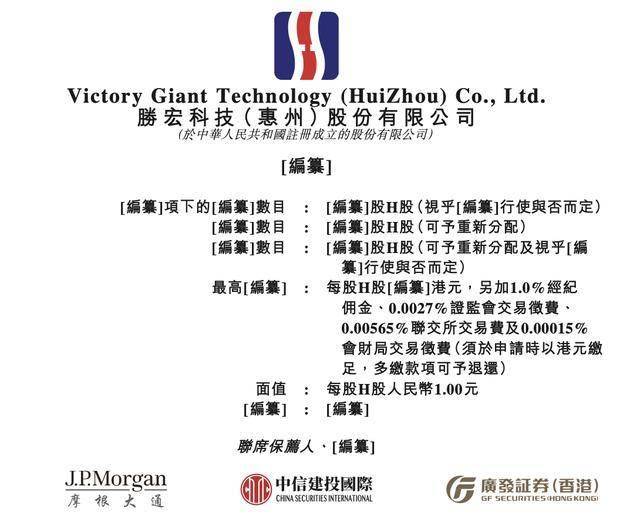
胜宏科技赴港IPO:背靠特斯拉、英伟达,董事长陈涛夫妇成百亿富豪
Sou Hu Cai Jing· 2025-09-05 09:49
Core Viewpoint - Shenghong Technology (Huizhou) Co., Ltd. has submitted its prospectus to the Hong Kong Stock Exchange, with JPMorgan, CITIC Securities International, and GF Securities (Hong Kong) as joint sponsors. The company specializes in high-performance computing PCBs and is positioned to lead the global market in AI and high-performance computing PCB revenue by Q1 2025 [2]. Financial Performance - Revenue for Shenghong Technology from 2022 to 2024 is projected to be 7.885 billion, 7.931 billion, and 10.731 billion yuan respectively, with net profits of 790 million, 671 million, and 1.154 billion yuan during the same period [2]. - In the first half of 2025, the company achieved revenue of 9.031 billion yuan, representing an 86% year-on-year increase, and a net profit of 2.143 billion yuan, reflecting a 366.89% year-on-year growth [4]. Market Position - According to Frost & Sullivan, Shenghong Technology holds the largest market share globally in AI and high-performance computing PCBs, with key applications in AI computing cards, servers, data center switches, and general substrates [2]. - The company has successfully entered the supply chains of top global server clients, including NVIDIA, AMD, Intel, and Tesla, which provides a solid foundation for future growth [7]. Ownership and Leadership - The founder and chairman, Chen Tao, along with his spouse Liu Chunlan, hold a combined 31.24% stake in Shenghong Technology [4]. - Chen Tao is recognized in the industry, being referred to as "the key person for NVIDIA in China" by NVIDIA's CEO Jensen Huang [7]. Wealth Ranking - According to the 2025 Hurun Global Rich List, Chen Tao and Liu Chunlan are ranked 2081 with a wealth of 13 billion yuan [8][9].