
企业出海

Search documents
动画电影《鬼灭之刃》让IMAX成抢票主战场;开拓海外市场仍是中企出海首要动因 | 消费早参
Mei Ri Jing Ji Xin Wen· 2025-11-17 23:15
Group 1: Film Industry - The animated film "Demon Slayer: Infinity Castle Chapter One" debuted in mainland cinemas, achieving a strong IMAX box office of 875 million yuan in its opening weekend, capturing 23% of the box office with only 1% of the screens [1] - The film's popularity has reignited the "midnight screening" trend in the Chinese film market, with IMAX midnight screenings accounting for 38% of the film's box office, generating 71 million yuan and setting a new record for IMAX midnight screenings of Japanese films in China [1] - The success of the film highlights the powerful appeal of established intellectual properties (IPs) and the importance of quality content in driving market recovery and attracting diverse international films to the Chinese market [1] Group 2: Corporate Expansion - A report by ACCA indicates that expanding overseas markets remains the primary motivation for Chinese companies venturing abroad, with traditional exports still dominating, while digital and platform-based models have a low representation [2] - From a financial management perspective, the report identifies regulatory compliance, geopolitical risks, and talent shortages as the three main financial risks faced by companies going abroad [2] - The traditional export model exposes companies to risks such as anti-dumping measures and exchange rate fluctuations, while the demand for cross-border tax compliance and localized talent is expected to benefit international audit, tax SaaS, and overseas outsourcing service providers [2] Group 3: Investment Activity - L'Oréal Group has made a minority equity investment in the Chinese skincare brand LAN, marking its first investment in a local skincare brand through its Shanghai-based investment arm [3] - This investment reflects L'Oréal's commitment to deepening its presence in the Chinese market and aims to enhance its portfolio in the clean skincare segment, while LAN is expected to benefit from resources that accelerate its internationalization [3] - The collaboration may spark a trend in the beauty industry, focusing on Eastern aesthetics and Chinese ingredients, potentially leading to a reevaluation of the value of Chinese beauty brands [3] Group 4: Corporate Financing - Tianwei Foods announced that it has submitted an application for issuing overseas listed shares (H-shares) to the Hong Kong Stock Exchange, with the application materials accepted by the China Securities Regulatory Commission [4] - This move is seen as a significant step for the company to expand its overseas financing channels and enhance its international influence, potentially attracting more international investors if the listing is successful [4] - The application process still faces uncertainties as it requires approvals from various regulatory bodies, but successful listing could provide new capital support for the company's long-term development [4]
临沂市青年企业家“企业出海”实战交流会成功举办
Sou Hu Cai Jing· 2025-11-17 18:13
临沂市青年企业家"企业出海"实战交流会成功举办 为助力青年企业家精准把握跨境贸易新机遇,满足企业发展实际需求,11月13日,临沂市青年企业家"企业出海"实战交流会在临沂科技大市场成功举办。 打造 区域科技创新高地 旗 ETH in un q 3 15 AR g c arr 来源:临沂市青年企业家协会 青年企业家培养计划采取青年企业家提需求,团委链接资源,机构合作提供服务的模式,为企业精准定制互动式学习培训课程。前期,团市委、市青企协 分别通过线上问卷调研,线下交流座谈的形式征集需求,梳理确定了培训内容,吸引了40余名青年企业家踊跃报名参加。下一步,青企协将以此次培训为 契机,发挥好协会组织联络功能,持续对接企业出海需求,通过政策解读、实战案例分享等形式,帮助企业熟悉海外法律法规与贸易规则,全面提升企业 国际拓展能力,为推动我市经济高质量发展注入新动能。 活动现场,科技大市场工作人员系统介绍了线上线下平台在整合创新资源、匹配人才与技术需求等方面的功能。随后,实战专家李成好、刘本兵分别围 绕"出海企业组织与人才管理"和"打通数字出海快车道"主题展开专题培训,结合真实案例与前沿工具,为企业出海提供实用指导。在交流环 ...


美盈森:当前国内出海的企业以行业头部企业为主
Zheng Quan Ri Bao Wang· 2025-11-14 11:45
Core Viewpoint - The company, Meiyingsen (002303), emphasizes its competitive advantages over local overseas enterprises, particularly in product quality, service, R&D design, and customer resources [1] Group 1: Competitive Landscape - Domestic enterprises venturing abroad are primarily industry leaders, indicating a strong overall competitiveness [1] - The company possesses significant competitive advantages in product quality, service, R&D design, and customer resources compared to local overseas competitors [1] Group 2: Service Capabilities - The company is capable of providing group-based support services that better meet global supply chain management needs for clients with order demands in multiple domestic and international regions [1]

秦朔对话联想副总裁:出海并非产业空心化,反而让中国制造更强
Feng Huang Wang· 2025-11-14 11:35
Core Insights - The discussion at the Caixin Summit focused on how Chinese companies can achieve long-term success in global markets, transitioning from "going out" to "moving up" in value [1] - Lenovo's global journey exemplifies this transition, showcasing significant growth and international presence, with nearly 80% of its revenue coming from overseas [1][2] Group 1: Lenovo's Globalization Journey - Lenovo operates in 180 markets globally, with over 30 production bases and 18 R&D centers, achieving a 22-fold revenue increase over 20 years [1] - The acquisition of IBM's PC business in 2004 marked a pivotal moment, transforming Lenovo into a globally competitive enterprise [1] - Lenovo became the world's top PC seller by 2013, validating the success of its integration strategy [1] Group 2: Strategic Characteristics of Globalization - Lenovo's strategy emphasizes "rooting in China," with 80% of production, 70% of R&D personnel, and 60% of employees based in China [2] - The "China + N" strategy involves establishing production bases in countries like Brazil, Hungary, and Mexico to enhance local service and supply chain resilience [2] - The company aims to create value for local customers and communities, promoting sustainable growth through symbiotic ecosystems [2] Group 3: Addressing Concerns of Industrial Hollowing - The practice of major Chinese companies like Lenovo demonstrates that international expansion does not lead to industrial hollowing but rather strengthens China's industrial capabilities [2][3] - For instance, Lenovo's global sales significantly contribute to its operations in China, highlighting the interconnectedness of domestic and international markets [2][3] - The competitive landscape necessitates global operational capabilities to respond swiftly to customer demands, enhancing market competitiveness [3]

上海临港:ToGlobal企业出海服务品牌发布
Xin Hua Cai Jing· 2025-11-14 07:09
Core Insights - The ToGlobal service brand has been launched in the Shanghai Free Trade Zone, focusing on empowering enterprises to go global through a comprehensive service ecosystem [1][2] - The initiative emphasizes a "From Local To Global" and "Global To Brand" approach, integrating technology and culture to facilitate international market access for brands [1] - A one-stop service system named "1+1+2" has been established, which includes a full-link service provider ecosystem and a lifecycle matrix centered on cross-border data and international data services [1] Group 1 - The ToGlobal initiative is a collaboration between Cross-Border Digital Technology and multiple enterprises and institutions to create an international data space ecosystem and enterprise outbound service ecosystem [1][2] - The service model includes both online connections and offline services, as well as domestic cooperation and overseas implementation [1] - The initiative aims to transform the enterprise outbound layout into a complete system, enhancing the overall service capabilities for businesses looking to expand internationally [2] Group 2 - The Lingang New Area is committed to high-level openness and aims to become a core hub for digital enterprises to "go global," facilitating international cooperation in data cross-border flow [2] - Various organizations, including Siemens and China Bank, are involved in building the enterprise outbound service ecosystem, indicating strong industry collaboration [2]

我国“小巨人”企业已超1.76万家
2 1 Shi Ji Jing Ji Bao Dao· 2025-11-14 05:31
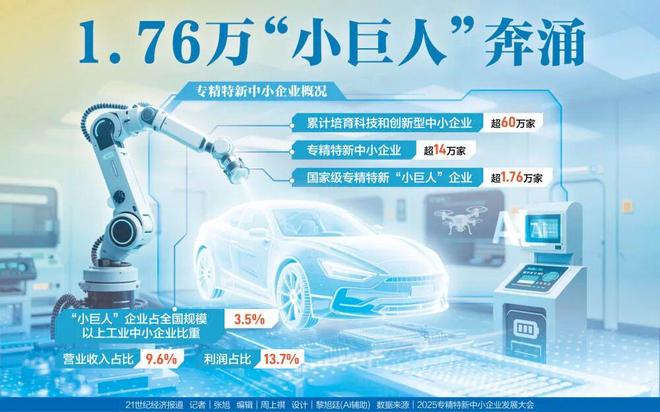
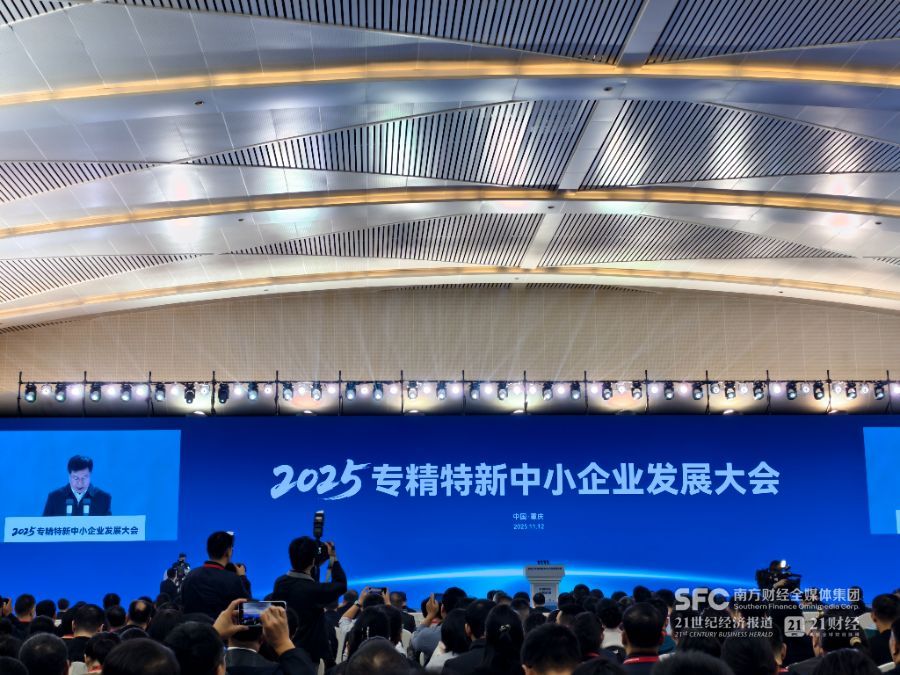
Core Points - The conference on the development of specialized, refined, unique, and innovative small and medium-sized enterprises (SMEs) highlighted the importance of SMEs in driving innovation, promoting employment, and stabilizing growth in China [1][4] - As of 2024, there are over 60 million registered SMEs in China, with SMEs accounting for 99.9% of all enterprises, 84.3% of employment, and 78% of total assets [4] - The development of specialized and innovative SMEs is supported by financial policies from the China Securities Regulatory Commission, which has implemented various measures to enhance financial support for quality SMEs [5] Group 1: Development and Impact of SMEs - Over 600,000 technology and innovation SMEs have been cultivated in China, with more than 140,000 specialized and innovative SMEs and approximately 17,600 national-level "little giant" enterprises [4][5] - "Little giant" enterprises represent 3.5% of the total number of industrial SMEs but contribute 9.6% of operating income and 13.7% of profits [4] - The average annual growth rates for value-added, operating income, and total profits of SMEs are 6.4%, 7.4%, and 5.4%, respectively, all exceeding those of large enterprises [4] Group 2: Financial Support and Market Access - The Shanghai and Shenzhen stock exchanges provide comprehensive services for SMEs, with around 1,800 specialized and innovative enterprises listed, accounting for 35% of listed companies [5] - Since the beginning of 2024, 80% of new listed companies have been specialized and innovative enterprises, with IPO financing reaching approximately 1.5 trillion yuan, representing 30% of total IPO financing [5] - The establishment of specialized boards for innovative SMEs has expanded to 30 provinces and cities, enhancing the multi-tiered capital market and optimizing financing support for SMEs [5] Group 3: Technological Advancements and Innovations - The exhibition at the conference showcased advancements in high-tech materials, humanoid robots, aerospace technology, and deep-sea exploration, reflecting the future landscape of specialized and innovative SMEs [1][7] - The new materials industry includes 3,661 specialized "little giant" enterprises, focusing on advanced chemical materials, high-performance composite materials, and nanomaterials [7] - The integration of artificial intelligence (AI) in SMEs is emphasized, with 238 typical AI application scenarios released, showcasing the potential for innovation and business model upgrades [10][11] Group 4: Global Expansion and AI Integration - Chinese SMEs are transitioning from product export to deeper integration in foreign markets, emphasizing localization and compliance in their global strategies [10] - The conference highlighted the role of AI in enhancing SMEs' capabilities, with a focus on intelligent hardware and software applications that support complex decision-making and automation [10] - Companies like Qiteng Robotics are expanding their international presence, providing services to major global corporations and exploring new business models for rapid deployment and data collection [11]
合规与增长两难:出海企业如何突围?业内人士谈破局关键
Xin Lang Cai Jing· 2025-11-13 12:44
Core Insights - Chinese companies are facing multiple challenges in their overseas expansion, including heightened compliance thresholds, restricted capital flows, and obstacles in localized operations [1] - The transition from "scale expansion" to "quality enhancement" is critical, with compliance and funding pressures being key bottlenecks for growth [1][2] - The future of overseas expansion for Chinese enterprises will focus on compliance, collaboration, and deep localization as core strategies [5] Compliance and Funding Challenges - The efficiency and security of cross-border capital flows are significant issues, with examples such as the unstable funding environment in Mexico leading to operational funding gaps for Chinese companies [1][2] - Companies are encouraged to diversify their transaction designs, such as utilizing local leasing and financing arrangements to activate assets and establish flexible capital reserve mechanisms [1] Financial Services and Compliance - Financial institutions like CITIC Bank are focusing on two main drivers to help companies balance compliance and growth: standardizing complex processes and enhancing financial services to activate development momentum [2] - Upgrading treasury management systems and offering innovative financial tools are essential for addressing financing difficulties faced by newly established overseas companies [2] Geopolitical and Regulatory Dynamics - The dynamic changes in geopolitical and regulatory policies are increasing the complexity of overseas operations, with specific examples highlighting the need for companies to adapt to local supply chain requirements [3] - The shift from document integrity checks to substantive reviews in ODI (Outbound Direct Investment) registration has led to failures for some companies due to undisclosed investment purposes [3][4] Hidden Risks in Overseas Expansion - Various overlooked aspects in the overseas expansion cycle can become significant obstacles, such as differences in financial regulations across countries that may hinder capital flow if not planned in advance [3][4] - Tax compliance discrepancies, such as Malaysia's SST tax not allowing deductions, can lead to unexpected tax burdens for companies [3] Future Trends in Overseas Expansion - The next decade will see a shift towards more precise investment strategies, with companies leveraging local industry advantages for specialized investments [5] - Localization and precise site selection will become core competitive advantages for companies expanding overseas, moving from simple branch establishment to deep localization [5]
1.76万“小巨人”奔涌 ,AI与出海潮动
2 1 Shi Ji Jing Ji Bao Dao· 2025-11-13 11:17
Core Insights - The conference on the development of specialized and innovative small and medium-sized enterprises (SMEs) highlighted the significant role of SMEs in driving innovation, employment, and economic growth in China [1][3] - As of now, over 600,000 technology and innovation SMEs have been cultivated, with more than 140,000 specialized and innovative SMEs and approximately 17,600 national-level "little giant" enterprises [1][3] - The conference emphasized the importance of financial support for the growth of specialized and innovative SMEs, with various policies introduced to enhance their access to capital [3][4] Group 1: SME Development and Impact - By the end of 2024, the number of registered SMEs in China is expected to exceed 60 million, accounting for 99.9% of all enterprises [3] - The contribution of "little giant" enterprises, which represent 3.5% of the total number of industrial SMEs, includes 9.6% of total revenue and 13.7% of total profits [3] - The average annual growth rates for value-added, revenue, and profit of SMEs are 6.4%, 7.4%, and 5.4%, respectively, all surpassing those of large enterprises [3] Group 2: Financial Support and Market Access - The Shanghai and Shenzhen stock exchanges provide comprehensive services for SMEs, with around 1,800 specialized and innovative enterprises listed, making up 35% of total listings [4] - Since the beginning of 2024, 80% of newly listed companies have been specialized and innovative enterprises, with IPO financing reaching approximately 1.5 trillion yuan, accounting for 30% of total IPO financing [4] - The establishment of specialized boards for these enterprises has expanded to 30 provinces and cities, enhancing the multi-tiered capital market and financing support for SMEs [4] Group 3: Technological Advancements and Innovations - The exhibition at the conference showcased advancements in high-tech materials, humanoid robots, aerospace technology, and deep-sea exploration, indicating a promising future for these sectors [1][5] - The new materials industry includes 3,661 specialized "little giant" enterprises, focusing on advanced chemical materials, high-performance composite materials, and nanomaterials [5] - The integration of artificial intelligence (AI) in SMEs is seen as a crucial opportunity for innovation and business model upgrades, with 238 typical AI application scenarios released for SMEs [10][11] Group 4: Global Expansion and AI Integration - Chinese SMEs are transitioning from product exports to deeper local integration in foreign markets, emphasizing compliance and technology leadership [10] - The conference highlighted the importance of AI in enhancing SMEs' capabilities, with a focus on intelligent hardware and software applications [10][11] - Companies like Qiteng Robotics are expanding their international presence, securing orders from major global firms and exploring new business models for robot operation services [13][14]
京港洽谈会签约额近560亿元,科创金融合作迈入新阶段
Xin Jing Bao· 2025-11-13 11:12
为更好支持内地企业出海,香港特区政府整合资源成立"内地企业出海专班"。香港投资推广署助理署长 李淑菁介绍,香港凭借健全的知识产权保护制度、近4700家初创企业生态体系以及亚洲第一的初创生态 系统排名,正积极建设国际创新科技中心,是内地企业"走出去"的理想平台。 第八届"京港青创杯"创业大赛总决赛作为科技专题活动的重要组成部分,吸引了来自人工智能、生命健 康等前沿领域的优质项目。经过激烈角逐,8个优秀创业项目在总决赛中获奖。这些项目展现了京港青 年在科技创新领域的活力与潜力。 各区精准推介,释放合作新机遇 本届洽谈会期间,北京多区开展专题推介活动,释放具体合作机会。 11月13日,第二十八届北京·香港经济合作研讨洽谈会(以下简称"京港洽谈会")在香港落下帷幕。本 届大会以"京港携手 联通世界"为主题,促成29个现场签约项目,签约金额近560亿元人民币,覆盖科技 服务、人工智能、生物医药等11个重点领域,展现了京港两地深化合作、共创未来的坚定决心。 共建联合实验室与出海新通道 科技合作成为本届洽谈会的亮点。在科技专题活动暨第八届"京港青创杯"创业大赛总决赛上,北京市科 委、中关村管委会与香港贸易发展局续签《深化京 ...
中信证券最新研判:A股迈向“低波动慢牛” 2026年聚焦三主线
Zhong Guo Jing Ying Bao· 2025-11-12 07:10
Group 1: Market Transition and Outlook - A-share listed companies are transitioning from domestic-focused enterprises to global multinational corporations, indicating a shift in China's capital market from emerging to mature status [1][4] - During the "14th Five-Year Plan" period, Chinese companies are expected to enhance their position in the global value chain, converting share advantages into pricing power, which forms the basis for a low-volatility slow bull market in A-shares [1][4] Group 2: Economic Growth Projections - China's economy is anticipated to continue a recovery trend, with growth projected at around 5% in 2025 and 4.9% in 2026, potentially showing a pattern of lower growth in the first half and higher growth in the latter half of 2026 [2] - Fiscal policy in 2026 is expected to be more proactive, maintaining a deficit ratio around 4%, with an increase in special bond quotas directed towards project construction [2] Group 3: Investment Strategy and Focus Areas - The investment strategy for 2026 should focus on three main lines: 1. The re-evaluation of pricing power in China's manufacturing sector, with an emphasis on industries like non-ferrous metals, chemicals, and new energy [6] 2. The deepening of enterprises' international expansion, particularly in sectors such as machinery, innovative pharmaceuticals, and military equipment [6] 3. The continuation of the technology market, with a focus on breakthroughs in AI commercialization and related hardware and applications [6] Group 4: Market Liquidity and Asset Allocation - The capital market is expected to see a continued influx of absolute return funds, contributing to a long-term downward trend in the volatility of broad-based A-share indices [6] - In terms of asset allocation, the global macro environment is generally accommodative, with expectations of a mild appreciation of the RMB and ongoing attractiveness of gold as a long-term investment asset [7]
