农业现代化

Search documents
《影响世界的中国农产品》品牌,华贵集团洪湖莲藕亮相北京天安门《辉煌的中国》核心展区
Sou Hu Wang· 2025-09-17 09:20
Core Insights - The Huagui Group's lotus industry image was showcased at the "Glorious China" exhibition, marking a significant milestone for Chinese agricultural brands on the global stage [1][3] Group 1: Company Achievements - Huagui Group is recognized as a leader in China's lotus industry, achieving a breakthrough in industry value exceeding 10 billion yuan [8] - The company has developed a comprehensive industrial chain from breeding research and intelligent processing to brand marketing, promoting over 30,000 farmers to prosperity [8] - Huagui Group has diversified its product offerings, including lotus stems, lotus soup, lotus powder, and lotus juice, and has won 7 "World Delicious Awards" [10] Group 2: Industry Context - The "Glorious China" exhibition aims to tell China's story and showcase achievements in agriculture, technology, and cultural heritage [3] - The region of Honghu is noted for its rich ecological resources and unique climate, contributing to the high quality of Huagui's lotus products [6] - The company is committed to building a trillion-level aquatic vegetable industry cluster, enhancing the modernization of agriculture and rural revitalization [12] Group 3: Strategic Partnerships - Huagui Group has partnered with Hubei Agricultural Development Group to establish Hubei Agricultural Development Honghu Aquatic Technology Co., focusing on creating a premium aquatic product brand [13]


中国人均粮食占有量达500公斤
Chang Jiang Shang Bao· 2025-09-17 03:35
Core Insights - The "14th Five-Year Plan" for agricultural and rural development in China has shown significant progress, with a focus on building a strong agricultural nation and promoting rural revitalization, contributing to high-quality economic development [1][3] Group 1: Agricultural Production and Food Security - China's grain production reached a new high, surpassing 1.4 trillion jin (approximately 700 million tons) last year, an increase of 74 billion jin (approximately 37 million tons) compared to 2020, ensuring food security for the population [1] - Per capita grain availability reached 500 kg, achieving basic self-sufficiency in grains and absolute safety in staple food supply [1] Group 2: Poverty Alleviation and Employment - The achievements in poverty alleviation have been solidified, with over 6 million individuals identified and assisted to eliminate the risk of returning to poverty, maintaining a stable employment scale of over 30 million for the formerly impoverished [1][2] - The "three guarantees" (compulsory education, basic medical care, and housing safety) for the impoverished population have seen continuous improvement [1] Group 3: Agricultural Modernization - Significant advancements in agricultural modernization have been made, with over 100 million acres of high-standard farmland established, a 63.2% contribution rate from agricultural technology, and over 75% mechanization in crop farming [2] - The coverage rate of quality seeds in crops exceeds 96%, indicating a strong focus on agricultural productivity [2] Group 4: Rural Development and Income Growth - The average disposable income for rural residents reached 23,119 yuan, with a noticeable reduction in the income gap between urban and rural residents, decreasing from a ratio of 2.56:1 in 2020 to 2.34:1 in 2024 [2] - The vitality of rural development is being enhanced through the regulation of homestead management and the promotion of new agricultural business entities, with over 2 million cooperatives and nearly 4 million family farms established [2] Group 5: Future Outlook - Looking ahead to the "15th Five-Year Plan," the foundation for agricultural and rural development is expected to be stronger, with goals set for achieving agricultural modernization and modern living conditions in rural areas by 2035 [3] - The focus will be on enhancing efficiency, increasing farmers' income, and promoting comprehensive rural revitalization [3]
2024年粮食产量比2020年增产740亿斤,人均粮食占有量达500公斤——中国人的饭碗端得更牢
Ren Min Ri Bao Hai Wai Ban· 2025-09-17 00:12
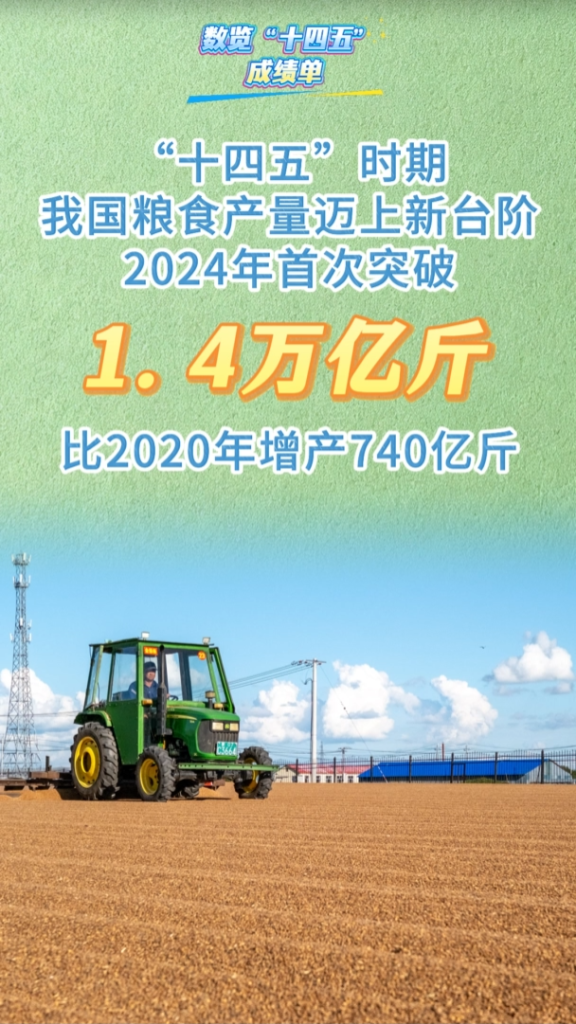
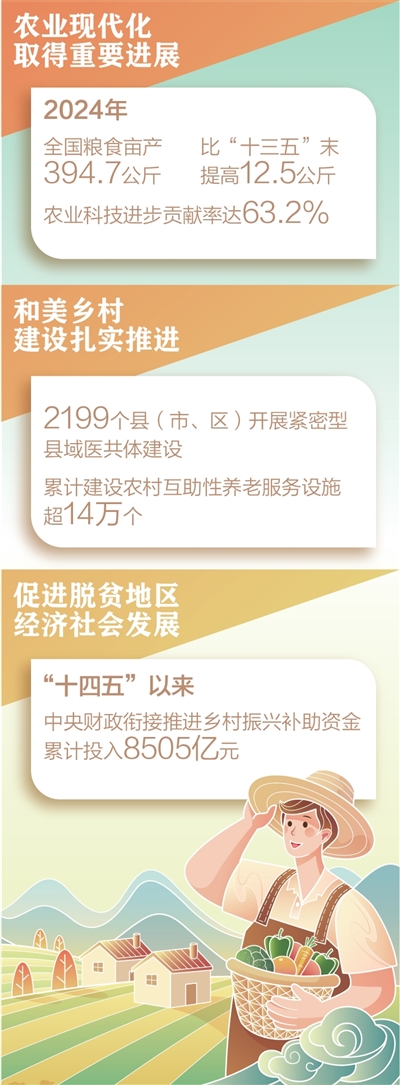
9月16日,国新办举行"高质量完成'十四五'规划"系列主题新闻发布会,介绍"十四五"时期农业农村 发展成就。农业农村部有关负责人在会上介绍,"十四五"以来,农业农村发展稳中有进、稳中向好,中 国人的饭碗端得更牢,农业现代化取得重要进展,为经济社会高质量发展提供了有力支撑。 "十四五"时期,中国粮食产量迈上新台阶,2024年全国粮食产量首次突破1.4万亿斤,比2020年增 产740亿斤。人均粮食占有量达500公斤,做到谷物基本自给、口粮绝对安全,国家粮食安全有充分保 障。 这是如何做到的? 提升产能。农业农村部部长韩俊介绍,"十四五"时期,中国扎实推进新一轮千亿斤粮食产能提升行 动,大力推进高标准农田建设,深入实施种业振兴行动,持续提升粮食综合生产能力。启动实施粮油作 物大面积单产提升行动,推动良田良种良机良法"四良"深度融合。2024年全国粮食亩产394.7公斤, 比"十三五"末提高12.5公斤,单产对粮食产量增长的贡献超60%。 优化结构。针对大豆油料等进口量较大的品种,持续提升国内产能。去年大豆产量达2065万吨,自 给率比2020年提高4个百分点;油料作物产量3978.7万吨,食用植物油自给率提高近5个 ...
中国人的饭碗端得更牢
Ren Min Ri Bao Hai Wai Ban· 2025-09-16 22:42
Core Insights - The article highlights the achievements in agricultural and rural development during the "14th Five-Year Plan" period, emphasizing the stability and progress made in ensuring food security and modernizing agriculture in China [1][2][3]. Group 1: Grain Production - During the "14th Five-Year Plan," China's grain production reached a new level, with the national grain output expected to exceed 1.4 trillion jin (approximately 700 million tons) in 2024, an increase of 74 billion jin compared to 2020 [2]. - The per capita grain availability reached 500 kg, ensuring basic self-sufficiency in grains and absolute safety in staple food [2]. - The increase in grain production is attributed to enhanced capacity, structural optimization, and improved farmer income through comprehensive support policies [3]. Group 2: Land and Soil Management - The total arable land area in China reached 1.94 billion mu (approximately 129 million hectares) by the end of last year, an increase of 28 million mu since 2020 [4]. - Over 100 million mu of high-standard farmland has been constructed, along with significant improvements in irrigation and road infrastructure [4]. - The third national soil survey was initiated in 2022, covering approximately 1.1 billion mu of agricultural land, which will provide essential data for optimizing agricultural production [5][6]. Group 3: Rural Living Environment - The quality of rural living environments has improved, with the rural sanitation toilet coverage reaching around 76%, and over 90% of administrative villages managing waste effectively [7]. - Infrastructure development has progressed, with rural road mileage exceeding 4.64 million kilometers and a rural water supply coverage rate of 94% [7]. - Public services in rural areas have been enhanced, including improved access to education and healthcare, with over 95% of village clinics included in health insurance [7]. Group 4: Future Outlook - Looking ahead to the "15th Five-Year Plan," the foundation for agricultural and rural development is expected to be stronger, with goals set for achieving agricultural modernization and improved living conditions in rural areas by 2035 [8].
粮食产量创新高 农村发展有活力(权威发布·高质量完成“十四五”规划)
Ren Min Ri Bao· 2025-09-16 22:29
Core Insights - The article highlights significant progress in agricultural modernization and rural development during the "14th Five-Year Plan" period, emphasizing the goal of building a strong agricultural nation and promoting comprehensive rural revitalization [3][10]. Agricultural Production - In 2024, China's grain production is expected to exceed 1.4 trillion jin (approximately 700 million tons), with a per capita grain availability of 500 kg, ensuring basic self-sufficiency in grains and absolute safety in staple food [4][9]. - The average grain yield reached 394.7 kg per mu (approximately 0.067 hectares) in 2023, an increase of 12.5 kg compared to the end of the "13th Five-Year Plan," with yield improvements contributing over 80% to the growth in grain production [5][4]. Agricultural Structure and Safety - The agricultural production structure is being optimized to adapt to market demand, with soybean production reaching 20.65 million tons in 2024, and the self-sufficiency rate increasing by 4 percentage points since 2020 [5]. - The quality and safety of agricultural products are being prioritized, with a monitoring compliance rate of 97.5% for agricultural product quality during the "14th Five-Year Plan" period [5]. Rural Infrastructure and Support Policies - A comprehensive policy framework to support farmers has been established, including subsidies, price supports, and insurance, aimed at stabilizing farmers' income from grain production [6][8]. - Significant investments have been made in rural infrastructure, with over 4.64 million kilometers of rural roads and a 94% coverage rate for tap water, enhancing public services in rural areas [6][8]. Poverty Alleviation and Economic Development - The government has implemented various support measures to consolidate and expand the achievements of poverty alleviation, with over 600 million monitoring subjects identified for assistance to prevent the risk of returning to poverty [8]. - Since the beginning of the "14th Five-Year Plan," a total of 850.5 billion yuan has been allocated to support rural revitalization, improving infrastructure and public services in poverty-stricken areas [8]. Employment and Income Growth - The income of farmers has seen rapid growth, with the urban-rural income ratio decreasing from 2.56:1 in 2020 to 2.34:1 in 2024, reflecting the effectiveness of policies aimed at supporting agricultural and rural development [9].
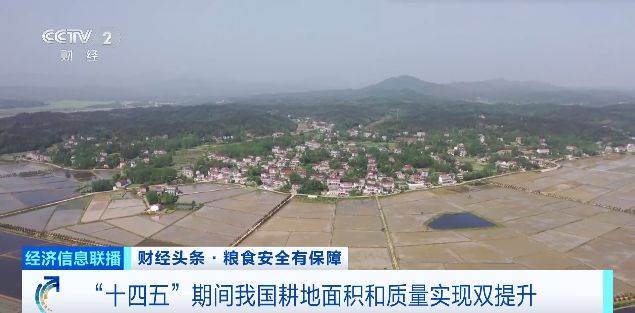
农业现代化取得重要进展!“十四五”期间耕地面积和质量实现双提升
Sou Hu Cai Jing· 2025-09-16 15:23
Core Insights - During the "14th Five-Year Plan" period, China has achieved significant progress in agricultural modernization, with improvements in both the quantity and quality of arable land [1][3]. Group 1: Agricultural Land and Quality - The national arable land area reached 1.94 billion acres by the end of last year, an increase of 28 million acres compared to 2020 [3]. - Over 100 million acres of high-standard farmland have been established, which has effectively enhanced agricultural production capacity [5]. Group 2: Financial Investment - The central government has invested over 700 billion yuan during the "14th Five-Year Plan" period, with the average financial input per acre exceeding 2,000 yuan in 2024 [5]. Group 3: Soil and Land Management - The governance of degraded farmland is actively being promoted, with measures such as infrastructure construction for black soil, protective farming, and soil erosion prevention [7]. - More than 400 million acres of black soil have been protected, and 33,000 erosion gullies have been treated, effectively curbing the degradation of black soil [9]. Group 4: Agricultural Technology and Services - The contribution rate of agricultural technology progress reached 63.2%, with the comprehensive mechanization rate of crop planting, sowing, and harvesting exceeding 75% [11]. - Over 2 million farmer cooperatives and more than 4 million family farms have been cultivated, with over 1.1 million operational service entities providing services over 2.29 billion acres last year [13].
14亿中国人的饭碗端得更牢 农业农村部:现在人均粮食占有量已达500公斤
Mei Ri Jing Ji Xin Wen· 2025-09-16 13:21
Core Viewpoint - The "14th Five-Year Plan" period has seen significant achievements in agricultural and rural development in China, ensuring food security and improving the quality of life for rural residents [1][2][3]. Group 1: Agricultural Production and Food Security - National grain production exceeded 1.4 trillion jin for the first time, an increase of 74 billion jin compared to 2020, with per capita grain availability reaching 500 kg [1][2]. - The country has achieved basic self-sufficiency in grains and absolute safety in staple food supply, ensuring national food security [2]. Group 2: Poverty Alleviation and Rural Revitalization - The success of poverty alleviation efforts has been solidified, with over 6 million monitoring subjects identified and supported to eliminate risks of returning to poverty [2][3]. - The income gap between urban and rural residents has narrowed, with the urban-rural income ratio decreasing from 2.56:1 in 2020 to 2.34:1 [3]. Group 3: Agricultural Modernization - Over 100 million acres of high-standard farmland have been established, with agricultural technology contribution rates reaching 63.2% and mechanization rates exceeding 75% [2]. - The coverage rate of quality seeds in crops has surpassed 96% [2]. Group 4: Food Safety and Quality Assurance - The national agricultural product quality safety monitoring pass rate has remained stable at over 97.5% during the "14th Five-Year Plan" [4]. - A total of 3,782 new or revised agricultural and veterinary drug residue standards have been established, increasing by nearly 40% compared to the end of the "13th Five-Year Plan" [4]. Group 5: Regulatory and Monitoring Framework - A comprehensive regulatory framework has been implemented, including the elimination of high-toxicity pesticides from agricultural production and a decrease in the use of veterinary antibiotics [4][5]. - Risk monitoring is conducted annually, covering a wide range of food products, with a focus on traceability and rapid detection of pesticide residues [4][6].
新华社权威速览丨势头良好!数据展现“十四五”农业农村发展新图景
Xin Hua She· 2025-09-16 12:12
Core Insights - The article highlights the achievements in agricultural and rural development during the "14th Five-Year Plan" period in China, emphasizing food security and poverty alleviation efforts [2][3]. Agricultural Production and Food Security - The annual grain production for 2024 is projected to exceed 1.4 trillion yuan, an increase of 740 billion yuan compared to 2020, with per capita grain availability reaching 500 kg, ensuring basic self-sufficiency and absolute food security [4]. - The supply of oil, sugar, fruits, vegetables, meat, eggs, milk, and aquatic products is abundant and diverse, enhancing the quality of life for the public [6]. Poverty Alleviation and Rural Revitalization - Over 6 million monitoring subjects have been identified for assistance, effectively eliminating risks of returning to poverty, with stable employment for over 30 million people from the poverty alleviation population [7]. - The "three guarantees" (compulsory education, basic medical care, and housing safety) and drinking water safety levels for the poverty alleviation population have continuously improved [7]. Agricultural Modernization - More than 100 million acres of high-standard farmland have been established, with significant advancements in agricultural modernization [7]. - The contribution rate of agricultural technology progress is reported at 62%, with a comprehensive mechanization rate of 75% for crop farming [8][9]. Rural Infrastructure and Public Services - By 2024, the revenue of large-scale agricultural processing enterprises is expected to reach 18 trillion yuan, with significant improvements in rural living conditions, including a sanitation toilet coverage rate of approximately 76% [12]. - Public service levels in rural education, healthcare, and elderly care are continuously improving, with various cultural and sports activities enhancing community engagement [13]. Income and Economic Disparity - The per capita disposable income of rural residents is projected to reach 23,119 yuan by 2024, with the urban-rural income ratio decreasing from 2.56:1 in 2020 to 2.34:1 [14]. Rural Development Initiatives - The second round of land contracts has been extended for another 30 years, with steady progress in the management of rural homesteads and collective land use [16]. - The cultivation of new agricultural business entities has been emphasized, with over 2 million farmer cooperatives and nearly 4 million family farms established [16].

“十四五”粮食产量迈上新台阶 农民收入保持较快增长
Yang Shi Wang· 2025-09-16 08:38
Core Insights - The agricultural and rural development in China has shown steady progress since the 14th Five-Year Plan, with continuous improvement in farmers' income levels [1] Group 1: Agricultural Production - The national grain production is set to exceed 1.4 trillion jin in 2024, an increase of 74 billion jin compared to 2020 [3] - The per capita grain availability has reached 500 kg, ensuring basic self-sufficiency in grains and absolute safety in staple food [3] Group 2: Poverty Alleviation and Employment - Over 6 million monitoring subjects have been identified and assisted to stabilize the elimination of poverty risks, with over 30 million people employed in the past four years [5] - The three guarantees for the impoverished population—education, basic medical care, and housing safety—have seen continuous improvement [5] Group 3: Agricultural Modernization - More than 100 million acres of high-standard farmland have been established, with a contribution rate of agricultural technology progress at 63.2% [5] - The comprehensive mechanization rate for crop farming exceeds 75%, and the coverage rate of quality seeds is over 96% [5] Group 4: Rural Economy and Income - The revenue of large-scale agricultural processing enterprises is projected to reach 18 trillion yuan in 2024 [7] - The per capita disposable income of rural residents is expected to reach 23,119 yuan in 2024, with the income gap between urban and rural residents narrowing from a ratio of 2.56:1 in 2020 to 2.34:1 [7]
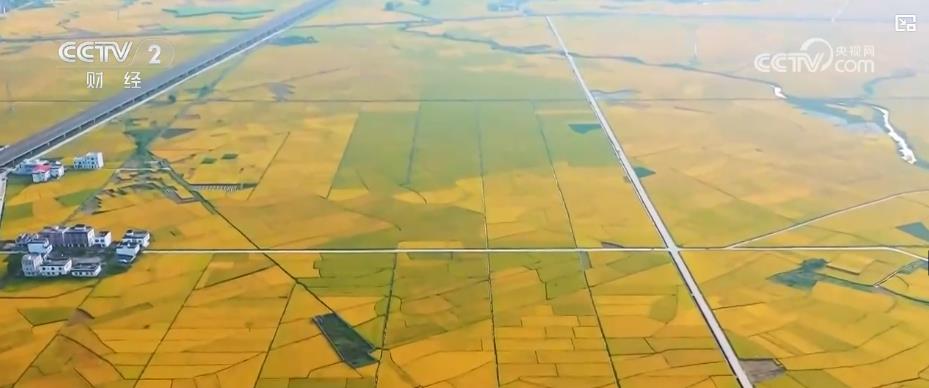
数览“十四五”成绩单|饭碗端得更牢!乡村颜值更高!农民腰包更鼓!
Xin Hua Wang· 2025-09-16 08:23
Core Points - The press conference held by the State Council Information Office on September 16 focused on the progress in agricultural and rural development under the "14th Five-Year Plan" [1] Group 1: Agricultural Production - Grain production has reached a new level, indicating significant advancements in agricultural output [1] Group 2: Agricultural Modernization - Important progress has been made in agricultural modernization, reflecting improvements in technology and practices within the sector [4] Group 3: Farmers' Income - The income levels of farmers have continued to rise, showcasing economic benefits for rural populations [8] Group 4: Rural Development - Rural development has been revitalized, leading to enhanced vitality in rural areas [10]