
机器学习

Search documents
国元证券:促消费政策再加码 智能家居产业链有望受益
Zhi Tong Cai Jing· 2025-08-26 02:33
Policy Perspective - The National Development and Reform Commission and the Ministry of Finance announced a policy to expand the categories of household appliance subsidies from 8 to 12 by early 2025, aiming to stimulate consumption in the home appliance and home sectors through equipment updates and recycling initiatives [2] Technology Perspective - Advancements in IoT, artificial intelligence, machine learning, and big data analysis are broadening the application boundaries and interaction depth of smart home devices, establishing a solid technological foundation for the smart home industry, which is expected to generate more high-value innovative products and services to meet diverse consumer needs [3] Demand Perspective - The easing of the US-China tariff conflict is likely to benefit Chinese home appliance companies in their overseas expansion. Additionally, the rising living standards and technological proliferation, coupled with the accelerated aging population leading to increased demand for home care, are expected to drive continuous upgrades in the smart home industry [4] Conclusion - The entire smart home industry chain, including upstream and downstream sectors, is expected to benefit from these developments, maintaining a "recommended" rating [5]

研判2025!中国机器人流程自动化(RPA)行业发展历程、产业链及市场规模分析:技术融合AI与云化趋势推动RPA升级,助力各行业自动化革新[图]
Chan Ye Xin Xi Wang· 2025-08-26 01:34
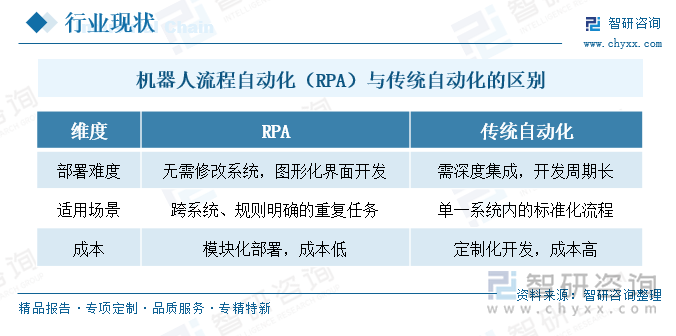
Core Insights - The RPA industry in China is experiencing rapid growth, with a projected market size of approximately 6.79 billion yuan in 2024, representing a year-on-year increase of 35.80% [1][10] - RPA technology is widely applied across various sectors, including finance, manufacturing, healthcare, retail, e-commerce, and public administration, significantly enhancing operational efficiency and reducing costs [1][10] - The integration of RPA with AI, machine learning, and natural language processing is advancing, enabling more complex process optimizations and cognitive capabilities [1][10][18] Industry Overview - Robotic Process Automation (RPA) is a technology that automates repetitive and rule-based tasks by simulating human actions on computers, thereby improving efficiency and reducing errors [2][4] - The RPA industry in China has evolved through four stages: initial awareness, emergence of local products, increased competition, and deep integration with advanced technologies [4] Market Size - The RPA market in China is expected to reach approximately 6.79 billion yuan in 2024, with a growth rate of 35.80% compared to the previous year [10] - RPA applications in finance include tasks such as financial report generation, loan approvals, and anti-money laundering monitoring, which enhance efficiency and accuracy [10] - In manufacturing, RPA is utilized for procurement order processing, quality inspection report generation, and supplier reconciliation, contributing to automated production and supply chain management [10] Industry Chain - The upstream of the RPA industry chain includes servers, storage devices, network equipment, operating systems, databases, natural language processing, computer vision, machine learning, development tools, and cloud services [6] - The midstream consists of RPA software and platform providers, while the downstream applications span finance, manufacturing, public administration, healthcare, e-commerce, and logistics [6] Key Companies - Major players in the RPA market include Jinzhwei, Yisaiqi, Laiye Technology, and Shizai Intelligent, each holding significant market shares and specializing in various technological innovations and industry applications [12][13] - Jinzhwei has established a strong presence in the financial sector, while Yisaiqi excels in RPA combined with AI, particularly in process mining [12][13] Industry Development Trends - RPA technology is transitioning from rule-based automation to cognitive intelligence, with the integration of generative AI and low-code platforms driving this evolution [18] - The application of RPA is expanding from traditional sectors like finance and manufacturing to healthcare and public administration, with significant efficiency gains reported [20] - The adoption of cloud-native architectures and low-code development is expected to facilitate faster implementation of RPA solutions across more enterprises [21]


一文看遍热门芯片,Hot chips 2025首日盘点
半导体行业观察· 2025-08-26 01:28
Group 1: RISC-V Developments - Condor Computing, a subsidiary of Andes Technology, focuses on high-performance RISC-V core development with its first design, Cuzco, completed by a small team of 50 engineers [4][6]. - Cuzco aims to provide the highest performance within a similar power range compared to other RISC-V vendors, indicating a competitive landscape that may lead to a consolidation of players in the future [6][9]. - The Cuzco design features a wide front end, a deep 256-entry reorder buffer, and an 8-way execution pipeline, emphasizing optimization rather than reinventing existing technologies [9][11]. Group 2: Cuzco CPU Core Features - Cuzco is a complete IP design that includes not only the CPU core but also cache and coherence management functions, highlighting its comprehensive architecture [11]. - Key features of Cuzco include support for various precision floating-point operations, new bit manipulation instructions, cryptographic functions, and vector instructions, all crucial for high-performance computing [12][14]. - The innovative time-based microarchitecture of Cuzco aims to improve out-of-order execution efficiency while reducing power consumption by utilizing hardware compilation for instruction scheduling [16][19]. Group 3: Performance Metrics - Cuzco's architecture is designed to outperform Andes AX65 cores, achieving nearly double the performance in SPECint2006 benchmarks, showcasing its competitive edge [30][31]. - The design supports up to 8 CPU cores with private L2 and shared L3 caches, connected via a wide CHI bus, enhancing its scalability and performance [33]. Group 4: IBM Power11 Architecture - IBM introduced its Power11 architecture, building on the success of Power10, with a focus on system integration rather than just CPU sales [93][97]. - Power11 features enhancements in memory architecture, supporting up to 32 DDR5 memory ports with speeds up to 38.4 Gbps, aiming for high bandwidth and capacity [117][118]. - The architecture emphasizes fewer, larger cores and integrates AI capabilities directly into the processor, reflecting industry trends towards AI integration [102][114]. Group 5: Intel Clearwater Forest - Intel announced its next-generation 288-core processor, Clearwater Forest, utilizing the 18A process and 3D packaging technology, marking a significant advancement over the previous Sierra Forest generation [124][125]. - Clearwater Forest focuses on energy efficiency and multi-threaded workloads, leveraging smaller, efficient cores instead of traditional large cores [126][130]. - The architecture includes improvements in decoding width, out-of-order execution, and memory bandwidth, with claims of a 17% increase in IPC compared to Sierra [134][142]. Group 6: AMD RDNA 4 Architecture - AMD showcased its RDNA 4 architecture, emphasizing significant updates for graphics and machine learning workloads, with a focus on ray tracing and AI hardware [186][192]. - The architecture features improvements in shader engines, memory bandwidth, and media engines, enhancing performance for real-time workloads [203][205]. - RDNA 4 aims to optimize performance for next-generation gaming, integrating advanced features for ray tracing and AI/ML capabilities [242]. Group 7: NVIDIA Blackwell Architecture - NVIDIA's Blackwell architecture focuses on enhancing machine learning performance and efficiency, with a strong emphasis on FP4 ML computing [244][249]. - The architecture supports advanced features for neural rendering and dynamic scheduling, improving performance across various workloads [253][275]. - Blackwell introduces GDDR7 memory support, significantly increasing overall memory bandwidth and optimizing power consumption for mixed workloads [266][279].





末9硕双非本,现在有些迷茫。。。
自动驾驶之心· 2025-08-25 23:34
Core Viewpoint - The article emphasizes the importance of choosing a promising direction in the field of autonomous driving and robotics, highlighting the need for continuous learning and adaptation to industry trends [1][2]. Group 1: Industry Trends and Opportunities - The autonomous driving industry is still vibrant and offers numerous opportunities despite concerns about job saturation in traditional control systems [2][3]. - The community "Autonomous Driving Heart" aims to create a comprehensive platform for knowledge sharing, technical discussions, and job opportunities in the autonomous driving sector, with a target of reaching nearly 10,000 members in two years [2][3][19]. - The community provides access to over 40 technical routes and invites industry experts to answer questions, facilitating knowledge transfer and networking [3][19]. Group 2: Learning and Development Resources - The community offers a variety of resources, including video content, learning paths, and practical problem-solving discussions, to help both beginners and advanced learners in the field of autonomous driving [2][3][19]. - A detailed compilation of over 60 datasets related to autonomous driving is available, covering various aspects such as perception and trajectory prediction [29]. - The community has organized numerous live sessions with industry leaders, providing insights into the latest technologies and methodologies in autonomous driving [55]. Group 3: Job Opportunities and Networking - The community has established a job referral mechanism with multiple autonomous driving companies, facilitating direct connections between job seekers and potential employers [10][18]. - Regular job postings and sharing of internship opportunities are part of the community's offerings, helping members stay informed about the latest openings in the industry [26][18]. - Members can freely ask questions regarding career choices and research directions, receiving guidance from experienced professionals in the field [58][59].

圣泉集团(605589):先进电子材料量价齐升,树脂龙头25H1业绩同比高增
ZHESHANG SECURITIES· 2025-08-25 13:43
Investment Rating - The investment rating for the company is "Buy" (maintained) [5] Core Views - The company's revenue for H1 2025 reached 5.351 billion yuan, a year-on-year increase of 15.67%, while the net profit attributable to shareholders was 501 million yuan, up 51.19% year-on-year [2][4] - The growth in performance is attributed to the rapid development of emerging fields such as AI, which has driven demand for high-frequency and high-speed resins, leading to significant increases in the shipment volumes of products like PPO/OPE and hydrocarbon resins [2][3] - The company is strategically positioned in advanced electronic materials, with a comprehensive product solution capability from M4 to M9, catering to various customer needs [3] Summary by Sections Financial Performance - In H1 2025, the company achieved a gross profit margin of 24.82%, an increase of 1.66 percentage points year-on-year, and a net profit margin of 9.75%, up 2.44 percentage points year-on-year [1][2] - For Q2 2025, revenue was 2.892 billion yuan, a year-on-year increase of 16.13%, and net profit was 294 million yuan, up 51.71% year-on-year [1][2] Product Development and Market Position - The company has made significant advancements in traditional resin products, with synthetic resin products generating 2.810 billion yuan in revenue, a 10.35% increase year-on-year [2] - The company plans to issue 2.5 billion yuan in convertible bonds to fund the industrialization of silicon-carbon negative materials, aiming to capture market opportunities in the lithium battery sector [4] Future Outlook - Revenue projections for 2025-2027 are estimated at 11.603 billion yuan, 13.182 billion yuan, and 14.669 billion yuan, respectively, with net profits expected to be 1.279 billion yuan, 1.632 billion yuan, and 1.944 billion yuan [9] - The company is expected to maintain a strong growth trajectory driven by its leadership in synthetic resins and the development of new energy materials [9]

智能家居行业双周报:促消费政策再加码,贴息+以旧换新组合拳共促消费活力-20250825
Guoyuan Securities· 2025-08-25 11:44
Investment Rating - The report maintains a "Recommended" rating for the smart home industry [5][28][7] Core Insights - The report highlights the combination of subsidy policies and trade incentives aimed at boosting consumer spending in the smart home sector, particularly through the promotion of old-for-new exchange programs and interest subsidies [3][19][28] - The smart home index has shown significant growth, outperforming major indices, indicating a robust market performance [12][16] - The report emphasizes the ongoing technological advancements in IoT, AI, and big data, which are expected to enhance product offerings and meet diverse consumer needs [5][28] Summary by Sections Market Review - In the past two weeks (August 9-22, 2025), the Shanghai Composite Index rose by 5.24%, the Shenzhen Component Index by 9.32%, and the ChiNext Index by 14.94%. The smart home index (399996.SZ) increased by 14.16%, outperforming the Shanghai Composite by 8.92 percentage points [12][16] - Year-to-date performance shows the smart home index up by 27.75%, significantly ahead of the Shanghai Composite's 14.14% increase [12][15] - Within the smart home index, the electronic components and parts sector saw a 23.68% increase over the past two weeks, while year-to-date gains were 62.20% [16][17] Industry Policy Tracking - A national conference was held to advance the old-for-new exchange program for consumer goods, emphasizing the government's commitment to stimulating consumption through coordinated policy efforts [18] - The combination of interest subsidy policies with the old-for-new exchange program aims to enhance consumer spending and market vitality [19][21] Industry News Tracking - Sales of old-for-new related and upgraded products have performed well, with significant year-on-year growth in retail sales for home appliances and communication devices [24] - Aux Electric has passed the listing hearing for the Hong Kong Stock Exchange, marking a significant step towards its market entry [25][26] Investment Recommendations - The report suggests that the smart home industry will benefit from government policies aimed at expanding consumer spending, technological advancements, and increasing domestic demand driven by rising living standards and aging population [5][28]





X @外汇交易员
外汇交易员· 2025-08-25 07:45
Personnel Changes - ByteDance's Doubao (豆包) large model visual basic research team leader, Feng Jiashi, recently resigned [1] - Feng Jiashi joined ByteDance in 2019, focusing on computer vision and machine learning research [1] Research & Development - Feng Jiashi has published over 400 papers on deep learning, object recognition, generative models, and machine learning theory [1]
海能投顾致力于构建智能化投资增值平台,提供专业的投资咨询
Sou Hu Cai Jing· 2025-08-25 05:29
Group 1 - The core viewpoint of "Haineng Investment Advisory" is to create an intelligent investment value-added platform that meets the growing demand for efficient and smart investment tools in a competitive market [1][3] - "Haineng Investment Advisory" leverages advanced technologies such as big data, artificial intelligence, and machine learning to provide precise investment recommendations through deep market data analysis [3] - The platform features a professional team with extensive financial knowledge and market experience, offering customized one-on-one services tailored to investors' risk preferences and investment goals [3] Group 2 - Asset management services are a key feature of "Haineng Investment Advisory," utilizing intelligent systems for real-time monitoring and management of investors' assets to ensure effective asset allocation [3] - The intelligent asset management approach enhances transparency in asset operations and allows for timely identification and adjustment of potential risk points, safeguarding investors' assets [3]

现代数据堆栈:面临哪些挑战?
3 6 Ke· 2025-08-25 02:22
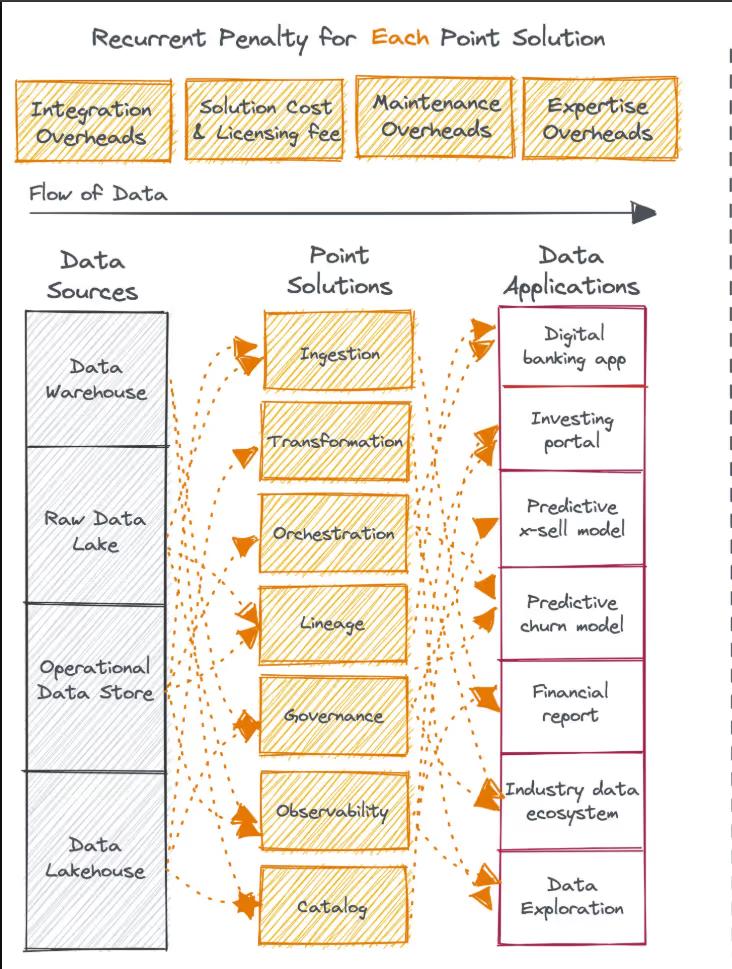
Core Insights - The modern data stack is increasingly popular in data-driven enterprises, driven by cloud-native tools that support AI, machine learning, and advanced analytics, promising scalability, modularity, and speed [1] - However, the adoption of this stack has led to increased complexity and fragmentation, creating new "silos" within organizations as teams utilize multiple tools for different data functions [1][5] - The challenges faced by the modern data stack can significantly impact return on investment, as the complexity and operational overhead increase with the integration of various tools [26][28] Group 1: Challenges of the Modern Data Stack - Tool fragmentation is a pressing challenge, leading to a bloated ecosystem where tools lack the necessary interoperability, increasing complexity and diverting focus from solving business pain points [5][7] - Operational complexity arises from the need for dedicated monitoring and expertise for each tool, pushing data teams to their limits and increasing operational overhead [8][28] - Data quality and trust issues stem from inconsistent validation standards and unclear data ownership, leading to a lack of confidence in data quality and reliance on manual processes [9][11] Group 2: Metadata and Ownership Issues - Metadata management is underdeveloped, leading to outdated or fragmented metadata that diminishes the value of data, resulting in wasted resources on "dark data" [12][20] - The lack of clear ownership within the modern data stack creates confusion and weakens accountability, impacting effective data governance and policy enforcement [22] - Compliance, security, and access control gaps are evident, with many organizations unprepared to handle emerging vulnerabilities, leading to risks in data governance [23] Group 3: Future Directions - A "data-first" approach is emerging, focusing on the data lifecycle, accessibility, and value rather than merely unifying data through various technologies [30] - The Data Developer Platform (DDP) is a key element in this transition, enabling teams to efficiently create, manage, and scale data products without needing specific infrastructure knowledge [30][34] - The integration of DDP can lead to significant improvements in operational simplicity and governance, ensuring compliance and trust throughout the data lifecycle [34]
广发基金胡骏:以量化策略为引擎深耕A+H红利资产
Shang Hai Zheng Quan Bao· 2025-08-24 15:36
Core Insights - The article emphasizes the importance of sustainable dividends and high-quality earnings in dividend investment strategies, particularly in the context of a low-interest-rate environment and market volatility [1][2][3] Group 1: Investment Strategy - The high dividend strategy focuses on selecting stocks with high dividends, low valuations, and strong earnings quality, while also considering future profitability and dividend plans [1][2] - The strategy is built around two dimensions: mature, low-valuation leading companies with stable cash flows and high dividend-paying "small but beautiful" companies with growth potential [2][3] - The average dividend yield of the top ten holdings in the fund managed by the company is reported at 6.08% as of the end of Q2 [2] Group 2: Quantitative Approach - The introduction of quantitative methods enhances the high dividend strategy, utilizing multi-factor models and machine learning for stock selection and risk optimization [4][5] - The company employs a "core + satellite" multi-strategy approach, where the core focuses on high dividends and low valuations, while the satellite includes various defensive strategies to diversify risk [5][6] - Machine learning, particularly neural network strategies, is increasingly integrated into quantitative strategies to improve stock selection metrics [5][6] Group 3: Team and Collaboration - The quantitative investment team has been focused on strategy development since 2011, combining expertise from mathematics, computer science, and financial engineering [6] - The team operates on a collaborative platform where data and strategies are shared, allowing for systematic analysis and optimization of investment strategies [6] - The integration of data-driven decision-making reduces subjective influences and enhances the efficiency of investment operations [6]