
多式联运

Search documents
我国交通运输取得历史性成就 17项主要指标年底前将全部完成
Jing Ji Ri Bao· 2025-07-21 22:18
Core Viewpoint - The construction of the national comprehensive transportation network has exceeded 90% completion, significantly enhancing transportation capabilities, service quality, and operational efficiency, aligning with the vision of smooth movement for people and goods. The transportation sector has achieved historic accomplishments during the "14th Five-Year Plan" period [1][2]. Group 1: Achievements in Transportation Infrastructure - The national comprehensive transportation network is crucial for the economic cycle and supports the new development pattern. The focus has been on integration, addressing shortcomings, and improving efficiency [2]. - By the end of 2024, the railway operating mileage is expected to reach 162,000 kilometers, an increase of approximately 16,000 kilometers since the end of the "13th Five-Year Plan," with high-speed rail accounting for 10,000 kilometers of this increase. The total length of highways will reach 5,490,000 kilometers, up by about 290,000 kilometers, including an increase of 30,000 kilometers in expressways [2]. - The fixed asset investment in transportation reached 15.2 trillion yuan over the first four years of the "14th Five-Year Plan," representing a year-on-year growth of 23.3% [2]. Group 2: Development of Rural Transportation - Since the 18th National Congress, over 4.9 trillion yuan has been invested in rural road infrastructure, with more than 1.2 trillion yuan allocated for maintenance. By the end of 2024, rural road mileage is expected to reach 4.64 million kilometers, establishing a basic network for rural connectivity [5]. - The proportion of graded rural roads has reached 97.3%, and the rate of good and medium-quality roads is 94.8%, significantly improving rural transportation conditions [5][6]. Group 3: Transportation Strong Country Initiative - The initiative to build a strong transportation country has been actively promoted, with over 1,200 units participating in 819 pilot projects since the issuance of the "Transportation Strong Country Construction Outline" in 2019 [7][8]. - Innovations in technology and management have been emphasized, with significant improvements in traffic efficiency and emergency response capabilities through digital transformation and integrated transport systems [7][8].
综合交通运输体系持续完善 六项主要指标已于去年提前完成 “人享其行、物畅其流”正加快实现(权威发布·高质量完成“十四五”规划)
Ren Min Ri Bao· 2025-07-21 22:11
Core Insights - The "14th Five-Year Plan" has achieved significant milestones ahead of schedule, with six key indicators completed by 2024, including highway mileage and urban rail transit operation mileage [1] - The construction of the national comprehensive transportation network has surpassed 90% completion, connecting over 80% of county-level administrative regions and serving approximately 90% of the economy and population [2][3] Infrastructure Development - The national comprehensive transportation network is being rapidly constructed, with a focus on railways as the backbone and highways as the foundation, while maximizing the advantages of water transport and civil aviation [2] - High-speed rail mileage has reached 48,000 kilometers, accounting for over 70% of the world's total, and the highway network has expanded to 191,000 kilometers [2] - The investment in transportation fixed assets during the first four years of the "14th Five-Year Plan" reached 15.2 trillion yuan, a year-on-year increase of 23.3% [3] Transportation Efficiency - Daily cross-regional travel averages about 180 million people, with 160 million tons of goods transported and 478 million express deliveries collected [4] - By 2024, the passenger volume of high-speed trains is expected to reach 3.272 billion, accounting for 75.9% of total railway passenger volume [4] - The integration of online ticketing, electronic payments, and facial recognition technology is enhancing service convenience [4] Logistics and Cargo Transport - During the "14th Five-Year Plan," it is projected that national railway cargo transport will exceed 2.5 billion tons, an increase of 500 million tons from the previous five-year period [7] - The volume of air cargo and mail transport is expected to reach 8.982 million tons in 2024, a 32.8% increase compared to 2020 [7] - The express delivery business volume is projected to grow from approximately 83 billion items in 2020 to 175 billion items in 2024, with an average daily collection exceeding 500 million items [7] Technological Innovation - The digital transformation of transportation infrastructure has upgraded over 60,000 kilometers of channels, improving traffic efficiency by approximately 20% [8] - Significant engineering projects and technological innovations, such as the CR450 train and the first domestically produced large cruise ship, are being developed [8] - The integration of various transportation modes and industries is being promoted to expand the transportation industry chain [9] Overall Impact - The comprehensive transportation network is increasingly becoming the "main artery" of the national economy, with high coverage and improved efficiency [11] - Enhanced transportation capabilities are facilitating more frequent personnel connections and reducing logistics costs, thereby strengthening the flow of production factors [11] - The achievements in transportation infrastructure reflect a vibrant and dynamic China, with innovations setting new benchmarks in the industry [10][12]
厦门国际枢纽港临港片区
Sou Hu Cai Jing· 2025-07-18 09:58
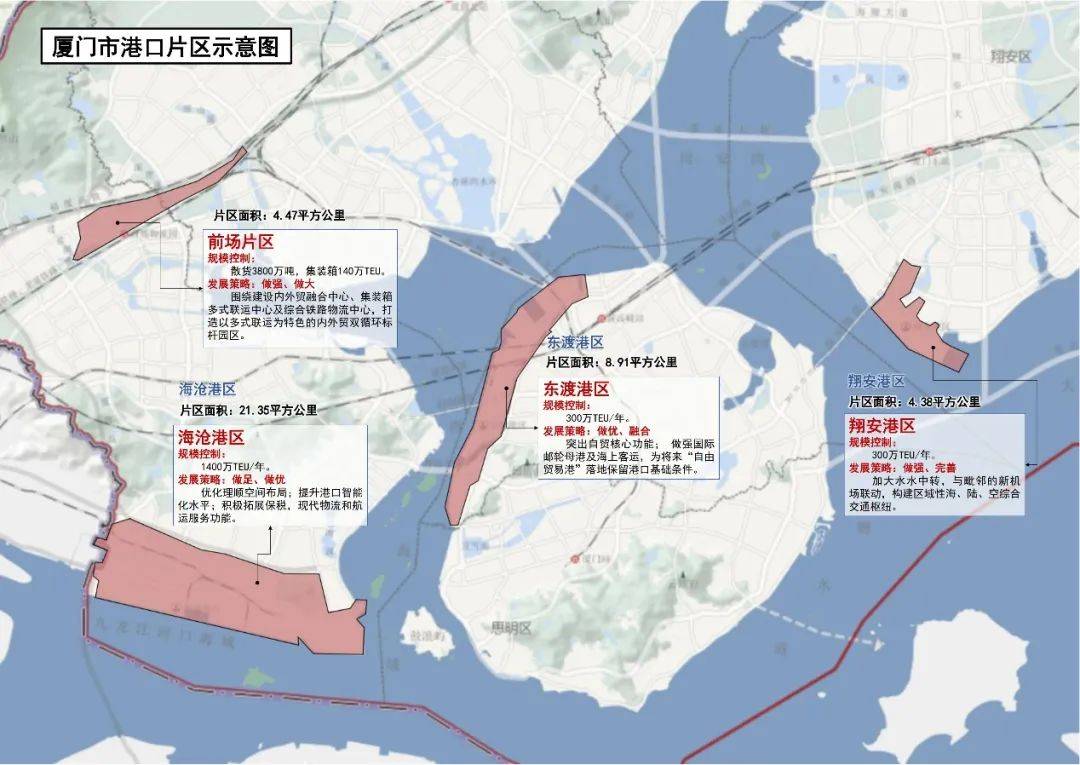
Overview - Xiamen Port is focusing on high-quality development by optimizing port-city relations and enhancing logistics systems, aiming for a container throughput of over 12.25 million TEUs in 2024 [1][3] Major Areas Introduction Haicang Port Area - Haicang Port has 40 berths, with a design capacity of 33.44 million tons and 8 million TEUs annually, aiming to increase container throughput to 14 million TEUs [4][6] - The area focuses on ocean transportation and aims to strengthen its position as a core international container hub [4][6] Dongdu Port Area - Dongdu Port has 23 berths with a design capacity of 257.4 thousand TEUs annually, focusing on near and medium-distance ocean transportation [7] - The area aims to develop modern logistics and shipping services, including international procurement and cross-border e-commerce logistics [7][6] Xiang'an Port Area - Xiang'an Port has 5 berths with a design capacity of 3.3 million tons, focusing on container and bulk cargo transportation [9][10] - The area aims to leverage its deep-water coastline and proximity to Xiamen Xiang'an International Airport to develop a comprehensive transportation hub [9][10] Qianchang Area - Qianchang Logistics Park is positioned as a core logistics hub, focusing on land-based logistics and supporting the construction of an international shipping center [12][13] - The area aims to develop a comprehensive railway logistics center and multi-modal transport solutions, enhancing trade links with Taiwan and Southeast Asia [12][13]

四川绘出物流降成本“施工图”
Si Chuan Ri Bao· 2025-07-14 07:38
Core Viewpoint - The Sichuan Provincial Government has issued an implementation plan aimed at effectively reducing logistics costs across the entire society, which is a key focus in the government's work report for the year [1][9]. Logistics Cost Analysis - While transportation costs per kilometer in China are lower than those in the US and Japan, the overall logistics costs as a percentage of GDP in China are significantly higher, reaching 14.1% compared to around 10% in developed economies [3][4]. - In Sichuan, the logistics cost as a percentage of GDP is projected to be 14.2% in 2024, slightly above the national average [4]. Challenges in Logistics - The high logistics costs in Sichuan are attributed to several factors, including inefficient resource allocation, low circulation efficiency, and a lack of integration in multi-modal transport systems [6][7]. - Key issues identified include poor rail and waterway transport, fragmented logistics providers, insufficient information platforms, and an unfavorable business environment [7]. Cost Reduction Goals - The implementation plan sets a target to reduce the logistics cost to 13.7% of GDP by 2027, focusing on optimizing the transportation structure and improving logistics efficiency [8][10]. - Specific goals include increasing the share of rail freight and waterway transport, as well as maintaining a steady growth rate in the value added by transportation, warehousing, and postal services [10]. Future Strategies - The plan emphasizes enhancing the efficiency of comprehensive transport organization and supporting the development of advantageous industries [12]. - It outlines initiatives to improve multi-modal transport, including encouraging transformation towards multi-modal operators and enhancing the functionality of transport hubs [13]. - The plan also highlights the importance of integrating logistics with local industrial characteristics, particularly in sectors like lithium battery transportation, which is crucial for Sichuan [14].
全国首例!燃料油驮背车试验运输在东营港疏港铁路成功启动
Qi Lu Wan Bao Wang· 2025-07-11 09:03
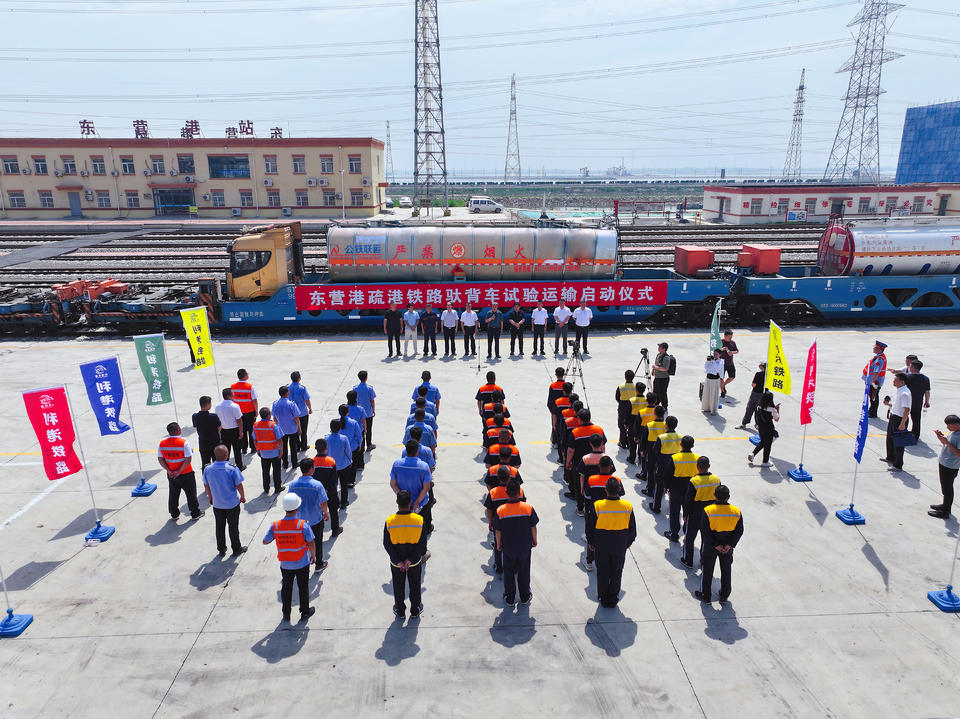
Core Viewpoint - The launch of the fuel oil piggyback transport trial at Dongying Port marks a national first in this transportation method, indicating a significant innovation in logistics and transportation systems in China [1][3]. Group 1: Trial Transport Details - The trial transport operates within the Dongying Port railway, covering a distance of 74 kilometers from Dongying Port Station to Mingji Station, utilizing a train set of 38 cars, which includes 6 fuel tank trucks and 64 tank containers [3]. - The trial employs only two national energy piggyback cars, consisting of STX1, STX2, STX3, and STX4 types, where STX1 and STX2 are for complete vehicle and drop-trailer transport, while STX3 and STX4 are for lifting transport [3]. Group 2: Transportation Model - Piggyback transport represents a seamless intermodal transport model that integrates road and rail, allowing trucks to be loaded onto trains for long-distance transport, followed by road delivery to the final destination [3]. - This model enhances efficiency by enabling "door-to-door" service, which includes short-distance collection by truck, long-distance rail transport, and final delivery by road [3]. Group 3: Strategic Implications - Dongying City is actively implementing the national "road-to-rail" strategy and promoting a modern comprehensive transportation system that supports high-quality development [3][4]. - The initiation of piggyback transport is seen as a critical breakthrough in advancing multi-modal transport projects, which aim to connect rail and road freight more deeply [4].
三羊马(001317) - 001317三羊马投资者关系管理信息20250710
2025-07-10 08:46
Group 1: Company Overview - The company specializes in automotive logistics services, focusing on multi-modal transportation, particularly rail and road combined transport [1] - It has established long-term partnerships with numerous domestic automobile manufacturers, enhancing its credibility and market position [1][2] Group 2: Competitive Advantages - Multi-modal transport model is the core competitive advantage, enabling cost reduction and efficiency improvement for clients [2] - A comprehensive logistics network centered around rail transport has been developed, allowing for efficient management and reduced communication costs [2] - The company has a professional operational team composed of in-house personnel and external partners, which enhances flexibility and reduces management costs [2] Group 3: Client Relationships - Major clients include well-known companies such as China Railway Special Cargo, Changan Minsheng Logistics, and Dongfeng Xiaokang, with stable long-term cooperation [2] - Payment terms with downstream manufacturers typically range from 1 to 3 months [2] Group 4: Financial Performance - The negative operating cash flow in 2024 was primarily due to new business expansions and increased receivables, impacting the net cash flow [3] Group 5: New Business Ventures - The company has introduced a new shareholder, Ice Zero Intelligent Technology, to its subsidiary, focusing on electronic components and robotics, marking the beginning of a new business exploration phase [3]
山西首列跨里海国际班列开行
Zhong Guo Xin Wen Wang· 2025-07-09 19:05
Core Insights - The launch of the first cross-Caspian international freight train from Shanxi, carrying locally manufactured photovoltaic components, marks the successful operation of the international logistics channel in the province [1][2] - The train is transporting 50 standard containers of photovoltaic products, weighing 1,159 tons, facilitated by a collaboration among several logistics and railway companies [1] - The cross-Caspian route, which connects China, Kazakhstan, and Azerbaijan, offers a more efficient transportation option, reducing transit time and enhancing supply chain resilience [1] Company and Industry Developments - Huayuan International Land Port Group, the largest comprehensive modern circulation enterprise in Shanxi, is tasked with creating a new window for external openness and is actively building a modern logistics industry system [1] - The company has established 23 regular China-Europe (Asia) freight train routes, reaching 48 major cities across 16 countries, and plans to maintain regular operations of the cross-Caspian international freight train [2] - The logistics hub in Baku, Azerbaijan, will facilitate the distribution of Shanxi's photovoltaic components to emerging energy markets in the Caucasus, Turkey, and Eastern Europe, enhancing the province's international market presence [1]
武汉港集装箱吞吐量突破187万标箱
Ren Min Wang· 2025-07-09 11:04
Core Insights - Wuhan's government has released a three-year action plan (2025-2027) to promote high-quality development of the Yangtze River middle reaches shipping center, highlighting the progress in construction and operational metrics [3] Group 1: Port Performance - In 2024, Wuhan Port achieved a container throughput of 1.8763 million TEUs, accounting for 76.7% of Hubei province's total and 33.7% of the total in the upper and middle Yangtze River region, maintaining its position as the "first port in the upper and middle Yangtze River" [3] - Wuhan Port has 150 productive berths and has formed a container port cluster centered around Yangluo Port, with an annual container handling capacity exceeding 4 million TEUs and an annual throughput capacity of 150 million tons [3] Group 2: Intermodal Transport Development - Wuhan has established the largest inland rail-water intermodal hub, with over 50 opened channels, achieving a rail-water intermodal volume of 231,600 TEUs in 2024, a year-on-year increase of 44%, leading the nation in both total volume and growth rate [3] Group 3: Economic Development Initiatives - The Yangtze New Area is designated as the core area for shipping center construction, with over 2,000 enterprises gathered in the Yangluo Port area, 80% of which are industrial companies, focusing on industries such as steel processing, equipment manufacturing, and health [3] - The area aims to develop three major industries: port logistics, port manufacturing, and shipping services, transitioning the port hub into an economic hub [3] Group 4: Strategic Goals and Innovations - The New Area aims for a target of 10 million TEUs, an international port, and a shipping center, implementing a development path of "port + channel + network + platform + industry" [4] - Innovations in customs procedures, such as "joint boarding inspections" and "direct loading and unloading," have significantly improved clearance efficiency, reducing waiting times and costs for local automotive exports [4]
航运巨头反垄断调查风暴:一场正在重塑国际货代市场的底层革命
Sou Hu Cai Jing· 2025-07-07 07:06
Core Insights - The article discusses the significant impact of the Kenyan Competition Authority's (CAK) antitrust investigation on the logistics and freight forwarding industry in East Africa, leading to a transformation in pricing and operational dynamics [1][2]. Pricing System Collapse - The CAK's investigation revealed a price-fixing agreement between shipping giants Maersk and CMA CGM, which had established a uniform terminal handling fee of $99 per 20-foot container, undermining the pricing foundation of the international freight market [2]. - Multinational shipping companies control over 70% of logistics contracts, creating a closed network that disadvantages local logistics firms, which own 90% of truck assets but only handle 30% of transport business [2]. - The investigation has led to a dramatic increase in complaints related to detention fees, with a reported 270% rise in customer complaints due to disputes over these fees in 2024 [2]. Supply Chain Financial Impact - Trade financing data from Dubai's NBD Bank indicates an 18 percentage point increase in the credit refusal rate for East African routes in Q1 2025, with 62% of refusals linked to shipping document delays [3]. - The average cash turnover rate for freight forwarding companies has decreased by 35% due to the "hidden pricing" controlled by shipping giants, leading to increased reliance on costly short-term financing [3]. Logistics Path Reconstruction - Following the CAK investigation, local logistics firms gained a 15% operational share at the new container terminal in Mombasa, resulting in a 210% year-on-year increase in cargo transported via the Nairobi-Malaba railway [4]. - In the cross-border e-commerce sector, there was an 85% increase in packages transported from Djibouti to Ethiopia in Q2 2025, while the traditional Mombasa route's share dropped to 48% [4]. Service Capability Transformation - A survey indicated that only 12% of local freight forwarding companies had rail intermodal operation qualifications in 2024, but this figure rose to 39% by July 2025 [5]. - The complexity of managing multiple documents in intermodal transport has led to a 30%-50% increase in service premiums for companies capable of integrating these operations, while traditional sea freight services have seen profit margins shrink to below 8% [5]. Market Structure Evolution - The CAK's investigation exposed the systemic control exerted by shipping giants over the freight forwarding market, with companies under exclusive contracts with Maersk facing 18%-22% lower booking costs compared to independent freight forwarders [6]. - Following the investigation, the CAK mandated shipping companies to allocate 20% of their capacity to independent freight forwarders, resulting in a market share increase for these companies from 17% to 31% in June 2025 [6]. Supply Chain Collaboration Changes - The breaking of shipping giants' monopolies has prompted freight forwarding companies to seek cross-segment collaborations, leading to the creation of a "door-to-door full chain service package" that is 15%-20% cheaper than bundled services from shipping giants [7]. - This decentralized collaboration model resulted in a 75% year-on-year revenue increase for alliance members in the first half of 2025, while companies relying solely on traditional shipping channels experienced a 12% revenue decline [7].
基础设施连线成网 物流通道高效畅达
Liao Ning Ri Bao· 2025-07-03 01:21
Core Viewpoint - The transportation industry in Liaoning Province has received national recognition for its high-quality development, particularly in the implementation of a multi-modal transport system that enhances logistics efficiency and reduces costs [1][2]. Group 1: Multi-Modal Transport System Development - Liaoning Province has established a multi-modal transport system characterized by smooth facility connections, advanced equipment, efficient services, and comprehensive standards, contributing to the optimization of transportation structure and logistics cost reduction in Northeast China [1][2]. - The province has focused on five key areas: building comprehensive multi-modal transport corridors, enhancing equipment levels, innovating transport mechanisms, strengthening core competitiveness, and promoting bilateral openness to address infrastructure shortcomings and improve service integration [2][3]. Group 2: Infrastructure and Connectivity Enhancements - The construction of a "channel + hub + network" logistics system has been prioritized, resulting in improved connectivity and efficiency across various transport modes, including the completion of significant highways and the opening of over 200 container shipping routes [3][4]. - Liaoning has expanded its domestic and international air cargo routes to 433, significantly enhancing airport connectivity and logistics capabilities [3]. Group 3: Quality Development and Regional Collaboration - The province has created a high-quality development pilot program, leading to the establishment of various transport modes such as sea-rail intermodal transport and the China-Europe freight train, achieving a record high of 183.2 million standard containers in sea-rail intermodal transport by the end of 2024, marking a 15.1% increase year-on-year [4]. - Collaborative efforts with neighboring provinces have focused on building a resilient and efficient grain logistics corridor, achieving an average annual transfer of over 70 million tons of grain while maintaining low loss rates in railway and port operations [4].