
中小金融机构减量提质

Search documents
年内226家村镇银行解散退出
券商中国· 2025-12-25 15:31
Core Viewpoint - The pace of mergers and restructuring among village banks is accelerating, with 226 banks exiting the market in 2025, which is 2.72 times the number in 2024 [1][2]. Group 1: Mergers and Restructuring - The number of village banks that have exited the market has increased rapidly, with 83 banks in 2024, 9 in 2023, and 8 in 2022 [2]. - The main models for the mergers and restructuring of village banks this year are "village to branch" and "village to division" [4]. - The "village to branch" model involves the absorption and merger of village banks by their main initiating banks, allowing for a smooth transition of assets, liabilities, and operations [5]. Group 2: Participation of Major Banks - In 2023, major state-owned banks began participating in the "village to branch" model, with the Industrial and Commercial Bank of China acquiring Chongqing Bishan Rural Bank as the first instance [6]. - Other major banks, including Minsheng Bank and Shanghai Pudong Development Bank, have also engaged in the acquisition of village banks [6][7]. - The involvement of larger banks is seen as beneficial for both their development and the risk management of village banks [7]. Group 3: Market Exit and Future Trends - The central economic work conference emphasized the need to continue reducing and improving the quality of small financial institutions, accelerating the exit of village banks [9]. - Industry experts predict that the pace of village bank exits will continue to increase in 2026, focusing on market-oriented restructuring and improving corporate governance [10]. - The case of Sichuan Yilong Huimin Rural Bank, which has maintained its operations for 18 years, highlights the potential for some banks to thrive by focusing on niche markets and local service [10].



中小金融机构减量提质加速:多地组建地市级统一法人农商行
2 1 Shi Ji Jing Ji Bao Dao· 2025-12-24 09:40
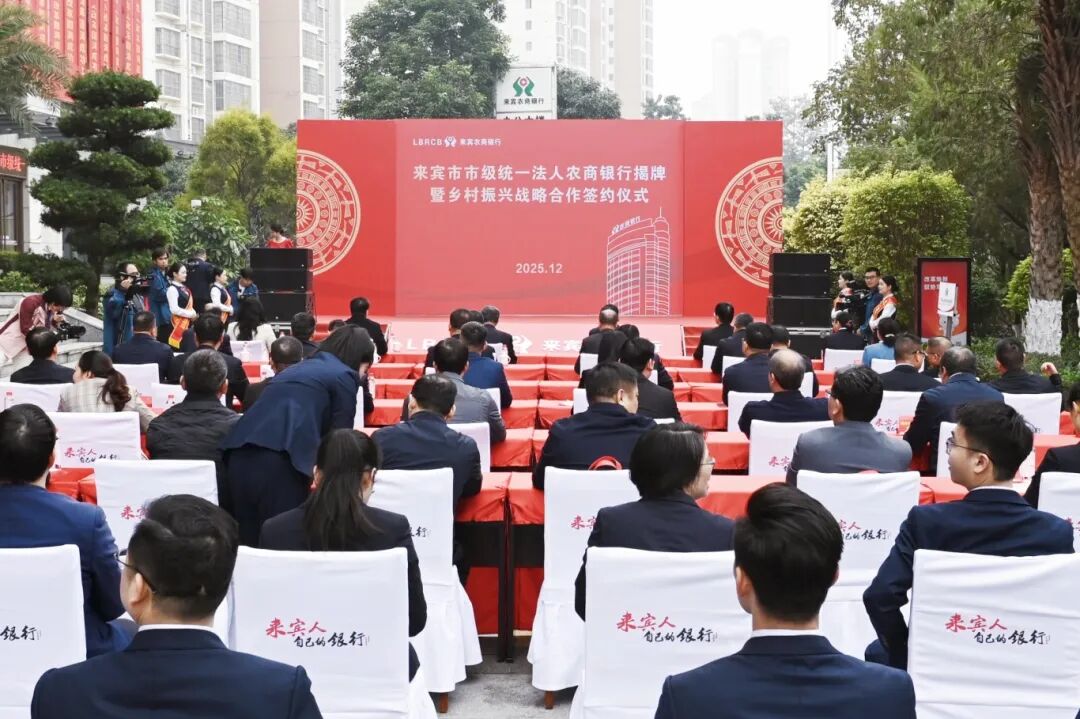
Core Viewpoint - The establishment of Laibin Rural Commercial Bank marks a significant achievement in the reform of rural cooperative institutions in Guangxi, representing the first city-level unified legal person rural commercial bank in the region [1][2]. Group 1: Bank Formation and Structure - Laibin Rural Commercial Bank was formed by merging five county-level rural cooperative institutions, resulting in total assets of 60.579 billion yuan, deposits of 52.635 billion yuan, and loans of 40.101 billion yuan [1][3]. - The bank has a comprehensive service network covering all levels from city to village, with 6 primary branches, 96 secondary branches, and 1,205 employees [3][9]. Group 2: Strategic Goals and Support Areas - The bank aims to focus on key areas such as industrial upgrading, project construction, rural revitalization, and inclusive finance, while maintaining risk management and operational standards [3][9]. - The establishment is part of a broader strategy by the local government to enhance financial services and support high-quality development in Laibin [2][9]. Group 3: Broader Industry Trends - Other provinces, including Sichuan, Xinjiang, Yunnan, Anhui, and Guizhou, are also advancing the establishment of city-level unified legal person rural commercial banks, indicating a trend towards consolidating smaller financial institutions [5][11]. - The ongoing reforms aim to improve economic efficiency, enhance risk management capabilities, and reduce redundant branches, thereby strengthening the overall competitiveness of rural financial institutions [11][12].
400多家小银行退场
Di Yi Cai Jing Zi Xun· 2025-12-23 13:41
Core Viewpoint - The establishment of Guizhou Rural Commercial United Bank marks a significant step in the ongoing reform of rural financial institutions in China, with a focus on consolidating resources and improving the quality of financial services while reducing the number of smaller banks [2][3][5]. Group 1: Establishment of Guizhou Rural Commercial United Bank - The Guizhou Rural Commercial United Bank has received approval to commence operations, becoming the seventh provincial rural financial institution to do so this year [3][5]. - The bank has a registered capital of 10.458 billion yuan, with major shareholders including Guizhou Financial Holding Group (65.844%), Guizhou Provincial Finance Department (15.032%), and Guizhou Moutai Group (9.562%) [3][4]. - The establishment of this bank is part of a broader trend where over 400 smaller banks, including village banks, have exited the market this year [6][8]. Group 2: Provincial Rural Financial Institution Reforms - A total of 13 regions have seen the new round of provincial rural financial institution reforms enter the implementation stage, with six institutions approved for operation this year [5][6]. - The reform strategy varies by region, with some provinces opting for the "provincial rural commercial united bank" model while others choose to establish independent provincial rural commercial banks [5][6]. - The majority of newly established provincial rural financial institutions have asset scales exceeding 500 billion yuan, with several surpassing one trillion yuan [6][7]. Group 3: Trends in the Banking Sector - The ongoing reforms have led to a significant reduction in the number of smaller banks, with 436 banks approved for dissolution or merger this year, surpassing totals from previous years [8][9]. - The central economic work conference emphasized the need for "reducing quantity and improving quality" among small financial institutions, indicating a continued trend towards consolidation [8][9]. - The focus on improving quality suggests that the reduction in the number of institutions should not compromise the overall quality of financial services provided [9].
400多家小银行退场
第一财经· 2025-12-23 12:55
Core Viewpoint - The article discusses the recent approval of the establishment of Guizhou Rural Commercial Union Bank, marking a significant step in the ongoing reform of rural financial institutions in China, with a focus on consolidating and enhancing the quality of smaller banks while larger provincial-level rural financial institutions are being established [3][5][10]. Group 1: Establishment of Guizhou Rural Commercial Union Bank - The Guizhou Rural Commercial Union Bank has received approval to commence operations, becoming the seventh provincial-level rural financial institution to do so this year [5][7]. - The bank has a registered capital of 10.458 billion yuan, with major shareholders including Guizhou Financial Holding Group (65.844%), Guizhou Provincial Finance Department (15.032%), and Guizhou Moutai Group (9.562%) [5][6]. - The establishment of this bank is part of a broader trend where over 400 smaller banks, including village banks, have exited the market this year, indicating a shift towards larger, more robust financial institutions [10][11]. Group 2: Provincial-Level Rural Financial Institution Reforms - A total of 13 regions have seen the implementation of the new round of provincial-level rural financial institution reforms, with six institutions approved or established this year [7][8]. - The reforms follow a "one province, one policy" principle, leading to different models being adopted across regions, with some opting for provincial-level rural commercial banks and others for provincial-level rural commercial union banks [8][9]. - Most newly established provincial-level rural financial institutions have asset scales exceeding 500 billion yuan, with several surpassing one trillion yuan, indicating significant consolidation in the sector [8][9]. Group 3: Trends in the Banking Sector - The article highlights a significant trend of consolidation in the banking sector, with over 436 banks approved for dissolution, merger, or cancellation this year, primarily affecting village banks [10][11]. - The central economic work conference emphasized the need for "reducing quantity and improving quality" among small financial institutions, suggesting that further consolidation and restructuring will continue [11]. - The focus on enhancing the quality of financial institutions is seen as crucial, with experts warning against the potential pitfalls of merely reducing numbers without improving overall quality [11].
6家万亿级“大银行”登场,400多家小银行退场|回望2025
第一财经网· 2025-12-23 11:17
Core Viewpoint - The establishment of Guizhou Rural Commercial Union Bank marks a significant step in the ongoing reform of rural financial institutions in China, with a focus on consolidating and enhancing the quality of smaller banks while larger provincial-level rural financial institutions are being formed [1][2][4]. Group 1: Establishment of Guizhou Rural Commercial Union Bank - The Guizhou Rural Commercial Union Bank has received approval to commence operations, becoming the seventh provincial-level rural financial institution established this year [2]. - The bank has a registered capital of 10.458 billion yuan, with major shareholders including Guizhou Financial Holding Group (65.844%), Guizhou Provincial Finance Department (15.032%), and Guizhou Moutai Group (9.562%) [2][3]. - Following the approval of 21 rural financial institutions' equity changes, Guizhou Rural Commercial Union Bank will become the major shareholder of these institutions, indicating a restructuring of ownership and management relationships [3]. Group 2: Provincial-Level Rural Financial Institution Reforms - A total of 13 regions have seen the new round of provincial-level rural financial institution reforms enter the implementation phase, with six institutions approved to operate this year [4][5]. - The reform is characterized by a "one province, one policy" approach, with different regions adopting various models for their rural financial institutions [4][5]. - Most newly established provincial-level rural financial institutions have asset scales exceeding 500 billion yuan, with several reaching over 1 trillion yuan [5][6]. Group 3: Trends in the Banking Sector - Over 400 small and medium-sized banks, primarily village and town banks, have exited the market this year, reflecting a trend towards consolidation in the banking sector [7]. - The number of banks approved for dissolution or merger has surpassed previous years, indicating a significant shift in the landscape of small financial institutions [7]. - The central economic work conference emphasized the need for "reducing quantity and improving quality" among small financial institutions, suggesting ongoing consolidation efforts [8].
瑞达期货铝类产业日报-20251223
Rui Da Qi Huo· 2025-12-23 09:19
研究员: 陈思嘉 期货从业资格号F03118799 期货投资咨询从业证书号Z0022803 铝类产业日报 2025/12/23 | 项目类别 | 数据指标 | 最新 | 环比 数据指标 | 最新 | 环比 | | --- | --- | --- | --- | --- | --- | | | 沪铝主力合约收盘价(日,元/吨) | 22,195.00 | -25.00↓ 氧化铝期货主力合约收盘价(日,元/吨) | 2,520.00 | +22.00↑ | | | 主力-连二合约价差:沪铝(日,元/吨) | -125.00 | -5.00↓ 主力-连二合约价差:氧化铝(日,元/吨) | -109.00 | +2.00↑ | | | 主力合约持仓量:沪铝(日,手) | 301,815.00 | -12484.00↓ 主力合约持仓量:氧化铝(日,手) | 135,956.00 | -15251.00↓ | | | LME铝注销仓单(日,吨) | 74,400.00 | 0.00 库存:氧化铝:合计(周,万吨) | 197,566.00 | -61270.00↓ | | 期货市场 | LME电解铝三个月报价(日,美元/ ...

碳酸锂产业日报-20251223
Rui Da Qi Huo· 2025-12-23 09:18
1. Report Industry Investment Rating - Not provided in the content 2. Core View of the Report - The lithium carbonate market is expected to be in a stage of increasing supply and stable high - demand, with continuous inventory reduction and a positive outlook. It is recommended to trade with a light position in a slightly bullish and volatile manner, while paying attention to trading rhythm and risk control [2]. 3. Summary by Relevant Catalogs 3.1 Futures Market - The closing price of the main contract is 120,360 yuan/ton, up 5,980 yuan; the net position of the top 20 is - 141,692 hands, up 5,257 hands; the position of the main contract is 671,573 hands, down 316 hands; the spread between near - and far - month contracts is - 1,560 yuan/ton, up 20 yuan; the Guangzhou Futures Exchange warehouse receipt is 16,651 hands/ton, up 240 hands [2]. 3.2 Spot Market - The average price of battery - grade lithium carbonate is 99,500 yuan/ton, up 500 yuan; the average price of industrial - grade lithium carbonate is 96,850 yuan/ton, up 500 yuan; the basis of the Li₂CO₃ main contract is - 20,860 yuan/ton, down 5,480 yuan [2]. 3.3 Upstream Situation - The average price of spodumene concentrate (6% CIF China) is 1,330 US dollars/ton, up 10 US dollars; the average price of amblygonite is 12,875 yuan/ton, up 575 yuan; the price of lithium mica (2 - 2.5%) is 4,670 yuan/ton, up 95 yuan [2]. 3.4 Industry Situation - The monthly output of lithium carbonate is 53,980 tons, up 2,450 tons; the monthly import volume is 22,055.19 tons, down 1,825.51 tons; the monthly export volume is 759.24 tons, up 513.33 tons; the monthly operating rate of lithium carbonate enterprises is 47%, unchanged; the monthly output of power batteries is 176,300 MWh, up 5,700 MWh; the price of lithium manganate is 37,000 yuan/ton, unchanged; the price of lithium hexafluorophosphate is 180,000 yuan/ton, unchanged; the price of cobalt - acid lithium is 346,600 yuan/ton, unchanged; the price of ternary material (811 type) in China is 167,000 yuan/ton, unchanged; the price of ternary material (622 power type) in China is 148,500 yuan/ton, unchanged [2]. 3.5 Downstream and Application Situation - The price of ternary material (523 single - crystal type) in China is 159,500 yuan/ton, unchanged; the monthly operating rate of ternary cathode materials is 51%, down 1%; the price of lithium iron phosphate is 40,600 yuan/ton, unchanged; the monthly operating rate of lithium iron phosphate cathode is 63%, down 1%; the monthly output of new energy vehicles is 1,880,000 vehicles, up 108,000 vehicles; the monthly sales volume is 1,823,000 vehicles, up 108,000 vehicles; the cumulative sales penetration rate of new energy vehicles is 47.48%, up 0.74%; the cumulative sales volume of new energy vehicles is 14,780,000 vehicles, up 3,518,000 vehicles; the monthly export volume of new energy vehicles is 300,000 vehicles; the 20 - day average volatility of the target is 45.11%, up 4.40%; the 40 - day average volatility of the target is 53.17%, up 0.99% [2]. 3.6 Option Situation - The total call position is 112,869 contracts, down 940; the total put position is 163,196 contracts, up 22,048; the put - call ratio of total positions is 144.59%, up 20.567%; the implied volatility of at - the - money IV is 0.37%, down 0.0319% [2]. 3.7 Industry News - Sichuan Energy Power's Lijiagou lithium mine project reached the designed production capacity at the end of August 2025 and is operating normally; the State Council held a meeting on the preparation of the "15th Five - Year Plan" Outline Draft; China's December LPR remained unchanged for 7 consecutive months; the Central Economic Work Conference deployed multiple key - area reform tasks [2]. 3.8 Market Analysis - The main contract of lithium carbonate fluctuated strongly, with a 5.67% increase at the close. The position decreased month - on - month, the spot price was at a discount to the futures price, and the basis weakened compared with the previous day. The domestic mining license cancellation event drove the lithium carbonate market up, with a certain follow - up increase in ore prices. The supply side is stable, and the inventory is decreasing, with high production willingness. The demand side is strong in the new energy vehicle and energy storage markets, and the demand for lithium carbonate is expected to remain high and stable [2]. 3.9 Option Market Analysis - The put - call ratio of option positions is 144.59%, up 20.567% month - on - month. The option market sentiment is bearish, and the implied volatility slightly decreased. Technically, the 60 - minute MACD has double lines above the 0 - axis and the red bars are expanding [2].
解码中央经济工作会议丨破立并举 重点领域改革靶向发力
Xin Hua She· 2025-12-23 02:17
Group 1 - The central economic work conference has outlined key reform tasks focusing on establishing a national unified market construction regulation, addressing "involution" competition, and implementing further state-owned enterprise reforms [1][2] - Experts indicate that the targeted reform tasks for the coming year aim to enhance economic vitality by balancing institutional construction and removing obstacles [1][2] - The conference emphasizes the need for specific measures to improve the efficiency of resource allocation within the unified market, addressing market distortions and promoting fair competition [1][2] Group 2 - The government aims to refine market operation rules, accelerate the establishment of a unified market construction regulation, and eliminate barriers in areas such as resource acquisition and government procurement [2] - The dual approach of activating micro-entity vitality includes further deepening state-owned enterprise reforms and enhancing policies to support the private economy [2][3] - The National Development and Reform Commission highlights the importance of opening competitive sectors to various business entities and supporting capable private enterprises in national projects [3] Group 3 - A series of fiscal and financial reforms have been proposed, including improving the local tax system and advancing the quality and reduction of small and medium-sized financial institutions [3][4] - The reform of the tax system aims to address local fiscal challenges and enhance the financial capacity of local governments [4] - The conference also indicates a potential acceleration in the consolidation of small and medium-sized financial institutions as part of risk prevention and resolution efforts [4]
深入推进中小金融机构减量提质
Jin Rong Shi Bao· 2025-12-22 03:51
中小金融机构是金融业的重要组成部分,是稳定宏观经济、服务民营小微、助力乡村振兴的重要力 量。中央经济工作会议提出"深入推进中小金融机构减量提质",为明年经济金融工作布置明确任务。 防控风险是金融工作的永恒主题,稳妥处置中小金融机构风险是重中之重。近年来,我国重点地 区"一省一策"形成中小金融机构改革化险方案,综合采取兼并重组、在线修复、市场退出等多种方式稳 妥推进。金融监管总局数据显示,截至今年6月末,我国银行业金融机构法人共4070家,较2024年末减 少225家,较"十三五"末减少534家,缩减的主要是中小银行。 当前,无论是高风险机构数量还是高风险资产规模,都较峰值大幅压降,在金融体系中占比都比较 小,风险完全可控,相当部分省份已实现高风险中小机构"动态清零"。 近年来,我国加快推进中小金融机构改革转型,健全公司治理,提升可持续发展能力。农信社改革 蹄疾步稳,过半省份组建省级法人机构;城商行改革重组有序实施,股份制银行高质量发展扎实推进; 保险、资管等机构加快回归本源,功能定位不断增强。 "明年是'十五五'开局之年,实现良好开局意味着要推动经济实现质的有效提升和量的合理增长, 这对金融服务提出更高要求。 ...
聚焦中央经济工作会议|深入推进中小金融机构减量提质
Xin Lang Cai Jing· 2025-12-21 04:15
中小金融机构是金融业的重要组成部分,是稳定宏观经济、服务民营小微、助力乡村振兴的重要力量。 中央经济工作会议提出"深入推进中小金融机构减量提质",为明年经济金融工作布置明确任务。 防控风险是金融工作的永恒主题,稳妥处置中小金融机构风险是重中之重。近年来,我国重点地区"一 省一策"形成中小金融机构改革化险方案,综合采取兼并重组、在线修复、市场退出等多种方式稳妥推 进。金融监管总局数据显示,截至今年6月末,我国银行业金融机构法人共4070家,较2024年末减少225 家,较"十三五"末减少534家,缩减的主要是中小银行。 当前,无论是高风险机构数量还是高风险资产规模,都较峰值大幅压降,在金融体系中占比都比较小, 风险完全可控,相当部分省份已实现高风险中小机构"动态清零"。 "随着高风险中小金融机构得到快速处置,需要深入推进减量提质。"中国邮政储蓄银行研究员娄飞鹏表 示,减量并非简单关停,而是通过市场化、法治化手段,有序出清高风险、低效能机构,增强金融机构 稳健性;提质则要通过整合资源、强化风控,提升机构可持续经营能力和高质量服务能力。 近年来,我国加快推进中小金融机构改革转型,健全公司治理,提升可持续发展能力。农 ...