
光互联

Search documents
1.6T光模块首批量产订单落地,英伟达GTC前夕产业链迎关键催化
Xuan Gu Bao· 2026-03-09 23:14
Group 1 - Applied Optoelectronics (AOI) announced the receipt of its first mass production order for 1.6T data center optical transceivers from a long-term major hyperscale customer, amounting to over $200 million, marking the official entry of the new generation of high-speed optical interconnect products into large-scale commercial use, which led to a 7% increase in its stock price [1] - Lumentum, another leader in the optical industry, saw its stock rise by 10% concurrently with AOI's announcement [1] - Guolian Minsheng Securities indicated that 2026 is viewed as the year of mass production for 1.6T optical modules, and the recent order validates this assessment [1] Group 2 - Nvidia announced a multi-year strategic partnership with Lumentum involving a $2 billion investment and multi-billion dollar procurement commitments, focusing on developing optical interconnect technology and packaging integration solutions for AI data centers [1] - Nvidia's CEO Jensen Huang stated that this collaboration will advance the development of the world's most advanced silicon photonics technology, aiming to "build the next generation of gigawatt-level AI factories" [1] - The upcoming Nvidia GTC conference, scheduled for March 16-19 in San Jose, is highly anticipated for the release of the next-generation AI chip roadmap and network architecture plans [1] Group 3 - According to Guotai Junan Securities, the current Scale-Up networks predominantly use copper cabling, which limits transmission distances to within a single cabinet, while optical interconnects can cover distances of several dozen to hundreds of meters, indicating a significant advantage [2] - The trend of optical interconnects replacing copper cabling is deemed irreversible as AI clusters expand to hundreds or even thousands of cards, with expectations for NPO to be applied in bulk by 2027 and CPO to be widely used in the Rubin Ultra platform by the end of 2027 [2] - The OFC 2026 event is expected to define the trends in the optical communication industry for 2026-2027, focusing on the mass production evolution of 1.6T and 3.2T, verification of CPO and NPO mass production progress, and the adaptability of optical circuit switching (OCS) in AI clusters [2] Group 4 - Zhongji Xuchuang is identified as a domestic leader in optical modules, actively advancing the research and customer validation of 1.6T products while maintaining a strong product line in 400G and 800G mass shipments [2] - Taicheng Light's main products include MPO and other multi-core connectors, suitable for high-density multi-fiber connections, primarily used for optical interconnects within large data centers [3]

通信行业:GTC、OFC前瞻
GF SECURITIES· 2026-03-09 06:48
Core Insights - The report maintains a "Buy" rating for the communication industry, indicating a positive outlook for investment opportunities in this sector [6][10]. Market Review - The communication sector experienced a decline of 0.63% from March 2 to March 6, 2026, outperforming the CSI 300 index, which fell by 1.07% [17]. - Over the past 30 days, the communication sector rose by 5.7%, while the CSI 300 index decreased by 0.2%, indicating a 5.9 percentage point outperformance [18]. - Year-to-date, the communication sector has increased by 6.4%, surpassing the CSI 300 index by 5.7 percentage points [18]. Industry Data Updates - As of the end of 2025, China had 4.838 million 5G base stations, a net increase of 588,000 from the previous year, representing 37.6% of total mobile phone base stations, up 4 percentage points from the end of 2024 [29]. - In December 2025, the domestic smartphone shipment reached 24.473 million units, a year-on-year increase of 29.1%, with 5G smartphones accounting for 90.4% of total shipments [33]. - The number of mobile IoT terminal users reached 2.888 billion by the end of 2025, with a net increase of 232 million users [36]. Key Events Review - GSMA reported that operators' capital expenditures (CAPEX) are expected to reach $1.2 trillion over the next five years, with mobile technology creating $7.6 trillion in economic value in 2025 [40]. - Amazon announced an additional investment of €18 billion in Spain for data center infrastructure, raising the total investment to €33.7 billion [41]. - NVIDIA plans to invest $2 billion in Lumentum to secure future supply of high-end laser components, enhancing its AI infrastructure capabilities [41][42].
老黄提前锁仓:CPO 大爆发前夜,光模块进入“军备竞赛”
美股研究社· 2026-03-03 12:45
Core Viewpoint - The article emphasizes that NVIDIA's recent investments in optical communication companies Lumentum and Coherent are not merely financial but strategic moves to secure supply chains and production capacity in the AI infrastructure landscape, marking a shift from chip performance competition to upstream supply chain control [2][3][10]. Group 1: NVIDIA's Strategic Moves - NVIDIA has invested $2 billion each in Lumentum and Coherent, along with significant procurement commitments, indicating a strategic blockade in the AI infrastructure [2][3]. - This investment is seen as a proactive measure to avoid past pitfalls experienced with HBM (High Bandwidth Memory), where supply constraints severely impacted profitability [6][10]. - By locking in production capacity, NVIDIA aims to create a "capacity community" with its suppliers, ensuring priority access to critical components as demand for AI capabilities surges [11][20]. Group 2: Market Dynamics and Implications - The article discusses the transition of AI server requirements from GPU manufacturing capacity to data transmission bandwidth and power consumption, highlighting the limitations of traditional electrical interconnects [7][8]. - As AI clusters evolve, the demand for optical interconnects, particularly Co-Packaged Optics (CPO), is expected to grow exponentially, potentially mirroring the explosive demand seen with HBM [17][18]. - The investment by NVIDIA is anticipated to alter the supply-demand dynamics in the optical module market, potentially leading to a seller's market where companies with locked-in capacity will have significant pricing power [21][22]. Group 3: Financial Projections and Market Reactions - Lumentum is projected to see a substantial increase in revenue due to its deepening relationship with NVIDIA, with estimates suggesting a potential doubling of its revenue to around $4 billion [13][14]. - The profitability of Lumentum is expected to improve significantly as AI data center optical modules command higher prices and margins compared to traditional telecom products [14][15]. - The market's response to Lumentum's stock performance reflects investor confidence in the long-term visibility of orders linked to NVIDIA, indicating a shift in valuation dynamics as the demand for optical modules increases [19][26]. Group 4: Future Outlook - The article concludes that NVIDIA's actions signal the beginning of a new phase in the AI power struggle, where the efficiency of data transmission will be as critical as chip performance [23][24]. - The focus for investors should shift from merely GPU manufacturers to upstream companies that are strategically tied to NVIDIA and possess essential optical interconnect technologies [25].


为发布CPO新方案铺路?英伟达重金押注光互联,为下一代AI架构锁定供应链
美股IPO· 2026-03-03 03:41
Core Viewpoint - NVIDIA has invested $4 billion in optical communication giants Coherent and Lumentum to secure supply chain capacity for the next generation of "AI interconnect" technology, with a focus on protecting the supply of Co-Packaged Optics (CPO) [1][4][6]. Investment Details - NVIDIA's investment includes a $2 billion commitment to each company, aimed at supporting domestic expansion and R&D in the U.S. [3][8]. - The investment will facilitate joint development of optical technologies and ensure priority in future capacity and supply arrangements [3][4]. Strategic Intent - The primary reason for the investment is to protect supply for CPO technologies, which are essential for addressing the limitations of traditional pluggable optical modules as AI cluster scales increase [6][10]. - The investment is seen as a proactive measure to secure capacity ahead of the anticipated demand surge in the "optical interconnect" era [6][10]. Focus on Key Components - NVIDIA's focus is on critical light sources and core device capacities needed for CPO, particularly targeting 400mW continuous wave (CW) lasers [7][8]. - The partnership with Coherent will prioritize capital expenditures to expand InP production capacity in Texas, while Lumentum will use funds to build a new wafer fabrication facility in the U.S. [8][9]. Timeline for Revenue Recognition - The multi-billion dollar procurement commitments are expected to begin in early 2027 and extend through 2030, indicating that revenue impacts will be realized later rather than immediately [9][10]. - The incremental revenue from the new partnership with Lumentum is anticipated to start reflecting in financial reports from the second half of 2027 [9]. Industry Implications - The investment signals a shift towards CPO technologies, which may negatively impact companies focused on traditional electrical interconnects in the short term [10][11]. - The transaction reinforces the theme of expanding the domestic supply chain in the U.S., potentially leading to increased caution among non-U.S. module manufacturers [11].


通信-光-的买点
2026-03-03 02:52
Summary of Conference Call Notes Industry Overview - The conference call primarily discusses the optical module industry and its market dynamics, particularly focusing on the trends and future outlook for companies involved in optical interconnects and related technologies [1][6][11]. Key Points and Arguments Market Dynamics - The stock price fluctuations of optical modules are influenced by market perception and capital dynamics, similar to the process observed in 2025, characterized by "fundamentals realization—cognitive diffusion—capital entry" [1]. - Current market valuation pressures on optical modules are nearing a phase limit, suggesting that large-cap optical module stocks may experience a recovery [1][10]. - Recent capital flows have shifted from leading large-cap stocks to smaller themes such as non-ferrous metals and commercial aerospace, indicating a structural choice to hedge against concentrated risks in large-cap stocks [1][5]. Technological Trends - CPO (Co-Packaged Optics) is identified as a medium to long-term technological trend, with high requirements for optical and electrical technology collaboration [1][4]. - The transition to CPO is driven by the increasing density of computing clusters and faster signal rates, necessitating a shift from traditional copper interconnects to optical interconnects [3][4]. Company Participation and Strategies - Companies in the optical module sector can engage in various CPO-related product systems, including customized optical engines, LPU/NPU solutions, and vertical integration towards upstream capabilities [1][7]. - The market currently favors companies like Tianfu due to their lower involvement in electrical interfaces, which is perceived as a way to mitigate uncertainties in the CPO era [8]. Future Outlook - Companies such as Xuchuang and Xinyi are expected to gradually enter a recovery phase, with significant production volumes of 800G and 1.6T expected to ramp up starting in Q2 2026 [2][9]. - The anticipated demand for 1.6T is projected to reach "tens of millions" of units by 2027, with the networking segment, particularly optical modules, expected to grow faster than the industry average [9]. Valuation and Investment Sentiment - Xuchuang's current valuation is considered relatively low, with a strong basis for recovery due to nearing completion of capital digestion and upcoming industry events [10]. - The market's understanding of optical interconnects has evolved from 2023 to 2026, with increasing recognition of the importance of optical technologies in the context of global computing power [11][12]. Risks and Concerns - There are concerns regarding the long-term capabilities of domestic optical companies to compete globally, particularly in terms of technological strength rather than just manufacturing advantages [12]. - The market's preference for smaller companies is driven by a perception that they can achieve significant growth more easily than larger firms [12]. Investment Strategy - The focus for 2026 should be on the overall positioning in the optical sector rather than individual stock selection, as missing out on optical-related investments could parallel missed opportunities in past tech booms [14]. - The "3.0 Four Little Dragons" strategy highlights emerging companies with potential for significant order or performance releases, indicating a shift in focus towards previously overlooked firms in the optical market [19]. Additional Important Insights - The macro narrative surrounding photonics is seen as a long-term trend that could redefine technological pathways, moving beyond traditional electronic frameworks [18]. - The rise of companies like Yizhongtian is viewed as a cornerstone investment due to their comprehensive capabilities in funding, orders, and R&D, positioning them well for future market opportunities [19]. This summary encapsulates the key insights and projections discussed during the conference call, providing a comprehensive overview of the current state and future outlook of the optical module industry.
为发布CPO新方案铺路?英伟达重金押注光互联,意在构建CPO“供应保护”
Hua Er Jie Jian Wen· 2026-03-03 02:33
Core Viewpoint - Nvidia has invested $4 billion in two optical communication giants, Coherent and Lumentum, to secure critical capacity for the next generation of AI computing architecture, marking a proactive step towards the "optical interconnect" era [1]. Group 1: Investment Details - Nvidia has established long-term partnerships with Coherent and Lumentum, involving joint research in optical technology, future capacity, and supply priority arrangements, alongside a multi-billion dollar procurement commitment [1][6]. - Each company received a $2 billion investment from Nvidia to support R&D and operational expansion in the U.S. [1][6]. Group 2: Strategic Intent - The primary goal of Nvidia's investment is to ensure supply protection for co-packaged optics (CPO), which is essential for addressing the interconnect bottlenecks in AI clusters [1][3]. - Barclays highlights that the investment is not just about general optical modules but focuses on critical light sources and core device capacity needed for CPO [3]. Group 3: Financial Implications - The procurement commitments are expected to begin in early 2027 and continue until 2030, indicating a longer-term strategy rather than immediate revenue recognition [4]. - The investment will primarily enhance Coherent's manufacturing capabilities in Texas and support Lumentum in building a new wafer fabrication facility in the U.S. [3][4]. Group 4: Industry Impact - The move signals a potential shift in the industry towards CPO technology, which could negatively impact companies focused on traditional electrical connections [5]. - The investment reinforces the theme of expanding the domestic supply chain in the U.S., potentially leading to a more cautious sentiment towards non-U.S. module manufacturers [5].
千亿级龙头股大涨!A股前三
Zhong Guo Zheng Quan Bao· 2026-02-26 08:52
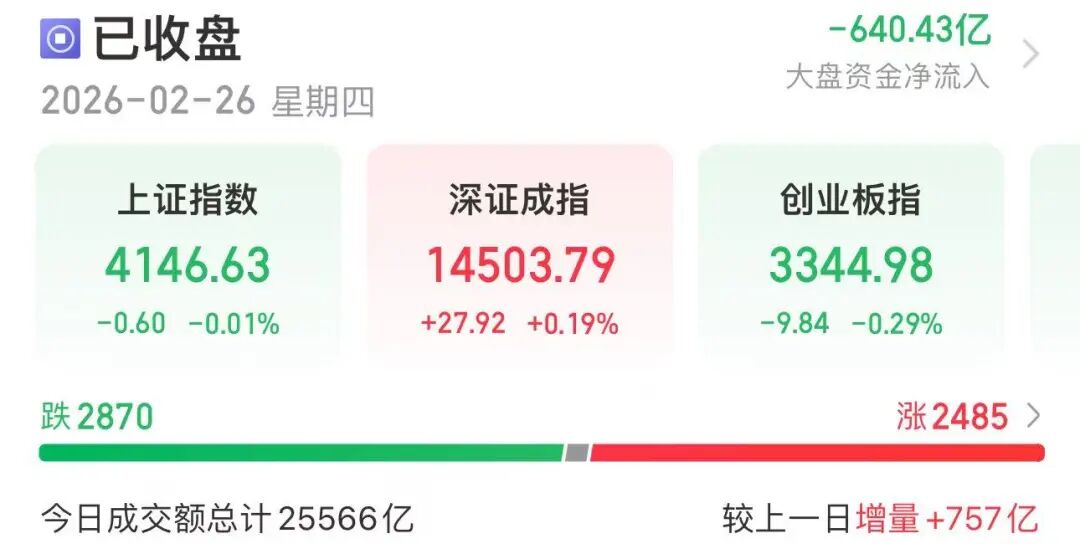
Market Overview - On February 26, A-shares showed mixed performance with the Shanghai Composite Index down 0.01%, Shenzhen Component Index up 0.19%, ChiNext Index down 0.29%, and the Sci-Tech Innovation Index up 1.29% [1] - The total trading volume reached 25,566 billion yuan, an increase of 757 billion yuan compared to the previous trading day [1] Sector Performance - AI hardware stocks surged due to Nvidia's better-than-expected earnings report and the ongoing AI wave, with significant gains in sectors such as CPO, copper cable high-speed connections, optical fibers, PCBs, liquid-cooled servers, and semiconductors [4][6] - Notable stocks included Cambrian (up nearly 10%), Tianfu Communication, and Hengtong Optic-Electric, with several stocks reaching historical highs [4] Key Stock Highlights - The top three stocks by trading volume were Shenghong Technology (247.03 billion yuan, up 7.75%), Cambrian (160.35 billion yuan, up 7.96%), and Tianfu Communication (156.56 billion yuan, up 6.01%) [4][5] - Shenghong Technology's latest market value is 275.07 billion yuan, Cambrian's is 492.87 billion yuan, and Tianfu Communication's is 281.44 billion yuan [4] Earnings Reports and Market Drivers - Cambrian's significant price increase was influenced by the earnings forecast from Haiguang Information, which expects a revenue growth of 62.91% to 75.82% year-on-year for Q1 2026, driven by increased R&D investment and enhanced product competitiveness [9] - Nvidia's Q4 earnings report showed revenue of $68.127 billion, exceeding market expectations, which positively impacted tech stocks in both the US and A-shares [10] - Global cloud service providers are projected to increase capital expenditures to over $710 billion by 2026, a 61% year-on-year increase, to enhance AI application infrastructure [10] Industry Trends - The storage chip market is expected to experience a price increase due to a widening supply-demand gap, which may persist throughout 2026 [10] - The shift from copper connections to optical interconnections is becoming crucial for achieving high-performance, high-bandwidth, low-latency AI networks, with ongoing technological advancements in optical modules [10][11]


电子行业深度报告AI基建,光板铜电—GTC前瞻Serdes,Rubin Ultra&CPO交换机详解
Soochow Securities· 2026-02-26 00:30
Investment Rating - Maintain "Buy" rating for the electronic industry [1] Core Insights - Focus on investment opportunities in the M9 PCB supply chain and CPO industry chain, highlighting key players such as 菲利华, 东材科技, and 英伟达 [2] - The report emphasizes the technological evolution of SerDes, which drives the upgrade of interconnect media for computing power, indicating a shift towards M9 materials and optical packaging [4][9] - The Rubin Ultra cabinet is expected to significantly enhance the performance of M9 materials and NPO optical engines, marking a definitive growth trend [4][34] - The CPO switch market is poised for rapid expansion, with core suppliers likely to benefit from increased demand for optical components [4][46] Summary by Sections 1. SerDes Evolution and Interconnect Media Upgrade - Continuous upgrades in SerDes technology are driving the growth of GPU interconnect bandwidth, with Nvidia's architectures showing a clear trend of doubling speeds from 56Gbps to 224Gbps [9][19] - The transition to M9 materials is necessary to support the increasing demands of SerDes speeds, as traditional materials cannot handle the higher frequencies without significant losses [19][22] - The report outlines the need for advanced materials and manufacturing techniques to meet the requirements of next-generation SerDes, emphasizing the importance of low-loss substrates [24][25] 2. Rubin Ultra Scale-Up Architecture - The Rubin Ultra cabinet achieves a groundbreaking total bandwidth of 1.5PB/s, representing a 12-fold increase over previous models, facilitated by a dual-layer network structure [34][37] - The internal network utilizes orthogonal backplane technology to minimize signal loss and latency, crucial for high-density GPU communication [38][42] - The second layer of the network employs NPO technology for inter-Canister communication, significantly enhancing bandwidth and reducing power consumption [43][45] 3. CPO Switch Product Matrix - Nvidia's Quantum X800-Q3450 is the first CPO switch to market, featuring a total switching bandwidth of 115.2T, showcasing advancements in port density and performance [46][49] - The upcoming Spectrum-X series will further expand Nvidia's CPO offerings, providing a complete technology layout from InfiniBand to Ethernet [54][57] - The design of the Spectrum-X switches emphasizes maintainability and redundancy, addressing challenges associated with tightly integrated optical components [58]
光互联开门红,坚定看好三大方向
2026-02-25 04:13
Summary of Conference Call on Optical Interconnection Sector Industry Overview - The conference focused on the optical interconnection sector, highlighting its growth potential and recent market dynamics, particularly in the context of technological advancements and stock performance in related companies like AMD and NVIDIA [1][2]. Key Points and Arguments Market Dynamics - The optical interconnection industry is experiencing a positive momentum driven by technological advancements and market catalysts, with significant stock price increases observed in major players [1]. - The sector is categorized into three segments: large optical, small optical, and new optical, each with distinct growth trajectories and market logic [1]. New Optical Segment - The new optical segment includes next-generation solutions such as CPU, NPU, and OCS, which are gaining traction due to rapid technological iterations and deployment [2]. - Lumentum reported substantial progress in the CPO field, securing multi-million dollar orders for high-power laser systems, with deliveries expected by 2027 [2][3]. Large Optical Segment - The large optical segment, primarily focused on optical modules, is expected to maintain a high growth trajectory, supported by increasing capital expenditures from major cloud service providers (CSPs) like Amazon and Google, which are projected to reach nearly $600 billion in 2026, a 60% year-over-year increase [7]. - The demand for optical modules is underpinned by the need for enhanced AI computing capabilities, with significant growth anticipated in 800G, 1.5T, and 3.2T optical products [9]. Small Optical Segment - The small optical segment, which includes second-tier optical module manufacturers, is poised for substantial growth as demand from CSPs expands beyond major players to include companies like Meta and AWS [13][14]. - The potential for second-tier companies to secure contracts with leading CSPs is increasing, which could lead to rapid revenue growth due to their smaller base and high elasticity in performance [14]. Additional Important Insights - The competition between CPU and traditional optical modules is stabilizing, with both technologies expected to coexist and grow, reflecting a positive outlook for the industry [11]. - The NPU segment is gaining attention, with major players like Tencent and Alibaba making significant advancements, indicating a shift in market focus towards this technology [10]. - The overall market logic for optical modules remains strong, with various catalysts expected to enhance growth prospects, including increased production capacity and technological advancements [12]. Recommendations - Continued monitoring of the optical interconnection sector is advised, with specific attention to key players such as Tianfu Communication and Juguang Technology for potential investment opportunities [6][12]. - The small optical segment should be closely watched for emerging opportunities, particularly in companies like Liantech and Green Li Eco, which may benefit from increased demand and supply chain integration [14].




腾景科技:公司紧跟高速光模块、CPO、OCS等多种光互联形态的技术发展趋势
Zheng Quan Ri Bao Zhi Sheng· 2026-02-12 13:45
Core Viewpoint - The company is strategically positioning itself to capitalize on the rapid development of AI computing power by advancing its optical communication business through various technologies such as high-speed optical modules, CPO, and OCS [1] Group 1: Business Strategy - The company is focusing on two main application areas: OCS optical switches and high-speed optical modules, while also developing its own CPO optical connector products [1] - In the OCS sector, the company aims to increase production capacity of large-size pure YVO4 yttrium vanadate crystals to ensure timely delivery and mass production of key products like two-dimensional collimator arrays [1] - The company is steadily advancing the research, validation, and market introduction of other supporting precision optical components [1] Group 2: Market Positioning - In the high-speed optical module sector, the company plans to accelerate the expansion of production capacity for precision optical components that are compatible with 800G and 1.6T high-speed optical module products [1] - The company is committed to continuously enhancing product competitiveness and market share to align with industry evolution [1]
