
医保改革

Search documents
锚定“急难愁盼” 政策精准发力筑牢民生底线
Xin Lang Cai Jing· 2025-12-23 23:14
Group 1: Economic Policy Focus - The Central Economic Work Conference emphasizes prioritizing people's livelihoods, focusing on employment and healthcare as core areas for economic work in the coming year [1][2] - A series of key deployments include actions to stabilize and expand employment, particularly for key groups such as college graduates and migrant workers [1][2] Group 2: Employment Strategies - Future employment efforts will focus on resolving structural employment issues, enhancing the alignment of university education with economic development, and providing targeted skills training [2] - The conference encourages support for flexible employment and new employment forms, allowing these workers to participate in social insurance without changing their employment methods [2] Group 3: Healthcare Reforms - The conference outlines important healthcare reforms, including optimizing drug procurement, deepening medical insurance payment reforms, and implementing long-term care insurance [2][3] - The National Health Commission emphasizes practical measures to invest in human resources, stabilize birth rates, and enhance healthcare services [3] Group 4: Medical Insurance Development - The focus of medical insurance reform will shift from expanding coverage to improving quality, aiming to reduce patient burdens while enhancing efficiency for medical institutions [4][5] - The National Medical Insurance Administration plans to consolidate universal coverage and promote the integration of commercial health insurance with basic medical insurance [4]
特朗普年终演讲释放关键信号:发钱、降息、改医保,瞄准中期选举?
Sou Hu Cai Jing· 2025-12-23 12:12
Economic Commitments - Economic issues were the core topic of Trump's year-end speech, where he claimed to have inherited a poor economic situation and emphasized significant improvements during his administration [5] - Trump made several economic commitments, including a substantial tax reform and a housing reform plan, while media analysis indicated a decline in his support regarding economic issues [7][8] - Specific policy adjustments include increasing the standard deduction for single filers to $15,750 and for married couples to $31,500, along with raising the state and local tax deduction cap from $10,000 to $40,000 [9] Federal Reserve Relations - Trump's economic commitments are contrasted by his ongoing disagreements with the Federal Reserve, particularly with Chairman Jerome Powell's interest rate policies, which Trump believes hinder economic growth [11] - Trump announced intentions to nominate a new Federal Reserve chair who would support significant interest rate cuts, although this process faces challenges due to the need for Senate confirmation [11] Healthcare Reform - The Affordable Care Act was highlighted in the speech, with Trump criticizing its financial burden and proposing reforms that would allow direct sales of pharmaceuticals to consumers [13][14] - The success of Trump's healthcare reform proposals will depend on the political dynamics in Congress [14] Military Benefits - Trump announced a plan to provide a "warrior bonus" of $1,776 to active-duty military personnel, funded partially by tariff revenues, which is seen as an effort to gain military support [15][16] Media Fact-Checking - Several statements made during the speech were fact-checked by media outlets, revealing inaccuracies regarding gas prices, food prices, employment numbers, and immigration statistics [17][18][22][23] - The speech is interpreted as a strategic move to bolster Trump's political ambitions ahead of the midterm elections, with a focus on economic prosperity [25]


大国五年丨最大医保网,筑牢“健康中国”底盘
Xin Hua She· 2025-12-15 07:33
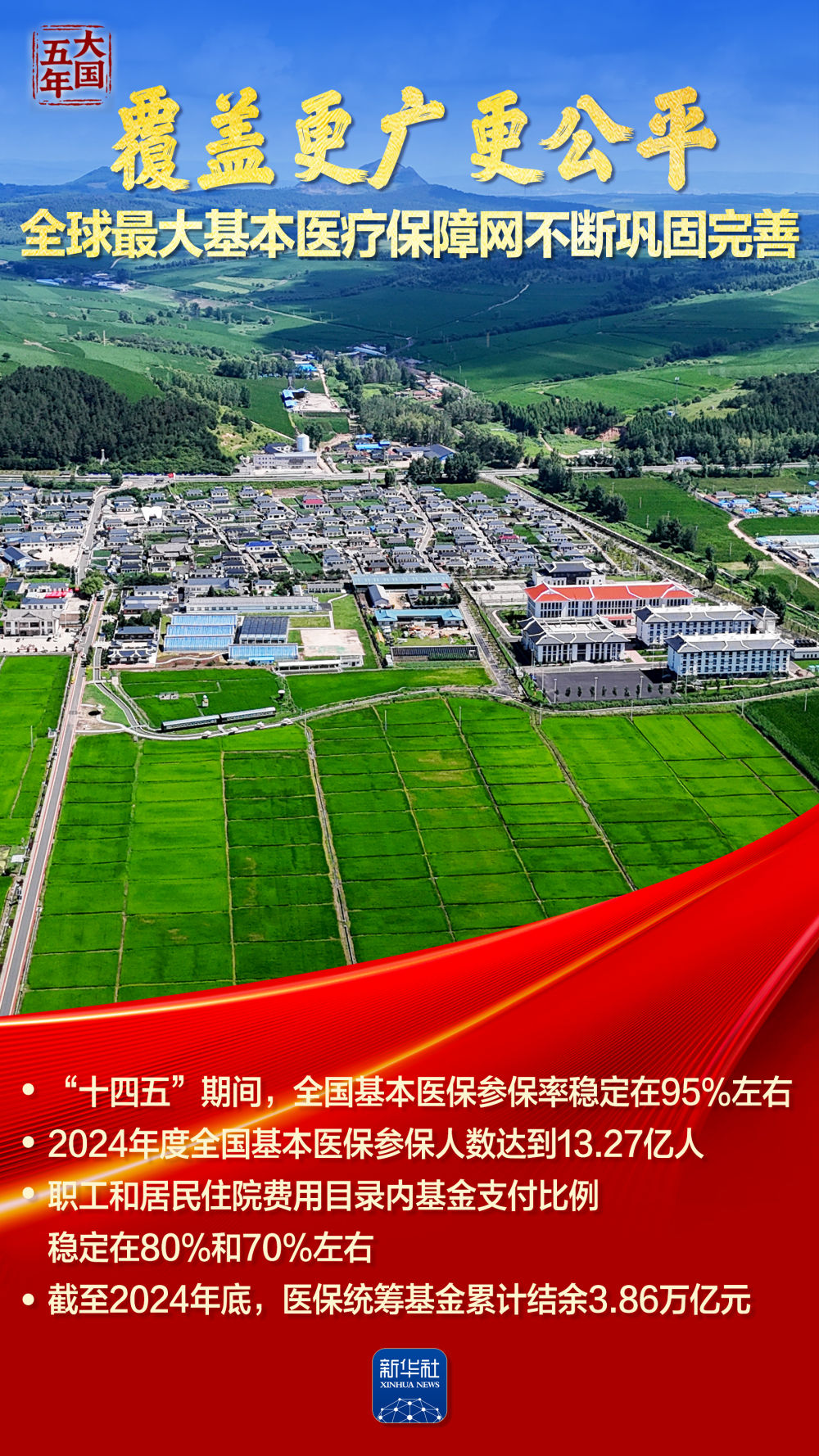
Core Insights - The article highlights the advancements and stability of China's healthcare insurance system during the "14th Five-Year Plan" period, emphasizing the establishment of a more equitable and efficient national healthcare network. Group 1: Healthcare Coverage - The national basic healthcare insurance coverage rate remains stable at around 95% during the "14th Five-Year Plan" period, with the number of insured individuals reaching 1.327 billion by 2024 [3] - The payment ratio for inpatient expenses is maintained at approximately 80% for employees and 70% for residents [3] Group 2: Financial Stability - By the end of 2024, the cumulative balance of the healthcare insurance fund is projected to reach 3.86 trillion yuan [4] - The basic healthcare insurance fund expenditure for 2024 is estimated at 2.98 trillion yuan, with a year-on-year decrease of about 5% in patient out-of-pocket expenses [16] Group 3: Long-term Care and Support - Over 8,800 long-term care service institutions have been established, with 300,000 care service personnel available [7][9] - The long-term care insurance system has expanded to cover 190 million people, benefiting over 2 million disabled individuals and reducing their care service costs by more than 50 billion yuan [9] Group 4: Drug Accessibility and Innovation - A total of 402 new drugs have been added to the healthcare insurance directory since the beginning of the "14th Five-Year Plan," with spending on innovative drugs in 2024 being 3.9 times that of 2020 [14] - More than 100 drugs are currently under application for inclusion in the innovative drug directory [14] Group 5: Service Improvement and Accessibility - The initiative to create a "15-minute healthcare service circle" has led to over 1.236 billion people using healthcare codes by June 2025 [24] - The online handling rate of healthcare administrative services has increased from 55% in 2020 to 92% in 2024 [24] - Cross-province direct settlement services for medical treatment have exceeded 500 million instances during the "14th Five-Year Plan" period [24] Group 6: Support for Vulnerable Populations - Since 2018, healthcare assistance has supported 350 million instances for low-income individuals, maintaining a 99% insurance coverage rate for rural low-income and poverty-stricken populations [25] - The reimbursement ratio for rural low-income individuals under the three-tiered support system exceeds 90% [25]
“十四五”期间 我国基本医保参保率稳定在95% 跨省异地就医直接结算超6亿人次
Yang Guang Wang· 2025-12-14 01:23
5年来,国家医保局加大基金使用监管力度,通过大数据模型和智能监管挽回基金损失95亿元。目 前药品追溯码已累计归集超1000亿条,有力地打击了违法违规行为。 明年,国家医保局将通过医保基金预付、即时结算等支付改革赋能医药机构高质量发展,同时持续 加大对医药产业创新发展的支持力度。 国家医保局数据显示,"十四五"期间,医保基金累计支出超13万亿元,惠及近200亿就诊人次;全 国生育保险的参保人数达到2.55亿人,近95%的统筹区将生育津贴直接发放给个人。国家医保局局长章 轲透露,5年来,国家组织药品和高值医用耗材集采已经覆盖糖尿病、肿瘤、感染等常见病用药和人工 关节、人工晶体、人工耳蜗等高值医用耗材。与此同时,跨省直接结算范围扩大,职工医保个人账户共 济范围拓宽至近亲属等举措落地。 章轲:5年来跨省异地就医直接结算服务超6亿人次,减少了群众的垫付超6600亿元。医保信息平台 接入了超100万家定点医药机构,日均结算超过了2800万人次,累计12.5亿人激活了医保码,并实现了 刷码就医购药。 央广网北京12月14日消息(记者杜希萌 孙永)据中央广播电视总台中国之声《新闻和报纸摘要》 报道,国家医保局13日透露,"十 ...
明年力争实现生娃基本“不花钱”,国家医保局最新消息发布
Mei Ri Jing Ji Xin Wen· 2025-12-13 23:13
Group 1 - The National Medical Insurance Administration reported that the personal account mutual aid amount for employee medical insurance has exceeded 100 billion yuan, with over 7.8 billion mutual aid instances in the past five years [1] - A comprehensive outpatient medication guarantee mechanism for hypertension and diabetes has been established, benefiting over 340 million people through major illness insurance [1] - The medical insurance system will continue to support the development of medical institutions, with a full rollout of disease-based payment methods by 2025 [1] Group 2 - The implementation of version 2.0 of the disease-based payment scheme will be completed by 2025, with improvements in special case negotiations and prepayment mechanisms [2] - All medical insurance regions will conduct real-time settlements, reducing the payment timeline to within 20 working days, with some areas achieving next-day settlements [2] - By 2026, version 3.0 of the disease-based payment scheme will be released, supporting the clinical use of new drugs and technologies [2] Group 3 - The National Medical Insurance Administration aims to achieve "no out-of-pocket" expenses for childbirth within the policy scope by 2026, expanding maternity insurance coverage [3] - The maternity insurance program will cover approximately 300 million insured individuals, with 2.55 billion people currently enrolled [3] - By 2026, efforts will be made to include flexible employment workers and migrant workers in the maternity insurance coverage [3] Group 4 - Over the past five years, approximately 120 billion yuan has been recovered from medical insurance fraud, with comprehensive coverage of all provinces through regular inspections [4] - The use of big data models and intelligent supervision systems has helped recover 9.5 billion yuan in fund losses [4] - Continuous efforts will be made to strengthen inspections and maintain the integrity of medical insurance funds, with zero tolerance for illegal activities [5]
国家医保局最新会议透露关键信号
21世纪经济报道· 2025-12-13 07:44
Core Viewpoint - The National Medical Insurance Administration summarized the achievements of the "14th Five-Year Plan" period and outlined key tasks for 2026, emphasizing the importance of healthcare reform and innovation to support public health and economic development [1][2]. Achievements of the "14th Five-Year Plan" - Standardized and unified the medical insurance system, enhancing the mutual assistance and protection functions of medical insurance [5]. - Strengthened the foundation for universal coverage, improving the quality and scope of insurance for flexible employment workers and migrant workers [6]. - Expanded the scope of benefits, with over 90% reimbursement for rural low-income individuals and the inclusion of assisted reproductive projects in insurance coverage [6]. - Optimized the payment mechanism, with 949 new drugs added to the insurance directory, totaling 3,253 drugs [6][7]. - Deepened drug price governance, promoting a unified national market for pharmaceuticals and medical supplies [7]. - Enhanced fund management, recovering approximately 120 billion yuan in misused funds over five years [8]. - Promoted digital empowerment in medical insurance, achieving over 600 million cross-province direct settlements [8]. - Emphasized the importance of party leadership in ensuring the stability and development of the medical insurance sector [8]. Key Tasks for 2026 - Consolidate the achievements of universal coverage and improve the basic medical insurance system [11]. - Support the development of commercial health insurance to create a multi-tiered medical security system [11]. - Strengthen fund management to ensure the safety and rational use of medical insurance funds [12]. - Adapt to population development strategies, promoting maternity and long-term care insurance [12]. - Optimize payment and settlement mechanisms to support the healthy development of the healthcare sector [13]. - Leverage strategic purchasing to support innovation in the pharmaceutical industry [13]. - Promote scientific approaches to medical insurance, enhancing the digital platform for universal coverage [14]. - Continuously improve service management to enhance the quality and efficiency of medical insurance services [14].

国家医保局:力争全国基本实现政策范围内分娩个人“无自付”
Mei Ri Jing Ji Xin Wen· 2025-12-13 04:06
每经AI快讯,据国家医保局消息,12月13日,全国医疗保障工作会议在北京召开。会议要求,2026年 各级医保部门要深入推进医保改革,积极推进科技创新。积极适应人口发展战略,推动生育保险和长期 护理保险发展。推动将灵活就业人员、农民工、新就业形态人员纳入生育保险覆盖范围。合理提升产前 检查医疗费用保障水平,力争全国基本实现政策范围内分娩个人"无自付"。将适宜的分娩镇痛项目按程 序纳入基金支付范围。全面实现生育津贴按程序直接发放给参保人。全面推进长期护理保险制度,优化 长护服务供给。鼓励商保机构开发商业长期护理保险产品。 ...
从慈善工程到医改探路者:黄海用20年做到“两个满意”
Zhong Guo Xin Wen Wang· 2025-12-05 06:23
Core Viewpoint - The Jilin Heart Hospital, through its "Ji Xin Project," has provided free treatment to over 30,000 impoverished heart disease patients, demonstrating a sustainable model of charitable healthcare that prioritizes transparency and quality [1][4][6]. Group 1: Project Development - The "Ji Xin Project" evolved from the "Life Light" initiative, which began in 2005, allowing patients to undergo surgery for a reduced fee of 8,000 yuan, supported by charitable contributions [3]. - By 2014, the project expanded to offer completely free surgeries to all impoverished heart disease patients, significantly increasing its impact [3]. - The hospital has integrated advanced techniques and expertise from international specialists, enhancing the quality of care and making it a recognized institution in Asia [3][4]. Group 2: Healthcare Reform Advocacy - The hospital's director, Huang Hai, emphasizes the need for systemic reforms in China's healthcare system, particularly addressing high hospitalization rates which are significantly above those in developed countries [6][7]. - Huang advocates for establishing national hospitalization standards and clinical pathway management to optimize healthcare costs and improve resource allocation [6][7]. - The implementation of the DRG payment system is seen as crucial for enhancing the efficiency of healthcare funding, with a strong correlation identified between clinical pathway completion rates and DRG effectiveness [7]. Group 3: Community Engagement and Future Vision - Huang Hai has taken on a leadership role in the Jilin Provincial New Social Class Persons Association, promoting the "Ji Xin Project" as a key initiative to engage more individuals in charitable healthcare efforts [8]. - The project aims to transition from individual efforts to a collective approach in philanthropy, encouraging broader participation in public health initiatives [8]. - The focus remains on refining the operational model of the "Ji Xin Project" to serve as a replicable example for national healthcare reform [9].


全市医保年会圆满落幕 共绘医保医疗协同发展新蓝图
Qi Lu Wan Bao· 2025-11-27 07:35
Core Insights - The conference focused on the challenges and opportunities presented by the deepening national medical insurance reform, discussing innovative paths for high-quality hospital development [1][2] - Over 140 representatives from various medical institutions attended, indicating strong engagement from the healthcare community [1] - Experts provided insights on payment reform, hospital operation management, and the collaborative development of medical insurance and healthcare [1] Group 1 - The conference was hosted by Weifang People's Hospital and included key figures such as the hospital's president and vice presidents [1] - Notable experts from both national and provincial levels were invited to share their knowledge and experiences [1] - The discussion segment featured representatives from various hospitals sharing successful experiences and innovative practices regarding current medical insurance reform challenges [1] Group 2 - The annual meeting was described as a high-level academic event aimed at building consensus and looking towards the future of the industry [2] - Weifang People's Hospital, as the main unit, expressed commitment to collaborating with member units to enhance medical insurance management in the city [2] - The goal is to provide better quality and more efficient medical services to insured individuals [2]
“十四五”期间,山东医保待遇水平稳步提升
Da Zhong Ri Bao· 2025-11-20 01:03
Core Insights - During the "14th Five-Year Plan" period, Shandong's medical insurance benefits have steadily improved, with the hospitalization reimbursement ratio for grassroots medical institutions exceeding 85% [1][2] Group 1: Medical Insurance Reforms - The hospitalization reimbursement ratios for employee and resident medical insurance remain stable at approximately 80% and 70%, respectively [2][3] - A comprehensive outpatient coordination system has been established, increasing the reimbursement ratio for outpatient services at grassroots medical institutions to 65% [3] - The reimbursement ratio for outpatient medications for residents with hypertension and diabetes has been raised to 75% [3] Group 2: Support for Vulnerable Groups - The rescue ratio for major disease medical insurance and assistance for vulnerable groups, including low-income families, has been increased to over 70% [3] - Shandong has achieved nationwide coverage for long-term care insurance for employees and is steadily advancing long-term care insurance for residents [3] Group 3: Collaborative Development in Healthcare - Shandong has been actively promoting centralized procurement of drugs and medical consumables, with 890 types of drugs and 40 categories of high-value medical consumables procured over the past five years [4] - The province has implemented a payment reform based on disease diagnosis-related groups (DRG) and disease-specific values (DIP), achieving coverage rates of 97.21% for disease types and 89.76% for funds [4] Group 4: Optimization of Public Services - The province has maintained a stable insurance coverage rate of 95% for the resident population during the "14th Five-Year Plan" period [5] - The direct settlement rate for cross-province hospitalization has improved from less than 50% during the "13th Five-Year Plan" to 94.49% [5] - A total of 35,000 grassroots medical insurance workstations have been established, achieving full coverage of the five-tier medical insurance service system [5]