对外贸易

Search documents
“钱凯—上海”海运航线进出口货值突破50亿元
Xin Hua Cai Jing· 2025-12-05 14:40
Core Insights - The "QianKai-Shanghai" shipping route has achieved significant milestones, with import and export value exceeding 5 billion RMB, reaching 5.35 billion RMB as of December 4, and handling 197,000 tons of goods [1] - The shipping time between China and Peru has been reduced from 35-40 days to 23 days, resulting in over 20% savings in logistics costs [1] - The trade value between Shanghai and Peru has increased by 47.1% in the first ten months of this year compared to the same period last year, highlighting the route's importance as an economic corridor between China and Latin America [1] Trade and Logistics - The "QianKai-Shanghai" route has facilitated the import of time-sensitive products from Peru, such as avocados and blueberries, with a dedicated "green channel" established for efficient customs clearance [1] - The route has also enabled the export of over 5,948 domestic vehicles from Shanghai to QianKai Port by the end of November, indicating strong export potential [1]
波黑塞族共和国前10个月外贸额超61亿美元,对欧贸易顺差扩大
Shang Wu Bu Wang Zhan· 2025-12-05 14:02
波黑塞族共和国广电网12月2日报道。波黑塞族共和国统计局数据显示,今年前10个月,该实体对外贸 易总额约61.5亿美元,进出口覆盖率为70.7%。其中出口额24.5亿美元,同比增长9.8%;进口额36亿美 元,同比增长6.2%。 按经济体统计,前10个月塞族共和国对欧盟国家出口约18亿美元,进口略超20亿美元,对欧出口和进口 分别同比增长7.6%和2.2%,显示欧盟市场贸易活跃度持续提升。(驻波黑使馆经商处) 从贸易伙伴看,塞尔维亚是最大贸易伙伴,双边贸易额突破10亿美元,意大利以7.58亿美元居次,克罗 地亚以6.98亿美元位列第三。 ...
爱沙尼亚2025年第三季度经济同比增长0.9%
Shang Wu Bu Wang Zhan· 2025-12-02 17:21
Economic Overview - Estonia's GDP reached €10.49 billion in Q3 2025, showing a year-on-year growth of 0.9% and remaining stable quarter-on-quarter [1] - Private consumption decreased by 0.6% year-on-year, while government consumption increased by 3.4%, marking the fastest growth since Q2 2024 [1] - Overall investment fell by 0.7% year-on-year, with government investment rising by 8.8% and corporate investment declining significantly by 27.3% [1] - Household investment in housing grew by 12.1% year-on-year [1] Trade Performance - External trade continued to grow, with goods and services exports increasing by 5.7% year-on-year and imports rising by 5.6% [1] - Net exports achieved positive growth for the second consecutive quarter [1] Sector Performance - The energy sector experienced the highest value-added growth at 21.5% year-on-year [1] - Manufacturing sector value-added grew by 7.9% year-on-year [1] - The real estate sector saw a value-added increase of 4.4% year-on-year [1] - The accommodation and food services sector faced the largest decline in value-added, down by 8.8% year-on-year [1] - Transportation sector value-added decreased by 6.9% year-on-year [1] - Wholesale and retail trade sector value-added also fell by 6.9% year-on-year [1] - Health and social work sector value-added declined by 4.5% year-on-year [1]
2025年1—10月蒙古对外贸易同比下降5.2%
Shang Wu Bu Wang Zhan· 2025-11-11 06:40
Core Insights - Mongolia's total foreign trade in January to October 2025 reached $21.596 billion, a year-on-year decrease of 5.2% [1] - The trade volumes with China, Russia, and Japan were $14.836 billion, $2.288 billion, and $0.983 billion, accounting for 68.7%, 10.6%, and 4.6% respectively [1] Trade Summary - Total imports in Mongolia for the same period amounted to $9.366 billion, with imports from China, Russia, and Japan at $3.823 billion, $2.240 billion, and $0.975 billion, representing 40.8%, 23.9%, and 10.4% respectively [2] - Total exports reached $12.231 billion, with exports to China, Switzerland, and the United States at $11.013 billion, $0.797 billion, and $0.105 billion, making up 90.0%, 6.5%, and 0.9% respectively [2]
黑龙江2024年对外贸易额较2020年翻一番
Zhong Guo Xin Wen Wang· 2025-10-28 13:33
Core Viewpoint - Heilongjiang Province's foreign trade volume is expected to double by 2024 compared to 2020, with an average annual growth rate of 19.3% [1] Group 1: Trade Growth and Development - In 2024, Heilongjiang Province will have 211 foreign trade partners, an increase of 32 compared to 2020 [1] - The number of foreign trade entities with import and export performance has reached 3,231, an increase of 709 from 2020 [1] Group 2: Strategic Positioning and Achievements - The province's strategy focuses on establishing a new high ground for China's northward opening, actively integrating into the new development pattern [1] - The foreign trade development has shown significant quantitative leaps and effective qualitative improvements during the 14th Five-Year Plan period [1] Group 3: Characteristics of Trade Development - The trade structure continues to optimize, significantly releasing development vitality [1] - New trade formats are emerging, accelerating the gathering of growth momentum [1] - The capability of trade platforms has been enhanced, leading to a more diversified opening pattern [1]
1—8月乌兹别克斯坦外贸总额达514亿美元
Shang Wu Bu Wang Zhan· 2025-10-22 17:36
Core Insights - Uzbekistan's foreign trade volume reached $51.4 billion from January to August 2025, an increase of $8.489 billion compared to the same period in 2024, representing a growth rate of 19.8% [1] Trade Overview - Exports amounted to $22.982 billion, showing a year-on-year growth of 31.3% [1] - Imports totaled $28.454 billion, with a year-on-year increase of 11.8% [1] - The trade deficit stood at $5.472 billion [1] Major Trade Partners - China remains Uzbekistan's largest trading partner, accounting for 18.9% of total foreign trade [1] - Other significant partners include Russia (16.1%), Kazakhstan (5.9%), Turkey (3.7%), and South Korea (2.2%) [1] Export Composition - In the first half of the year, goods exports were $17.282 billion, making up 75.2% of total exports, while services exports were $5.708 billion, accounting for 24.8% [1] - The top three categories for goods exports were industrial products (11.1%), food (7.8%), and chemicals (5.9%) [1] - For services, the leading sectors were tourism (53.6%), transportation (32.0%), and telecommunications, computer, and information services (7.9%) [1] Import Composition - Goods imports reached $25.529 billion, representing 89.7% of total imports, while services imports were $2.925 billion, making up 10.3% [2] - The primary categories for goods imports were machinery and transport equipment (33.8%), industrial products (16.1%), and chemicals (12.6%) [2] - In services, the main sectors were tourism (56.8%), transportation (18.0%), and telecommunications and information services (9.7%) [2]
【环球财经】今年前九个月吉尔吉斯斯坦经济同比增长10%
Xin Hua Cai Jing· 2025-10-16 06:20
Economic Overview - The GDP of Kyrgyzstan for the first nine months of the year is estimated at 1.2405 trillion som (approximately 14.2 billion USD), reflecting a year-on-year growth of 10% [1] - The service sector accounts for 50% of the economy, while the goods production sector represents 34.7%, and product taxes contribute 15.3% [1] Sector Performance - Industrial production increased by 10.2% year-on-year [1] - The construction sector experienced significant growth of 29.6% [1] - Wholesale and retail trade grew by 10.9% [1] - Agriculture, forestry, and fishing saw a modest increase of 0.9% [1] - The hotel and restaurant services sector grew by 19.2% [1] - Communication services expanded by 7.2% [1] - Freight volume increased by 10.6% [1] Trade Dynamics - The foreign trade volume of Kyrgyzstan for January to August was 9.8481 billion USD, showing a year-on-year decline of 9.1% [1] - The decrease in trade is attributed to a 23.7% drop in exports and a 5.2% reduction in imports [1] - In the trade structure, exports account for 17.6% while imports make up 82.4% [1]
山东省贸促会:驭经贸之舟,扬帆山东对外贸易新航程
Qi Lu Wan Bao· 2025-09-25 02:35
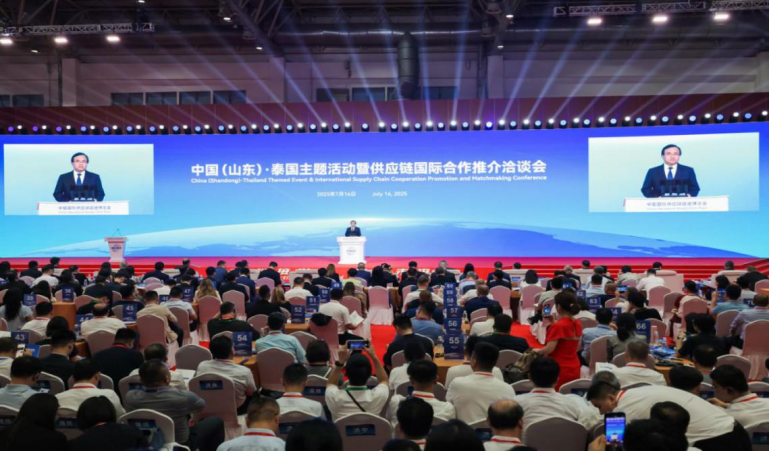
Core Viewpoint - Shandong Provincial Council for the Promotion of International Trade (CCPIT) is actively enhancing foreign trade through innovative measures, focusing on stabilizing enterprises and markets amid a complex international economic landscape [1][3]. Group 1: Major Trade Activities - The CCPIT has meticulously organized significant trade events, such as the third Chain Expo, which featured an exhibition area of 2,600 square meters and attracted over 6,000 professional visitors and buyers, showcasing the leading quality and quantity of participating enterprises in the national trade promotion system [1][3]. - A themed event titled "China (Shandong) - Thailand" was organized, with a scale of 700 participants, including over 200 foreign guests, laying a foundation for deep cooperation in the supply chain between Shandong and Thailand [3]. Group 2: Building International Connections - The CCPIT has successfully invited 29 delegations from 13 countries and regions to promote diversified international economic cooperation through the "One City, One Industry" brand initiative [3]. - The organization has facilitated visits from representatives of 10 foreign consulates, multinational companies, and institutions to explore Shandong's automotive and laser industries, uncovering numerous cooperation opportunities [3]. Group 3: Belt and Road Initiative - The CCPIT is actively engaging business representatives from Belt and Road countries to conduct mutual promotion and park inspections, strengthening economic ties and broadening the international perspective of Shandong enterprises [5]. Group 4: Local Initiatives - Various city-level trade promotion councils in Shandong are innovating and actively participating in enhancing foreign trade, such as the establishment of the Zibo International Reception Hall to showcase products and attract international service institutions [7]. - The Dezhou Trade Promotion Council is focusing on enterprise needs by creating high-level matching platforms to help stabilize orders and expand markets [7]. - The Yantai Trade Promotion Council selects 100 projects annually to provide comprehensive services for enterprises, significantly aiding in securing overseas orders [7]. Group 5: Future Outlook - The Shandong trade promotion system aims to stabilize development by leveraging major trade activities as a breakthrough point, planning to create more platforms for local enterprises to expand internationally [11]. - Future initiatives include deepening international cooperation by organizing delegations from Europe and ASEAN to visit Shandong while also leading local enterprises to explore new markets and secure orders [11].

【省统计局】前八月陕西经济运行平稳向好
Shan Xi Ri Bao· 2025-09-17 00:43
Economic Overview - The provincial economy has maintained a stable and positive trend in the first eight months, with steady industrial production, effective investment growth, and a robust consumer market [1][2] Industrial Production - The industrial added value of enterprises above designated size increased by 8.4% year-on-year in the first eight months [1] - The equipment manufacturing industry experienced significant growth, with an increase of 11.8% in added value, and specific sectors such as electrical machinery and equipment manufacturing saw a remarkable 41.8% increase [1] - Key products showed varied growth, including coal production up by 2.2%, natural gas production up by 3.4%, and automobile production up by 16.6%, with new energy vehicles increasing by 17.6% [1] Fixed Asset Investment - Fixed asset investment grew by 4.1% year-on-year, with industrial investment showing a rapid increase of 19.4% [1] - Manufacturing investment rose by 23.2%, and industrial technological transformation investment surged by 31% [1] - Private investment also performed well, increasing by 11%, which is 6.9 percentage points higher than the overall investment growth rate [1] Consumer Market - Retail sales of consumer goods in enterprises above designated size increased by 7.9% year-on-year [2] - The "old-for-new" consumption policy showed positive effects, with home appliances and audio-visual equipment retail sales rising by 33.7% [2] - Online retail remained active, with a 21.2% year-on-year increase in sales through public networks, accounting for 22.6% of total retail sales [2] Foreign Trade - The total import and export value reached 332.597 billion yuan, a year-on-year increase of 10.5% [2] - Exports amounted to 230.434 billion yuan, growing by 13.2%, while imports were 102.163 billion yuan, up by 4.8% [2] - The export of "new three samples" products, including lithium-ion batteries and electric vehicles, saw significant growth, with increases of 97.7% and 84.4% respectively [2]
樊纲:经济特区在经济发展中的独特作用
Sou Hu Cai Jing· 2025-08-26 10:48
Core Insights - The establishment of Special Economic Zones (SEZs) in China has become a model for many developing countries in formulating their development strategies, particularly in overcoming initial developmental challenges [2][3] Group 1: Role of Special Economic Zones - SEZs utilize a new system and policies to create a "resource aggregation depression," attracting scarce resources from across the country for effective utilization, thus facilitating growth and development [3][4] - The initial success of SEZs, such as Shenzhen, was primarily due to the attraction of domestic investment and talent rather than foreign investment, highlighting the importance of internal resource reallocation [4][5] - SEZs have played a crucial role in breaking away from the rigidities of planned economies, allowing for a more dynamic and efficient allocation of resources [5][6] Group 2: Trade and Economic Development - SEZs were established with the primary goal of enhancing foreign trade, particularly through processing trade, leveraging the abundant labor resources available in developing countries [6][7] - The geographical positioning of SEZs, especially those located along coastlines, facilitates quicker integration into international markets, leading to accelerated trade growth [6][7] Group 3: Introduction of Scarce Resources - SEZs serve as a platform for introducing foreign capital, management, and technology, addressing the deficiencies in growth factors within the country [8][9] - The introduction of these scarce resources not only alters the local factor endowment structure but also enhances the potential for industrial upgrading [9][10] Group 4: Information and Knowledge Transfer - The opening of SEZs has led to the introduction of market-oriented stakeholders, which has changed the interest landscape and accelerated systemic reforms [10][11] - The experiences and information gained from SEZs can be disseminated nationwide, providing a model for other regions to follow in their reform processes [10][12] Group 5: Ongoing Challenges and Adaptations - SEZs are at the forefront of addressing various socio-economic challenges, such as income disparity and urbanization issues, providing valuable lessons for national policy [11][12] - The continuous evolution of SEZs reflects their enduring significance in the broader context of economic, social, cultural, and political development [12][13]