
尿素市场供需

Search documents
银河期货尿素日报-20251117
Yin He Qi Huo· 2025-11-17 11:06
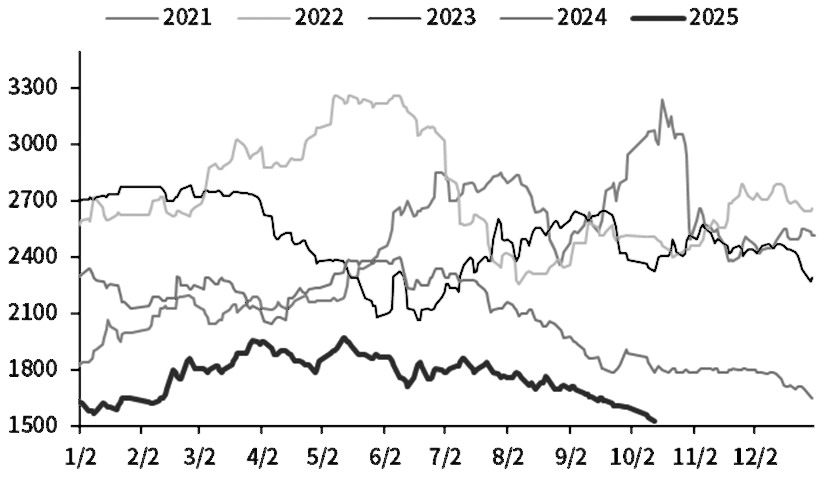
Group 1: Report Summary - Report Title: Urea Daily Report, November 17, 2025 [2] - Report Type: Energy and Chemical Research Report [2] - Research Object: Urea Market Group 2: Market Review - Futures Market: Urea futures fluctuated and closed at 1662 (+13/+0.79%) [3] - Spot Market: Factory prices were weakly stable with decent transactions. Prices in different regions were as follows: Henan 1530 - 1550 yuan/ton, Shandong small - sized 1540 - 1500 yuan/ton, Hebei small - sized 1560 - 1570 yuan/ton, Shanxi medium and small - sized 1480 - 1520 yuan/ton, Anhui small - sized 1540 - 1550 yuan/ton, Inner Mongolia 1450 - 1490 yuan/ton [3] Group 3: Important Information - Urea Daily Output: On November 17, the daily output was 204,400 tons, an increase of 1100 tons from the previous working day and 22,400 tons from the same period last year [4] - Urea Operating Rate: The operating rate on that day was 84.53%, a 4.00% increase from 80.53% in the same period last year [4] Group 4: Logic Analysis - Market Sentiment: The impact of the new export quota news faded, market sentiment cooled, and the spot factory prices of urea in mainstream regions declined [5] - Regional Analysis: In Shandong, the mainstream factory price led the increase before, now the market sentiment cooled, industrial compound fertilizer operating rate declined, and it was expected that the factory price would decline. In Henan, the market sentiment was weak, the factory price followed the increase before and was expected to follow the decline. In the delivery area and surrounding areas, the factory price followed the increase, and it was expected to remain stable. The Northeast demand was stable [5] - Supply and Demand: The maintenance devices returned one after another, and the daily output increased to around 204,000 tons. The fourth batch of quotas was issued, and the international price's influence on the domestic market increased again. The compound fertilizer production in Central and North China basically ended, the grass - roots stocking was coming to an end, the compound fertilizer factory operating rate declined, and the demand showed a downward trend [5] - Inventory: Urea production enterprise inventory decreased by 100,000 tons to around 1.5 million tons, still at a high level [5] - Outlook: In the short term, the domestic demand was still limited, the agricultural demand ended, the compound fertilizer had not started on a large scale, and the spot market sentiment was still low. The fourth - batch export quota was expected to be around 600,000 tons, which would boost the domestic market sentiment in the short term. The urea fundamentals were still loose, and it was expected to continue the downward trend [5] Group 5: Trading Strategy - Unilateral: Short selling [6] - Arbitrage: Wait - and - see [6] Group 6: Related Charts - Charts include urea daily output, operating rate, coal - based and gas - based operating rates and outputs, enterprise and port inventories, compound fertilizer operating rate and factory inventory, melamine operating rate, and Northeast arrival volume from 2022 to 2025 [11][15]
银河期货尿素日报-20251114
Yin He Qi Huo· 2025-11-14 11:46
Group 1: Report Overview - Report Title: Urea Daily Report on November 14, 2025 [2] - Report Type: Energy and Chemical Research Report [2] - Report Focus: Urea Market in the Commodity Sector [1][2] Group 2: Market Review - Futures Market: Urea futures fluctuated and closed at 1652 (0/0%) [3] - Spot Market: Factory prices were weakly stable with general trading. Prices varied by region, e.g., Henan at 1560 - 1570 yuan/ton, Shandong small - sized at 1560 - 1600 yuan/ton [3] Group 3: Important Information - Urea Daily Output: On November 14, it was 20.33 tons, an increase of 0.58 tons from the previous workday and 1.86 tons from the same period last year [4] - Urea Operating Rate: On November 14, it was 84.08%, a 2.38% increase from 81.70% in the same period last year [4] Group 4: Logical Analysis - Market Sentiment: The impact of the new export quota news faded, and market sentiment cooled. Mainstream spot factory prices fell with weak trading [5] - Regional Analysis: Shandong expected falling prices due to weak demand; Henan expected to follow the downward trend; the delivery area and Northeast expected stable prices [5] - Supply and Demand: Supply increased as maintenance units returned. Demand was weak as the fourth - batch quota was issued, and domestic demand entered a "vacuum period" [5] - Price Forecast: With a loose supply - demand situation, urea prices are expected to continue to decline [5] Group 5: Trading Strategy - Unilateral Strategy: Short positions are recommended [6] - Arbitrage Strategy: Hold off on arbitrage operations [6] Group 6: Related Charts - Charts cover various aspects such as urea daily output, operating rate, production, enterprise inventory, and related downstream product data from 2022 - 2025 [10][14]
回归基本面,尿素震荡偏弱
Yin He Qi Huo· 2025-11-14 11:45
Group 1: Report Industry Investment Rating - Not provided in the given content Group 2: Core Viewpoints of the Report - The market sentiment has cooled down after the impact of the new export quota news faded. The ex - factory prices of urea in mainstream areas are falling, and the trading volume is weak. The supply has recovered, and the ex - factory prices are expected to continue the downward trend [5]. - The domestic supply is loose, and the overall demand is showing a downward trend. The autumn fertilizer season in North China has ended, and the downstream grass - roots orders are scarce. The domestic demand is still limited in the short term, and the spot market sentiment remains sluggish [5]. - The fourth batch of export quotas is expected to be around 600,000 tons. The international market will have a greater impact on the domestic market, but the domestic autumn fertilizer is fully over, and the overall domestic demand is about to enter a "vacuum period" [5]. Group 3: Summary by Relevant Catalogs 1. Transaction Strategy - For unilateral trading, go short at high levels; for arbitrage, stay on the sidelines; for over - the - counter trading, stay on the sidelines [5]. 2. Core Data Changes Supply - In the 45th week of 2025 (20251106 - 1112), the capacity utilization rate of coal - based urea in China was 87.53%, a week - on - week increase of 1.87%; the capacity utilization rate of gas - based urea was 72.76%, a week - on - week decrease of 0.29% [6]. - In the 45th week of 2025 (20251106 - 1112), the capacity utilization rate of urea in Shandong was 87.38%, a week - on - week increase of 0.81% [6]. Demand - In the 46th week of 2025 (20251107 - 1113), the weekly average capacity utilization rate of melamine in China was 57.48%, an increase of 4.28 percentage points from the previous week [6]. - In the 46th week of 2025 (20251107 - 1113), the capacity utilization rate of compound fertilizer was 30.32%, a week - on - week decrease of 0.72 percentage points [6]. - As of November 14, 2025, the urea demand of sample compound fertilizer production enterprises in Linyi, Shandong was 1,300 tons, an increase of 280 tons from the previous week, a week - on - week increase of 27.45% [6]. - From November 7 to November 14, 2025, the arrival volume of urea in the Northeast was 106,000 tons, an increase of 11,000 tons from the previous week [6]. - As of November 12, 2025, the pre - order days of Chinese urea enterprises were 7.71 days, an increase of 0.42 days from the previous period [6]. Inventory - On November 12, 2025, the total inventory of Chinese urea enterprises was 1.4836 million tons, a decrease of 94,500 tons from the previous week [6]. - The sample inventory of Chinese urea ports was 82,000 tons, a week - on - week increase of 3,000 tons, a week - on - week increase of 3.8% [6]. Valuation - The price of Jincheng anthracite lump coal is firm, and the price of Yulin pulverized coal has declined slightly. The fixed - bed production of urea has a loss of 110 yuan/ton, the water - coal slurry production has a loss of 70 yuan/ton, and the entrained - flow bed production has a profit of 168 yuan/ton. The futures are fluctuating, the basis is - 100 yuan/ton, and the 1 - 5 spread is - 67 yuan/ton [6].
银河期货尿素日报-20251111
Yin He Qi Huo· 2025-11-11 09:16
1. Report Industry Investment Rating - Not provided in the report 2. Core View of the Report - The report anticipates that urea will continue its downward trend. The domestic supply is abundant, and with the end of the autumn fertilizer season in North China, the overall demand is set to enter a "vacuum period." Although the issuance of the fourth batch of export quotas may boost market sentiment in the short - term, the fundamentals of urea remain loose [5]. 3. Summary According to Relevant Catalogs Market Review - **Futures Market**: Urea futures fluctuated and weakened, closing at 1640 (-21/-1.26%) [3]. - **Spot Market**: The ex - factory prices were weakly stable with average trading. Different regions had different ex - factory price ranges, such as 1580 - 1590 yuan/ton in Henan, 1590 - 1600 yuan/ton for small - sized in Shandong and Hebei, 1500 - 1550 yuan/ton for medium and small - sized in Shanxi, 1560 - 1570 yuan/ton for small - sized in Anhui, and 1420 - 1490 yuan/ton in Inner Mongolia [3]. Important Information - On November 11, the daily production of the urea industry was 19.51 tons, unchanged from the previous working day and an increase of 1.49 tons compared to the same period last year. The operating rate was 83.41%, up 3.68% from 79.73% in the same period last year [4]. Logical Analysis - The impact of the news about the new export quota has faded, and market sentiment has cooled. In Shandong, the mainstream ex - factory quotes led the increase, but market sentiment cooled, with the industrial compound fertilizer operating rate declining, raw material inventory being abundant, finished product inventory being high, and few grass - roots orders. In Henan, the market sentiment was weak, and the ex - factory quotes followed the increase. In the areas around the delivery zone, the ex - factory prices followed the increase, and the market atmosphere was average. The demand in Northeast China was stable, and the trading sentiment was okay [5]. - The maintenance devices have gradually returned, and the daily average production has increased to around 19.6 tons. On the demand side, with the issuance of the fourth batch of quotas, the influence of international prices on the domestic market has increased again. The compound fertilizer production in Central and North China has basically ended, and the grass - roots stockpiling is coming to an end. The operating rate of compound fertilizer plants has declined, and the urea inventory can be used for more than half a month. The inventory of urea production enterprises has increased slightly by 20,000 tons to around 1.58 million tons, which is at a high level overall [5]. - The domestic supply is loose, and the overall demand is showing a downward trend. In the short term, the domestic demand is still limited. Although the new quota issuance will boost market sentiment to some extent in the short - term, the domestic autumn fertilizer has ended, and the overall demand is about to enter a "vacuum period." With the recent callback of bulk commodities and the loose fundamentals of urea, it is expected that urea will continue to decline [5]. Trading Strategy - **Unilateral**: Short at high levels [7]. - **Arbitrage**: Wait and see [7].
尿素周报:高价抵触,盘面小幅回调-20251103
Guan Tong Qi Huo· 2025-11-03 11:32
Report Industry Investment Rating - Not provided Core Viewpoints of the Report - Although the current demand side is weak, there are still expectations for the future market. Factors such as off - season storage and compound fertilizer winter storage will affect urea prices. Currently, the futures price is in a correction phase, and it is expected to mainly fluctuate at a low level and difficult to return to the previous low [1] Summary by Relevant Catalogs Spot Market Dynamics - In the urea spot market, during the end - stage of autumn fertilizers, downstream buyers mainly replenish inventory at low prices, with strong wait - and - see sentiment and low acceptance of high prices. Since the weekend, urea quotes have been on a downward trend [1][3] Futures Dynamics - Last week, the urea futures market showed a decline. As of November 3, the main January contract of urea closed at 1,623 yuan/ton, a decrease of 18 yuan/ton compared to the settlement price on October 27. The weekly trading volume was 1,223.75 million tons, a week - on - week decrease of 255.05 million tons; the open interest was 685.03 million tons, a week - on - week decrease of 71.40 million tons. The futures price decline was less than that of the spot price, and the basis strengthened. As of November 3, the 01 - contract basis was - 63 yuan/ton, a weekly change of - 13 yuan/ton, and the 1 - 5 spread was - 86 yuan/ton, a weekly change of - 5 yuan/ton [5] Urea Supply Side - Last week, urea weekly output increased. From October 23 to 29, the weekly output was 1.3153 million tons, a week - on - week increase of 37,400 tons, or 2.93%. The average daily output was 187,900 tons. Coal - based weekly output was 1.0371 million tons, a week - on - week increase of 1.71%; gas - based weekly output was 278,200 tons, a week - on - week increase of 7.75%. The next cycle is expected to see an increase in output. On November 3, 2025, the national daily output of urea was 198,200 tons, an increase of 7,800 tons from the previous day, with an operating rate of 83.75%. In the raw material market, coal price increase slowed down last week, but it is expected to rise due to upcoming heating season demand. LNG prices rose by 7.67% week - on - week, synthetic ammonia price center shifted up, and the spread between synthetic ammonia and urea weakened by 26 yuan/ton week - on - week. Methanol price was stable, and the spread between methanol and urea weakened by 30 yuan/ton week - on - week [10][12][13] Urea Demand Side - Last week, the compound fertilizer price remained flat. As of October 31, the 45% sulfur - based compound fertilizer was quoted at 2,900 yuan/ton. The compound fertilizer market is in the co - existence stage of autumn fertilizer end and winter storage, with slow overall fertilizer preparation rhythm. The operating load and inventory of compound fertilizer factories increased. From October 25 to 31, the compound fertilizer operating rate was 31.04%, an increase of 3.33 percentage points from the previous week. The average weekly capacity utilization rate of melamine was 49.98%, an increase of 1.68 percentage points from the previous period. As of October 31, the total inventory of Chinese urea enterprises was 1.5543 million tons, a week - on - week decrease of 4.66%, and the port sample inventory was 110,000 tons, a decrease of 100,000 tons from the previous week [15][16][18] International Market - International urea prices rose last week. European demand was strong, and the final tender volume of the Indian tender was 431,000 tons, lower than the procurement target, which may lead to a new round of Indian tenders. In September 2025, China's urea export volume was about 1.37 million tons, and from January to September 2025, the total export volume was about 2.81 million tons. As of October 31, small - particle Chinese FOB price was $377.5/ton, up $2.5/ton week - on - week; large - particle Chinese FOB price remained flat at $392.5/ton [21][22][23]
需求释放,尿素震荡反弹
Yin He Qi Huo· 2025-10-27 05:00
Group 1: Report Industry Investment Rating - Not provided Group 2: Core Viewpoints of the Report - Last week's view was that demand was sporadically released, and the ex - factory price stopped falling and rebounded; this week's view is that demand is released periodically, and the ex - factory price is mainly stable with an upward trend [5] - Short - term domestic demand is still limited, agricultural demand has ended, compound fertilizer has not started on a large scale, and the spot market sentiment is still low. The price difference between domestic and international markets is still large, but the export window is about to close, and the impact of the international market on the domestic market is greatly weakened. In the short term, it is slightly stronger, and in the medium - to - long term, it is still weak [5] - The trading strategy is to be slightly stronger in the short term and weaker in the medium - to - long term for unilateral trading, and to wait and see for arbitrage and over - the - counter trading [5] Group 3: Summary According to the Table of Contents 1. Comprehensive Analysis and Trading Strategy - Due to partial device maintenance, the daily output has dropped to around 187,000 tons. The Indian tender price has dropped to around $400 CFR, and the price difference between domestic and international markets is large, but the export window is about to close [5] - The compound fertilizer production in central and northern China has basically ended, the grass - roots stockpiling is coming to an end, the operating rate of compound fertilizer plants has declined, and the inventory of urea can be used for more than half a month, so the procurement sentiment for raw materials is not high [5] - The inventory of urea production enterprises has increased by 14,700 tons to around 1.63 million tons, which is at a high level overall [5] - With the firm rise of futures, downstream agricultural follow - up, and better weather, the shipment of compound fertilizer products in the central plains has accelerated, and raw material procurement at low prices for rigid demand has improved the order receipt of manufacturers, and the ex - factory price has been raised [5] - The ex - factory price in the mainstream delivery area has rebounded to around 1,540 - 1,570 yuan/ton, and the downstream acceptance has decreased. After the meeting, there is no stimulus policy, and the demand sustainability needs to be observed [5] 2. Fundamental Data - **Supply - National**: In the 42nd week of 2025 (October 16 - 22, 2025), the capacity utilization rate of coal - based urea was 81.23%, a week - on - week decrease of 2.42%; the capacity utilization rate of gas - based urea was 67.56%, a week - on - week decrease of 3.19% [6] - **Supply - Shandong**: In the 42nd week of 2025 (October 16 - 22, 2025), the capacity utilization rate of Shandong urea was 83.82%, unchanged from the previous week [6] - **Demand - Melamine**: In the 43rd week of 2025 (October 17 - 23, 2025), the weekly average capacity utilization rate of Chinese melamine was 48.30%, a decrease of 6.88 percentage points from the previous week [6] - **Demand - Compound Fertilizer**: In the 43rd week of 2025 (October 17 - 23, 2025), the capacity utilization rate of compound fertilizer was 27.71%, a week - on - week increase of 3.53 percentage points [6] - **Demand - Compound Fertilizer Urea Demand**: As of October 24, 2025, the urea demand of sample compound fertilizer production enterprises in Linyi, Shandong was 850 tons, an increase of 450 tons from the previous week, a week - on - week increase of 112.5% [6] - **Demand - Northeast Arrival Volume**: This week (October 17 - 24, 2025), the arrival volume of urea in the Northeast was 110,000 tons, a decrease of 5,000 tons from the previous week [6] - **Demand - Advance Receipts**: As of October 22, 2025, the advance order days of Chinese urea enterprises were 7.41 days, an increase of 0.7 days from the previous period [6] - **Inventory - Enterprise**: On October 22, 2025, the total inventory of Chinese urea enterprises was 1.6302 million tons, an increase of 14,800 tons from the previous week [6] - **Inventory - Port**: In the 43rd week, the sample inventory of urea ports was 210,000 tons, a week - on - week decrease of 236,000 tons [6] - **Valuation**: In terms of profit, the price of Jincheng anthracite lump coal was firm, the price of Yulin pulverized coal increased, the spot price of urea rebounded, the fixed - bed production had a loss of 125 yuan/ton, the coal - water slurry production had a loss of 110 yuan/ton, and the entrained - flow bed production had a profit of 124 yuan/ton. The futures fluctuated, the basis was - 100 yuan/ton, and the 1 - 5 spread was - 70 yuan/ton [6]
尿素周报:农需好转,盘面触底回升-20251025
Wu Kuang Qi Huo· 2025-10-25 13:59
1. Report Industry Investment Rating - Not provided in the document 2. Core Viewpoints of the Report - Weather improvement has led to increased downstream agricultural purchases and a decline in supply, slowing down the inventory accumulation of enterprises. The futures market has seen four consecutive days of gains, but the spot market has underperformed, resulting in a further weakening of the basis. The 1 - 5 spread is at a low level compared to the same period in previous years. Currently, the high - inventory situation of enterprises remains unchanged, suppressing the performance of near - term spot prices, and there is still a lack of strong driving forces [12]. - In terms of fundamentals, the supply side has seen an increase in device maintenance, with the enterprise operating rate at 78.03%, a month - on - month decrease of 2.61%. The daily production is 18.49 tons, lower than the same period last year. On the demand side, the downstream agricultural demand has increased, and the enterprise's advance orders have risen. The compound fertilizer operating rate has bottomed out and rebounded, reaching 27.71%, a month - on - month increase of 3.35%. Overall, the domestic demand has improved [12]. - Both coal - based and gas - based production profits are at a low level. The strengthening of the futures market has led to a further weakening of the basis, and the 1 - 5 spread remains at a low level. The export profit is at a high level, and the domestic market is relatively undervalued, indicating that the urea valuation is low [12]. - The enterprise inventory is 163.02 tons, a month - on - month increase of 1.48 tons, and at a high level compared to the same period last year. The port inventory is 21 tons, a month - on - month decrease of 23.6 tons, indicating an accelerated departure of goods from the port [12]. - In the short term, the agricultural demand has improved, and the compound fertilizer operating rate has also increased, leading to an improvement in short - term supply and demand and a strengthening of the futures market. However, the spot market has been slow to follow the price increase, resulting in a weak basis. Currently, consumption still lacks positive factors, and the supply - side enterprise profits are at a low level. Given the low valuation and weak driving forces, the downward space for spot prices is relatively limited. The market is waiting for positive factors to emerge. In the future, as the weather improves, downstream enterprises will have a stronger willingness to stockpile fertilizers, and with the upcoming off - season storage, off - season storage merchants are expected to have a strong purchasing willingness at the current low price level, and there are still some positive factors waiting to be released in the market. In terms of strategy, due to the high inventory, the price volatility has decreased, and the downward space for prices is relatively limited. It is recommended to wait and see or pay attention to long - position opportunities at low prices [12]. 3. Summary According to the Table of Contents 3.1. Weekly Assessment and Strategy Recommendation - **Market Review**: The futures market has seen four consecutive days of gains due to improved weather, increased downstream agricultural purchases, and a decline in supply. The spot market has underperformed, and the basis has further weakened. The 1 - 5 spread is at a low level compared to the same period in previous years [12]. - **Fundamentals**: Supply side: Device maintenance has increased, with an operating rate of 78.03% and daily production of 18.49 tons. Demand side: Agricultural demand has increased, and the compound fertilizer operating rate has rebounded to 27.71% [12]. - **Valuation**: Both coal - based and gas - based production profits are at a low level. The export profit is high, and the domestic market is relatively undervalued [12]. - **Inventory**: Enterprise inventory is 163.02 tons, a month - on - month increase of 1.48 tons. Port inventory is 21 tons, a month - on - month decrease of 23.6 tons [12]. - **Market Logic**: Short - term improvement in supply and demand has led to a strengthening of the futures market, but the spot market has been slow to follow, resulting in a weak basis [12]. - **Strategy**: Wait and see or pay attention to long - position opportunities at low prices [12] 3.2. Futures and Spot Market - **Price Data**: The prices of futures contracts 09, 01, and 05 have all increased compared to the previous week. The basis in Shandong, Henan, and Hebei has weakened. The prices of downstream products such as compound fertilizer and melamine have remained stable, with some changes in profits [13]. - **Trading Volume and Open Interest**: The futures market has rebounded with a decrease in open interest [28] 3.3. Profit and Inventory - **Production Profit**: Both coal - based and gas - based production profits are at a low level compared to the same period in previous years [32] - **Inventory**: Enterprise inventory is at a high level compared to the same period in previous years, while port inventory has decreased [37] 3.4. Supply Side - **Urea Capacity**: There are plans to put new urea production facilities into operation, but the specific impact on supply needs to be further observed [46] - **Urea Operating Rate**: Short - term maintenance losses have increased, and the operating rate has decreased [48] - **Device Maintenance**: Many enterprises are undergoing routine, loss - based, or policy - based maintenance, and some enterprises have planned maintenance in the future [51][52] 3.5. Demand Side - **Consumption**: The monthly consumption shows certain seasonal characteristics [57] - **Compound Fertilizer**: The operating rate has bottomed out and rebounded, and the production profit has changed slightly [61] - **Nitrogen Source Comparison**: The price ratios of urea to synthetic ammonia, ammonium sulfate, ammonium chloride, and monoammonium phosphate show certain trends [63] - **Melamine**: The operating rate, profit, and export volume show certain changes [66][68] - **Terminal Demand**: The demand in industries such as plywood, real estate shows certain trends [74][78] - **Export**: The export profit is good, and the export volume shows certain changes [84][85] 3.6. Option - Related - The open interest, trading volume, open interest PCR, trading volume PCR, and volatility of urea options show certain characteristics [95][97][104] 3.7. Industrial Structure Diagram - The urea industry chain has certain characteristics, and the fertilizer demand of domestic and international crops shows seasonal patterns [107][114]
需求持续不振,尿素震荡下行
Yin He Qi Huo· 2025-10-20 08:50
Report Summary 1. Industry Investment Rating No investment rating information is provided in the report. 2. Core Viewpoints - The demand for urea continues to be weak, and the price is oscillating downward. The market sentiment is generally low, with mainstream urea spot ex - factory quotes falling and trading being mediocre [5]. - Some urea production devices are under maintenance, and the daily output has dropped to around 187,000 tons. The export window is about to close, and the impact on the domestic market sentiment is limited [5]. - The compound fertilizer production in central and northern China has basically ended, the grassroots stocking is winding up, the operating rate of compound fertilizer plants has declined, and the demand for raw materials is low. The inventory of urea production enterprises has increased to around 1.61 million tons, remaining at a high level [5]. - In the short term, the domestic demand is still limited, the agricultural demand has ended, and the compound fertilizer has not started production on a large scale. The spot market sentiment remains sluggish. Although the price difference between domestic and foreign markets is still large, it only provides some support to the domestic spot market [5]. - The ex - factory prices of some manufacturers have been lowered, but the order intake is still weak. The fundamentals are still relatively loose, and a strategy of shorting on rebounds is recommended [5]. 3. Summary by Directory Chapter 1: Comprehensive Analysis and Trading Strategies - **Overview**: The demand for urea is weak, and the price is oscillating downward. Different regions have different price trends. The overall supply is loose, and the demand is declining. The trading strategy is to short on rebounds in the short - term for single - side trading, and to remain on the sidelines for arbitrage and over - the - counter trading [5]. - **Core Data Changes** - **Supply**: In the 41st week of 2025 (October 9 - 15), the capacity utilization rate of coal - based urea in China was 83.65%, a week - on - week decrease of 4.74%; the capacity utilization rate of gas - based urea was 70.75%, a week - on - week decrease of 2.64%. In Shandong, the capacity utilization rate of urea was 83.82%, a week - on - week decrease of 0.51% [6]. - **Demand**: In the 42nd week of 2025 (October 10 - 16), the average weekly capacity utilization rate of melamine in China was 55.18%, a decrease of 10.29 percentage points from the previous week. The capacity utilization rate of compound fertilizer was 24.18%, a week - on - week decrease of 1.32 percentage points. As of October 17, the urea demand of sample compound fertilizer producers in Linyi, Shandong was 400 tons, a week - on - week decrease of 220 tons or 35.46%. As of October 15, the pre - order days of Chinese urea enterprises were 6.71 days, a decrease of 0.29 days from the previous period [6]. - **Inventory**: On October 15, the total inventory of Chinese urea enterprises was 1.6154 million tons, an increase of 171,500 tons or 11.88% from the previous week. As of October 16, the sample inventory of Chinese urea ports was 446,000 tons, an increase of 31,000 tons or 7.47% from the previous week [6]. - **Valuation**: The price of Jincheng anthracite lump coal is firm, the price of Yulin pulverized coal has risen, the spot price of urea has fallen. The fixed - bed production incurs a loss of 110 yuan/ton, the coal - water slurry production incurs a loss of 80 yuan/ton, and the fluidized - bed production has a profit of 150 yuan/ton. The futures are oscillating, with a basis of - 100 yuan/ton and a 1 - 5 spread of - 70 yuan/ton [6]. Chapter 2: Weekly Data Tracking The report only lists the sub - items such as "Mainstream Manufacturer Ex - factory Prices", "Basis", "Regional Spread", etc., but no specific content for these sub - items is provided in the given text, so a detailed summary cannot be made.
尿素 缺乏回升动能
Qi Huo Ri Bao· 2025-10-15 22:51
Core Viewpoint - After the National Day holiday, the price of urea futures has reached a new low for the year, with total open interest increasing significantly, indicating a market in a phase of delayed demand release, limited supply contraction, and undecided policies [1] Demand Dynamics - The demand for urea is currently characterized by delayed release and structural differentiation, with initial signs of recovery in autumn fertilizer demand following the end of rainfall in North China, but downstream stocking enthusiasm remains low [2][4] - The price of small granular urea has recently dropped to around 1500 yuan/ton, a 14.53% decrease compared to the same period last year, with some regions seeing spot prices fall to 1460 yuan/ton, marking a yearly low [4] Industrial Demand - Industrial demand for urea shows a differentiated pattern, with compound fertilizer companies holding 735,000 tons of finished product inventory and a low operating rate of 25.5% year-on-year [5] - The decline in urea prices has led to increased profits for melamine, with theoretical gross margins rising to 400 yuan/ton, while the board industry faces reduced production due to persistent humid weather [5] Supply Situation - Short-term supply contraction is limited, with urea daily production dropping from around 200,000 tons to nearly 190,000 tons due to maintenance, but still at a high level compared to the past five years [6][8] - The impact of maintenance on production is expected to be minimal, with only a few companies announcing specific maintenance schedules [9] Policy and Export Outlook - In September, China's urea exports reached 1 million tons, but the cumulative export volume from January to September was only 2.44 million tons, far below the annual quota of 4.2 million tons [10] - The upcoming tender from India for 2 million tons of urea presents a significant opportunity for domestic companies to reduce inventory, contingent on the extension of the export window and potential adjustments to export pricing policies [10] Price Guidance - The China Nitrogen Fertilizer Industry Association has issued a quarterly guidance price for urea, indicating a clear intention to support prices, although practical implementation remains questionable [11] - Urea inventory has risen to a high of 1.4439 million tons, which is expected to suppress upward price movement in the short term [11][13] Market Sentiment - The emergence of low prices has led to marginal improvements in the urea fundamentals, with futures prices finding support around 1600 yuan/ton, but the market still faces significant supply-demand pressures [13]

大越期货尿素早报-20251013
Da Yue Qi Huo· 2025-10-13 06:32
Group 1: Report Industry Investment Rating - No relevant content provided Group 2: Core View of the Report - The overall supply of domestic urea exceeds demand significantly. The daily production and operating rate are slightly declining but still at a relatively high level, and enterprise inventories are accumulating. Both industrial and agricultural demand are weak, and although the third - batch of export quotas has been released, the support for domestic prices is limited. It is expected that the UR contract will show a weak and volatile trend today [4]. Group 3: Summary by Related Catalogs Urea Overview - **Fundamentals**: Current daily production and operating rate are slightly down but still high, enterprise inventories are accumulating, and demand from both industrial and agricultural sectors is weak. There is a large price difference between domestic and international markets for exports, but the third - batch of quotas has limited support for domestic prices. The spot price of the delivery product is 1710 (+10), and the overall fundamentals are bearish [4]. - **Basis**: The basis of the UR2601 contract is 113, and the premium/discount ratio is 6.6%, which is bullish [4]. - **Inventory**: The UR comprehensive inventory is 168.6 million tons (+16.1), which is bearish [4]. - **Disk**: The 20 - day moving average of the UR main contract is downward, and the closing price is below the 20 - day line, which is bearish [4]. - **Main Position**: The net position of the UR main contract is short, and the short position is increasing, which is bearish [4]. - **Expectation**: The main contract of urea is expected to be weak and volatile. International urea prices are strong, but the support for domestic prices is limited. Both industrial and agricultural demand are weak, and the overall domestic supply exceeds demand. It is expected that UR will show a weak and volatile trend today [4]. - **Leverage Factors**: Bullish factor is the strong international price; bearish factors are high operating and daily production levels and weak domestic demand. The main logic lies in the marginal changes in international prices and domestic demand [5]. Spot and Futures Market - **Spot**: The spot price of the delivery product is 1710 (+10), the Shandong spot price is 1710 (+10), the Henan spot price is 1720 (0), and the FOB China price is 3099 [6]. - **Futures**: The price of the UR01 contract is 1597 (-12), the UR05 contract is 1666 (-11), and the UR09 contract is 1702 (1). The basis of the UR2601 contract is 113, and the premium/discount ratio is 6.6% [4][6]. Inventory - The UR comprehensive inventory is 168.6 million tons (+16.1), including 108.6 million tons of UR manufacturer inventory and 60 million tons of UR port inventory [4][6]. Supply - Demand Balance Sheet - From 2018 to 2024, the urea industry has seen continuous growth in production capacity, with growth rates ranging from 8.4% to 15.5%. Production, net imports, apparent consumption, and other indicators have also changed accordingly. For example, in 2024, the production capacity was 4418.5, with a growth rate of 13.5%, production was 3425, net imports were 360, and the import dependence was 9.5% [9].