新能源汽车技术升级

Search documents
明年起实施,新能源车购置税减免技术门槛提高
Mei Ri Jing Ji Xin Wen· 2025-10-10 10:06
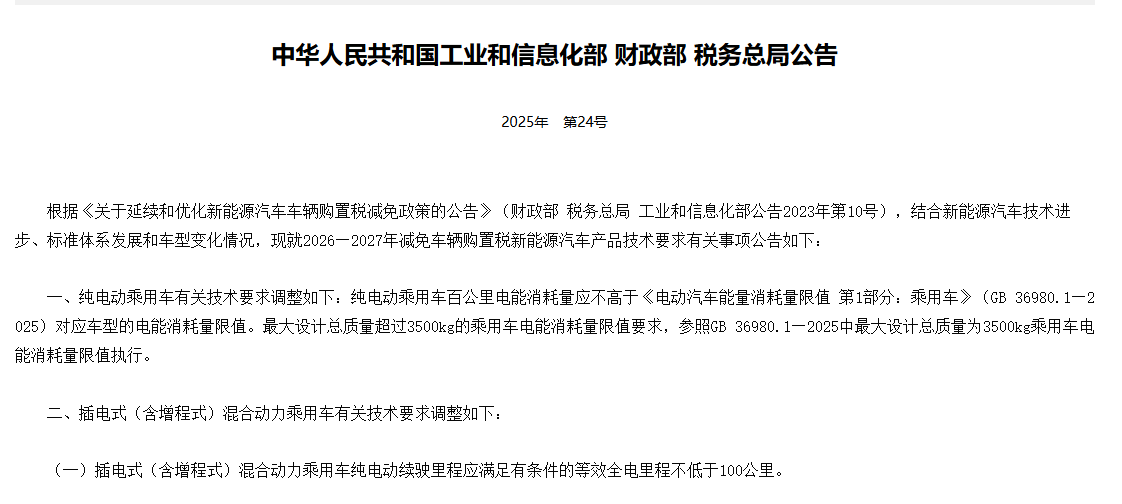
Core Points - The announcement introduces updated national standards for energy consumption in pure electric passenger vehicles and raises the pure electric range requirement for plug-in hybrid vehicles from 43 kilometers to 100 kilometers [2][7] - The changes aim to align policy with rapid advancements in battery technology and to encourage companies to increase R&D investments, phasing out outdated products and promoting high-quality development in the industry [2][6] Group 1: New Standards and Requirements - The new standards require pure electric passenger vehicles to meet specific energy consumption limits as defined in the mandatory national standard GB 36980.1—2025, which will be enforced starting January 1, 2026 [3][5] - The energy consumption limit for conventional models has been tightened by approximately 11% compared to previous phases, with the weight thresholds adjusted to 1090 kg and 2710 kg [5][6] - The new requirements are expected to indirectly curb the trend of oversized electric vehicles, as higher vehicle weight typically leads to increased energy consumption [5] Group 2: Impact on Plug-in Hybrid Vehicles - The announcement significantly raises the pure electric range requirement for plug-in hybrid vehicles, which is anticipated to enhance consumer experience and reduce daily travel costs [7][8] - Approximately 40% of currently available plug-in hybrid vehicles have a pure electric range below 100 kilometers, which may lead to a clearance sale by manufacturers before the new standards take effect [7][8] Group 3: Future of Tax Policies - The announcement signals a potential end to the current exemption from vehicle purchase tax for new energy vehicles, with expectations that a 5% tax rate will be implemented starting next year [10] - The new technical requirements are seen as a precursor to the upcoming half-price vehicle purchase tax policy for eligible models, which will be effective from January 1, 2026 [10]

明年起实施!新能源车购置税减免技术门槛提高 专家:引导企业加大研发投入 淘汰落后产品
Mei Ri Jing Ji Xin Wen· 2025-10-10 09:37
Core Points - The announcement introduces updated national standards for energy consumption in pure electric passenger vehicles and raises the pure electric range requirement for plug-in hybrid vehicles from 43 kilometers to 100 kilometers [3][9] - The new standards aim to align with rapid advancements in battery technology and to encourage companies to increase R&D investments, phasing out outdated products and promoting high-quality development in the industry [3][8] Summary by Category New Standards Implementation - The new energy consumption limits for pure electric passenger vehicles will be enforced starting January 1, 2026, based on the mandatory national standard GB 36980.1—2025 [4][8] - The revised energy consumption limits are approximately 11% stricter than previous phases, with the weight thresholds adjusted to 1090kg and 2710kg for vehicle classifications [7] Impact on Plug-in Hybrid Vehicles - The new requirement for plug-in hybrid vehicles significantly raises the pure electric range threshold, which is expected to enhance consumer experience and reduce daily travel costs [9][10] - Approximately 40% of currently available plug-in hybrid vehicles have a pure electric range below 100 kilometers, which may lead to a clearance sale by manufacturers before the new standards take effect [9][10] Market and Policy Implications - The announcement signals a potential end to the current exemption from vehicle purchase tax for new energy vehicles, with a shift towards a 5% tax rate expected in the near future [13] - The new technical requirements are seen as a necessary step for vehicles to qualify for the upcoming half-price vehicle purchase tax policy, which will be applicable from January 1, 2026 [13]
明年起实施!新能源车购置税减免技术门槛提高 专家:引导企业加大研发投入,淘汰落后产品
Mei Ri Jing Ji Xin Wen· 2025-10-10 09:27
Core Viewpoint - The Ministry of Industry and Information Technology (MIIT) and other departments have issued an announcement regarding the technical requirements for new energy vehicles (NEVs) to be eligible for vehicle purchase tax exemptions from 2026 to 2027, emphasizing the need for higher technical standards to promote quality development in the industry [1][4][9]. Summary by Sections Technical Requirements for NEVs - The announcement introduces updated national standards for the energy consumption of pure electric passenger vehicles, requiring a maximum energy consumption of 100 kilometers for plug-in hybrid vehicles, up from the previous 43 kilometers [4][10]. - The new standards aim to align with advancements in battery technology and encourage companies to invest in research and development, phasing out outdated products [4][9]. Implementation Timeline - The new technical requirements will take effect on January 1, 2026, for models listed in the directory of NEVs eligible for vehicle purchase tax exemptions [4][5]. Energy Consumption Standards - The energy consumption limit for pure electric passenger vehicles is set according to the national standard GB 36980.1-2025, which will be enforced starting January 1, 2026 [5][8]. - The new standard tightens energy consumption limits by approximately 11% compared to previous phases, reflecting the need for improved vehicle efficiency [8]. Market Impact - The increase in the pure electric range requirement for plug-in hybrid vehicles may lead to a clearance sale for models that do not meet the new standards, as around 40% of currently available models have a pure electric range below 100 kilometers [10][11]. - The announcement is seen as a signal that the exemption policy for NEV purchase taxes may be phased out, with a potential shift to a 5% tax rate starting next year [13]. Industry Response - Experts suggest that automakers should prepare for the new standards by enhancing their vehicle designs and focusing on improving the efficiency of their electric systems [4][9]. - The new requirements are expected to drive technological upgrades in battery capacity and hybrid systems, enhancing product safety and competitiveness [8][9].
新能源车购置税政策“提门槛” 插混车型续航须超100公里
Qi Lu Wan Bao Wang· 2025-10-10 07:48
Core Viewpoint - The announcement from the Ministry of Industry and Information Technology, Ministry of Finance, and State Taxation Administration indicates that the purchase tax exemption policy for new energy vehicles will continue from January 1, 2026, but with significantly raised technical thresholds to promote high-quality industrial development [1][2]. Group 1: Policy Overview - The purchase tax exemption for eligible new energy vehicles will remain in effect until the end of 2027, with a 50% tax reduction in 2026 and a maximum tax reduction of 15,000 yuan per vehicle [2][7]. - The new policy links tax benefits directly to compliance with updated technical standards, marking a shift from subsidy-driven support to innovation-driven growth in the new energy vehicle sector [2][8]. Group 2: Technical Requirements - For pure electric passenger vehicles, the energy consumption must meet the latest national standards, ensuring compliance with GB36980.1—2025 [3]. - Plug-in hybrid vehicles must achieve a minimum pure electric range of 100 kilometers, a significant increase from the previous requirement of 43 kilometers, reflecting a 132% rise [4][8]. - Fuel consumption for plug-in hybrids must be reduced according to vehicle weight, with specific thresholds set for different weight categories [4]. Group 3: Transition and Compliance Management - Vehicles listed in the tax exemption directory before December 31, 2025, that meet the new requirements will automatically transition to the 2026 directory, while non-compliant models will be removed [5][7]. - New models seeking inclusion in the 2026 directory must be submitted by December 12, 2025, with a dynamic regulatory mechanism allowing for reapplication of previously removed models [6]. Group 4: Market Impact and Future Trends - The new technical requirements are expected to accelerate product iteration and enhance energy efficiency and range in the new energy vehicle market [8]. - Current mainstream plug-in hybrid models already exceed the new 100-kilometer electric range requirement, indicating readiness for compliance [9]. - By 2030, the market is projected to balance between pure electric, plug-in hybrid, and fuel vehicles, each accounting for approximately 30% of the market share, driven by the new policy's emphasis on technological advancement [9].
都市车界|新能源车购置税政策“提门槛” 插混车型续航须超100公里
Qi Lu Wan Bao· 2025-10-10 07:35
Core Insights - The Ministry of Industry and Information Technology, Ministry of Finance, and State Taxation Administration announced a continuation of the vehicle purchase tax exemption policy for new energy vehicles (NEVs) starting January 1, 2026, with significantly higher technical requirements aimed at promoting high-quality industrial development [1][3]. Policy Overview - The purchase tax exemption will remain in effect until the end of 2027, with a 50% tax reduction in 2026 and a maximum tax reduction of 15,000 yuan per vehicle [3][9]. - The new technical standards will disqualify models that do not meet the updated criteria from enjoying tax benefits, indicating a shift from policy subsidies to technological innovation [3][10]. Technical Requirements - For pure electric vehicles, the energy consumption per 100 kilometers must comply with the latest national standards, ensuring energy efficiency [4]. - For plug-in hybrid vehicles, the pure electric driving range requirement has increased from 43 kilometers to 100 kilometers, a 132% increase [1][5]. - Fuel consumption in electric mode must also be reduced according to specific weight categories, with stricter limits for heavier vehicles [5][6]. Transition and Compliance - Vehicles listed in the tax exemption directory before December 31, 2025, that meet the new requirements will automatically transition to the 2026 directory; non-compliant models will be removed [7][9]. - New models must be submitted for inclusion in the 2026 directory by December 12, 2025, with a dynamic regulatory mechanism in place for compliance [8]. Market Impact - The new requirements are expected to drive technological upgrades in the NEV sector, pushing manufacturers to enhance research and development efforts and phase out outdated products [10]. - As of September 2025, plug-in hybrid vehicles accounted for 30.7% of total NEV sales, indicating a significant market presence that may be affected by these new standards [10][11]. - The policy aims to align with advancements in battery technology and engine efficiency, ensuring that the market evolves towards high-quality development rather than mere scale expansion [10][11].
车辆购置税减免门槛提高,插混车型纯电续航至少100公里
Bei Ke Cai Jing· 2025-10-09 13:59
Core Insights - The Ministry of Industry and Information Technology, along with two other departments, announced new technical requirements for electric vehicles and plug-in hybrid vehicles, effective January 1, 2026, which include stricter energy consumption standards and an increase in the pure electric range requirement for plug-in hybrids from 43 kilometers to 100 kilometers [1][2][4] Group 1: Technical Requirements - The new announcement specifies that pure electric passenger vehicles must meet the energy consumption limits set by the national standard GB 36980.1-2025, which will be implemented starting January 1, 2026 [2][3] - The requirement for plug-in hybrid vehicles now mandates a minimum pure electric range of 100 kilometers, significantly up from the previous threshold of 43 kilometers [2][3] Group 2: Industry Impact - The new technical requirements are expected to drive technological upgrades in the industry, prompting companies to increase R&D investments to enhance battery technology and energy management efficiency [4][5] - The changes may lead to the elimination of outdated models from the market, optimizing competition and concentrating resources among companies with stronger technological capabilities [4][5] Group 3: Consumer Impact - Consumers will see changes in vehicle purchase costs, as only models meeting the new technical requirements will qualify for tax exemptions, potentially reducing the range of available models in the short term [5] - In the long term, the market is expected to offer more high-quality products, encouraging consumers to pay closer attention to vehicle technical specifications when making purchasing decisions [5]
新能源车购税减免,门槛进一步提高
第一财经· 2025-10-09 09:09
近日,工信部等三部门发出公告,调整2026—2027年减免车辆购置税新能源汽车产品技术要求,明 确纯电动乘用车、插电式(含增程式)混合动力乘用车有关技术要求调整等情况。 本文字数:2285,阅读时长大约4分钟 作者 | 第一财经 葛慧 随着2025年走进尾声,明年的新能源汽车到底怎么补贴备受关注。 2025.10. 09 2026年1月1日起,列入《减免车辆购置税的新能源汽车车型目录》的车型,需符合本公告要求。 2026年1月1日(含)起,在2026年及以后生效的《减免税目录》发布后,购置列入《减免税目 录》的新能源汽车,可按规定享受车辆购置税减免政策。 对比之前的政策,这份2025年第24号公告主要针对2026至2027年的新能源汽车购置税减免政策, 在技术门槛上进行了显著的提升,核心变化是引入了更新的国家标准,对车辆的能耗和续航提出了更 严格的要求。 其中,纯电方面,百公里电耗不高于GB36980.1—2025的限值。 插混(含增程)方面,有条件的等效全电里程不低于100公里;电量保持模式中,油耗需低于GB 19578限值的 70%~75%;在电量消耗模式中,电耗需低于GB 36980.1限值的 140% ...
阿维塔战略2.0发布:2030年推17款车,全球销量80万辆
Bei Ke Cai Jing· 2025-09-20 14:29
Core Insights - Avita Technology officially launched its Strategy 2.0 on September 20, focusing on product, technology, service upgrades, and globalization [1] - The company aims for global sales of 400,000 units and annual revenue of 100 billion yuan by 2027, with targets of 800,000 units by 2030 and 1.5 million units by 2035 [1] Product Upgrades - Avita plans to jointly launch 5 new models by 2026 and 17 models by 2030, covering sedans, SUVs, MPVs, and sports cars [1] Technology Upgrades - Continuous evolution in areas such as QianKun Intelligent Driving, HarmonyOS Cockpit, Kunlun Range Extender, Shenhui Super Charging, Taihang Intelligent Control Chassis, and Xiaoyao Hybrid Battery [1] New Model Launch - The Avita 07 2026 model has been officially launched, featuring 6 variants with both range extender and pure electric power options, priced between 219,900 yuan and 279,900 yuan [1] - All variants are equipped with Huawei's QianKun ADS 4 and HarmonyOS Cockpit HarmonySpace 5, along with Taihang Intelligent Control Chassis; the range extender version offers an optional 52 kWh battery from CATL [1] - The new model is available on Huawei's official store under the "QianKun Intelligent Driving" section [1]
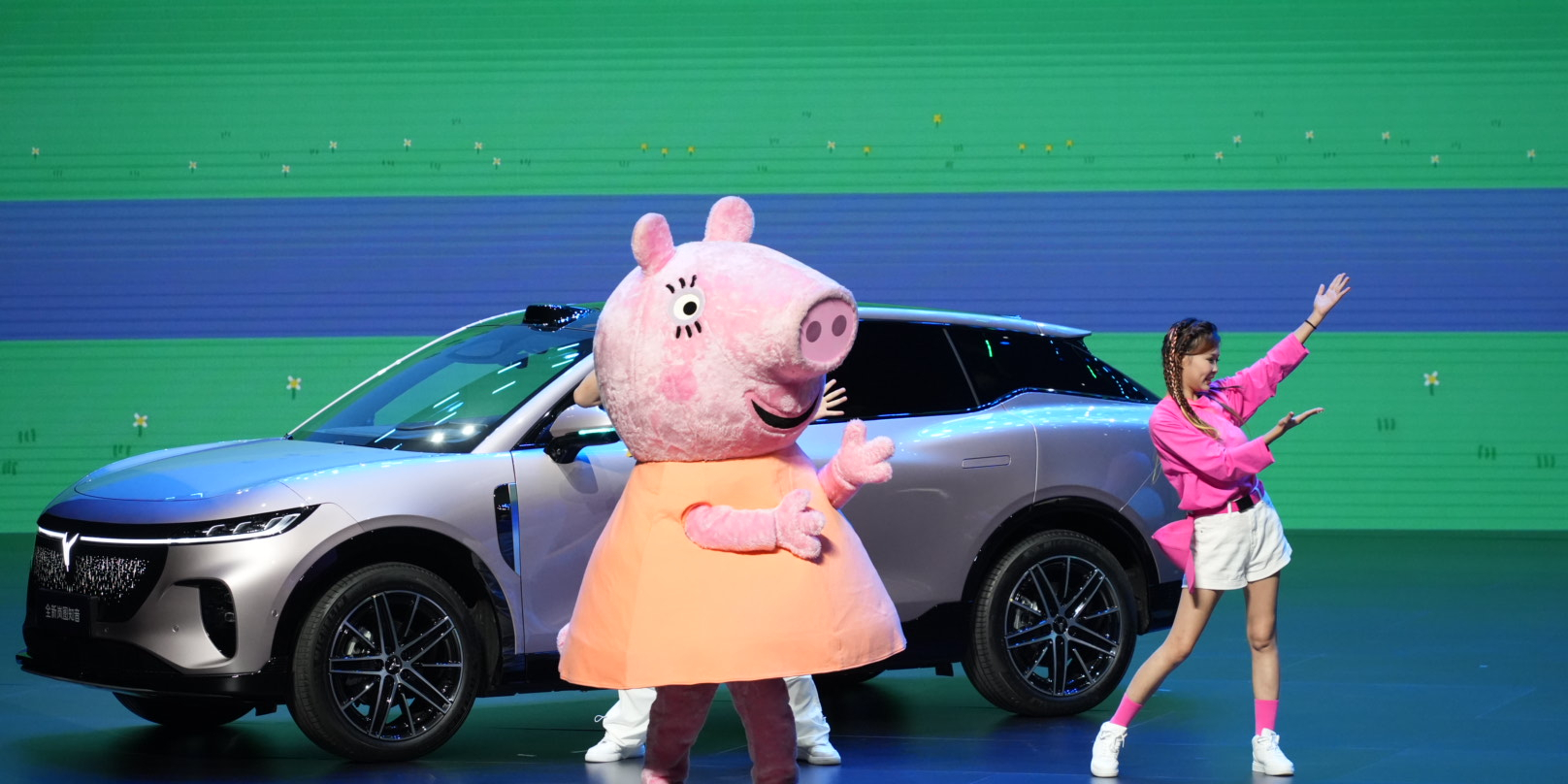
被寄予“爆款”希望,全新岚图知音担当销量与盈利重任
Jing Ji Guan Cha Wang· 2025-08-31 01:05
Core Viewpoint - The launch of the new Lantu Zhiyin marks a significant step for Lantu Motors as it aims to establish a strong presence in the mid-to-large family SUV market, with a focus on creating a "hit" model alongside the Lantu FREE+ [2][3] Group 1: Product Launch and Market Positioning - The new Lantu Zhiyin is priced between 202,900 and 242,900 yuan and is defined as the "fifth-generation pure electric SUV," representing an investment of over 500 million yuan and 1,202 upgrades [2] - Lantu Motors aims for the Zhiyin to become a best-selling model, similar to the Lantu FREE+, to enhance its competitive edge in the market [2][3] - The company has received over 3,000 orders within 12 minutes of the Zhiyin's launch, indicating strong market potential [3] Group 2: Technical Specifications and Features - The Zhiyin features an 800V high-voltage silicon carbide platform, with a maximum range of 650 km and acceleration from 0 to 100 km/h in 6.8 seconds for the rear-wheel drive version and 4.3 seconds for the all-wheel drive version [4] - It offers a long-range version with a 901 km range and a 112 kWh battery, which is the largest in its class [4] - The vehicle is equipped with Huawei's advanced driving system ADS 4 and HarmonySpace 5, featuring 192-line lidar and 29 sensors for enhanced smart driving capabilities [4] Group 3: Comfort and Luxury Features - The Zhiyin includes 12-layer cloud comfort zero-pressure seats, certified by OEKO-TEX for skin-friendliness, and features such as ventilation, heating, and massage functions for all seats [5] - It incorporates double-layer soundproof glass and a dual-door refrigerator with UV sterilization, typically found in vehicles priced at 500,000 yuan [5] Group 4: Competitive Landscape and Challenges - The Zhiyin faces competition from popular models like Xpeng G6 and Zeekr 7X, which may impact its sales performance [3] - The vehicle's internal competition with the Lantu FREE+ is acknowledged, although they target slightly different demographics [6] - The recent launch of Huawei's Hongmeng Zhixing "Fifth Realm" H5 model, priced at 169,800 yuan, poses a challenge by potentially lowering the perceived value of Lantu's offerings [7] Group 5: Production Capacity and Future Outlook - Lantu Motors has acquired the Dongfeng Nissan Yunfeng factory, which has an annual capacity of 150,000 units, expandable to 300,000 units, to support the production of the Zhiyin [7] - The company is currently producing over 600 vehicles daily and is working to ensure timely delivery of the Zhiyin models [7]
新一代智己LS6预售订单破4.8万辆,2025成都车展预售权益再加码
Zhong Guo Jing Ji Wang· 2025-08-29 08:51
Group 1 - The new generation of Zhiji LS6 has received significant attention since its pre-sale began on August 15, with over 48,000 pre-orders reported [3] - The vehicle features "Star" super extended range technology, offering a pure electric range of 450 kilometers and a comprehensive range of 1502 kilometers, which is double that of traditional fuel vehicles [5] - The LS6 has successfully passed extreme cold testing, addressing concerns about charging in winter conditions, ensuring reliable battery performance [5] Group 2 - The LS6's configuration includes advanced features such as a new generation Lingxi digital chassis, smart four-wheel steering system, and ultra-fast 800V charging platform [7] - The vehicle's luxurious interior has attracted over 75% of users, with high-end features like a dual-door refrigerator and electric sunshade [7] - The upcoming flagship model, Zhiji LS9, will showcase high-performance "Star" super extended range technology and luxury features like 4D mechanical massage seats, set to launch in Q4 of this year [8]