
智能体技术

Search documents
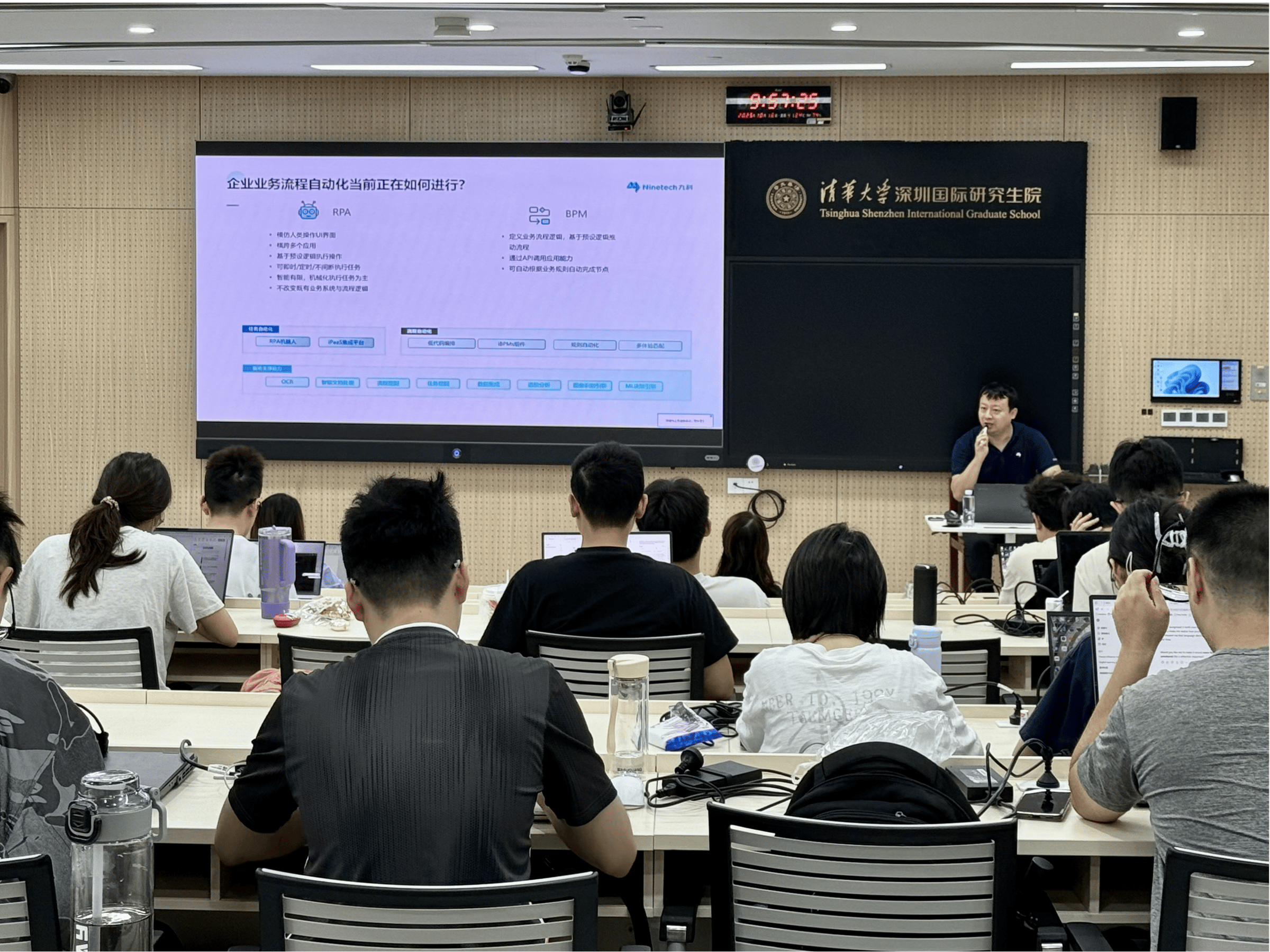
校企联动赋能人才!九科信息走进清华,共探Agent智能体落地难题
Sou Hu Cai Jing· 2025-10-22 23:23
Core Insights - The lecture by the Vice President of Jiukai Information Technology, Fu Kai, focused on the future of enterprise AI automation and the role of intelligent agents in transforming business efficiency [1][4][18] Group 1: Development and Application - Intelligent agents are redefining enterprise workflows by overcoming the limitations of traditional automation, which required manual definition of every operational step [4][5] - The four core application areas for intelligent agents have emerged since the explosion of large language model technology in 2023 [5] - Examples of intelligent agent applications include content understanding and review, digital work assistants, content generation, and end-to-end business process automation [7][8][9] Group 2: Current Status and Challenges - The intelligent agent market appears product-rich, but there is a prevalent issue of "top-heavy" ecosystems, with many products focusing on knowledge Q&A rather than actionable execution [10][13] - A case study from a large automotive company illustrates the challenge, where over 2,000 intelligent agents were built, yet core execution tasks still required human intervention [10][13] Group 3: Jiukai Information's bit-Agent - Jiukai Information has developed a new generation of enterprise-level GUI agents, known as bit-Agent, which can perform specific tasks by simulating human actions on computer interfaces [13][14] - The bit-Agent is designed to be adaptable, supporting various models and allowing for private deployment based on data security needs [14] - The bit-Agent's unique "process solidification" feature allows it to save executed tasks as templates, significantly reducing token consumption and minimizing error risks [14][16] Group 4: Impact and Value - The bit-Agent has demonstrated significant efficiency improvements, reducing inspection time from 5 minutes to 30 seconds and decreasing error rates by over 93% in a large automotive company's safety operations [15][16] - The core goal of enterprise intelligent automation is to create a new human-machine collaboration model, with the bit-Agent exemplifying this shift from a "Q&A assistant" to a "digital employee" [18]

为“硬核”工业装上智慧大脑
Zhong Guo Qing Nian Bao· 2025-09-26 22:39
Group 1 - The 25th China International Industry Fair (CIIF) opened in Shanghai, attracting nearly 3,000 exhibitors from 28 countries and regions, showcasing advancements in smart manufacturing and new industrialization [1] - The Minister of Industry and Information Technology stated that China's industrial added value is expected to reach 40.5 trillion yuan in 2024, with manufacturing value added at 33.6 trillion yuan, maintaining the world's largest scale for 15 consecutive years [1] - During the "14th Five-Year Plan" period, China's manufacturing value added is projected to increase by 8 trillion yuan, contributing over 30% to global manufacturing growth [1] Group 2 - The performance of sand painting robots at the fair demonstrated the integration of AI in traditional industries, with the robotic arms achieving a repeat positioning accuracy of ±50 microns [2] - Various types of robots, including humanoid and wheeled robots, showcased collaborative work in a simulated "future factory" environment [2] Group 3 - KPMG's report highlighted that intelligent technology is becoming the next frontier in industrial tools, with companies like Yuejiang enabling rapid integration of multi-form robots without major modifications to existing production lines [3] - Intelligent machine tools with autonomous exploration capabilities are set to enhance manufacturing efficiency significantly [3] Group 4 - Shanghai Electric showcased a project that converts corn straw into green methanol, representing a significant step in sustainable energy solutions for industrial high-end equipment [4][5] - The "Harmonious System," a digital control system for nuclear power plants, was presented, marking a technological advancement in nuclear safety and operational efficiency [5] Group 5 - The fair featured advanced technologies such as acoustic fiber materials for health monitoring and AI chips driving digital transformation in industries [6] - Shanghai Superconductor Technology's second-generation high-temperature superconducting tape was highlighted for its strategic significance in various advanced applications [6] Group 6 - A Zhejiang-based factory utilized AI tools to enhance production capabilities, achieving significant improvements in manufacturing processes and connecting Chinese manufacturing with global supply chains [7]
周鸿祎对谈罗永浩:聊了雷军、智能体和行业定位
第一财经· 2025-09-24 11:47
Core Insights - The discussion between Luo Yonghao and Zhou Hongyi highlights the evolving role of entrepreneurs as influencers, differentiating them from traditional internet celebrities who primarily focus on direct monetization through sales [3][4] - Zhou Hongyi emphasizes the rapid evolution of AI, particularly the importance of intelligent agents over single large models, suggesting that multi-agent collaboration can achieve greater outcomes [3][5] - The conversation also touches on the changing dynamics between startups and major tech companies, with Zhou reflecting on past conflicts and the current need for collaboration in the AI space [5][6] Group 1: Entrepreneurial Influence - Zhou Hongyi describes the first generation of internet celebrities as providing alternative pathways for ordinary people, while entrepreneur influencers like Yu Minhong and Lei Jun focus on promoting their companies rather than selling consumer products [3][4] - The role of entrepreneur influencers is likened to a new form of marketing and public relations, leveraging their personal influence to communicate corporate values [3] Group 2: AI Development and Impact - Zhou Hongyi notes that the overall evolution of AI is surpassing expectations, but warns that AGI (Artificial General Intelligence) is not expected in the near term [3][6] - He argues that the future will see individuals who can effectively use AI outperforming those who cannot, with repetitive tasks being automated while new roles, such as AI trainers, will emerge [6] Group 3: Industry Dynamics and Collaboration - Zhou Hongyi shares insights on the positioning of 360 as an "industry supporting role," choosing to focus on vertical markets rather than competing with established giants in the general AI model space [5] - He reflects on past confrontations with major tech companies, acknowledging the need for a more collaborative approach in the current landscape, including partnerships with 16 major AI firms [5]


盘点2025智能体技术在企业运营的三大核心场景
Sou Hu Cai Jing· 2025-09-22 06:01
Core Insights - The article discusses the emergence of intelligent agent technology as a solution to the challenges of "growth anxiety" and "efficiency bottlenecks" faced by companies in the current era of stock competition [1] Group 1: Intelligent Customer Service and Q&A Systems - Traditional customer service systems are inadequate for current economic demands, as exemplified by I.T Group, which handles approximately 25,000 conversations monthly, exceeding 35,000 during peak sales [2] - NetEase Cloud's customer agent solution employs a hybrid model, allocating 70% of common inquiries to traditional NLP robots and 30% to customer agents, resulting in a 60% improvement in response speed and a reduction in query handling time from 2 minutes to as little as 17 seconds [2] - The intelligent agent's unique advantages in cross-border e-commerce are highlighted, providing 24/7 multilingual support and effectively addressing cross-time zone service challenges [2] Group 2: Data Intelligence Analysis - Companies have historically relied on manual experience for data analysis, leading to inefficiencies; Tencent's Customer AI marketing decision engine addresses this by personalizing user experiences throughout their journey [4] - Customer AI's core capability lies in "four-dimensional matching," optimizing the combination of people, content, products, and rights, while also predicting user conversion probabilities and churn risks [4] - The Magic Agent system consists of multiple specialized agents that collaborate, allowing a single operator to execute complex marketing activities efficiently [4] Group 3: Automated Data Processing - Frontline employees often face repetitive data processing tasks, which are time-consuming and error-prone; a cross-platform data intelligence processing system has been developed to address these challenges [6] - This system captures all relevant approval process details in real-time, enhancing data flow efficiency and enabling automatic data processing, reducing manual reporting time from two hours to mere minutes with 100% accuracy [6] - McKinsey's Lilli platform demonstrates advanced applications in automated data processing, with over 75% of employees using it monthly for drafting proposals and creating presentations [7] Group 4: Intelligent Agent Technology Architecture and Implementation Path - Successful deployment of intelligent agent technology in enterprises often utilizes a hybrid architecture, balancing cost and responsiveness [9] - The integration of large language models, screen semantic understanding, and robotic process automation in the intelligent agent framework allows for accurate task execution without API integration [9] - Tencent's Magic Agent system exemplifies advanced multi-agent collaboration, enabling gradual deployment of intelligent capabilities tailored to business needs [9] Conclusion - Intelligent agent technology is transitioning from concept validation to core operational processes, becoming a crucial force for efficiency enhancement and work transformation [11] - The rapid growth of global AI spending indicates widespread adoption of intelligent agent technology across industries, with a common trend of hybrid models balancing capability and cost [11] - Successful implementation hinges on selecting solutions that align closely with business processes, with a predicted shift towards human-machine collaboration as the mainstream application model [11]

世纪恒通:公司密切关注智能体等前沿技术的发展动态
Zheng Quan Ri Bao Wang· 2025-09-15 13:45
Core Viewpoint - The company is closely monitoring the development of frontier technologies such as intelligent agents and is engaged in ongoing technical tracking and business exploration in related fields [1] Group 1 - Intelligent agent technology is recognized as a trend in industry development, but its specific applications and potential impacts on the company's business require comprehensive assessment based on market maturity, customer demand, and the company's actual development situation [1] - There is uncertainty regarding the integration of intelligent agent technology into the company's operations [1] - The company will continue to focus on its main business development while cautiously advancing research and application adaptation of related technologies [1]

慧择第二季度营收3.97亿元 同比增长40%
Zhong Zheng Wang· 2025-09-15 12:51
Group 1 - The core viewpoint of the article highlights the strong financial performance of the digital insurance service platform Huize in Q2, with significant year-on-year growth in revenue and premium metrics [1][2] - In Q2, the company achieved a revenue of 397 million yuan, representing a 40% year-on-year increase [1] - The first-year premium (FYP) reached 1.128 billion yuan, up 73% year-on-year, while the total gross written premium (GWP) was 1.796 billion yuan, reflecting a 34% increase [1] Group 2 - The company reported a net profit of 10.88 million yuan for the quarter [1] - Huize's average first-year premium for long-term insurance exceeded 7,600 yuan, marking an 87% year-on-year increase, indicating enhanced capability in attracting and servicing high-value clients [2] - The company is focusing on floating income products and has solidified its market leadership in dividend savings insurance, with its main products gaining market recognition [2] Group 3 - As of the end of June, the platform's cumulative number of insured clients surpassed 11.4 million, with 400,000 new clients added in the quarter, indicating healthy user base expansion [2] - The average age of long-term insurance policyholders in Q2 was 35.2 years, with over 65% of clients coming from second-tier cities and above [2] - The integration of AI technology has significantly enhanced customer service, with the AI app serving over 15,000 users daily and a more than 50% increase in self-insurance rates for new clients [1]

基于工业大模型、Agent构建电子产品工业AI智能装备解决方案,每年节省百万级资源损耗 | 创新场景
Tai Mei Ti A P P· 2025-09-05 10:59
Core Insights - The consumer electronics industry is facing multiple structural challenges, including talent shortages, quality control difficulties, and limitations of traditional machine vision solutions [1] Group 1: Industry Challenges - There is a significant demand for quality inspection engineers due to rising technical barriers, but competition for skilled labor is leading to a shortage of quality workforce [1] - The complexity of defects in consumer electronics products presents challenges in quality control, as manual inspection is prone to systemic errors and cannot keep pace with high production demands [1] - Traditional machine vision solutions are limited by their algorithmic generalization capabilities, making them costly to adapt to diverse product types and defects, which hinders flexible production [1] Group 2: Proposed Solutions - The solution focuses on appearance quality inspection of electronic devices and components, utilizing an industrial large model and intelligent agent technology to create a comprehensive defect detection ecosystem [2] - IndustryGPT, the world's first industrial multimodal large model, serves as a generative AI engine for industrial applications, integrating throughout the entire process from data labeling to model training and deployment [2] - The SMore ViMo intelligent industrial platform offers a full-stack intelligent capability for industrial manufacturing, supporting seamless transitions from data management to deployment [3] Group 3: Implementation and Results - The five-axis AI-AOI integrated device enables AI-driven defect detection for various electronic products, significantly improving detection accuracy and efficiency [3] - The solution can detect over 16 types of defects simultaneously, with a false rejection rate below 5% and a defect detection time of only 2 seconds per item [4] - The algorithm model supports different product types, reducing costs and enhancing overall efficiency, potentially saving manufacturers millions in resource waste annually [5]
黄仁勋:中国市场规模庞大,英伟达正争取Blackwell出口许可
3 6 Ke· 2025-08-28 12:28
Core Viewpoint - Nvidia's Q2 FY2026 earnings report exceeded market expectations, indicating sustained demand for AI infrastructure with sales growth projected to remain above 50% [3][4][6] Financial Performance - Nvidia's revenue and profit surpassed market forecasts, with a notable 35% increase in stock price this year, although there was a slight decline in after-hours trading due to data center revenue not meeting expectations [4][6] - The company anticipates an additional $7 billion in revenue for Q3, primarily driven by data center business [16] Product Development - Key products such as the Blackwell and Rubin platforms are showing significant progress, with Blackwell achieving a record high performance and a 17% quarter-over-quarter growth [5][20] - The GB300 chip has entered mass production, with weekly output expected to reach approximately 1,000 racks, and the Rubin chip is on track for large-scale production next year [5][6] Market Dynamics - The AI infrastructure market is projected to reach $3-4 trillion in the next five years, driven by the increasing demand for computational power from AI applications [7][8] - Nvidia's potential revenue in the Chinese market is estimated to reach $50 billion by 2025, with a compound annual growth rate of 50% expected [7][15] Geopolitical Factors - The U.S. government has begun approving licenses for the sale of H20 chips to China, with Nvidia estimating potential revenue of $2-5 billion from these sales in Q3 [6][15] - The company is actively engaging with the U.S. government to facilitate the sale of Blackwell chips to China, emphasizing the strategic importance of the Chinese market [15][16] Industry Trends - The demand for AI infrastructure is being fueled by the rapid evolution of AI technologies, with companies increasingly adopting AI-driven solutions across various sectors [21] - Nvidia's transition from a GPU company to a full-stack AI infrastructure provider is enhancing its competitive edge in the market [11][13]


人工智能下半场 智能体技术重构安全生态
Zhong Guo Chan Ye Jing Ji Xin Xi Wang· 2025-08-26 03:23
Core Insights - Artificial intelligence (AI) is recognized as a strategic force driving a new wave of technological revolution and industrial transformation, marking a new phase in its development characterized by "technical breakthroughs, scenario implementation, and safety assurance" [1] - The integration of AI with the real economy is becoming increasingly evident, with significant innovations and advancements in AI technology [2] - The rise of intelligent agents (AI agents) is transforming industries and enhancing productivity, leading to a fundamental change in human-computer interaction [2][7] Group 1: AI Development and Integration - AI technology is rapidly evolving, with collective breakthroughs in the field and deeper integration with the real economy [2] - The combination of AI and security is becoming tighter, enhancing network security through proactive and adaptive technological tools [2] - The development of large models is ushering in an era of intelligence, driving high-quality development across various sectors [2] Group 2: Security Risks and Challenges - The rapid advancement of AI technology is accompanied by increasing cybersecurity risks, with hackers leveraging AI to enhance their capabilities [4] - There is a growing complexity in governance and security challenges, necessitating a focus on innovation and the integration of AI with security measures [3][4] - The emergence of new security threats requires a proactive approach to enhance response capabilities and safeguard digital infrastructure [4][5] Group 3: Recommendations for Industry Players - Private enterprises are encouraged to align with national strategies, promote open innovation, and build a governance system that fosters responsible AI development [3] - Collaboration among various stakeholders, including government, industry, academia, and research, is essential to create a robust AI and security ecosystem [10][12] - Emphasis on building a reliable and efficient AI infrastructure is crucial for supporting the development of AI applications with business value [9][11] Group 4: Future Directions and Innovations - The evolution of AI agents is seen as a key to overcoming existing limitations in AI applications, transitioning from mere thinking capabilities to actionable tasks [7][8] - There is a need for continuous innovation in AI technology and architecture to enhance efficiency and accessibility while ensuring sustainable development [11] - International collaboration is vital to address global challenges in AI and digital security, focusing on ethical guidelines and data sharing [12]
北京数字安全产业规模破千亿元
Bei Jing Ri Bao Ke Hu Duan· 2025-08-06 22:45
Core Insights - The 13th Internet Security Conference (ISC.AI 2025) was held in Beijing, highlighting the city's leadership in AI and digital security, with 132 large models registered, accounting for over 30% of the national total [1][4] - Beijing's digital security industry is the largest in China, with a scale of 104.6 billion yuan, representing 48% of the national total, and six of the top ten revenue-generating companies in this sector are based in Beijing [1][4] Group 1: AI and Digital Security Integration - The integration of AI technology and digital security is crucial for accelerating digital economic development, as emphasized by experts at the conference [1] - The need for a fundamental transformation in security measures is highlighted, moving from reactive to proactive defense strategies using AI capabilities [1][2] Group 2: Industry and Economic Impact - Beijing's digital economy is projected to reach a value of 2 trillion yuan in 2024, with a year-on-year growth of approximately 7.5%, supporting high-quality development in the capital [4] - The city has attracted over 40% of the nation's top AI talent, with more than 2,400 AI companies and a core industry scale nearing 350 billion yuan [4] Group 3: Expert Collaboration and Future Directions - The conference gathered top AI and security experts from academia, industry, and government, aiming to produce forward-looking insights on economic and social development [2] - The focus is on creating a new model for the integration of "AI + digital security" to establish Beijing as a benchmark for digital economy development in China and globally [2]