比较优势理论

Search documents
江苏的“均衡发展”,其他省可以复制吗?
Hu Xiu· 2025-06-06 02:24
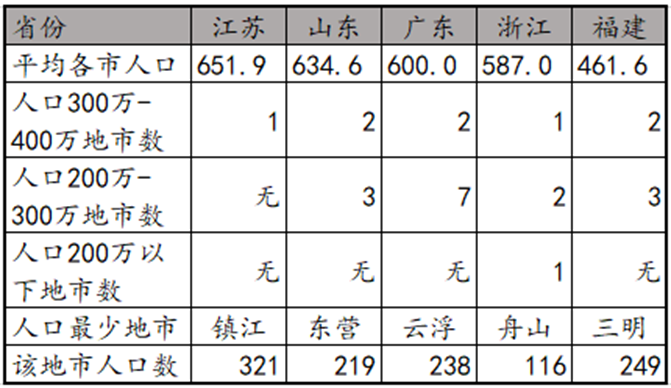
Core Viewpoint - Jiangsu Province is highlighted as a model of balanced regional development in China, with all its prefecture-level cities ranking in the top 100 for GDP, a feat unmatched by other provinces [1][8]. Group 1: Population and City Structure - Jiangsu has the highest average population per prefecture-level city among five provinces, with an average of 651.9 thousand people, and it is the only province without cities with populations below 3 million [4][7]. - The absence of cities with populations below 3 million in Jiangsu contributes to its cities all ranking in the top 100 for GDP, unlike other coastal provinces that have smaller cities [4][5]. Group 2: Geographic and Economic Advantages - Jiangsu's unique geographic conditions, being predominantly flat and water-rich, allow for high population density and balanced distribution, facilitating industrial development [7][14]. - The province's transportation infrastructure, including its extensive river and canal systems, significantly enhances its industrial capabilities, with cargo throughput estimated at 28.5 million tons, surpassing that of Shanghai and Zhejiang combined [10][11]. Group 3: Industrial Development - Jiangsu's industrialization is supported by low-cost land, transportation, and labor, making it an attractive location for industries to thrive [9][14]. - The province has successfully transferred industries from southern Jiangsu to northern regions, leveraging its favorable geographic conditions for industrial growth [12][14]. Group 4: Comparisons with Other Provinces - Other provinces face challenges in replicating Jiangsu's model due to less favorable geographic conditions, leading to industrialization being concentrated in major cities rather than evenly distributed [15][19]. - The article argues that Jiangsu's balanced development is a result of its natural advantages rather than government policies, contrasting it with the more centralized industrial development seen in provinces like Guangdong and Zhejiang [16][19].

美国贸易代表:美国不能接受中国万亿美元的贸易顺差3
Sou Hu Cai Jing· 2025-05-27 15:10
Core Viewpoint - The article discusses the growing trade surplus of China, which reached nearly $1 trillion last year, and the implications this has for U.S.-China relations, highlighting the U.S. concerns over China's manufacturing dominance and its impact on American industries [3][12][15]. Trade Surplus - Trade surplus is defined as a situation where a country's exports exceed its imports, with China achieving a trade surplus close to $1 trillion last year [3]. - China's ability to export such a large volume of goods is attributed to its scale of manufacturing and cost control, which has made its products attractive to global buyers [3][12]. U.S. Perspective - The U.S. perceives China's reliance on manufacturing as a deviation from previous development paths, leading to concerns about global demand insufficiency rather than overcapacity [4][12]. - The decline of U.S. industrial power post-World War II has contributed to wealth disparity and dissatisfaction among American blue-collar workers, who feel marginalized by globalization [4][5][10]. Economic and Security Concerns - The U.S. is motivated by economic and security concerns, recognizing that industrial capacity is closely linked to military manufacturing capabilities [6][12]. - Events like the COVID-19 pandemic and the Russia-Ukraine conflict have heightened U.S. awareness of the risks associated with over-reliance on foreign supply chains [6][12]. Comparative Advantage Theory - The article references the comparative advantage theory, suggesting that while countries should specialize in their strengths, China's broad manufacturing capabilities have led to a convergence of advantages, creating competitive pressures on developed nations [8][9]. - The fear is that if China excels in high-end manufacturing, particularly in semiconductors, it could undermine the remaining industrial advantages of developed countries like the U.S. [9][12]. Globalization and Competition - The article posits that as comparative advantage theories fail, globalization may devolve into a zero-sum game, leading to intensified competition and trade friction [13][14]. - China's significant trade surplus is viewed as a threat to the industrial bases of developed countries, prompting fears of a strategic shift in global manufacturing [14][15]. Future Implications - As tensions rise, China is encouraged to expand its domestic market and reduce reliance on Western economies, while seeking new emerging markets [15][16]. - The article concludes that the competition between the U.S. and China is a natural response to the evolving global economic landscape, where both nations must adapt to new realities [16].

米兰报告的迷思——问题、目标与路径
Di Yi Cai Jing· 2025-05-06 06:35
Group 1 - The core issue identified in the Milan Report is the long-term overvaluation of the US dollar, which negatively impacts US export competitiveness and manufacturing development [2][4] - The report suggests that the high valuation of the dollar is a result of past US government policies aimed at maintaining a strong dollar, rather than actions taken by other countries [2][3] - The report's proposed solutions, such as currency devaluation of exporting countries to offset tariff-induced price increases, contradict its own premise and may exacerbate the dollar's overvaluation [2][6] Group 2 - The report's notion that bringing manufacturing back to the US aligns with the desires of the American workforce is flawed, as younger generations are less inclined to pursue factory jobs [3][4] - The historical context of US industrialization is tied to excessive financialization, which has led to a lack of innovation and competitiveness in the manufacturing sector [4][5] - The report acknowledges the issue of deindustrialization but fails to provide a viable path for reindustrialization that addresses the underlying economic challenges [4][6] Group 3 - The proposed "three-step" approach in the report includes using tariffs to create initial shocks, forming alliances similar to the Plaza Accord, and implementing systematic containment of strategic rivals [6][7] - The reliance on tariffs as a negotiation tool risks escalating global trade tensions, reminiscent of the Smoot-Hawley Tariff Act, which had severe economic repercussions [6][7] - The report's strategy of linking security guarantees with trade and finance may lead to coercive alliances, undermining the credibility of the US in international trade agreements [6][7]
专家:美国抛弃国际自由贸易规则 或加速全球贸易体系重构 | 国际识局
Zhong Guo Xin Wen Wang· 2025-04-22 03:19
中新网4月22日电(记者陈彩霞)"美国总统特朗普对关税的错误理解,导致他做出了一系列错误决定, 对全球资本市场、股市及债市造成严重冲击,将美国单边霸凌主义表现得淋漓尽致。"中国社科院国家 全球战略智库国际政治研究部主任赵海在接受中新网采访时如是说道。 赵海认为,目前中美双方在沟通层面存在着重大障碍,而这些障碍"明显是美方制造出来的"。 赵海强调,美国发起的关税战短期内遭遇强烈反弹,导致美国内市场陷入混乱,民众抗议不断,其阵营 内部也出现分裂——代表华尔街资本的美国亿万富翁马斯克与"美国优先"派代表、白宫贸易和制造业高 级顾问彼得·纳瓦罗激烈对立。 "面对各方压力,特朗普被迫调整策略,将关税政策仓促退让包装成'抬价后谈判'的既定计划,试图通 过施压换取他国让步,并最终将矛头集中指向中国。"赵海说道。 针对美"对等关税"一再升级,中方先后出台一系列反制措施,有力回击经济霸凌。 当地时间4月18日,美国哥伦比亚广播公司援引多名消息人士透露,由于特朗普政府对中国商品加征的 畸高关税将导致供应链危机,特朗普政府内部已开始讨论组建一个工作组,以便在未能与中国政府谈判 取得突破的情况下紧急处理这些问题。 他分析称,中美关系 ...
越南韩国对华加征关税!为什么越来越多国家害怕中国制造?
Sou Hu Cai Jing· 2025-04-14 10:40
就在特朗普宣布对华加征104%的超级关税之后,欧盟委员会主席冯德莱恩也在电视讲话中称,欧盟对此表示关切,呼吁双方理性克制。 最重要的是,冯德莱恩说,"我们也会密切关注这些关税可能带来的间接影响,因为我们无法消化全球的产能过剩,也不会接受对我们市场的倾销行为。" 二元对立的全球化,就更需要我们理解对方的意图和想法,这一点有助于我们更好理解今天这个世界。 就在特朗普宣布对等关税前一天,还发生了一件大事,但由于特朗普的对等关税过于炸裂,导致很多人都没有注意到这件事。 没有注意到,并不代表着这件事不存在。 4月1日,越南对产自我国和韩国的普碳及合金钢镀层板卷做出反倾销初裁,初步裁定对涉案产品征收临时反倾销税,其中我国为0至37.13%。 韩国也紧随其后发布公告,决定对我国生产的厚板征收最高38%的关税,韩国方面称,此举旨在应对近四五年来,我国日益深化的"低价倾销式钢铁出口"。 所谓的倾销当然是胡说八道,但越南和韩国的反应,并非偶然。 事实上,对我国商品出口的担忧,并不是目前才发生的;在2018年,特朗普第一个任期时,就提到了这一点。 在新冠病毒时期后,欧盟又率先提出了"去风险化",要在供应链上摆脱对我国商品的依赖。 ...


独家专访斯蒂芬·罗奇:美国2026年将面临显著衰退风险,产业链回流的想法不切实际
2 1 Shi Ji Jing Ji Bao Dao· 2025-03-26 07:49
Economic Outlook - The risk of a significant recession in the U.S. by 2026 is increasing due to rising uncertainty surrounding Trump's policies, despite the current economic stability [2][5][6] - Trump's claim that the U.S. economy is "detoxifying" is criticized as a political excuse rather than an economic term, with emphasis on using classic indicators like unemployment rates and consumer spending to assess economic health [2][5][6] Market Dynamics - The U.S. stock market is highly concentrated, with seven major stocks accounting for 34% of the total market value, indicating a bubble risk similar to the early 2000s internet bubble [2][7] - Current market enthusiasm driven by AI advancements is deemed unsustainable, with potential for significant corrections in the future [2][7] Trade Policies and Global Impact - Trump's high tariffs on steel and aluminum have prompted retaliatory measures from the EU and Canada, increasing global production and distribution costs [3][10] - The idea of forcing supply chains to return to the U.S. is viewed as impractical due to the complexity and high costs involved, which could ultimately harm American consumers [3][14] AI Competition - The competition in AI is more intense than previously acknowledged, with breakthroughs like DeepSeek posing significant challenges to U.S. companies due to their low-cost advantages [1][15] - The shift towards more efficient production models is anticipated as countries adapt to the competitive landscape shaped by advancements in AI [15][16] Historical Context - The current trade policies echo historical mistakes, such as the Smoot-Hawley Tariff, which led to a global trade war and economic depression in the 1930s, highlighting a lack of historical awareness in current U.S. policy [17]