
混合所有制改革

Search documents
重大资产重组!A股公司公告,不停牌!
中国基金报· 2025-12-07 01:18
Core Viewpoint - Zhongneng Electric plans to acquire control of three companies, which is expected to constitute a significant asset restructuring [2][5][11]. Group 1: Acquisition Details - Zhongneng Electric intends to purchase 65% equity and related debts of Shandong Dachai Electric Co., Shandong Dachai High Voltage Switch Co., and Shuifa Chixiang Electric (Shandong) Co. for a total transaction value of approximately 857 million yuan [2][7]. - The acquisition will be conducted through public bidding at the Shandong Property Rights Exchange, with a total base price of 857 million yuan for the three assets [7][8]. - The company plans to fund the entire transaction with self-raised funds, without issuing new shares [7][8]. Group 2: Financial Performance of Target Companies - The three target companies show significant financial performance divergence, with combined projected revenues for 2024 reaching approximately 1.154 billion yuan, which represents 100.56% of Zhongneng Electric's expected revenue for the same period [7][9]. - Dachai Electric reported a net loss of 30.83 million yuan, while Dachai High Voltage also incurred a loss of 14.14 million yuan; in contrast, Shuifa Chixiang achieved a net profit of 10.54 million yuan [9][10]. - The total assets of the target companies amount to approximately 1.42 billion yuan, with net assets of about 747 million yuan [8][9]. Group 3: Strategic Rationale - The acquisition aims to fill the product gap in the high-voltage sector, enhancing Zhongneng Electric's product offerings and aligning with its strategic shift from medium-voltage to high-voltage products [5][11][12]. - The target companies specialize in high-voltage transformers and switches, which are critical for the new power system construction, thus positioning Zhongneng Electric to better compete in the market [11][12]. - The acquisition will provide access to established customer resources and qualifications in the mainstream power market, particularly with State Grid and other major clients [12][13].



中能电气拟竞拍三家公司控制权,预计构成重大资产重组
Zhong Guo Ji Jin Bao· 2025-12-06 15:34
Core Viewpoint - Zhongneng Electric plans to acquire control of three companies, which is expected to constitute a significant asset restructuring [1][6] Group 1: Acquisition Details - Zhongneng Electric intends to purchase 65% equity and related debts of Shandong Dachai Electric Co., Ltd., Shandong Dachai High Voltage Switch Co., Ltd., and Shuhua Chixiang Electric (Shandong) Co., Ltd. [1][3] - The total base price for the three transactions is set at 857 million yuan [4] - The payment for the acquisition will be entirely funded by the company's own resources, without issuing new shares [5] Group 2: Financial Performance of Target Companies - The three target companies show significant financial performance divergence, with total projected revenue for 2024 estimated at approximately 1.154 billion yuan, representing 100.56% of Zhongneng Electric's expected revenue [6][8] - Dachai Electric reported a net loss of 30.83 million yuan, while Dachai High Voltage incurred a net loss of 14.14 million yuan; in contrast, Shuhua Chixiang achieved a net profit of 10.54 million yuan [8] - The total assets and net assets of the target companies are 1.42 billion yuan and 747.27 million yuan, respectively [7] Group 3: Strategic Rationale - The acquisition aims to fill the gap in Zhongneng Electric's product offerings in the high-voltage sector, which is crucial for the company's strategic expansion [9][10] - The target companies specialize in high-voltage transformers and switches, which aligns with Zhongneng Electric's goal to enhance its competitive position in the high-voltage market [9][10] - The acquisition will provide access to established customer resources and qualifications in the mainstream power market, particularly with State Grid [10] Group 4: Transaction Process - The board of Zhongneng Electric approved the proposal to participate in the bidding process and agreed to pay a deposit of up to 100 million yuan [6] - The transaction is subject to approval from the company's extraordinary general meeting [6]
国资旗下洛轴股份创业板IPO获受理,2025上半年净利超上年全年
Sou Hu Cai Jing· 2025-12-02 02:02
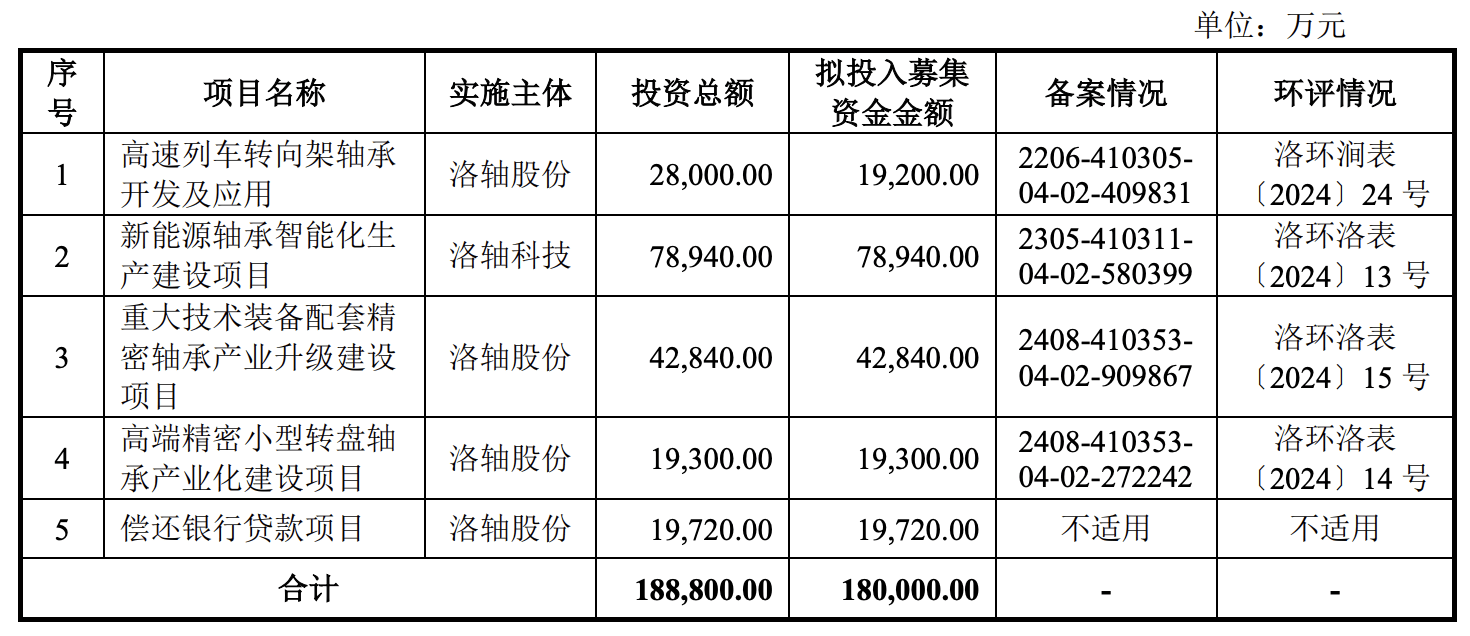
Group 1 - Luoyang Bearing Group Co., Ltd. (referred to as Luoyang Bearings) has received acceptance for its IPO on the ChiNext board, with CITIC Securities as the sponsor [3] - Established in 2004 with a registered capital of 600 million yuan, Luoyang Bearings is a comprehensive manufacturing enterprise in China's bearing industry, with major clients including CRRC, BYD, and Envision Energy [3] - The company plans to raise 1.8 billion yuan for four major projects, including the development and application of high-speed train bogie bearings, as well as to repay bank loans [4] Group 2 - As of December 31, 2022, the total assets of Luoyang Bearings were 870.28 million yuan, with a net profit of -55.44 million yuan [5] - The company has shown a steady increase in operating income from 3.34 billion yuan in 2022 to an expected 4.67 billion yuan in 2024 [5] - In 2023, the company has benefited from product structure optimization, downstream market demand release, and improved operational efficiency, leading to a steady increase in performance, with net profit in the first half of 2025 exceeding the total for the previous year [6]

IPO雷达|洛轴股份递表深交所!2亿元募资偿还贷款,应收账款、负债率高悬
Sou Hu Cai Jing· 2025-11-29 05:25
Core Viewpoint - Luoyang Bearing Group Co., Ltd. (referred to as "Luoyang Bearings") submitted its prospectus to the Shenzhen Stock Exchange, aiming to raise 1.8 billion yuan for various projects and debt repayment [1] Group 1: Fundraising and Investment Projects - The company plans to use the raised funds for the development and application of high-speed train bogie bearings, intelligent production of new energy bearings, upgrading of precision bearings for major technical equipment, and industrialization of high-end precision small turntable bearings [1][2] - A total of 1.97 billion yuan will be allocated for repaying bank loans [1] Group 2: Financial Performance - During the reporting period from 2022 to the first half of 2025, Luoyang Bearings achieved operating revenues of 3.342 billion yuan, 4.441 billion yuan, 4.675 billion yuan, and 2.821 billion yuan, respectively [2] - The net profit attributable to shareholders was -67 million yuan, 231 million yuan, 251 million yuan, and 257 million yuan for the same periods [2] Group 3: Business Operations and Market Position - Luoyang Bearings is one of the largest comprehensive bearing manufacturing enterprises in China, focusing on the R&D, production, and sales of bearings and related components [4] - The sales revenue from finished bearings during the reporting period was 3.060 billion yuan, 4.170 billion yuan, 4.379 billion yuan, and 2.684 billion yuan, accounting for 94.58%, 96.43%, 96.69%, and 97.55% of the main business revenue, respectively [4] Group 4: Supply Chain and Related Party Transactions - The company procured bearing steel and other raw materials from its related party, Jiyuan Steel, with procurement amounts of 603 million yuan, 700 million yuan, 714 million yuan, and 322 million yuan, representing 16.91%, 16.70%, 16.81%, and 12.54% of total procurement, respectively [4] - Jiyuan Steel is the largest supplier for Luoyang Bearings in 2023 and 2024 [4] Group 5: Financial Risks and Debt Management - The company has a high debt level, with asset-liability ratios of 84.57%, 82.19%, 79.43%, and 80.74% during the reporting period [5] - The company relies heavily on debt financing for its major development and fixed asset investments, which may lead to financial pressure and repayment risks if not managed effectively [5] Group 6: Shareholder Issues - A 4.995% stake held by a major shareholder, AVIC Industry Investment, has been frozen by the court until June 16, 2028, which may pose risks to the company's shareholding structure [6][8]
东航物流(601156):首次覆盖报告:航空物流领先服务商,业绩稳健增长可期待
ZHONGTAI SECURITIES· 2025-11-25 11:12
Investment Rating - The report assigns an "Outperform" rating for the company, indicating a "Buy" recommendation for investors [2]. Core Insights - The company is a leading air logistics service provider backed by China Eastern Airlines Group, with a stable operating profit and significant growth in comprehensive logistics services [4][5]. - The air express business serves as the foundation, while comprehensive logistics solutions represent a secondary growth curve [4][5]. - The company has a robust network of air routes, covering 16 international cities and reaching 1,000 destinations globally [4][17]. - The comprehensive logistics solutions have seen a notable increase in revenue share, driven by the rapid growth of cross-border e-commerce logistics solutions [4][18]. Financial Performance - The company achieved a revenue of 20,621 million yuan in 2023, with a projected increase to 24,056 million yuan in 2024, reflecting a year-on-year growth of 17% [2]. - The net profit attributable to shareholders is expected to rise from 2,488 million yuan in 2023 to 2,688 million yuan in 2024, marking an 8% increase [2]. - The earnings per share (EPS) is projected to be 1.57 yuan in 2023, increasing to 1.69 yuan in 2024 [2]. Business Segments - The company's main business segments include air express, ground comprehensive services, and comprehensive logistics solutions [15][4]. - The air express segment is characterized by high gross margins and significant operational advantages, with a gross margin of 18.91% in H1 2025 [4][40]. - Ground comprehensive services benefit from a strong market position at Pudong Airport, achieving a gross margin of 34.19% in H1 2025, significantly higher than competitors [4][47]. - Comprehensive logistics solutions are expanding rapidly, with cross-border e-commerce solutions growing by 41% in export volume and 48% in weight in 2024 [58][62]. Market Outlook - The supply of cargo aircraft remains tight, while demand for air logistics is expected to improve due to economic growth and the booming cross-border e-commerce market [75][85]. - The report forecasts that the net profit for the company will reach 26.29 billion yuan in 2025, 28.10 billion yuan in 2026, and 31.15 billion yuan in 2027, with corresponding P/E ratios of 9.8X, 9.2X, and 8.3X [4][5].

鼎和财险的转型阵痛与挑战:从“电网自保”到市场化求生
Hua Xia Shi Bao· 2025-11-24 09:20
Core Viewpoint - The recent transfer of 6.5% equity from Southern Power Grid Finance Co. to Southern Power Grid Industrial Finance Holding Group highlights the ongoing changes in the ownership structure of Dinghe Property Insurance, which is facing challenges in its market-oriented transformation despite a history of profitability [2][4]. Group 1: Ownership and Financial Performance - Dinghe Property Insurance, established in 2008, has seen its premium income grow from 121 million to 7.535 billion by 2024, maintaining a net profit streak for over a decade [3]. - The company’s net profits from 2021 to 2024 were 1.026 billion, 1.082 billion, 1.225 billion, and 700 million respectively, indicating fluctuations in profitability [3]. - Related party transactions with power sector stakeholders contributed significantly to premium income, amounting to 2.593 billion, 2.826 billion, and 3.06 billion from 2021 to 2023, representing 47.40%, 44.49%, and 45.13% of total premium income [3]. Group 2: Market Position and Challenges - The unique ownership structure of Dinghe Property Insurance provides stable business sources but limits its market development potential [4]. - The company initiated a mixed-ownership reform in 2021, raising 6.451 billion through the introduction of three strategic investors, changing its status from a wholly-owned subsidiary to a diversified equity entity [4]. - The company’s capital base was recently increased from 4.643 billion to 6 billion through a capital reserve conversion, a rare practice in the industry [5]. Group 3: Management and Strategic Direction - Dinghe Property Insurance has experienced stability in management, with only four chairpersons and five general managers over 17 years, reflecting a reliance on shareholder-appointed executives [5][6]. - The introduction of a market-oriented management system in 2020 marked a significant shift, with the first externally recruited general manager, Jin Peng, breaking the previous internal leadership pattern [6]. - The current leadership transition to Liu Dong, an experienced insurance professional, signals a commitment to further professionalize operations [6]. Group 4: Risk Exposure and Future Goals - The company faces significant risks due to its close ties to the power sector, as evidenced by increased claims from natural disasters in 2024, leading to a 29.41% rise in claims expenditures to 4.268 billion [7]. - Dinghe Property Insurance set an ambitious "10020" development goal for 2025, aiming for 10 billion in premium income and 2 billion in net profit, but is currently falling short of these targets [8]. - The company’s cost structure has been under pressure, with claims expenses constituting 65% of total expenditures in 2024, alongside rising commission and management costs [8]. Group 5: Market Independence and Future Transformation - Dinghe Property Insurance has yet to demonstrate its ability to operate independently from its shareholder support, raising questions about its market expansion capabilities [9]. - The challenge lies in balancing the advantages of shareholder resources while establishing a competitive market position, crucial for the company's future development [9].

国资委部署下半年国企改革重点 将推2到3家央企集团层面实施股权多元化
Mei Ri Jing Ji Xin Wen· 2025-11-24 04:09
Core Insights - The State-owned Assets Supervision and Administration Commission (SASAC) held a video conference to summarize the first half of the year and outline key tasks for the second half, emphasizing the continuous growth of state-owned enterprises (SOEs) and central enterprises (CEs) in revenue and profit [1] - In the first half of the year, the revenue of SOEs reached 25.7 trillion yuan, a year-on-year increase of 10.6%, while total profit amounted to 1.6509 trillion yuan, up 22.6% [1] - The meeting provided a detailed roadmap for the next steps in SOE reform, including mixed ownership reform, mergers and acquisitions, and market value management [1] Mixed Ownership Reform - Mixed ownership reform has become a key focus, with significant events occurring in the first half of the year, such as China Unicom's board nominations including executives from major private companies like Baidu, JD.com, Alibaba, and Tencent [2] - The railway sector also saw progress, with Tencent and Geely Holdings acquiring a 49% stake in a subsidiary of China Railway [4] - The SASAC plans to advance mixed ownership reform at the group level, with 2-3 central enterprises expected to implement diversified equity structures [4] Strategic Restructuring of Central Enterprises - The SASAC reported progress in the restructuring of central enterprises, including the merger of Wuhan University of Posts and Telecommunications and the China Academy of Telecommunications Technology to form a new entity focused on 5G technology [6][7] - The SASAC aims to promote strategic restructuring in five key sectors: equipment manufacturing, coal, electricity, telecommunications, and chemicals, concentrating state capital in strategic industries [7][8] Value Management and Shareholder Returns - SASAC emphasized the importance of value management to enhance shareholder returns, advocating for a focus on intrinsic value and the integration of quality assets [9] - The meeting outlined a roadmap for improving value management practices, including monitoring listed companies and encouraging mergers to enhance value [9][10] - The SASAC also suggested linking executive compensation to stock performance to align management interests with shareholder value [10]
宁波建工:发行股份购买资产获上交所审核通过 进一步完善建筑业产业链
Zheng Quan Shi Bao Wang· 2025-11-20 13:33
Core Viewpoint - Ningbo Construction's acquisition of 100% equity in Ningbo Traffic Engineering Construction Group for 1.527 billion yuan is a strategic move to enhance competitiveness and resolve industry competition issues, approved by the Shanghai Stock Exchange [1][2]. Group 1: Transaction Details - The transaction involves issuing shares to acquire Ningbo Traffic Engineering Construction Group, with a transaction price of 1.527 billion yuan [1]. - The share issuance price is set at 3.49 yuan per share, with an estimated issuance of approximately 438 million shares, representing 28.71% of the post-issue total share capital [1]. - The controlling shareholder, Ningbo Transportation Investment Holding Group, commits to a 36-month lock-up period for the acquired shares, reflecting confidence in the company's long-term development [1]. Group 2: Strategic Significance - Ningbo Traffic Engineering Construction Group holds rare qualifications in comprehensive transportation construction, including top-level qualifications in highway, port, municipal, and railway engineering [2]. - The acquisition will consolidate various business segments under Ningbo Construction, enhancing independence and resolving competition issues within the industry [2]. - The integration of resources between Ningbo Construction and Ningbo Traffic Engineering will optimize internal resource allocation and strengthen the company's overall service capabilities in civil engineering [2]. Group 3: Market Implications - The transaction aligns with national policies promoting high-quality infrastructure development and reflects the trend in the construction industry [3]. - As the 14th Five-Year Plan approaches, the transportation infrastructure sector is expected to experience new growth opportunities, positioning Ningbo Construction favorably for undertaking major projects and expanding market reach [3].

破局与赋能:城投公司转型的动因分析与路径探索
Zheng Quan Shi Bao Wang· 2025-11-18 03:31
Group 1: Driving Factors for Urban Investment Transformation - Urban investment companies in China are under unprecedented pressure to transform from traditional government financing platforms to market-oriented, industrial entities due to external policy, debt, and market pressures [1][2][3] - The People's Bank of China and other departments have mandated that urban investment companies fully "exit the platform" by June 2027, detaching from government financing functions [2] - As of June 2025, urban investment companies had a total interest-bearing debt of 67.82 trillion yuan, with high financing costs in key provinces [2] Group 2: Internal Demand for Sustainable Development - The traditional reliance on government credit and fiscal support is unsustainable, necessitating a shift towards market-oriented and industrialized operations for survival [3] - The transformation allows urban investment companies to diversify income sources, improve cash flow structures, and enhance resilience against economic cycles [3] Group 3: Transformation Paths for Urban Investment Companies - Urban investment companies need to adapt to tightened policies and market changes through four main transformation paths: business structure, asset and capital, management mechanism, and debt resolution [4] - The first path involves shifting focus from infrastructure construction to becoming urban operation service providers, regional development operators, and resource integrators [5][6][8] - The second path emphasizes asset securitization and mixed-ownership reforms to optimize capital structures and reduce debt ratios [9] - The third path focuses on modernizing management mechanisms to improve efficiency and reduce administrative burdens [10][11] - The fourth path involves debt restructuring and financial transformation to mitigate risks and enhance operational capabilities [12] Group 4: Significance of Urban Investment Transformation - The transformation of urban investment companies is crucial for implementing national strategies and promoting local economic development [13][14] - It serves as a core engine for upgrading local economies by optimizing resource utilization and enhancing resilience against economic fluctuations [15] - The transformation also represents a key practice in deepening state-owned enterprise reforms at the local level, addressing common issues such as administrative dominance and weak profitability [16]
平台线上低价卖黄金却“延迟发货” 有人买了上百万元!要与国企混改?涉事国企:已全面停止混改工作
Mei Ri Jing Ji Xin Wen· 2025-11-08 15:18
10月29日,《每日经济新闻》报道深圳优联网讯网络科技有限公司(以下简称"深圳优联")旗下的优联 云购商城长期低价线上销售黄金,且多次出现延迟发货问题。 2024年以来,优联云购自称销售新疆"地方补贴产品",消费者购买后可返U豆(类似购物积分),并可 用U豆低价购买黄金。 今年8月前后,优联云购对黄金"延迟发货",公司称将与国企新疆昆仑天和农业科技发展有限公司(以 下简称"昆仑天和")开展混合所有制改革,需核实"补贴"等。 11月8日,《每日经济新闻》记者从昆仑天和关联方了解到,昆仑天和已就相关事件委托律师发布声 明,主要内容包括:昆仑天和是深圳优联的供应商之一,向深圳优联供应新疆地方特色产品,公司与消 费者不产生直接法律关系,公司也从未参与优联云购的运营管理、用户服务、销售模式制定、营销策略 决策及相关促销活动等工作。昆仑天和向深圳优联供应的货物没有任何政府补贴。关于混合所有制改革 事宜,公司前期仅有初步意向,目前已全面停止拟与深圳优联的混改工作。 另据消费者提供的资料,深圳市场监管部门11月回应消费者表示,企业(深圳优联)涉嫌诈骗和非法集 资。 另一方面,记者以消费者身份与深圳优联工作人员对话后,公司一方 ...