生态环境分区管控

Search documents
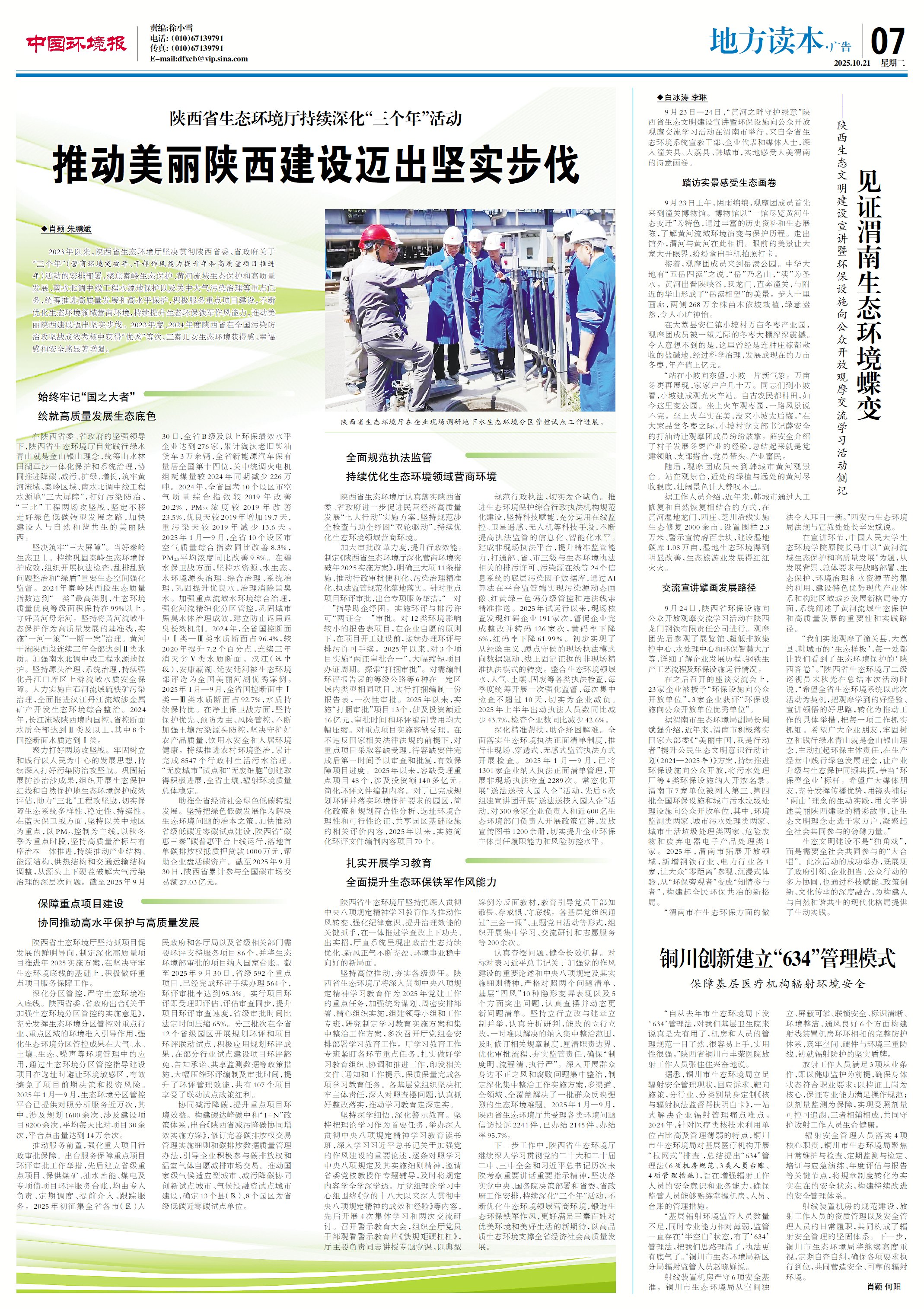
持续深化“三个年”活动,推动美丽陕西建设迈出坚实步伐
Zhong Guo Huan Jing Bao· 2025-10-21 01:24
Core Viewpoint - The Shaanxi Provincial Ecological Environment Department is actively implementing the "Three Years" initiative to enhance the business environment, improve the capabilities of officials, and promote high-quality projects, focusing on ecological protection and pollution control, thereby advancing the construction of a beautiful Shaanxi [2][4][14]. Group 1: Ecological Protection and High-Quality Development - The department emphasizes the integration of ecological protection and high-quality development, particularly in the Qinling Mountains and the Yellow River basin, while also addressing air pollution in the Guanzhong area [2][4][14]. - In 2023 and 2024, Shaanxi Province received an "excellent" rating in the national pollution prevention and control assessment, significantly enhancing the ecological environment satisfaction among residents [2][4]. Group 2: Pollution Control and Environmental Quality - The ecological quality index for the Qinling section in Shaanxi is expected to reach the highest category by 2024, with over 99% of the area maintaining good ecological quality [4][15]. - The Yellow River's water quality in Shaanxi has consistently met Class II standards for three consecutive years, with ongoing efforts to protect water sources [4][15]. - By 2024, 96.4% of national control sections in the province are projected to meet Class I to III water quality standards, improving by 7.2 percentage points since 2020 [16]. Group 3: Economic and Administrative Reforms - The department is implementing reforms to streamline administrative processes, including a "two-in-one" approval system for environmental assessments and pollutant discharge permits, significantly reducing project approval times [5][23]. - As of September 2025, 95.3% of provincial key projects have completed environmental assessment procedures, with a 65% reduction in approval times compared to legal requirements [19][23]. Group 4: Green and Low-Carbon Development - Shaanxi is promoting green and low-carbon development as a fundamental strategy to address ecological issues, with initiatives like the "Carbon Benefit Sanqin" platform facilitating carbon asset management for enterprises [17]. - By September 2025, the province has participated in national carbon market transactions totaling 2.703 billion yuan [17]. Group 5: Enhancing Business Environment - The department is committed to optimizing the business environment in the ecological sector, implementing measures to support private sector development and reduce burdens on enterprises [22][24]. - A comprehensive administrative enforcement system is being established to enhance regulatory efficiency and reduce the compliance burden on businesses [24][25].

山东建立起覆盖全域的生态环境分区管控体系,为发展树立“绿色标尺”
Da Zhong Ri Bao· 2025-09-30 01:07
Core Viewpoint - Shandong has established a comprehensive ecological environment zoning and control system to set a "green benchmark" for development [1] Group 1: Project Implementation - The "Liaohotou to Jinan" project aims to meet approximately 100 million square meters of heating demand in Jinan, while minimizing environmental impact during construction [2] - The project team utilized the ecological environment zoning control information platform for digital analysis, ultimately selecting a route that reduced investment and environmental impact [2][3] Group 2: Ecological Environment Zoning Control - Shandong initiated ecological environment zoning control in late 2018, categorizing land into various environmental control units based on "three lines and one list" [3] - The zoning system includes 614 priority protection units, 1,187 key control units, and 949 general control units, totaling 2,750 control units across the province [3] Group 3: Project Site Selection - The ecological zoning map allows for efficient project site selection, providing clear guidelines on which areas are suitable for development without harming the environment [4] - The Jining New Materials Industrial Park has implemented strict zoning control, resulting in the rejection of nine high-energy-consuming projects and the acceptance of two green low-carbon projects [4] Group 4: Benefits to Enterprises - Since the launch of the ecological environment zoning control information platform in 2021, it has been accessed over 32,000 times, aiding nine key projects with a total investment of 340.4 billion yuan [5] - The platform has helped avoid 35 ecological sensitive areas and optimized project routes, reducing the length of ecological protection line crossings by 38.58 kilometers [5]
高质量完成“十四五”规划丨以生态环境高水平保护推动高质量发展
Xin Hua She· 2025-09-23 00:33
Core Viewpoint - The Chinese government is making significant strides in ecological and environmental improvements during the "14th Five-Year Plan" period, transitioning from pollution control to comprehensive construction of a beautiful China [1][6]. Environmental Quality Improvement - Since the beginning of the "14th Five-Year Plan," the ecological environment quality has continuously improved, with PM2.5 concentrations in cities expected to drop to 29.3 micrograms per cubic meter by 2024, a 16.3% decrease from 2020 [2]. - The proportion of good air quality days has increased to 87.2%, up by 2.4 percentage points from 2020, and the proportion of good water quality monitoring points has exceeded 90% for the first time [2]. Pollution Control Achievements - Significant progress has been made in pollution prevention, including the completion of clean heating transformations for 41 million households and the elimination of nearly 20 million high-emission vehicles during the "14th Five-Year Plan" [2]. - Over 360,000 river and 63,000 sea pollution outlets have been identified, with remediation completion rates of 90% and 93.3% for major river basins and key bays, respectively [2]. Solid Waste Management - The solid waste pollution prevention efforts have shown notable results, including a 58.8% increase in hazardous waste disposal capacity and a 72.4% increase in municipal waste incineration capacity since the end of the "13th Five-Year Plan" [3]. - The Ministry of Ecology and Environment is focusing on illegal dumping and disposal of solid waste, including hazardous waste and electronic waste [3]. Green Development Initiatives - The government is promoting green low-carbon development, establishing the world's largest carbon trading market, and initiating a voluntary greenhouse gas reduction trading market [2]. - A comprehensive policy system has been developed to enhance green productivity and optimize industrial structure, with a notable increase in environmental assessments for wind and new energy vehicle projects [4]. Ecological Protection and Regulation - A two-level, three-category ecological environment zoning control system has been established, with over 40,000 control units defined for differentiated management [5]. - The focus is on high-level protection to foster new productive forces and enhance environmental governance [4]. Beautiful China Construction - The construction of a beautiful China is a key component of the national rejuvenation dream, with pilot projects initiated in regions like Beijing-Tianjin-Hebei and the Yangtze River Delta [6]. - The goal is to achieve comprehensive coverage in environmental governance and transformation of development methods by 2027, with a focus on practical results rather than formalism [6].
生态环境部:分区管控,对于污染较轻的行业尝试取消环评审批
Nan Fang Du Shi Bao· 2025-09-19 06:57
Core Viewpoint - The Chinese government is enhancing ecological environment management through a comprehensive zoning control system, which aims to promote high-quality development while ensuring environmental protection [1][2][3]. Group 1: Ecological Environment Zoning Control System - The "two-level, three-category, one-list" ecological environment zoning control system has been established, achieving full regional coverage and differentiated access [1]. - Over 40,000 control units have been delineated across provinces and cities, categorized into "priority protection, key control, and general control" [1]. - A system has been developed to automatically assess environmental compliance based on project location and industry type, facilitating government management, corporate investment, and public oversight [1]. Group 2: Relationship Between Zoning Control, Environmental Impact Assessment, and Emission Permits - Zoning control, environmental impact assessment (EIA), and emission permits form an interconnected environmental management chain, clarifying access requirements for high-quality development [2]. - Zoning control encourages polluting industries to cluster in designated parks with adequate pollution control facilities, simplifying EIA processes for new projects [2]. - For less polluting industries, EIA approvals are being eliminated in favor of direct management through emission permits, with 31 industries currently piloting this approach [2]. Group 3: Future Plans for Ecological Environment Management - Future efforts will focus on optimizing the zoning control system to enhance precision, integration, and practicality [3]. - A five-year periodic adjustment of zoning control plans will be implemented, along with improved coordination with land spatial planning policies [3]. - The application of artificial intelligence will be promoted to enhance grassroots environmental management capabilities, supporting high-quality development and the construction of a beautiful China [3].
我省生态环境分区管控体系初步形成全域覆盖
Xin Hua Ri Bao· 2025-09-14 23:19
Core Viewpoint - The implementation of ecological environment zoning and control aims to safeguard regional ecological functions and improve environmental quality through differentiated and precise management [1][2] Group 1: Ecological Environment Zoning and Control System - Jiangsu has divided its land and sea into 4,570 control units, with 4,268 on land and 302 at sea, each equipped with an "ecological environment access list" that specifies entry requirements and regulates development activities [1] - The "Jiangsu Provincial Ecological Environment Zoning and Control Comprehensive Service" platform has been established to support this system, integrating vector data from all control units and facilitating data sharing across various levels of government [1] - The platform has over 6,700 registered users, with a total of 133,000 visits and 29,000 analysis reports generated, providing public services such as environmental feasibility analysis for site selection [1] Group 2: Impact of Zoning and Control Implementation - Since the introduction of the "Three Lines and One List" ecological environment zoning and control scheme in 2020, the system has optimized the site selection of 102 linear projects, avoiding national ecological protection red lines and provincial ecological space control areas [2] - The initiative has protected 202 important ecological spaces and has either blocked or optimized 281 projects in industries such as chemicals, metallurgy, and electroplating, effectively preventing ecological damage at the source [2]
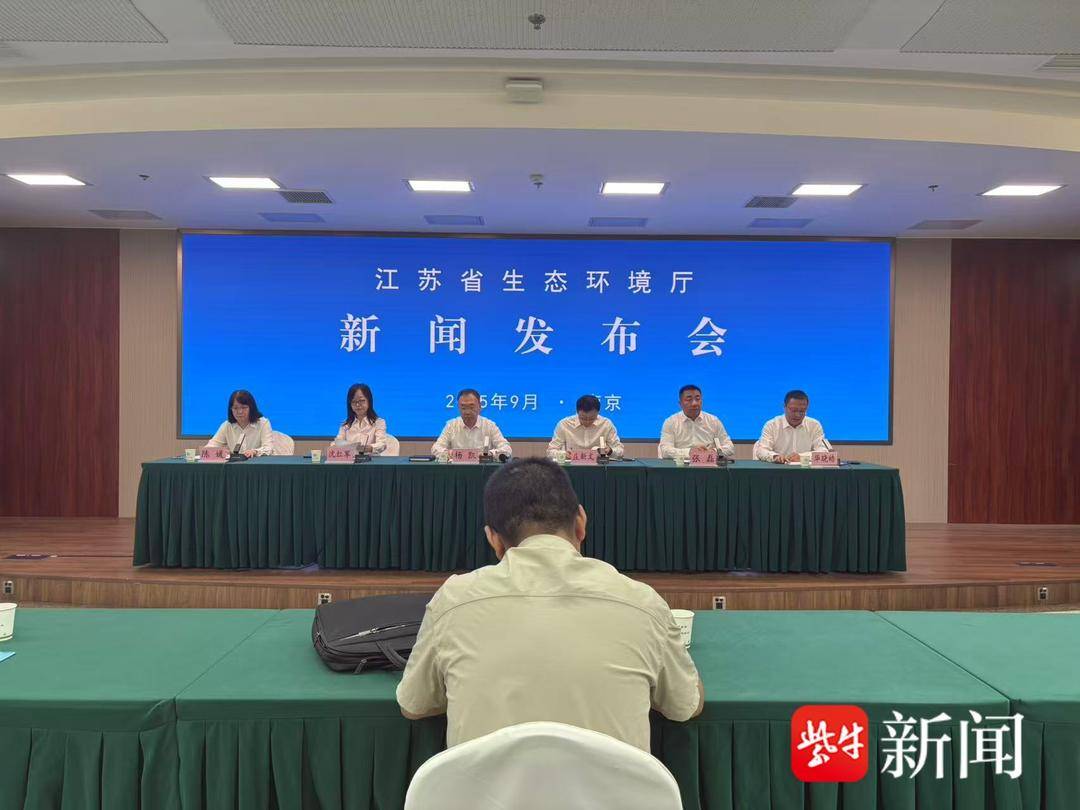
保护了202个重要生态空间,江苏生态环境分区管控成效明显
Yang Zi Wan Bao Wang· 2025-09-12 12:54
Core Viewpoint - The ecological environment zoning and control system in Jiangsu Province is a significant innovation in ecological civilization construction, aimed at implementing differentiated and precise management by region, thereby establishing clear boundaries for development and protection [1][3]. Group 1: Implementation and Progress - Since the implementation of the ecological environment zoning and control system, Jiangsu has optimized the site selection for 102 linear projects, actively avoiding national ecological protection red lines and provincial ecological space control areas, thus protecting 202 important ecological spaces [1][3]. - The Jiangsu Provincial Environmental Protection Department has established a comprehensive service platform for ecological environment zoning and control, aiming for clear management rules and easy access to policy documents and services for enterprises [3]. Group 2: Environmental Quality Improvement - The ecological environment quality in Jiangsu has significantly improved since the implementation of the zoning control system, with the annual average water quality of national monitoring sections reaching excellent levels for three consecutive years [4]. - As of January to August 2025, 92.4% of national monitoring sections' water quality met or exceeded Class III standards, and the overall water quality of the Yangtze River and the Grand Canal in Jiangsu is rated as excellent [4]. - The average concentration of PM2.5 has met the secondary air quality standard for four consecutive years, indicating a steady improvement in air quality [4].
推动城市“再野化”,近距离感受自然
Zhong Guo Huan Jing Bao· 2025-08-26 03:12
Core Concept - Urban "rewilding" is gaining attention as a new concept that respects natural succession and restores ecological integrity, aiming to enhance biodiversity and ecosystem self-sustainability through the reconstruction of key species and their ecological functions [1] Group 1: Value Clarification and Urban Practice - "Rewilding" emphasizes ecological autonomy in urban spaces, aiming to reduce reliance on continuous human management by establishing resilient ecosystems that can self-maintain with minimal intervention [2] - The transition from "landscape greening" to "life system reconstruction" is essential, addressing the issue of over-reliance on artificial management and promoting natural recovery [2] - Establishing "natural recovery priority zones" within ecological protection units can facilitate dynamic transformation of degraded spaces, ensuring a smooth transition from static protection to dynamic restoration [2] Group 2: Ecological Red Lines and Green Bottom Lines - All development activities must adhere to ecological protection red lines to ensure the authenticity and integrity of ecosystems, thereby laying a solid foundation for ecological safety [3] - A comprehensive monitoring network utilizing satellite remote sensing and ground inspections will help manage human activities in red line areas, adjusting management methods based on ecological monitoring data [3] - An accountability mechanism for ecological damage should be established, incorporating red line management into local government assessment systems to ensure compliance with ecological protection standards [3] Group 3: Collaborative Governance - Urban "rewilding" requires a governance structure that promotes horizontal collaboration and vertical integration among multiple departments [4] - Establishing a responsibility checklist and information-sharing platform will facilitate project approval and ecological data management, enhancing overall governance efficiency [4] - A cross-departmental performance evaluation system should include core ecological indicators, driving accountability in governance [4] Group 4: Demonstration Models and System Transformation - Focusing on typical degraded urban spaces, a "pilot first" strategy can be implemented to extract replicable "rewilding" models [5] - Successful examples include the restoration of abandoned mining sites in Huzhou, Zhejiang Province, and biodiversity initiatives in Beijing's Wenyu River Park, showcasing effective practices in urban rewilding [5] - The outcomes from these pilot projects can be summarized and promoted through a systematic approach, transitioning from local practices to a national ecological governance framework [5]
传达学习习近平总书记重要讲话重要指示精神 集思广益编制好上海“十五五”规划 市委常委会举行会议
Jie Fang Ri Bao· 2025-08-23 02:28
Group 1 - The meeting emphasized the importance of studying and implementing Xi Jinping's important speech regarding the 60th anniversary of Tibet Autonomous Region, aiming to contribute to Tibet's long-term stability and high-quality development through targeted assistance [1] - The meeting highlighted the need to incorporate public expectations, expert opinions, and grassroots experiences into the "14th Five-Year Plan" to ensure it aligns with people's wishes and guides economic and social development [2] - The meeting called for a focus on political responsibility and risk management in flood prevention and disaster relief, emphasizing the importance of detailed implementation of safety measures and emergency preparedness [2] Group 2 - The meeting underscored the need to enhance the ecological environment zoning and control system, promoting a balance between economic development and ecological protection [3] - It was noted that a collaborative mechanism across departments and regions should be established to ensure effective implementation of environmental tasks [3]
上海市委常委会传达学习习近平总书记重要讲话和重要指示精神,研究了这些重要事项
Di Yi Cai Jing· 2025-08-22 12:43
Group 1 - The meeting emphasized the importance of implementing Xi Jinping's important speech and directives regarding the 60th anniversary of Tibet Autonomous Region, focusing on enhancing support for Tibet's long-term stability and high-quality development [1][2] - The meeting highlighted the need for precise assistance, increasing support for grassroots and livelihood initiatives, and deepening the "team-style" assistance mechanism in education and healthcare [1][2] - The meeting called for strengthening national unity efforts, fostering a sense of community among various ethnic groups, and ensuring that all communities thrive in Shanghai [1] Group 2 - The meeting stressed the importance of incorporating public expectations, expert opinions, and grassroots experiences into the "14th Five-Year" planning process to align with people's wishes and guide socio-economic development [2] - The meeting underscored the need for political responsibility and proactive measures in flood prevention and disaster response, including risk forecasting, hazard identification, and emergency preparedness [2] - The meeting called for a focus on ecological civilization, enhancing the ecological environment control system, and promoting coordinated economic and environmental development [3]
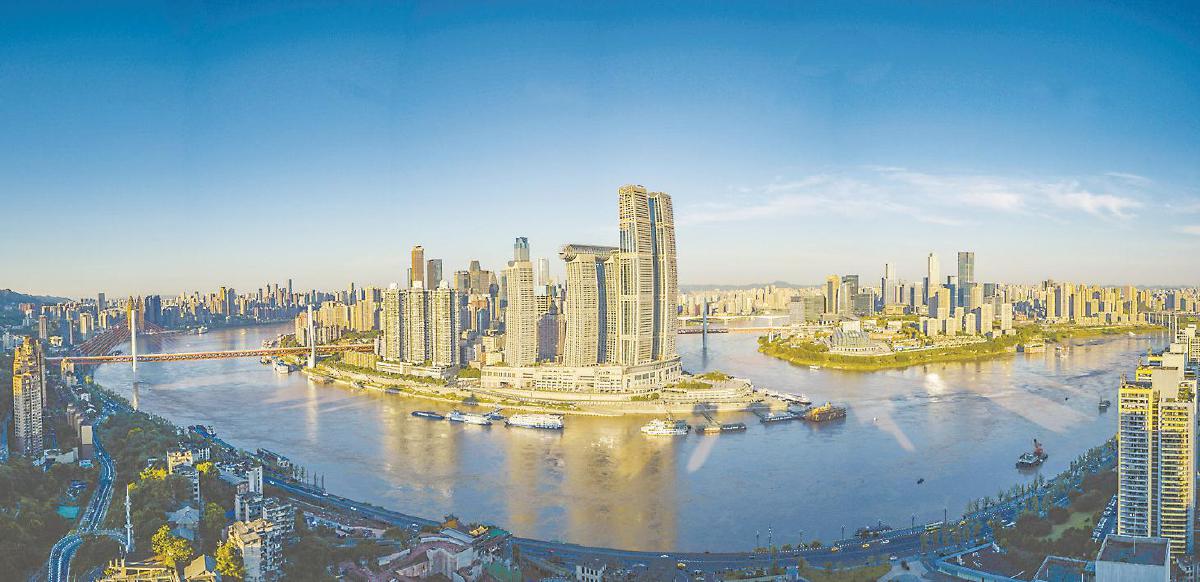
重庆筑牢长江上游生态屏障
Zhong Guo Huan Jing Bao· 2025-06-05 00:14
Core Viewpoint - Chongqing has achieved significant improvements in environmental quality, with the Yangtze River's water quality remaining excellent for eight consecutive years and a 100% good water quality ratio at 74 national monitoring points for two years [2][3]. Group 1: Water Quality and Pollution Control - Chongqing has implemented rigorous measures for river pollution control, including the investigation and remediation of wastewater discharge outlets [2]. - The city has completed the governance of 1,314 rural black and odorous water bodies, benefiting over 800,000 residents and significantly improving rural landscapes [3]. - The water environment management big data system has reduced the time for identifying and tracing water pollution issues from an average of 7 days to under 24 hours [8]. Group 2: Air Quality Improvement - In 2024, Chongqing recorded 333 days of good air quality, with PM2.5 concentration decreasing by 8.4% year-on-year [2][8]. - The city has launched an air quality improvement action plan, which has led to a 49.2% reduction in complaints about restaurant oil smoke [3]. Group 3: Ecological Protection and Green Development - Chongqing has maintained a forest coverage rate of over 55%, promoting integrated protection and restoration of natural resources [2]. - The city has established a horizontal ecological compensation mechanism along the Yangtze River, encouraging upstream and downstream cooperation for ecological protection [10]. - Chongqing's carbon market has shown strong growth, with the highest carbon price increase among eight pilot carbon markets in the country, supporting the city's green development initiatives [3]. Group 4: Urban Environment and Quality of Life - The city has made significant progress in addressing urban issues such as restaurant oil smoke and noise pollution, enhancing the livability of urban areas [3]. - The governance of 61 kilometers of riverbanks has transformed them into attractive urban landscapes, contributing to the overall aesthetic of the city [6].