电动汽车转型

Search documents
GM Raises Outlook on Boost From Truck Sales, Tariff Relief
Youtube· 2025-10-21 14:13
Core Insights - The company has demonstrated resilience and agility in navigating challenges such as COVID-19, chip shortages, and shifts towards electric vehicles (EVs) since 2020 [2][3][5] Financial Performance and Strategy - The company has improved its balance sheet and inventory management, reducing dealership inventory by approximately 40%, which has freed up working capital for reinvestment [10] - The company has announced a $4 billion investment to enhance US manufacturing capacity, focusing on diversifying supply chains and reducing reliance on China [7][8] Market Position and Future Outlook - The company remains committed to its long-term vision for EVs despite short-term adjustments in capacity to align with current demand [5][4] - Recent tariff adjustments have resulted in a reduction of the total tariff forecast by about $500 million, aiding competitiveness and investment in the US [13] - The company anticipates improved margins in 2026, aiming to return to targeted margins of 8-10% [16] Operations in China - The company has restructured its operations in China to adapt to increased competition, achieving profitability every quarter this year [17][19]


大众集团权力震荡,奥博穆卸任保时捷CEO
Zhong Guo Qi Che Bao Wang· 2025-10-21 01:11
Core Viewpoint - The resignation of Oliver Blume as CEO of Porsche is a significant shift in leadership due to pressure from labor unions and declining performance, while he will continue as CEO of Volkswagen Group until the end of 2030 [1][3][7]. Group 1: Leadership Changes - Oliver Blume has been the CEO of Porsche since 2015 and took over as CEO of Volkswagen Group in September 2022, holding both positions until now [3][4]. - Michael Leiters, former CEO of McLaren, will succeed Blume as Porsche CEO starting January 1, 2026 [1][11]. - Blume's dual role faced increasing scrutiny amid a major restructuring plan and operational challenges at Porsche, leading to dissatisfaction among investors and internal stakeholders [3][5][7]. Group 2: Performance Issues - Porsche's net profit for the first half of the year was €718 million, a dramatic decline of 66.6% year-over-year, with a sales return rate dropping from 15.7% to 5.5% [9]. - The company has faced challenges due to weak demand in China, rising export tariffs to the U.S., and uncertainties in transitioning to electric vehicles, prompting multiple downward revisions of financial forecasts [9]. - A significant restructuring plan has been announced, which includes a shift back to internal combustion engine models and a halt on upcoming electric vehicle launches, expected to result in a €1.8 billion loss in operating profit for 2025 [9]. Group 3: Future Outlook - Michael Leiters is expected to navigate the challenges at Porsche by balancing new model investments with cost reductions, leveraging his experience from McLaren [9][10]. - The automotive industry is watching closely to see if Leiters can successfully lead Porsche through its current difficulties and restore its profitability [10].

保时捷高层人事调整:迈克尔·莱特斯将于2026年出任CEO
Huan Qiu Wang Zi Xun· 2025-10-19 03:28
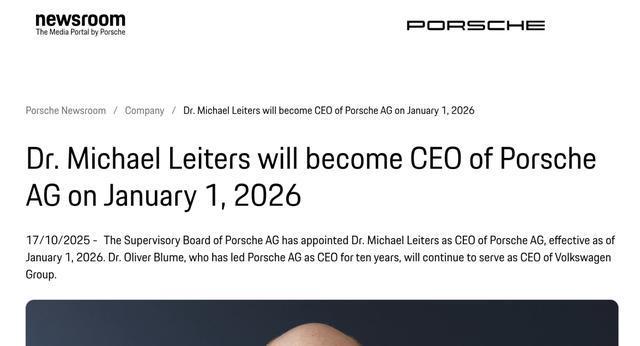
Core Insights - Porsche is set to replace its current CEO Oliver Blume amid internal pressures and rising investor dissatisfaction [1][3] - Michael Leiters, who has a strong background with Porsche and experience in the automotive industry, is expected to take over the CEO position [1][3][4] Company Situation - Porsche has faced challenges that have weakened its ability to withstand market fluctuations, including increased export tariffs to the U.S. and uncertainties surrounding its electric vehicle transition [3] - The company has significantly adjusted its planned $2.1 billion investment in its electrification strategy [3] - Porsche's projected operating profit margin for 2025 is only 2%, raising concerns among shareholders [3] Leadership Background - Michael Leiters, 54, previously worked at Porsche for 13 years, leading key projects such as the Cayenne, which helped reshape the brand [3][4] - After leaving Porsche, Leiters served as Chief Technical Officer at Ferrari and later became CEO of McLaren, where he successfully launched new models [3][4] - The supervisory board believes Leiters' experience and technical background will help restore Porsche's stability and competitive edge in the global market [4]
通用汽车取消下一代氢燃料电池研发项目,究竟出于怎样的考量?
Zhong Guo Qi Che Bao Wang· 2025-10-13 08:49
Core Viewpoint - General Motors has decided to cancel its next-generation hydrogen fuel cell development project and shelve plans for a $55 million factory in Detroit, citing a lack of viable development pathways for this emerging power technology [2][3] Group 1: Strategic Shift - The decision to halt hydrogen fuel cell research is driven by high hydrogen energy costs in the U.S. and limited infrastructure, which restricts consumer acceptance of fuel cell vehicles [3][5] - General Motors will continue its joint venture with Honda in Brownstown Township, focusing on providing power support for data centers, while shifting resources towards electric vehicle development [3][4] - The company aims to prioritize engineering talent and resources to advance electric vehicle initiatives, reflecting a broader trend of resource reallocation in the automotive industry [8] Group 2: Historical Context - General Motors has a long history in hydrogen energy, having introduced its first hydrogen fuel cell test vehicle, the Electrovan, in 1966, showcasing its early vision for hydrogen applications in the automotive sector [6] - The company formed a joint venture with Honda in 2013 to collaborate on hydrogen fuel cell technology, initially expressing optimism about the market potential [6] Group 3: Market Challenges - Despite previous investments, the hydrogen fuel cell technology faces significant market promotion challenges and extended investment return timelines, leading to a reevaluation of its viability [6][9] - The high terminal price of hydrogen for vehicles in the U.S. remains a barrier, with diesel costs for commercial vehicles being significantly lower, making it difficult for hydrogen fuel cell vehicles to compete on a lifecycle cost basis [7] Group 4: Future Outlook - Industry experts suggest that a "hydrogen-electric hybrid" model could be a viable path forward, particularly in commercial vehicles, where hydrogen fuel cells can be utilized for long-distance transport while electric power can be used for short-range deliveries [9] - The strategic shift by General Motors may weaken the position of North American automakers in the hydrogen vehicle sector, potentially impacting the EU's hydrogen strategy and delaying the commercialization timeline for hydrogen vehicles [8][9]

法拉利(RACE.US)股价暴跌:谨慎业绩展望与首款电动车计划受挫
智通财经网· 2025-10-09 12:50
Core Viewpoint - Ferrari's cautious earnings outlook has disappointed investors, overshadowing the launch of its first electric vehicle, leading to a significant drop in the company's stock price, marking the largest single-day decline in nine years [1] Group 1: Earnings Outlook - Ferrari expects adjusted profits to grow from €2.72 billion this year to at least €3.6 billion (approximately $4.2 billion) by 2030, indicating a slower growth rate than previously anticipated by management three years ago [1] - The company has slightly raised its revenue forecast for this year, expecting net revenue to reach or exceed €7.1 billion, up from the previous guidance of "at least €7 billion" [2] - Adjusted EBITDA expectations have been increased by 1.5% to "at least €2.68 billion," but the projected EBITDA margin for 2030 is expected to exceed 40%, lower than the analysts' average expectation of 42% [2] Group 2: Market Reactions - Following the earnings outlook announcement, Ferrari's stock price fell by as much as 16%, the largest single-day drop since its Milan listing in January 2016, with a pre-market decline exceeding 12% in the U.S. [1] - Analysts had high expectations prior to the investor day, with some anticipating a downward adjustment in electric vehicle targets to drive significant profit growth [1] Group 3: Electric Vehicle Strategy - Ferrari has announced a reduction in its electric vehicle production plans, projecting that pure electric models will account for about 20% of its product lineup by 2030, down from the initial target of 40% set in 2022 [2] - The company is facing challenges in the electric transition, similar to other luxury car manufacturers, as affluent consumers remain hesitant to switch to plug-in electric vehicles [3] - Ferrari is also struggling to regain momentum in the Chinese market, where sales have stagnated [3]

德国工业心脏之痛:特朗普关税下 汽车大厂深陷裁员潮
Di Yi Cai Jing· 2025-09-29 10:48
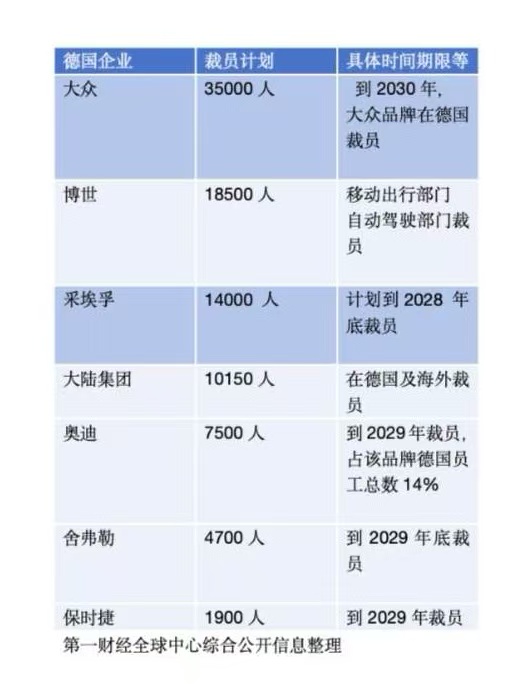
Core Insights - The recent announcement by the Trump administration to impose a 25% tariff on imported heavy trucks has negatively impacted the already fragile state of the German automotive industry [1][2] - Bosch, Germany's largest automotive parts supplier, plans to cut 13,000 jobs over the next five years, signaling a critical warning for the industrial sector [1][6] - German Chancellor Merz is set to host an automotive summit on October 9, with various stakeholders expected to attend, amid ongoing challenges in the automotive sector [1] Industry Overview - The automotive and parts sector's weight in the DAX index has significantly decreased from approximately 21% in 2015 to below 10% by 2025, indicating a fundamental shift in the industry structure [2] - German automotive manufacturers are struggling with weakened demand, high labor and energy costs, and increasing competition from rapidly developing manufacturers [2][3] - Major companies like Daimler Trucks and Volkswagen's Traton saw their stock prices drop following the tariff announcement [2] Employment Impact - Bosch's job cuts are part of a broader trend, with other companies like Continental, Schaeffler, and ZF also reducing positions and expenses due to economic pressures [3][5] - Volkswagen is limiting production and temporarily closing two electric vehicle factories in Germany, with plans to cut 35,000 jobs by 2030 [3][5] - The German automotive industry has already eliminated approximately 55,000 jobs over the past two years, with expectations of further job losses in the coming years [5] Economic Forecast - A joint economic forecast from five major German economic research institutions predicts only a 0.2% growth for the German economy in 2025, largely due to the impact of U.S. tariff policies [7][8] - The report highlights that while the service sector is growing, the manufacturing sector's recovery remains weak due to high costs and a lack of structural reforms [8] - Germany's reliance on exports, which has historically been around 70%, makes it particularly vulnerable to external shocks like tariffs [8] Government Response - The Merz government has attempted to boost confidence through increased military spending and a €100 billion "Made in Germany" investment plan, but these efforts have yet to yield significant results [8][9] - There are indications that some German automakers are shifting their business models to take on defense contracts, which could provide some economic relief [9]
特朗普关税下,大众、博世、奥迪、保时捷等德国汽车大厂深陷裁员潮
第一财经· 2025-09-29 10:23
Core Viewpoint - The recent announcement by the Trump administration to impose a 25% tariff on imported heavy trucks has further exacerbated the already fragile state of the German automotive industry, leading to significant job cuts and restructuring efforts among major manufacturers and suppliers [2][5]. Group 1: Impact of Tariffs and Economic Conditions - The German automotive sector is struggling with declining sales, profit warnings, and the impact of U.S. tariffs, prompting a summit hosted by Chancellor Merz to address these challenges [2][5]. - Economic experts indicate that Germany has not yet emerged from its economic crisis, with a full recovery potentially not occurring until after 2026 due to tariff impacts and necessary structural adjustments [2][5][14]. Group 2: Job Cuts and Corporate Restructuring - Bosch announced plans to cut 13,000 jobs over the next five years, signaling a broader trend of layoffs across the German automotive industry, including major players like Daimler, Volkswagen, and Ford [2][10]. - The automotive industry has already seen approximately 55,000 jobs eliminated over the past two years, with projections indicating that tens of thousands more jobs could be lost by 2030 [9][10]. Group 3: Shift in Industry Structure - A report from Goldman Sachs highlights a fundamental shift in the DAX index's industry structure, with the automotive and parts sector's weight dropping from about 21% in 2015 to less than 10% [5]. - The transition to electric vehicles is slower than anticipated, leading to increased pressure on German manufacturers to downsize and restructure [7][12]. Group 4: Future Economic Outlook - A joint economic forecast from five major German economic research institutions predicts only a 0.2% growth for Germany in 2025, with manufacturing recovery remaining weak due to high energy and labor costs [14][15]. - The reliance on exports, which has historically been around 70% for Germany, makes the economy particularly vulnerable to external shocks like U.S. tariffs [16].

欧洲电动车争相“破局”稀土依赖 Neo耗资7500万美元磁体工厂正式投产
智通财经网· 2025-09-19 07:04
Core Insights - European electric vehicle executives are focusing on securing rare earth magnets, essential components for electric vehicles, with a new factory in Estonia by Neo Performance Materials starting production [1][2] - The factory has an initial capacity to produce enough magnets for up to 1 million vehicles annually, addressing supply chain vulnerabilities in Europe [1][2] - Neo's CEO emphasized the project's significance for Europe's material supply chain amid global trade tensions [1][2] Group 1: Factory and Production - Neo's factory in Estonia represents a $75 million investment and is expected to produce 2,000 tons of magnets annually, meeting about 10% of Europe's demand [2][3] - The raw materials for the magnets will be sourced from Australia, and Neo has secured contracts worth between $50 million to $100 million for 5 to 7 years [2][3] - Plans for expansion by 2027 aim to triple the factory's production capacity to meet increasing demand from European automakers transitioning to electric vehicles [3] Group 2: Market Context and Demand - The electric vehicle market is experiencing a surge in demand as manufacturers prepare for regulations to phase out new combustion engine vehicles by 2035 [3] - Major automotive companies like BMW, Volkswagen, and Mercedes-Benz are launching new electric models to compete with increasing pressure from Chinese manufacturers [3] - General Motors is also securing rare earth magnets from various suppliers to ensure a domestic supply chain for its electric vehicle production [3][4] Group 3: Competitive Landscape - Neo Performance Materials is currently the only company in the West with the capability to produce electric vehicle traction motor magnets [2][4] - The company has a first-mover advantage in the European market, as other firms are still in the planning stages for similar production capabilities [4][5] - Estonia is highlighted as the only region outside Asia with rare earth separation and purification capabilities, enhancing its strategic importance in the supply chain [4][5]
AKWEL: NET INCOME OF €13.6M IN THE FIRST HALF OF 2025
Globenewswire· 2025-09-18 15:45
Core Insights - AKWEL reported a net income of €13.6 million for the first half of 2025, a decrease of 32.9% compared to €20.2 million in the same period of 2024 [3][4]. Financial Performance - The consolidated revenue for the first half of 2025 was €510.6 million, down 3.4% from €528.8 million in the first half of 2024 [3]. - EBITDA significantly dropped to €6.5 million, reflecting an 86.8% decline from €49.2 million year-over-year [3]. - Current operating income increased by 14.1% to €27.8 million, with a current operating margin of 5.4%, up 0.8 percentage points from 4.6% [3]. - Operating income decreased by 7.4% to €26.8 million [3]. - Financial income turned negative at -€1.9 million, compared to zero in the previous year [3]. - The net margin fell to 2.7%, down 1.2 percentage points from 3.8% [3]. Operational Insights - The company improved operational performance in its factories, particularly through effective salary cost management [4]. - Ongoing customer disputes regarding SCR tanks negatively impacted results, leading to an external cost impact of €52.5 million [4]. - Current operating income was partially supported by reversals of provisions amounting to €32.8 million [4]. Cash Position and Strategic Focus - As of June 30, 2025, the net cash position, including lease liabilities, was €139.2 million, an increase from €133.4 million at the end of 2024 [5]. - AKWEL's activities with strategic customers showed resilience, aided by the postponement of SCR tank production shutdown to 2026 [5]. - The company remains focused on strategic priorities, including product development for electric vehicles, optimizing operational performance, and fulfilling CSR commitments [6]. Company Overview - AKWEL is an independent family business listed on Euronext Paris, specializing in parts and systems for the automotive and heavy-vehicle industry, particularly in fluid management and structural parts for electric vehicles [7]. - The company operates in 20 countries across five continents and employs approximately 8,600 people globally [8].

工业4.0变0.4,德国轮胎业一落千丈!
Sou Hu Cai Jing· 2025-09-16 03:06
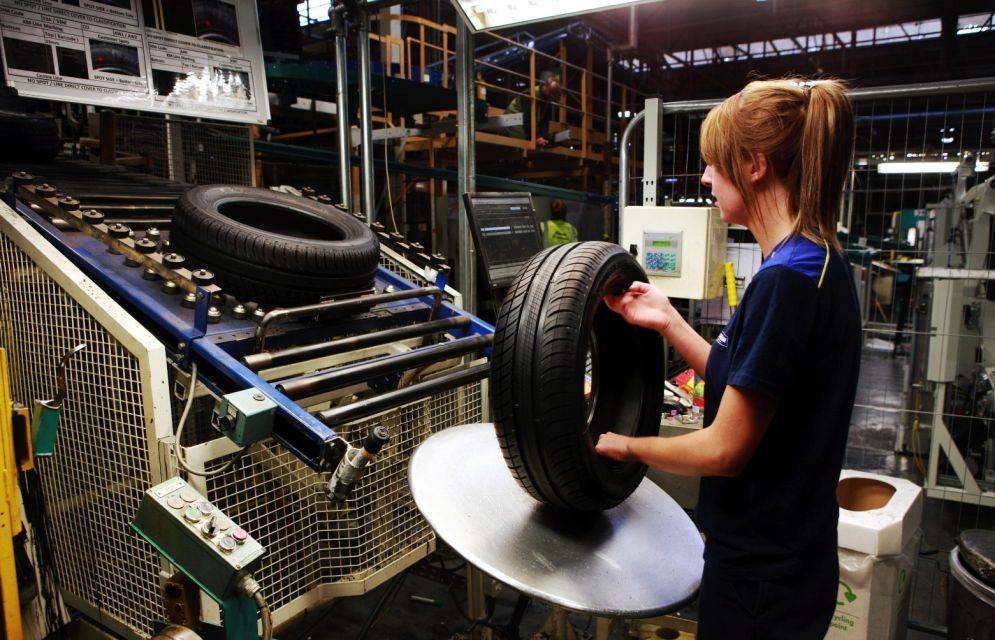
Core Viewpoint - The German rubber industry, particularly the tire manufacturing sector, is facing a severe downturn characterized by declines in production, sales, and employment, prompting concerns about the future of this once-dominant industrial sector in Europe [1][6]. Industry Overview - The German rubber industry reported a total production decline of 8.2% in the first half of 2025, dropping to 560,000 tons [2]. - Tire manufacturing specifically saw a production decrease of 8.2%, amounting to 220,000 tons, while rubber products also fell by 8.1% to 340,000 tons [2]. - The average capacity utilization across the industry is at 77.8%, down by 1.1 percentage points from the previous year [4]. Employment and Sales Impact - Total employment in the rubber industry has decreased by 6.2%, resulting in 60,200 jobs, with the tire sector alone losing 7.7% of its workforce, leaving only 18,000 positions [4]. - Tire sales revenue continued to decline, with total sales dropping by 8.2% to €1.91 billion in the first half of the year. Domestic sales fell by 8.2% to €1.4 billion, while exports decreased by 8.1% to €510 million [4]. Factory Closures and Job Cuts - A significant wave of factory closures and layoffs is sweeping through the German tire manufacturing sector, with Michelin announcing the gradual shutdown of its Karlsruhe and Trier plants, effectively exiting the truck tire production business in Germany [8]. - Goodyear plans to completely close its Fulda plant by 2025, affecting approximately 1,050 jobs, and will cease tire manufacturing at its Pfaffenhausen plant by 2027, impacting around 700 positions [10]. - The closure of these facilities means that one-third of Germany's 12 tire production plants may shut down in the coming years, severely impacting industry production capacity [12]. Competitive Challenges - The challenges facing the German tire industry are attributed to multiple factors, including intense international competition, with Michelin citing the increasing competition from low-cost truck tires and a lack of competitiveness in both European and export markets [13]. - The transition of the German automotive industry towards electric vehicles is also straining upstream suppliers, as demand for traditional components declines while the new market landscape remains unstable [15]. - High operational costs and a complex regulatory environment are seen as significant barriers to competitiveness, with industry leaders calling for urgent reforms to alleviate these pressures [17].