科创板第五套上市标准

Search documents
科创板第五套标准重启后 首家创新医疗器械IPO受理
Di Yi Cai Jing· 2025-11-06 09:22
Core Points - Shenzhen Core Medical Technology Co., Ltd. has had its IPO application accepted by the Shanghai Stock Exchange on November 6, marking it as the first innovative medical device company to be accepted under the fifth set of listing standards for the Sci-Tech Innovation Board [1] - The prospectus indicates that Core Medical has received investments from multiple qualified institutional investors, making it the second company after Zhuhai Tenomab Pharmaceutical Co., Ltd. to be recognized as having qualified institutional investors in its Sci-Tech Innovation Board application [1]

52亿,北京明星企业要IPO了
投中网· 2025-11-04 07:04
Core Viewpoint - Beijing Anshi Biotechnology Co., Ltd. is pursuing an IPO on the Sci-Tech Innovation Board, utilizing the fifth set of listing standards that focus on innovation attributes and market potential rather than current profitability [5][6]. Group 1: Company Overview - Anshi Biotechnology aims to commercialize its innovative cancer drug, Beruatinib, which is currently its only marketed product and a key asset for the company [9][10]. - The company has achieved significant revenue growth, with Q1 2025 revenue reaching approximately 64.04 million yuan, nearly five times the total revenue of 2023 [19]. Group 2: IPO and Fundraising - Anshi Biotechnology plans to raise 2.45 billion yuan through its IPO, with 1.95 billion yuan allocated for new drug research and 500 million yuan for working capital [7][21]. - The company has completed three rounds of fundraising totaling over 2.55 billion yuan, with significant participation from top venture capital firms [24][25][26]. Group 3: Product and Market Potential - Beruatinib has received conditional approval for multiple indications, including non-small cell lung cancer and glioma, and has been included in the national medical insurance directory, leading to a significant increase in sales [10][20]. - The market for MET-TKI drugs in China is projected to grow rapidly, from approximately 600 million yuan in 2024 to 27.2 billion yuan by 2035, providing a substantial growth opportunity for Anshi Biotechnology [20]. Group 4: Financial Performance and Risks - Despite revenue growth, Anshi Biotechnology has not yet achieved profitability, with cumulative losses reaching 782 million yuan by Q1 2025 [19]. - The company faces risks associated with high goodwill from acquisitions, which could impact financial performance if the core product does not meet market expectations [12][18].


尚未盈利冲刺科创板成长层 沐曦股份IPO将于10月24日上会
Zhong Guo Jing Ying Bao· 2025-10-19 04:13
Core Viewpoint - The Shanghai Stock Exchange has announced that the listing committee will review the IPO application of Muxi Integrated Circuit (Shanghai) Co., Ltd. on October 24, 2023, despite the company not being profitable yet [1] Company Summary - Muxi Integrated Circuit has focused on the GPU and artificial intelligence industry since its establishment, aiming to promote the self-controllability of China's intelligent computing power industry chain [1] - The company has developed core technologies in high-performance GPU chips and their foundational system software, becoming one of the few domestic enterprises with comprehensive capabilities in GPU IP, GPU SoC, high-speed interconnects, and GPU software [1] - As of March 31, 2025, Muxi Integrated Circuit holds 255 domestic authorized patents, including 245 invention patents, and has been recognized as a national-level specialized and innovative "little giant" enterprise [1] Industry Summary - The AI chip industry is expected to grow rapidly, providing a broader market space for Muxi Integrated Circuit's main business, which is anticipated to maintain steady revenue growth [2] - The company is projected to reach its breakeven point by 2026, driven by high levels of R&D investment and market expansion [2] - The establishment of the Sci-Tech Innovation Growth Layer and the resumption of the fifth set of listing standards on the Sci-Tech Innovation Board reflect the market's demand for supporting "hard technology" enterprises, indicating a more refined and inclusive capital market [2][3]
科创板IPO第五套标准扩围推进中,上交所霍瑞戎:已与多家企业开展预沟通
Di Yi Cai Jing· 2025-09-17 02:56
Core Viewpoint - The Shanghai Stock Exchange is actively engaging with multiple companies in the commercial aerospace, artificial intelligence, and low-altitude economy sectors to expand the fifth set of listing standards to these industries [1] Group 1: Policy Developments - The "1+6" reform policy for the Sci-Tech Innovation Board was released in June, which reinitiated the fifth set of listing standards and broadened its applicability [1] - Since the policy's announcement, 15 new IPO applications have been accepted on the Sci-Tech Innovation Board, including 4 from unprofitable companies [1] Group 2: Industry Impact - Among the companies applying under the fifth set of standards, 1 has been accepted, and 2 previously submitted companies have received effective registration [1] - To date, 3 unprofitable companies have successfully registered since the policy was implemented [1]
火箭、卫星开启IPO辅导潮,商业航天排队上市
Guan Cha Zhe Wang· 2025-08-13 11:36
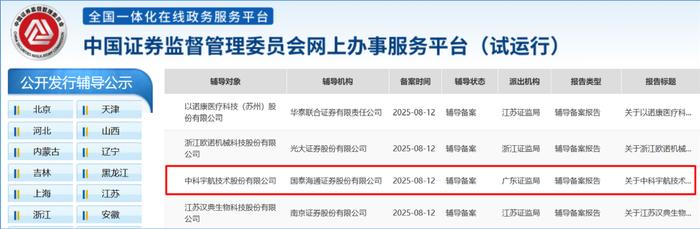
Core Viewpoint - The news highlights the initiation of the IPO process for China Aerospace Technology Co., Ltd. (中科宇航), marking a significant moment in the commercial aerospace sector as multiple companies pursue public listings simultaneously, indicating a competitive landscape for the title of "first commercial aerospace stock" in China [7][9]. Group 1: Company Overview - China Aerospace Technology Co., Ltd. was established on December 19, 2018, with a registered capital of 36 million yuan, and is headquartered in Guangzhou [3]. - The controlling shareholder is Beijing Pengyi Junlian Space Technology Center (Limited Partnership), holding a 27.7476% stake [3]. Group 2: IPO Guidance and Regulatory Framework - The IPO guidance for China Aerospace is being conducted by Guandong Securities Regulatory Bureau, with the guidance agreement signed on August 8, 2025 [4]. - The recent regulatory changes have opened a "green channel" for commercial aerospace companies to go public, allowing firms that are not yet profitable to access the capital markets [8][11]. Group 3: Market Context and Valuation - The total valuation of the three companies pursuing IPOs, including China Aerospace, Blue Arrow Aerospace, and Yixin Aerospace, exceeds 39 billion yuan, with China Aerospace valued at 11 billion yuan [9]. - The demand for low-orbit satellite constellations is projected to generate an average annual demand of 18 billion yuan over the next three years, highlighting a significant supply-demand gap in the market [9]. Group 4: Regulatory Changes and Opportunities - The new regulations under the "1+6" policy have reduced barriers for companies in high-tech sectors, allowing them to bypass traditional profitability requirements [11]. - The introduction of a pre-review mechanism for core technologies and risk points can save companies 2-3 months in the IPO process [12]. Group 5: Industry Outlook - 2025 is being referred to as a "turning point year" for commercial aerospace in China, with the market beginning to recognize the long-term potential of space infrastructure investments [9][15]. - The evolution of the commercial aerospace sector is seen as a shift from being a state-controlled domain to one where private equity and venture capital can play a significant role [15].
泰诺麦博三年多亏损超15亿负债率高企,创新药企乘东风还是成冬风?
Sou Hu Cai Jing· 2025-08-13 04:42
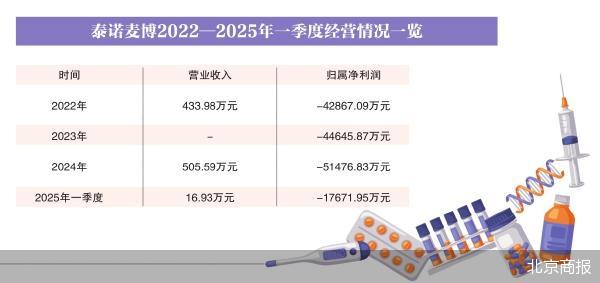
Core Viewpoint - Zhuhai Tainuo Maibo Pharmaceutical Co., Ltd. (Tainuo Maibo) has submitted its application for listing on the Sci-Tech Innovation Board, marking it as the first company accepted under the newly restarted fifth set of listing standards, attracting significant market attention [1] Company Overview - Tainuo Maibo was established in 2015 and focuses on the research, production, and sales of fully human monoclonal antibody new drugs, utilizing its proprietary HitmAb® technology platform [2][3] - The company aims to develop innovative drugs with independent intellectual property rights to address infectious diseases, autoimmune diseases, malignant tumors, and other medical needs [2] Financial Performance - The company has reported continuous losses, with total losses amounting to 1.567 billion yuan over the reporting periods from 2022 to Q1 2025 [3] - Revenue figures show 4.3398 million yuan in 2022, 15.0559 million yuan in 2024, and 169,300 yuan in Q1 2025, indicating a low sales volume and a production-sales rate of only 0.32% in Q1 2025 [2][3] R&D and Innovation - Tainuo Maibo has invested nearly 1.3 billion yuan in R&D, with a compound annual growth rate of 14.8% from 2022 to 2024 [11] - The company holds 37 domestic and 6 international authorized invention patents, with over 50 additional patents pending [11] Product Pipeline - The main product, Staitouta Monoclonal Antibody Injection, has been approved for sale in China as of February 2025, targeting emergency prevention of tetanus [5][6] - Another key product, TNM001, is in Phase III clinical trials for targeted tumor treatment [5] Market Challenges - The company faces significant competition from established products in the market, with its main competitor's pricing being significantly lower, which may limit market expansion [7][12] - The product has not yet entered the medical insurance system, which poses a challenge for market penetration [7] Financial Health - The company's liabilities have been increasing, with current liabilities reaching 254 million yuan in Q1 2025, representing a significant portion of total liabilities [9] - The asset-liability ratio has been rising, indicating potential pressure on the company's financial flexibility and long-term development [10] Future Prospects - Tainuo Maibo plans to raise 1.5 billion yuan through its IPO, with funds allocated for new drug R&D, expansion of antibody production facilities, and operational capital [13] - The company must navigate short-term cost pressures and long-term policy uncertainties while maintaining its innovation advantage to establish a sustainable commercialization model [13]
科创板第五套标准新进展!时隔两年,拿到批文!
券商中国· 2025-08-09 04:53
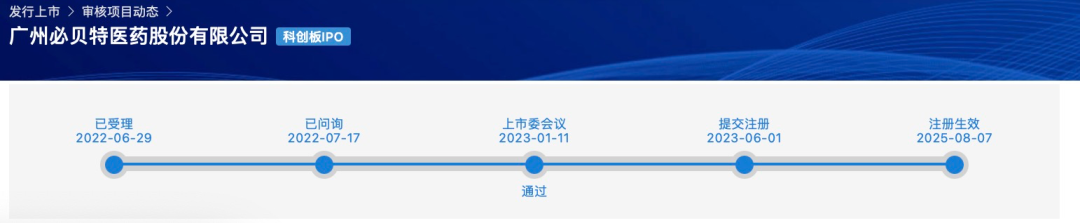
Core Viewpoint - The approval of Guangzhou Bibet Pharmaceutical Co., Ltd.'s IPO marks a significant development for companies choosing the fifth listing standard of the Sci-Tech Innovation Board, indicating a gradual resumption of the IPO process for unprofitable tech firms [1][2]. Group 1: Company Overview - Bibet is a biopharmaceutical company focused on innovative drug development, particularly in oncology, autoimmune diseases, and metabolic diseases, aiming to create first-in-class drugs and address unmet clinical needs [4]. - The company has been granted approval under the fifth listing standard, which requires a market value of at least RMB 4 billion and at least one core product approved for phase II clinical trials [6]. Group 2: IPO Process and Timeline - Bibet received approval from the Sci-Tech Innovation Board's listing committee on January 11, 2023, and submitted its IPO registration application to the CSRC on June 1, 2023, after a two-year wait for the IPO approval [2][3]. - Since the resumption of the fifth listing standard in June 2025, there are currently six unprofitable companies in the IPO queue, with two having received approval, including Bibet [10][11]. Group 3: Financials and Fundraising - Bibet plans to raise approximately RMB 2 billion through its IPO, with allocations of RMB 500 million for working capital, RMB 950 million for new drug development, and RMB 550 million for the construction of a research and development center and formulation industrialization base [7]. - The company reported zero revenue for 2022 and 2023, with net losses of RMB 188.34 million, RMB 172.76 million, and an expected loss of RMB 56 million for 2024, totaling a cumulative loss of RMB 417.09 million [8].

证监会同意!重启后又一家
Shang Hai Zheng Quan Bao· 2025-08-08 14:22
Core Viewpoint - Guangzhou Bibetter Pharmaceutical Co., Ltd. has received approval from the China Securities Regulatory Commission for its IPO application on the Sci-Tech Innovation Board after a 14-month hiatus [1][8]. Company Overview - Bibetter focuses on major diseases such as tumors, autoimmune diseases, and metabolic diseases, developing First-in-Class drugs and innovative drugs to meet unmet clinical needs [2]. - The company plans to issue up to 90 million shares and aims to raise 2.005 billion yuan, with 949 million yuan allocated for new drug R&D, 555 million yuan for the construction of a R&D center and formulation industrialization base, and 500 million yuan for working capital [2]. Financial Performance - Bibetter reported no operating revenue for 2022, 2023, and 2024, with net losses of 188 million yuan, 173 million yuan, and 55.998 million yuan respectively [2]. - Total assets decreased from 587.2168 million yuan in 2022 to 332.4771 million yuan in 2024, while equity attributable to shareholders dropped from 468.3349 million yuan to 290.2201 million yuan over the same period [3]. - The company has a high R&D expense ratio, with R&D expenses of 167 million yuan, 158 million yuan, and 120 million yuan for the years 2022 to 2024, significantly above the average of comparable companies [3][5]. Market Position and Future Prospects - As of the date of the prospectus, Bibetter has one Class 1 innovative drug, BEBT-908, approved for market, with other products in various clinical trial phases [4][6]. - The company is expected to maintain high R&D expenditures and will likely continue to operate at a loss in the foreseeable future, with no dividends anticipated post-IPO [6]. - The market potential for its core products targeting high-incidence cancers is significant, with an expected post-IPO market valuation of no less than 4 billion yuan [8]. Shareholding Structure - Before the issuance, the company has no controlling shareholder, with the actual controller, Qian Changgeng, holding 43.96% of the shares [9].
科创板第五套标准重启后首单IPO过会
Jin Rong Shi Bao· 2025-08-08 08:00
Group 1 - The core viewpoint of the news is that Wuhan Heyuan Biotechnology Co., Ltd. has successfully passed the listing review by the Shanghai Stock Exchange, marking it as the first company to benefit from the reactivation of the fifth listing standard for unprofitable enterprises on the Sci-Tech Innovation Board [1][4] - Heyuan Biotechnology plans to raise 2.4 billion yuan through its IPO, with approximately 1.658 billion yuan allocated for the construction of a recombinant human albumin industrialization base, while the remaining funds will be directed towards new drug research and development and to supplement working capital [2][3] - The company has been focusing on the research of rice endosperm cell expression systems and the development of recombinant protein drugs since its establishment in 2006, with significant investments in R&D leading to continuous losses [2][4] Group 2 - The fifth listing standard emphasizes "market value + R&D," allowing unprofitable but high-growth technology innovation enterprises to list, particularly in the biopharmaceutical and semiconductor sectors [4][6] - Since the establishment of the Sci-Tech Innovation Board, 20 companies have successfully listed under the fifth standard, all being innovative biopharmaceutical enterprises, with a combined revenue exceeding 14 billion yuan in 2024, reflecting a growth of over 40% compared to 2023 [5][6] - Recent reforms aim to enhance the adaptability and inclusiveness of the Sci-Tech Innovation Board, with new measures introduced to support more frontier technology sectors such as artificial intelligence and commercial aerospace [6][7]
科创板第五套纳新 泰诺麦博闯关
Bei Jing Shang Bao· 2025-08-04 16:00
Core Viewpoint - The recent acceptance of Zhuhai Tainuo Maibo Pharmaceutical Co., Ltd.'s IPO application marks the first project under the reactivated fifth listing standard of the Sci-Tech Innovation Board after a two-year hiatus, indicating ongoing support for innovative pharmaceutical companies in the capital market [1][3][4]. Company Overview - Tainuo Maibo, established in 2015, focuses on innovative biopharmaceuticals aimed at blood product alternatives, with its core product, TNM002 (Staidota Monoclonal Antibody Injection), being the first-in-class recombinant anti-tetanus toxin monoclonal antibody drug approved in China [3][4]. - The company has faced continuous losses, with a cumulative loss of approximately 1.39 billion yuan from 2022 to 2024, primarily due to its focus on long-term, high-investment R&D projects [1][9]. Financial Aspects - Tainuo Maibo plans to raise 1.5 billion yuan through its IPO, allocating 830 million yuan for new drug R&D, 330 million yuan for antibody production base expansion, and 340 million yuan for working capital [4]. - The company reported a mere 169,300 yuan in sales revenue for its core product in March, highlighting challenges in market penetration and competition [6][9]. Market Competition - The core product faces competition from established therapies such as tetanus immunoglobulin and tetanus antitoxin, which have been in clinical use for years, resulting in a more mature market with higher clinical awareness [6][7]. - The company acknowledges the risk of slow market penetration due to the need for extensive promotion and acceptance of its innovative therapy among healthcare professionals and patients [6][9]. Regulatory Environment - The reactivation of the fifth listing standard reflects a more rational view of the high-risk, high-investment nature of the biopharmaceutical industry, with the capital market showing continued interest in antibody drugs and innovative therapies [4][5]. - Regulatory scrutiny will focus on the company's core technology barriers, clinical value, and the efficiency of fund utilization, particularly in relation to its ongoing losses and R&D investments [10].