
算力

Search documents
从狂热到回撤:AI硬件的第一次真实压力测试
美股研究社· 2026-03-22 12:36
Core Viewpoint - The current AI market is more about capital investment than a true productivity revolution, with fears centered on capital withdrawal rather than technological stagnation [1] Group 1: AI Hardware Market Dynamics - The AI market over the past two years has been a revaluation of computing infrastructure rather than a pure AI boom, with companies like Bloom Energy and Micron Technology benefiting as "shovel sellers" [3] - Short-term demand for AI hardware is driven by exponential growth in computing power needs, leading to increased demand for electricity, optical communication, and data center infrastructure [6] - Long-term sustainability of this demand hinges on the ability of AI models to generate stable commercial returns, which is currently lacking as many AI applications remain in low-cost acquisition phases [6][7] Group 2: Market Corrections and Expectations - The rapid rise of AI hardware stocks has led to significant corrections as market expectations shift, particularly regarding capital expenditure and supply-demand dynamics [9][10] - The first correction stems from changing expectations about capital expenditure as the profitability of model companies comes into question, leading to a reassessment of future computing investments [10] - The second correction is due to supply-side adjustments, where previously constrained supply is beginning to meet demand, leading to price elasticity changes [10] - The third correction involves a return to valuation fundamentals, where high growth expectations are recalibrated, causing stock prices to drop even without a fundamental deterioration [11] Group 3: Investment Strategy Shifts - Investors need to transition from a "story-driven" valuation to a "cash flow-driven" approach, recognizing that AI models require longer return cycles and higher capital consumption [13][14] - Investment focus should shift from sector selection to company selection, prioritizing firms with cost advantages and stable cash flows to navigate through market cycles [15] - Understanding the cyclical nature of AI hardware is crucial, with investment strategies needing to adapt based on current market conditions rather than solely future potential [15][16] Group 4: Structural Changes and Future Opportunities - The long-term logic of AI hardware exists but will manifest through complex and volatile patterns rather than linear growth, with structural changes providing clues for navigating cycles [17] - The AI landscape is characterized by a cycle of "explosion—overcapacity—clearing—rebalancing," where companies maintaining healthy balance sheets during downturns will capture greater market share in subsequent cycles [16][17] - The ultimate winners in the AI revolution will be those who create real value rather than merely consuming capital, emphasizing the importance of endurance in the market [19][20]


通信周观点:XPO可插拔路线升级,国产模型包揽龙虾调用榜TOP3-20260322
Changjiang Securities· 2026-03-22 10:42
Investment Rating - The report maintains a "Positive" investment rating for the communication equipment sector [11] Core Insights - The communication sector saw a 0.25% increase in the 10th week of 2026, ranking 11th among primary industries in the Yangtze River region; since the beginning of 2026, the sector has risen by 4.74%, ranking 15th [2][5] - Oracle's FY26Q3 cloud business revenue reached $17.19 billion, a year-on-year increase of 21.7%, with a net profit of $3.72 billion, up 26.7% year-on-year [6] - Broadcom launched the world's first 3nm 400G single-channel DSP chip, which is foundational for the next generation of optical modules and switches [7] - The establishment of three major MSA (Multi-Source Agreement) groups aims to promote high-density pluggable optical technology and set standards for optical engines [7] - OpenClaw continues to lead in the AI agent field, with its top three models being domestically produced, each surpassing 1 trillion token consumption [8] Summary by Sections Market Performance - The communication sector's individual stock performance showed significant gains for companies with a market capitalization over 8 billion yuan, with Changfei Fiber (+13.5%), Guangxun Technology (+11.0%), and Zhiwei Intelligent (+10.4%) leading the gains; while Runze Technology (-10.3%), Huafeng Technology (-9.2%), and Xinke Mobile (-8.4%) faced the largest declines [5] Oracle's Cloud Business - Oracle's cloud application revenue was $4.03 billion, up 13.2% year-on-year, while cloud infrastructure revenue surged to $4.89 billion, reflecting an 84.3% increase [6] - The multi-cloud database business saw a staggering year-on-year growth of 531%, with global coverage achieved across various cloud platforms [6] Technological Developments - Broadcom's new 3nm DSP chip is set to enhance the capabilities of future optical modules and switches, marking a significant technological advancement [7] - The three MSAs focus on different aspects of optical technology integration, with notable participation from major industry players [7] AI and Token Consumption - OpenClaw's platform has seen a dramatic increase in usage, with a monthly website visit count of 27 million and a 925.04% month-on-month growth [8]


华为云官宣下场“养虾”!腾讯阿里已抢先布局,科技巨头激战智能体赛道
券商中国· 2026-03-22 08:18
Core Viewpoint - Huawei officially announced its entry into the "shrimp farming" competition, joining Tencent and Alibaba in the race to develop AI agents, referred to as "lobsters" in the industry, which are designed to enhance enterprise productivity and not just provide emotional value [1][2]. Group 1: Industry Developments - Huawei Cloud will launch a series of industry-specific AI agents, including OfficeClaw and CodeClaw, based on its AgentArts platform in the second half of this year [1][2]. - Tencent has actively participated in this trend by launching the WeChat ClawBot plugin, allowing users to integrate AI agents into their WeChat experience [2]. - Alibaba has established the Alibaba Token Hub (ATH) to focus on AI commercialization, aiming for over $100 billion in annual revenue from cloud and AI within five years [2]. Group 2: Technological Advancements - The AgentArts platform will be publicly tested in April, allowing developers and enterprises to create their own AI agents for free [3]. - Huawei plans to release an open-source version of the AI agent development platform in May [3]. - The demand for computing power is surging due to the rapid growth of AI applications, with daily Token usage in the ToB sector exceeding 500 billion [5]. Group 3: Future Outlook - The year 2025 is anticipated to be the year of deep integration between industries and AI, while 2026 is expected to focus on further embedding AI into core production scenarios [4]. - Huawei Cloud is set to introduce a next-generation 3D data center to address the increasing demand for computing power and reduce Token costs [6]. - The competition among tech giants is shifting from technical specifications to validating commercial value, with Huawei Cloud announcing a 200 million yuan AI ecosystem fund [6].



发 token 当工资?工程师不只拿现金和期权,开始按 token 分身价了
AI前线· 2026-03-21 05:33
Group 1 - The core idea of the article is that tokens are becoming a new currency in Silicon Valley for attracting talent, with companies starting to allocate annual token budgets to engineers to enhance productivity [2][4][9] - Companies like Alibaba are also beginning to distribute token allowances internally, indicating a shift in how employee benefits are structured, with AI access becoming a standardized benefit [2][10] - The rising importance of tokens is linked to the increasing costs associated with AI usage, which are becoming a significant part of overall employee costs, potentially exceeding 20% of an engineer's total cost [5][6][8] Group 2 - The article discusses how the cost of AI inference is becoming a critical factor in productivity, with estimates suggesting that spending $10,000 on inference could lead to significant productivity gains [7][8] - Companies are now facing the challenge of measuring the return on investment for AI expenditures, as these costs are no longer just software subscription fees but are directly impacting cash flow [6][7] - The competition for AI resources is intensifying, with candidates increasingly inquiring about the availability of AI compute resources during job interviews, indicating a shift in how engineers perceive their work and compensation [11][12] Group 3 - The article highlights the rapid increase in token consumption, with significant spikes observed in usage metrics, leading to price increases for AI services from major providers [14][15][19] - Major companies are adjusting their pricing strategies in response to rising token consumption, with some models seeing price hikes of over 450% [15][16][19] - The narrative around tokens is being shaped by major players in the AI industry, with the potential for tokens to become a new standard of value in the AI economy [20][22][23] Group 4 - The article suggests that the future of compensation may involve tokens rather than traditional currency, with discussions around a universal basic income model based on AI compute resources [24][25][26] - Companies are beginning to formalize the use of tokens in their operational frameworks, with Alibaba establishing a dedicated unit to manage token distribution and application [25][26] - The article warns of a new form of inequality emerging in the tech industry, where access to AI resources could create significant disparities in productivity among engineers [12][13]


中国联通:营收稳健增长,AI带动盈利质量优化-20260320
SINOLINK SECURITIES· 2026-03-20 10:24
Investment Rating - The report maintains a "Buy" rating for the company, with expected PE ratios of 14.71, 14.37, and 14.08 for the years 2026, 2027, and 2028 respectively [4] Core Insights - The company's revenue for 2025 is projected at 392.22 billion RMB, reflecting a year-on-year growth of 0.68%, while the net profit attributable to shareholders is expected to be 9.13 billion RMB, a 1.07% increase [2] - In Q4 2025, the company's revenue was 99.24 billion RMB, showing a slight decline of 0.23% year-on-year but a 6.96% increase quarter-on-quarter. The net profit for the same period was 355 million RMB, down 48.71% year-on-year and 85.36% quarter-on-quarter [2][3] - The company is experiencing pressure in traditional telecom business, but strategic emerging industries now account for over 86% of total revenue, with significant growth in AI-related revenues, which increased by 140% year-on-year [3] - The company has demonstrated strong cash flow management, with a net cash flow from operating activities of 91.41 billion RMB and a free cash flow growth of 24.7% to 37.3 billion RMB [3] - Capital expenditures for 2025 are projected at 54.2 billion RMB, with plans for 50 billion RMB in 2026, focusing on computing power investments [3] Financial Projections - Revenue projections for 2026, 2027, and 2028 are 408.46 billion RMB, 424.49 billion RMB, and 438.80 billion RMB respectively, with net profits expected to be 10.54 billion RMB, 10.79 billion RMB, and 11.01 billion RMB [4][9] - The company’s operating income growth rate is expected to be 4.14% in 2026, 3.93% in 2027, and 3.37% in 2028, while net profit growth rates are projected at 15.49%, 2.40%, and 2.01% for the same years [9]

中国联通(600050):点评:营收稳健增长,AI带动盈利质量优化
SINOLINK SECURITIES· 2026-03-20 09:52
Investment Rating - The report maintains a "Buy" rating for the company, with expected stock price increases of over 15% in the next 6-12 months [5][13]. Core Insights - The company's revenue for 2025 is projected at 392.22 billion yuan, a year-on-year growth of 0.68%, while the net profit attributable to shareholders is expected to be 9.13 billion yuan, reflecting a 1.07% increase [2][5]. - The fourth quarter of 2025 showed a revenue of 99.24 billion yuan, down 0.23% year-on-year but up 6.96% quarter-on-quarter, with a net profit of 355 million yuan, down 48.71% year-on-year and 85.36% quarter-on-quarter [2][3]. - The company is focusing on strategic emerging businesses, which now account for over 86% of total revenue, with significant growth in AI-related revenues, which increased by 140% year-on-year [3][4]. Summary by Sections Financial Performance - The company reported a stable cash flow with a net operating cash flow of 91.41 billion yuan for the year, and free cash flow increased by 24.7% to 37.3 billion yuan [3]. - The annual dividend per share is set at 0.1635 yuan, marking a 3.5% increase from the previous year [3]. Capital Expenditure and Growth Strategy - Capital expenditures for 2025 are projected at 54.2 billion yuan, with plans for approximately 50 billion yuan in 2026, focusing on computing power investments which will exceed 35% of total capital expenditures [4]. - The company’s cloud services revenue grew by 5.2% year-on-year, and its IDC business revenue reached 28.1 billion yuan, up 8.5% year-on-year [4]. Future Projections - Revenue forecasts for 2026, 2027, and 2028 are 408.46 billion yuan, 424.49 billion yuan, and 438.80 billion yuan respectively, with net profits projected at 10.54 billion yuan, 10.79 billion yuan, and 11.01 billion yuan [5][10]. - The company’s price-to-earnings (P/E) ratio is expected to be 14.71, 14.37, and 14.08 for the years 2026, 2027, and 2028 respectively [5].
证券研究报告、晨会聚焦:计算机苏仪:OpenClaw辨析:再次强调其安全应用-20260319
ZHONGTAI SECURITIES· 2026-03-19 13:05
Core Insights - The report emphasizes the renewed interest in AI capabilities sparked by OpenClaw, highlighting its potential applications and the need for further exploration in the tech community [3][4] - OpenClaw's current application is not yet mature, with limited commercial products available in both ToC and ToB sectors, raising concerns about security and privacy [3] Group 1: Industry Opportunities - OpenClaw is expected to create new AI task execution methods, leading to increased demand for computing power, particularly in inference computing [3] - Investment opportunities are identified in local and cloud deployment related to the increased computing power requirements driven by OpenClaw [3] - The emphasis on security, privacy, and compliance has become a critical focus area due to OpenClaw's implications [3] Group 2: Application Potential - OpenClaw demonstrates significant potential in office collaboration ecosystems through its ability to handle complex task planning and execution [3]
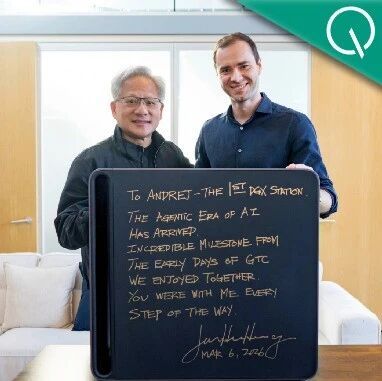
英伟达首台DGX GB300,老黄亲自登门送给他
量子位· 2026-03-19 07:09
Core Viewpoint - The article discusses the significance of NVIDIA's CEO Jensen Huang personally delivering the first DGX Station (GB300) to Andrej Karpathy, highlighting the rise of individual developers in the AI era and the importance of computational power in the ongoing AI model competition [1][9][58]. Group 1: Delivery of DGX Station - Huang's delivery of the DGX Station to Karpathy symbolizes a milestone in the AI era, marking the emergence of personal developers as key players [1][9]. - This event is reminiscent of Huang's previous deliveries, such as the first DGX-1 to OpenAI, which played a crucial role in the deep learning revolution [8][39]. - The DGX Station (GB300) is designed for individual developers, providing data center-level AI computing power in a compact form [28][30]. Group 2: Significance of Individual Developers - Karpathy is recognized as a representative of individual developers, transforming AI from a corporate domain to a system manageable by individuals [17][19]. - His recent work focuses on creating systems that allow a single person to complete the entire process from idea to product [18][19]. - The choice of Karpathy for this delivery underscores the shift towards distributed computing and the importance of individual contributions in the AI landscape [58][61]. Group 3: Technical Specifications of DGX Station - The DGX Station (GB300) features 748GB of unified memory and 20 PFLOPS of computing power, enabling the execution of large-scale AI models [30]. - It allows seamless migration of local projects to cloud environments, addressing the need for continuous AI operation [31][32]. - The system is tailored for developing and running AI agents, reflecting the growing trend of personal AI applications [24][34]. Group 4: Broader Implications for the Industry - Huang's actions signal a strategic move by NVIDIA to position itself as a foundational supplier in the AI model competition, emphasizing the necessity of computational resources [50][56]. - The article suggests that the future of AI development will increasingly rely on individual developers rather than large organizations, as computational power becomes more accessible [58][61]. - NVIDIA is also enhancing its infrastructure for AI agents, indicating a comprehensive approach to support developers from hardware to software [34][36].
A股三大指数下挫,绿电、算力概念掀涨停潮,港股“龙虾”股集体回落,MiniMax大跌13%
21世纪经济报道· 2026-03-19 04:02
Market Overview - The A-share market experienced a downward adjustment, with the Shanghai Composite Index falling by 0.95% to 4024.23 points, the Shenzhen Component Index down 1.11% to 14030.34 points, and the ChiNext Index decreasing by 0.11% to 3342.64 points [1][2] - The total trading volume in the Shanghai and Shenzhen markets reached 1.3 trillion yuan, an increase of 649 billion yuan compared to the previous trading day, with over 4400 stocks declining [1][2] Sector Performance - The green energy and computing power sectors showed resilience, with stocks like Jinkai New Energy and Dongfang New Energy hitting the daily limit, while companies in the computing power hardware sector, such as Yuanjie Technology, also saw significant gains [5] - The energy and chemical sectors experienced a strong rally in commodity futures, with fuel oil contracts rising over 11%, methanol up over 10%, and crude oil increasing by over 8% [5] Stock Movements - The optical module index rose over 2%, with notable gains in stocks like Changguang Huaxin and Yuanjie Technology, which increased by over 13% and 8% respectively [6] - Conversely, the non-ferrous metals sector faced declines, with Longda Co. dropping over 9% and several other companies in the sector also experiencing significant losses [6] Corporate Announcements - Xiaomi Group announced the launch of its new electric vehicle, the Xiaomi SU7, with a pre-sale price ranging from 229,900 to 309,900 yuan, and introduced three self-developed large models [6] - Alibaba and Baidu both announced price increases, leading to a collective rise in computing power concept stocks [5] Institutional Activity - New institutional investments were reported, with social security funds entering 11 new heavy positions, indicating potential shifts in market sentiment [7]

财信证券晨会纪要-20260319
Caixin Securities· 2026-03-18 23:30
Market Overview - The A-share market showed a mixed performance with the Shanghai Composite Index closing at 4062.98, up by 0.32%, while the Shenzhen Component Index rose by 1.05% to 14187.80 [1][9] - The ChiNext Index and the STAR 50 Index performed well, increasing by 2.02% and 1.36% respectively, indicating a strong performance in the innovation and growth sectors [1][9] - The overall market saw a total trading volume of 20610.28 billion, which decreased by 1635.4 billion compared to the previous trading day [10] Industry Dynamics - Hengli Group signed three cooperation agreements to establish a ship power system industrial park and a polyester new materials industrial park in Dalian, with a total investment of approximately 165 billion [25] - The aluminum import and export data for February showed a mixed trend, with alumina exports down by 29.4% year-on-year, while aluminum ore imports increased by 18.1% [26] - The construction machinery sector in Hunan province saw a 27.4% increase in exports, totaling 64.6 billion, with significant growth in exports to the UAE and Saudi Arabia [51] Company Updates - Wanchen Group reported a revenue of 514.59 billion for 2025, a 59.17% increase year-on-year, with a net profit growth of 358.09% [39] - Yifang Bio announced that its D-2570 treatment for psoriasis has been approved for a Phase II clinical trial in the US [41] - Kaili Medical plans to repurchase shares worth between 1 billion and 2 billion, aiming to enhance investor confidence [43] - Funeng Technology received a notification from GAC Group for battery development, marking a significant step in its market recognition [46]