
美国货币政策

Search documents
美银看好黄金2026上探5000美元,白银或飙至309美元历史高位
Xin Lang Cai Jing· 2026-01-06 01:28
Group 1 - Bank of America predicts that gold will remain a key hedging tool in investment portfolios, with an average price of $4,538 per ounce by 2026, while silver prices may peak between $135 and $309 per ounce [3][11] - The forecast is based on expectations of declining gold supply and rising costs, with North American gold production expected to decrease by 2% to 19.2 million ounces this year [3][10] - Average all-in sustaining costs are projected to rise by 3% to approximately $1,600 per ounce, slightly above market expectations, while producers' profitability is expected to increase significantly, with EBITDA projected to grow by 41% to around $65 billion by 2026 [3][10] Group 2 - The current gold-silver ratio of approximately 59 suggests that silver may outperform gold, with historical ratios indicating potential high points for silver prices [4][11] - Investment demand for gold has surged, particularly from retail investors, with inflows into gold-backed ETFs reaching the highest level since 2020 [5][12] - High-net-worth investors currently allocate only 0.5% of their assets to gold, indicating significant room for growth in gold investment [5][12] Group 3 - Central banks are expected to continue purchasing gold, with gold reserves now exceeding holdings of U.S. Treasury bonds, averaging 15% of total reserves [6][13] - A diversified strategy that includes gold is beneficial for both central bank and institutional portfolios [6][13] - The performance of gold as an asset has been strong, making it difficult for portfolio managers to ignore its potential contributions [7][14] Group 4 - U.S. monetary policy will be a crucial factor influencing gold prices in 2026, with models indicating that gold prices tend to rise by an average of 13% when inflation exceeds 2% during easing cycles [7][14] - A modest increase in investment demand of 14% could drive gold prices to $5,000 per ounce, while a 55% increase would be necessary to reach $8,000 per ounce [5][12]


美元创八年最差年度表现美联储主席人选或成2026年走势关键
Sou Hu Cai Jing· 2026-01-01 05:39
Group 1 - Analysts warn that if the next Federal Reserve Chair implements more significant interest rate cuts as expected, the US dollar may weaken further [2] - The biggest factor affecting the dollar in Q1 2026 will be the Federal Reserve, particularly the identity of the next chair after Jerome Powell's term ends in May 2026 [2] - Market expectations indicate that the US will likely see at least two interest rate cuts in 2026, leading to a divergence in monetary policy compared to other developed economies, which diminishes the dollar's attractiveness [2] Group 2 - The euro has strengthened significantly against the dollar, primarily due to moderate inflation in the Eurozone and an impending wave of defense spending, which has led to minimal bets on rate cuts in the Eurozone [2] - Interest rate traders anticipate that central banks in Canada, Sweden, and Australia will raise rates, contrasting with the US outlook [2] - Data from the Commodity Futures Trading Commission (CFTC) shows that while there was a brief bullish position on the dollar, it quickly reverted to a dominant bearish stance since April 2025 [2]
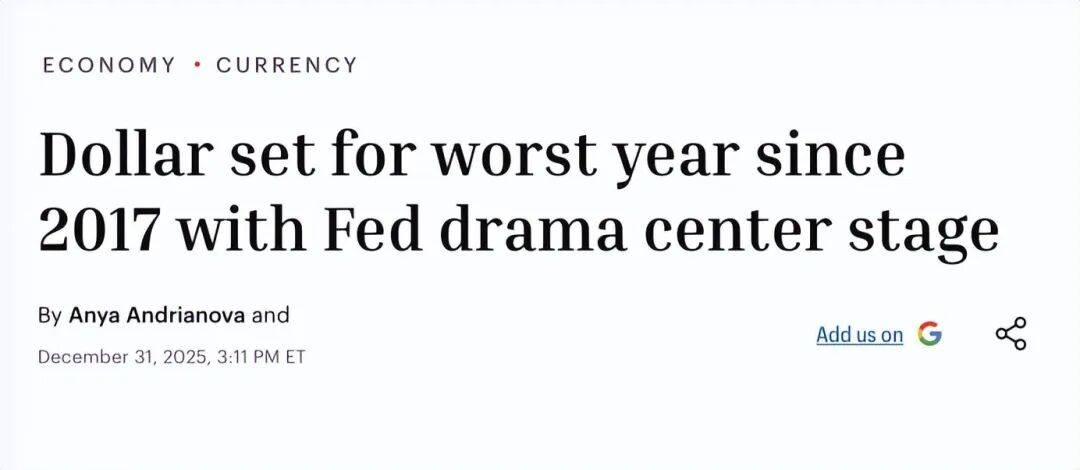
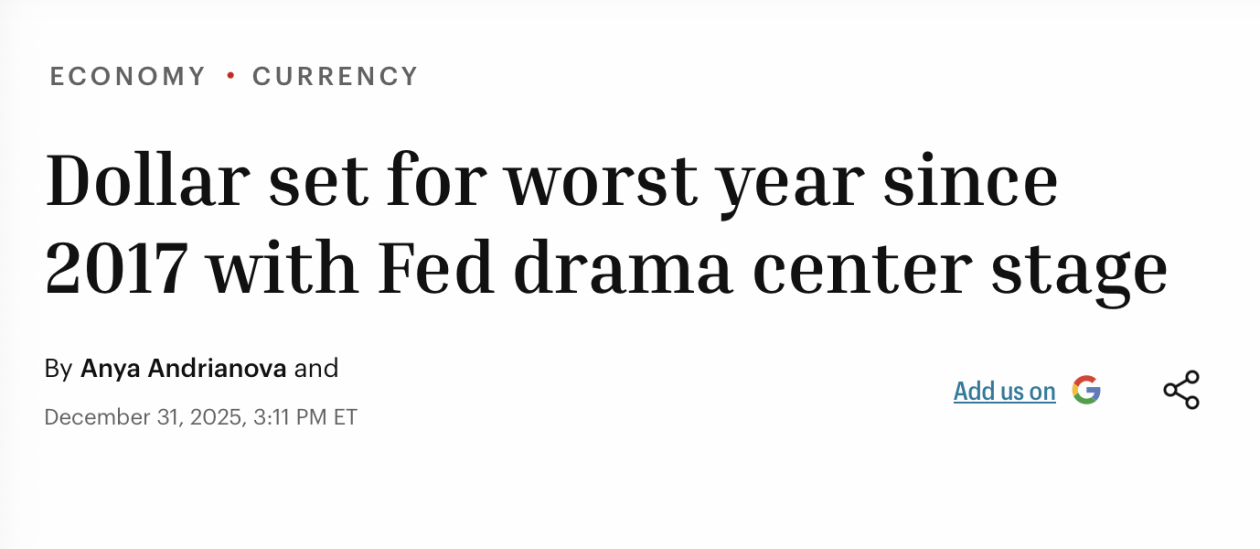
美元创八年最差年度表现 美联储主席人选或成2026年走势关键
Xin Lang Cai Jing· 2026-01-01 01:16
Core Viewpoint - Analysts warn that if the next Federal Reserve Chair adopts more aggressive rate cuts as expected, the US dollar may weaken further [1] Group 1: Federal Reserve Leadership - The biggest factor affecting the dollar in Q1 2026 will be the Federal Reserve, particularly who will succeed Jerome Powell after his term ends in May 2026 [1] - Potential candidates for the next Fed Chair include Kevin Hassett, Christopher Waller, and Kevin Warsh [1] Group 2: Market Expectations and Currency Trends - The market widely anticipates at least two rate cuts in the US in 2026, leading to a divergence in monetary policy compared to other developed economies, which diminishes the dollar's attractiveness [1] - The euro has strengthened significantly against the dollar due to mild inflation in the Eurozone and an impending wave of defense spending, resulting in almost zero bets on rate cuts in the Eurozone [1] - Rate traders expect central banks in Canada, Sweden, and Australia to raise interest rates [1] Group 3: Market Sentiment on Dollar Positions - Data from the Commodity Futures Trading Commission (CFTC) shows that the dollar briefly saw bullish positions in December 2025 but quickly reverted to a dominant bearish stance since April 2025 [1]
拉加经委会调低智利2025年增长预期
Shang Wu Bu Wang Zhan· 2025-12-30 17:25
Core Viewpoint - The Economic Commission for Latin America and the Caribbean (ECLAC) has slightly revised Chile's economic growth forecast for 2025 from 2.6% to 2.5%, while maintaining a 2.2% growth expectation for 2026, amid a backdrop of weak regional economic dynamics [1] Economic Growth Projections - ECLAC projects that the overall growth rate for Latin America and the Caribbean will be 2.4% in 2025 and 2.3% in 2026, indicating a continuation of low growth around 2.3% for four consecutive years [1] - Key growth drivers such as private consumption and external demand are expected to lose momentum by 2026, with a slowdown in job creation also anticipated [1] Country-Specific Insights - Among major countries, Venezuela, Paraguay, and Argentina are expected to lead in growth rates, while Mexico and Bolivia have lower growth expectations [1] Risks and Recommendations - ECLAC warns that future growth faces multiple risks, including global macroeconomic fluctuations, U.S. monetary policy, and internal debt pressures [1] - The commission calls for countries to promote production transformation to enhance growth potential [1]
TMGM外汇:鲍威尔任期将届,2026 年后会彻底离开美联储吗?
Sou Hu Cai Jing· 2025-12-26 05:45
Group 1 - The discussion around Federal Reserve Chairman Jerome Powell's future is increasing, with indications that he may fully leave the Fed after his term ends in May 2026 [1] - Powell's potential departure is influenced by the stability of the Federal Open Market Committee (FOMC) and ongoing political pressures, which may affect his decision to step down [3] - The transition of leadership at the Fed is critical, as a smooth handover is necessary for maintaining consensus and support within the committee [3] Group 2 - The potential changes in leadership are prompting a reassessment of the long-term outlook for the US dollar, with concerns about policy uncertainty arising from leadership transitions [4] - The stability of the Fed's governance structure is closely linked to the future trajectory of the dollar, alongside interest rate policies and economic data [4] - Current discussions regarding personnel changes are speculative, and actual decisions will follow legal procedures, with outcomes influenced by various factors [4]
How investors buy gold and what fuels the market
Reuters· 2025-12-23 10:27
Core Viewpoint - Gold prices are approaching the $4,500-an-ounce mark, driven by expectations of looser U.S. monetary policy and ongoing geopolitical tensions [1] Group 1: Market Dynamics - Gold is currently buoyed by expectations of a more accommodative monetary policy from the U.S. [1] - Geopolitical tensions continue to influence gold prices, contributing to their upward trajectory [1]

国泰君安期货:金银铂钯年末表现强势,明年要关注哪些变化?
Xin Lang Cai Jing· 2025-12-23 06:38
Core Viewpoint - The precious metals sector has shown strong performance this year, with gold and silver breaking historical highs, and platinum and palladium also experiencing upward momentum. Factors such as macroeconomic support, spot market contradictions, demand expectations, and market sentiment are driving precious metal prices. As the year ends, attention should be paid to the driving factors for the precious metals sector in the coming year and how they may differ from this year [3][10]. Gold - U.S. Monetary Policy: The median forecast from the Federal Reserve's dot plot in September and December indicates that the interest rate cut cycle may continue into 2026, but at a slower pace. Monitoring whether policy rates approach the theoretical neutral rate is essential [3][10]. - U.S. Fiscal Expansion: The Federal Reserve is set to restart balance sheet expansion in December, primarily through short-term Treasury purchases. The impact of this expansion on U.S. dollar liquidity should be observed [3][10]. - Geopolitical Factors: The global economic and political uncertainty index reached a historical high in April and remains elevated. Attention should be given to short-term impacts from "event-driven" factors on gold, as well as broader long-term strategic considerations [3][10]. Silver - Continued Macroeconomic Easing: The current macroeconomic environment remains accommodative, which may have a relatively mild impact on silver prices [4][11]. - Ongoing Spot Market Contradictions: Factors such as supply-demand gaps, tariff expectations leading to inventory arbitrage, and continuous accumulation in silver ETFs are causing persistent contradictions in the silver spot market. Monitoring changes in futures inventory, London market leasing rates, and domestic-international price differentials is crucial [5][11]. - Demand Growth Points: Attention should be paid to whether the growth rate of photovoltaic installations domestically and internationally will face a decline, as well as the consumption of silver by AI computing centers [6][12]. Platinum and Palladium - Supply Constraints: South Africa is facing electricity supply shortages, rising mining costs, and decreased willingness to develop new projects, which may limit the growth elasticity of platinum group metal production next year. The potential for recycled supply to alleviate tight supply-demand conditions should be monitored [6][13]. - Demand Side Differences: In the automotive catalytic field, the increasing penetration rate of hybrid vehicles globally may alleviate the pressure on platinum and palladium demand caused by the decline in pure gasoline vehicle ownership. The forms of investment demand differ, with physical investment in platinum and financial instruments like ETFs for palladium being areas of focus [6][13]. - Capital Outflow Effect: Attention should be given to the "investment spillover" effect within the precious metals sector, especially after sustained strong performance in silver, which may lead to significant price fluctuations in platinum and palladium [6][13].

全球流动性”祛魅“,中国资产”重估“
Guohai Securities· 2025-12-20 12:20
Group 1: U.S. Monetary Policy Outlook - U.S. job market shows signs of weakness with November 2025 unemployment rate rising to 4.6%, the highest since October 2021[10] - November 2025 CPI unexpectedly dropped to 2.7%, below the expected 3.1%, indicating easing inflation concerns[13] - The Federal Reserve is expected to implement two rate cuts in 2026, each by 25 basis points, driven by economic data and political pressures[21] Group 2: Japanese Monetary Policy Outlook - Japan's core CPI in November 2025 was 3.0%, remaining above the central bank's 2% target for 44 consecutive months[30] - The Bank of Japan is anticipated to raise rates 1-2 times in 2026, each by 25 basis points, reflecting a cautious approach due to structural constraints[31] - Japan's government debt remains the highest globally, limiting the potential for significant rate increases[35] Group 3: Impact of Global Liquidity Changes - The liquidity premium is diminishing, shifting asset pricing back to fundamentals, particularly affecting U.S. equities and bonds[42] - Chinese assets are benefiting from external liquidity easing and internal profit cycles, with a focus on PPI recovery driving profit elasticity[46] - Hong Kong stocks are expected to attract capital due to their low valuation and high dividend yield, with performance increasingly dependent on domestic fundamentals[54]
2025年11月美国CPI数据点评:偏鸽的数据,有限的分量
Tebon Securities· 2025-12-19 06:51
Inflation Data - The November CPI in the U.S. increased by 2.7% year-on-year, lower than the expected 3.1%[2] - The core CPI rose by 2.6% year-on-year, significantly below the expected 3%, marking the lowest level since March 2021[2] - Month-on-month, the CPI increased by 0.2%, down from the previous value of 0.3%[2] Data Collection Issues - Data collection for CPI was disrupted due to a government shutdown, leading to limited reference data for October and November[2] - The Labor Bureau used September data as a base for October due to the lack of survey data, raising concerns about data comparability[2] - The collection window for November data was extended, but this change still affects the reliability of the data[2] Market Expectations - Despite the lower inflation figures, market expectations for interest rate cuts remain largely unchanged, with a 72.3% probability of no rate change in January 2026[2] - The probability of a rate cut in March 2026 remains below 50%, indicating market skepticism about the inflation data[2] Geopolitical and Economic Risks - Potential escalation in U.S.-China tensions could significantly impact foreign trade and financial markets[5] - Geopolitical crises, such as the Israel-Palestine or Russia-Ukraine conflicts, may lead to increased global risk aversion and market volatility[5] - A downturn in the U.S. economy could exert additional pressure on the global economy, affecting trade and financial markets[5]
纽约金价18日微跌 白银获利回吐
Xin Hua Cai Jing· 2025-12-19 00:58
Group 1 - The core viewpoint of the articles indicates that gold prices experienced a slight decline due to profit-taking by short-term traders, despite initially rising to a two-month high following lower-than-expected U.S. inflation data [1] - The U.S. Consumer Price Index (CPI) for November increased by 2.7% year-on-year, marking the lowest level since July and below the market forecast of 3.1% [1] - The core inflation rate, excluding food and energy, rose by 2.6% year-on-year, the lowest since March 2021, also falling short of the expected 3.0% [1] - The Philadelphia Federal Reserve's manufacturing survey indicated a December manufacturing outlook index of -10.2, significantly lower than the expected 3.0 [1] - Initial jobless claims for the week ending on the 13th were reported at 224,000, a decrease of 13,000 from the previous week, aligning with market expectations [1] Group 2 - The European Central Bank decided to maintain interest rates, resulting in minimal initial reaction in the gold market, which still held a high support level despite widespread profit-taking [2] - Silver futures for March delivery fell by 2.17%, closing at $65.45 per ounce [3]