跨境并购

Search documents
002769跨境并购,今起停牌!
Shang Hai Zheng Quan Bao· 2025-12-03 23:05
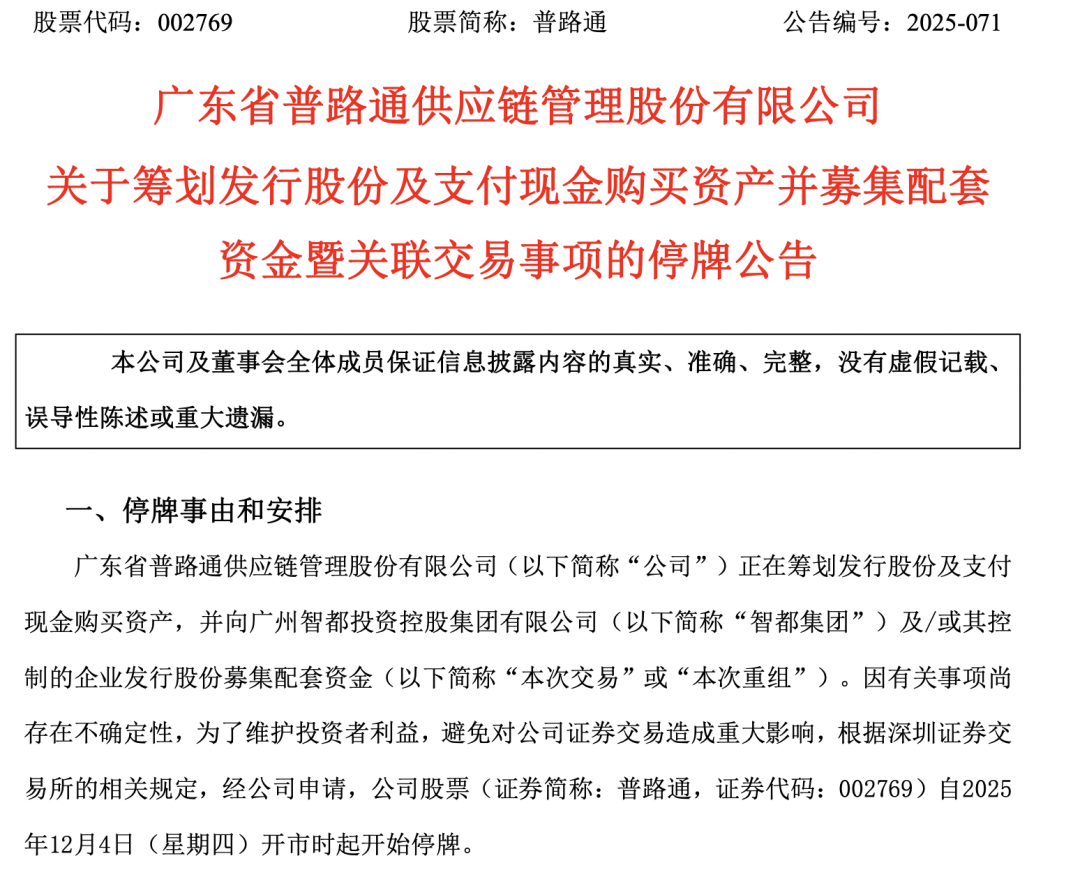
Core Viewpoint - The announcement of the "Six Guidelines for Mergers and Acquisitions" has led to increased inclusivity and flexibility in A-share listed companies' merger and acquisition activities, with enhanced attractiveness for cross-border mergers and acquisitions [1] Company Overview - Pulutong (002769) announced on December 3 that it is planning to acquire control of Leqee Group Limited through a combination of issuing shares and cash payments, while also raising matching funds from Guangzhou Zhidu Investment Holdings Group Co., Ltd. and/or its controlled enterprises [1][3] - The company’s stock will be suspended from trading starting December 4, with a plan to disclose the transaction proposal within no more than 10 trading days [3] - If the board meeting to review and disclose the restructuring plan is not held within the stipulated time, the stock will resume trading by December 18 at the latest, and the related matters will be terminated [3] Target Company Details - Leqee Group Limited, established in 2018 and registered in the Cayman Islands, specializes in brand digital and e-commerce services, offering a wide range of professional services including e-commerce operations, channel expansion, digital marketing, consumer operations, professional customer service, warehousing logistics, strategic consulting, and technical solutions [3][4] - The company operates across major domestic and cross-border e-commerce platforms, including Tmall, JD.com, and Douyin, serving various sectors such as beauty, maternal and infant products, and food [3] Transaction Details - The preliminary transaction counterparties include shareholders of the target company, such as CMC Lollipop Holdings Limited and CMC Lollipop II Holdings Limited [4] - Pulutong has signed intention agreements with some counterparties, agreeing to purchase equity in the target company through share issuance and cash payments, with the final price determined by an evaluation report from a qualified appraisal agency [4] - The transaction will not result in a change of the company's actual controller [4] Financial Performance - In the first three quarters of the year, Pulutong achieved operating revenue of 505 million yuan, a year-on-year increase of 14.13%, and a net profit attributable to shareholders of 35.99 million yuan, marking a turnaround from losses [5] Stock Performance - Prior to the restructuring suspension, Pulutong's stock showed active performance, with multiple consecutive trading days of increases. On December 3, the stock opened with a limit-up and closed at 12.94 yuan per share, with a total market capitalization of 4.831 billion yuan [6]


15亿收购“埋雷”!跨境大卖星徽股份追讨原股东六千万欠税
Nan Fang Du Shi Bao· 2025-11-30 13:17
Core Viewpoint - Xinghui Co., Ltd. is pursuing legal action against nine former shareholders of Zebao Technology for a tax dispute arising from its 2018 acquisition, seeking compensation of 68.52 million yuan, with the case accepted by the court but not yet heard [2][5]. Group 1: Acquisition Background - Zebao Technology, once a leading player in cross-border e-commerce, was acquired by Xinghui in 2018 for 1.53 billion yuan, with a payment structure of 891 million yuan in shares and 639 million yuan in cash, resulting in approximately 1.14 billion yuan in goodwill [3][4]. - At its peak in 2020, Zebao Technology contributed 86.43% of Xinghui's cross-border e-commerce revenue, becoming a core growth driver for the company [3]. Group 2: Legal Disputes - The ongoing legal disputes between Xinghui and the former shareholders of Zebao Technology have escalated, with previous accusations of operational manipulation and tax evasion leading to significant financial losses for Zebao [4][5]. - In 2024, Zebao Technology filed a lawsuit against former executives for 242.5 million yuan due to alleged misconduct, indicating a deteriorating relationship between former partners [4]. Group 3: Tax Issues - The current lawsuit for 68.52 million yuan is rooted in undisclosed cross-border tax liabilities, with the total principal amount owed reaching 48.7752 million yuan, which was not revealed during the acquisition process [5][6]. - The former shareholders are being held accountable for compliance and financial accuracy as per the acquisition agreement, with Xinghui seeking joint liability for the tax claims [6]. Group 4: Financial Performance - Xinghui's financial performance shows a revenue decline of 6.23% year-on-year for the first three quarters of 2025, totaling 1.112 billion yuan, while net profit for the same period was 2.692 million yuan, reflecting a significant increase of 106.21% [7][8]. - The outcome of the ongoing lawsuit could significantly impact Xinghui's profitability, as a successful claim would alleviate financial pressure [7]. Group 5: Industry Implications - The ongoing disputes serve as a warning for the cross-border e-commerce industry regarding compliance risks, emphasizing the need for thorough due diligence in tax and operational compliance before acquisitions [9]. - The reliance on a single platform, as seen with Zebao's previous dependence on Amazon, poses risks, highlighting the importance of diversifying sales channels and enhancing compliance to avoid operational pitfalls [9].


跨境并购总规模同比翻倍!中资券商需提升“复杂交易”能力
券商中国· 2025-11-28 09:13
Core Viewpoint - The article highlights the recent policy incentives for cross-border mergers and acquisitions (M&A) in China, indicating a significant increase in the willingness of Chinese companies to engage in such activities, driven by supportive government measures and market dynamics [1][2][3]. Policy Support for Cross-Border M&A - The "Guangdong Province Financial Support for Enterprises to Carry Out Industrial Chain Integration and M&A Action Plan" proposes initiatives such as exploring the establishment of cross-border integration and M&A funds with Hong Kong and Macau capital [2]. - Various local governments, including Shenzhen and Shanghai, have released supportive policies for M&A, emphasizing the connection between Hong Kong capital markets and domestic resources [2][3]. Market Trends in Cross-Border M&A - There is a noticeable shift towards more rational selection of targets, with Chinese companies focusing on high-quality assets that provide strategic value, particularly in sectors like high-end manufacturing, new energy, and biomedicine [3][5]. - The M&A models are becoming more flexible, with an increase in joint ventures, minority stake investments, and greenfield projects, moving beyond traditional controlling stake acquisitions [5][6]. Growth in M&A Activity - From early October 2024, Chinese companies disclosed 182 outbound M&A events totaling 177.25 billion yuan, with 142 events in 2025 alone, reflecting a year-on-year doubling in scale [3][5]. - The article notes that listed companies are playing a significant role in this surge, driven by the need for international business expansion and sustainable growth [6]. Challenges for Chinese Investment Banks - Despite the growth in cross-border M&A, Chinese investment banks face challenges in navigating complex regulatory environments and understanding local market dynamics [7][8]. - There is a need for investment banks to enhance their capabilities in managing intricate cross-border transactions and to provide tailored services to meet the evolving needs of Chinese enterprises [7][8].

券商资管“公募热”退潮:年内三家撤回,仅剩国金等批文;多家基金公司撤销监事会 | 券商基金早参
Mei Ri Jing Ji Xin Wen· 2025-11-28 01:05
Group 1 - The enthusiasm for public fund licenses among securities asset management companies has significantly cooled, with three institutions withdrawing their applications this year, leaving only Guojin Asset Management in the queue for approval [1] - This trend reflects a rational return to the industry regarding public fund licenses, potentially leading to a greater focus on active management capabilities and promoting differentiated competition among firms [1] - The reduction in new entrants may alleviate homogenization pressure in the public fund industry, prompting existing institutions to strengthen their core competitiveness [1] Group 2 - The total scale of cross-border mergers and acquisitions (M&A) has doubled year-on-year, with Chinese enterprises disclosing 182 outbound M&A events totaling 177.25 billion, of which 142 events occurred in 2025 alone, amounting to 156.85 billion [2] - Major securities firms are actively seizing opportunities in cross-border M&A, with firms like CICC and CITIC Securities enhancing their service offerings and team structures to capture market share [2] - Despite the growth, many Chinese securities firms still lack the capability to handle complex cross-border transactions, which remains a shortcoming in the industry [2] Group 3 - The number of newly established index-enhanced funds has surged over 400% year-on-year, with 160 new products launched this year, driven by policy support, improved index systems, and increased investor demand [3] - This explosive growth indicates a strong market preference for passive investment strategies, leading to intensified competition among public fund institutions [3] - The trend may reshape the asset management industry landscape, concentrating funds further into leading index products and enhancing overall market pricing efficiency [3] Group 4 - Several fund companies have begun to abolish their supervisory boards, following Yingda Fund's lead, with firms like Yimin Fund and Fangzheng Fubang Fund also making this move to streamline operations and reduce costs [4] - The decision to eliminate supervisory boards reflects an internal optimization strategy within the legal framework, aimed at enhancing efficiency and lowering operational costs [4] - This trend may support stock prices of small and medium-sized public companies and accelerate industry consolidation, indicating a shift towards more refined operational practices in the financial sector [4]
四大证券报精华摘要:11月28日
Zhong Guo Jin Rong Xin Xi Wang· 2025-11-28 00:23
Group 1 - The core viewpoint of the news is that several small and medium-sized public fund companies in China are following the lead of Yingda Fund by abolishing their supervisory boards, allowing the audit committee of the board of directors to assume the supervisory functions, which is seen as an internal optimization within legal boundaries aimed at reducing operational costs and streamlining processes [1][3] - The insurance industry is responding to the emerging field of humanoid robots by launching specialized insurance products, including coverage for robot body loss, third-party liability, and employer liability, indicating a need for innovation in risk management to address the unique risks associated with this new industry [2][4] - The investment interest in dividend-themed funds is increasing, with a record issuance scale of 66.15 billion yuan in November, marking the highest monthly establishment scale for dividend-themed funds this year, as major fund companies expand their offerings in this area [3][10] Group 2 - The National Development and Reform Commission is actively promoting the expansion of infrastructure REITs to include more sectors such as urban renewal facilities, hotels, sports venues, and commercial office facilities, indicating a strategic move to diversify investment opportunities [2][4] - The trend of A-share companies pursuing spin-off listings is gaining momentum, with China CRRC planning to spin off its subsidiary for listing on the Shenzhen Stock Exchange, reflecting a broader industry trend where nearly 30 A-share companies have initiated spin-off plans since 2025 [5][6] - Local governments are increasingly implementing policies to support enterprises in utilizing multi-level capital markets, which is expected to enhance financial empowerment for the real economy and promote the listing of more quality companies [9][10]
跨境并购市场持续回暖,2025年总规模同比翻倍
Sou Hu Cai Jing· 2025-11-27 23:45
Core Viewpoint - The recent issuance of the "Guangdong Province Financial Support for Enterprises to Carry Out Industrial Chain Integration and Mergers Action Plan" signals a favorable policy environment for cross-border mergers and acquisitions (M&A) in China, with various initiatives aimed at enhancing cross-border integration and collaboration with Hong Kong and Macau capital [1] Group 1: Policy Developments - The plan includes measures such as exploring the establishment of cross-border integration and merger funds with Hong Kong and Macau capital [1] - Other cities like Shenzhen and Shanghai have also released favorable policies for cross-border M&A, indicating a broader trend across the country [1] Group 2: Market Trends - The cross-border M&A market is experiencing a resurgence, characterized by more rational target selection, flexible acquisition models, and diversified target regions [1] - From early October 2024 to the present, Chinese companies have disclosed 182 outbound M&A events, totaling 177.25 billion yuan [1] - In 2025 alone, 142 deals have been disclosed, with a total scale of 156.85 billion yuan, representing a year-on-year doubling in activity [1] Group 3: Role of Companies - Listed companies are playing a significant role as the main force in these M&A activities, highlighting their importance in the current market dynamics [1]
跨境并购市场持续回暖 2025年总规模同比翻倍
Zheng Quan Shi Bao Wang· 2025-11-27 23:06
Core Insights - The recent issuance of the "Guangdong Province Financial Support for Enterprises to Carry Out Industrial Chain Integration and Mergers Action Plan" indicates a favorable policy environment for cross-border mergers and acquisitions (M&A) in China [1] - The cross-border M&A market is experiencing a resurgence, characterized by more rational target selection, flexible acquisition models, and diverse target regions [1] - From October 2024 to the present, Chinese companies have disclosed 182 outbound M&A events totaling 177.25 billion yuan, with 142 events in 2025 alone, reflecting a year-on-year doubling in scale [1] Policy Developments - The new policy encourages the establishment of cross-border integration and merger funds in collaboration with Hong Kong and Macau capital [1] - Local governments in Shenzhen, Shanghai, and other regions have also released favorable policies to support cross-border M&A activities [1] Market Trends - The current trend in the cross-border M&A market shows a shift towards more rational decision-making in target selection and an increase in the flexibility of acquisition strategies [1] - The diversity in target regions for M&A activities is also on the rise, indicating a broader scope for investment opportunities [1] Financial Statistics - The total disclosed amount for outbound M&A events from October 2024 to now is 177.25 billion yuan, with a significant portion occurring in 2025 [1] - The number of disclosed M&A events in 2025 has reached 142, with a total scale of 156.85 billion yuan, marking a year-on-year increase of 100% [1]
跨境并购总规模同比翻倍 中资券商需提升“复杂交易”能力
Zheng Quan Shi Bao· 2025-11-27 21:19
Core Insights - The recent issuance of the "Guangdong Province Financial Support for Enterprises to Carry Out Industrial Chain Integration and Mergers Action Plan" indicates a strong governmental push towards cross-border mergers and acquisitions (M&A) [1][2] - The cross-border M&A market is experiencing a resurgence, characterized by more rational target selection, flexible acquisition models, and diversified target regions [1][4] Group 1: Policy Initiatives - The plan encourages the establishment of cross-border integration and merger funds in collaboration with Hong Kong and Macau capital, optimizing mechanisms for qualified foreign and domestic limited partners [2][3] - Local governments, including Shenzhen and Shanghai, have introduced supportive policies for M&A, facilitating cross-border financing and asset transfers [2][3] Group 2: Market Trends - There is a notable increase in cross-border M&A intentions among Chinese enterprises, with 182 outbound M&A events disclosed since early October 2024, totaling 177.25 billion [3] - The willingness of Chinese companies to engage in cross-border M&A has significantly increased, particularly in high-end manufacturing, new energy, and biomedicine sectors [3][4] Group 3: New Trends in M&A - Chinese enterprises are adopting a more rational approach to cross-border investments, focusing on strategic value and unique advantages in target selection [4][5] - The acquisition models are becoming more diverse, including joint ventures and minority stake investments, rather than solely focusing on controlling stakes [4][5] Group 4: Challenges for Chinese Investment Banks - Despite the growth in cross-border M&A, many Chinese investment banks face challenges in navigating complex regulatory environments and market conditions [6][7] - There is a need for investment banks to enhance their capabilities in managing cross-border transactions and to build networks with international firms to improve service offerings [6][7]


跨境并购总规模同比翻倍中资券商需提升“复杂交易”能力
Zheng Quan Shi Bao· 2025-11-27 19:37
Core Insights - The recent issuance of the "Guangdong Province Financial Support Plan for Enterprises to Carry Out Industrial Chain Integration and Mergers" indicates a favorable policy environment for cross-border mergers and acquisitions (M&A) in China, with initiatives such as establishing cross-border integration funds with Hong Kong and Macau capital [1][2] - There is a notable increase in the willingness of Chinese enterprises to engage in cross-border M&A, particularly in high-end manufacturing, new energy, and biomedicine sectors, driven by the need to acquire technology, brands, and overseas channels [3][4] Policy Support - Various local governments, including Shenzhen and Shanghai, have introduced supportive policies for M&A, such as facilitating cross-border financing and optimizing foreign debt registration processes [2][4] - The policies aim to provide strategic direction and financial support for enterprises to acquire key technologies and enhance global market presence through cross-border M&A [2][4] Market Trends - The cross-border M&A market is experiencing a resurgence, characterized by more rational target selection, flexible acquisition models, and diversified target regions [1][4] - Chinese companies are increasingly favoring "small but beautiful" targets that offer unique advantages, focusing on strategic value rather than merely controlling stakes [4][5] Transaction Data - As of early October 2024, Chinese enterprises have disclosed 182 outbound M&A transactions totaling 177.25 billion yuan, with 142 transactions amounting to 156.85 billion yuan reported in 2025 alone, indicating a year-on-year doubling in scale [3][5] Challenges for Financial Institutions - Despite the growth in cross-border M&A, many Chinese securities firms face challenges in navigating complex regulatory environments and understanding local market dynamics [6][7] - There is a need for securities firms to enhance their capabilities in managing cross-border transactions, including building international partnerships and developing a deeper understanding of global market practices [7]
中资投行如何“铺路架桥”?看出海“尖兵”中金公司实践
券商中国· 2025-11-27 01:14
Core Viewpoint - The article highlights the evolution of Chinese investment banks, particularly CICC, as they expand their cross-border operations and adapt to global markets, showcasing their role in facilitating Chinese enterprises' internationalization and contributing to the high-quality development of China's capital market [1][2]. Group 1: Cross-Border M&A Activities - In 2024, Yancoal Energy successfully completed the acquisition of German company Scharff, overcoming various challenges such as regulatory compliance and geopolitical risks, with CICC acting as the exclusive financial advisor [1][3]. - The cross-border M&A market has seen increased activity in 2024, with notable transactions including China Baowu's acquisition of Simandou Iron Ore and Zijin Mining's acquisition of Newmont's Akyem gold mine, all facilitated by Chinese investment banks [3][4]. - CICC has completed over 200 cross-border transactions since its establishment, demonstrating its extensive experience in this area [4]. Group 2: Innovative Approaches and Tools - CICC's success in cross-border transactions is attributed to its professional capabilities, understanding of local capital markets, and a global resource network, which allows for efficient coordination [5]. - In the Yancoal acquisition, CICC utilized innovative financial tools, such as engaging a professional insurance firm to provide representations and warranties, mitigating potential risks associated with the transaction [6]. Group 3: Internationalization and Competitive Advantages - CICC has established branches in major global financial centers, including New York, London, and Frankfurt, creating a comprehensive network to support cross-border M&A services [7]. - The company leverages its long-standing relationships with Chinese enterprises, deep understanding of their needs, and established connections in global capital markets to provide competitive advantages over foreign investment banks [8]. - Despite existing challenges, such as a shorter history and fewer overseas talents compared to foreign banks, CICC is optimistic about overcoming these shortcomings through continuous learning and experience accumulation [8].