
长期价值创造

Search documents
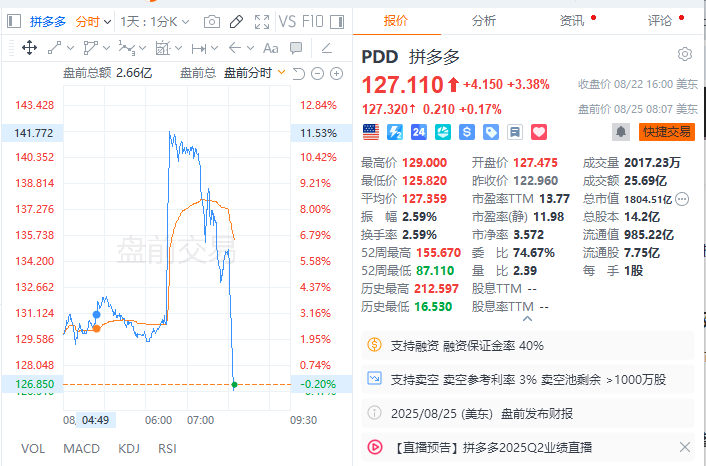
拼多多电话会全文:不认为这个季度利润可以持续,甘于牺牲短期利润,长期坚持反哺生态
美股IPO· 2025-08-25 14:21
Core Viewpoint - The company emphasizes a long-term investment strategy focused on supporting merchants, sacrificing short-term profits for sustainable ecosystem growth [3][6][10]. Financial Performance - In Q2, the company reported revenue of 1,040 billion RMB, a 7% year-on-year increase, but the growth rate has slowed compared to Q1 [3][19]. - Operating profit decreased by 21% year-on-year to 258 billion RMB, while net profit fell by 4% to 306.8 billion RMB [3][22]. - The company acknowledges that the current profit levels are not sustainable and expects continued fluctuations in future earnings due to ongoing investments [3][27][39]. Merchant Support Initiatives - The company has launched a "100 Billion Support Plan" to provide substantial resources to merchants, aiming to enhance the overall ecosystem [7][13]. - Various initiatives, such as reducing fees and improving logistics, have been implemented to support merchants, resulting in significant cost savings and increased order volumes in remote areas [8][14][33]. - The company is focusing on helping small and medium-sized businesses and traditional brands adapt to market changes and consumer demands [16][32]. Consumer Engagement - The company has expanded consumer reward programs, including a 10 billion coupon initiative, to enhance customer value and drive sales during promotional events [9][39]. - During the 618 shopping festival, the company provided substantial subsidies and coupons, leading to record sales across multiple categories [39]. Global Business Strategy - The company acknowledges that its global business is still in the early stages and plans to invest in local supply chains, service optimization, and compliance capabilities [10][29]. - The company aims to adapt to changing global trade dynamics and consumer needs while enhancing its service quality and operational efficiency [30][29]. Future Outlook - The company remains committed to long-term value creation, prioritizing ecosystem health over short-term financial performance [3][10][39]. - The management anticipates ongoing investment in merchant support and consumer experience, which may lead to continued short-term profit volatility [3][27][39].



PDD(PDD) - 2025 Q2 - Earnings Call Transcript
2025-08-25 12:32
Financial Data and Key Metrics Changes - In Q2 2025, total revenues increased by 7% year over year, driven by growth in online marketing services and transaction services [22] - Operating profit declined by 21% year over year, reflecting the company's commitment to long-term investments over short-term financial results [7][27] - Non-GAAP operating profit margin decreased to 27% from 36% in the same quarter last year [27] - Net income attributable to ordinary shareholders decreased by 4% year over year [28] Business Line Data and Key Metrics Changes - Revenues from online marketing services increased by 30% year over year [22] - Revenues from inspection services grew by 1% compared to the same quarter last year [22] - Total cost of revenues increased by 36% from RMB 33.7 billion in Q2 2024 to RMB 45.9 billion in Q2 2025, primarily due to higher fulfillment fees and payment processing fees [23] Market Data and Key Metrics Changes - The company observed a 40% growth in order numbers from remote regions due to logistic support initiatives [8] - The June 18 shopping festival saw record sales across multiple categories, indicating strong consumer demand [10][20] Company Strategy and Development Direction - The company launched a RMB 100 billion support program to invest in the merchant ecosystem and drive long-term value creation [6][14] - Focus on high-quality growth by creating long-term opportunities for merchants and investing in consumer experience [11][20] - The company aims to deepen its support for individual merchants and explore new business models in response to intensified competition [34][37] Management's Comments on Operating Environment and Future Outlook - Management acknowledged the rapid changes in the external environment and the challenges faced by merchants [6] - The company remains committed to long-term value creation, even if it leads to fluctuations in profitability [11][59] - Management expressed confidence in the potential of China's consumer market, despite escalating competition [61] Other Important Information - The company is actively investing in agri-tech and has launched initiatives to support agricultural technology research [10][11] - The total grocery business is viewed as a meaningful long-term investment, with plans to deepen commitments across product quality and delivery efficiency [52] Q&A Session Summary Question: Insights on revenue growth rate narrowing and competitive dynamics - Management noted intensified competition leading to slower revenue growth and emphasized a proactive approach to strengthen the platform ecosystem [34][35] Question: Future directions for global business and growth opportunities - Management highlighted steady consumer demand and the need for continuous investment in supply chain capabilities to adapt to changing market conditions [38][39] Question: Key changes observed since the RMB 100 billion support program launch - Management reported early effects of the support program, including increased merchant efficiency and market reach [45][46] Question: Company's view on the grocery business amidst competition - Management affirmed commitment to the grocery business, emphasizing the importance of creating unique value and addressing supply chain challenges [49][52] Question: Stability of investment cycle and profit margin trends - Management indicated that Q2 profits benefited from seasonality and that fluctuations in profitability are expected in the coming quarters [57][59] Question: Updates on consumer sentiment and macro trends - Management observed steady growth in retail sales and online penetration, while acknowledging the competitive landscape's impact on consumer behavior [61][63]
拼多多电话会:甘于牺牲短期利润,长期坚持反哺生态
Hua Er Jie Jian Wen· 2025-08-25 12:21
Core Viewpoint - Pinduoduo's net profit declined in Q2 due to intense competition in the e-commerce sector and increased support for merchants, but results were significantly better than market expectations. The management emphasized a commitment to long-term value creation over short-term profits [1][4]. Financial Performance - In Q2, Pinduoduo achieved revenue of $37 billion, representing a year-on-year growth of 10% [8]. - Operating profit decreased by 21% year-on-year, reflecting the impact of substantial investments in merchant support and ecosystem development [4]. Strategic Initiatives - The company launched the "100 Billion Support Plan," which involves significant resource allocation to support the merchant ecosystem and explore new business models globally [4][5]. - Pinduoduo's initiatives have led to a 40% increase in order volume for remote areas, enhancing the quality of life for consumers in those regions [4]. Long-term Focus - Management reiterated the importance of long-term investments in ecosystem building and consumer experience, indicating that profitability may fluctuate as a result of these strategies [6][9]. - The company is prioritizing high-quality growth and is willing to sacrifice short-term profits for sustainable development [1][6].
Air T Stock Rises Following Q1 Earnings With Higher Revenue and Loss
ZACKS· 2025-08-18 19:05
Core Viewpoint - Air T, Inc. (AIRT) reported mixed financial results for the fiscal year ended June 30, 2025, with revenue growth but increased net losses, highlighting both strengths in certain segments and weaknesses in others [1][2][7]. Revenue and Earnings Performance - AIRT reported revenues of $70.9 million for Q1 fiscal 2026, a 6.7% increase from $66.4 million in the prior-year quarter [2] - The company posted a net loss of $1.6 million, compared to a loss of $0.3 million in the same quarter last year, with loss per share widening to $0.61 from $0.12 [2] - Operating income improved to $0.4 million from a loss of $0.6 million in the prior-year quarter [2] Segment Results - Ground Support Equipment and Digital Solutions showed strong contributions, while Commercial Aircraft, Engines, and Parts experienced weakness [3] - Overnight Air Cargo revenues increased by 0.7% to $30.6 million, but adjusted EBITDA decreased by 17.2% to $1.6 million due to lower maintenance margins [5] - Ground Support Equipment revenues surged by 104.9% to $15.1 million, with adjusted EBITDA turning positive at $1.4 million from a loss of $0.5 million [5] - The Commercial Aircraft, Engines, and Parts segment saw revenues decline by 16.3% to $21.9 million, primarily due to weaker component sales, with adjusted EBITDA down 54.7% to $0.8 million [6] - Digital Solutions revenues rose by 24.9% to $2.1 million, narrowing adjusted EBITDA loss to $0.1 million from $0.3 million [6] Key Business Metrics - Adjusted EBITDA was $1.5 million, up 71.1% from $0.9 million in the prior year [4] - Investment balance in equity method investees increased to $19.9 million from $19 million at the end of March 2025 [4] Management Commentary - Chairman and CEO Nick Swenson expressed satisfaction with the company's performance and highlighted strategic initiatives for long-term value creation, particularly in Ground Support Equipment and Digital Solutions [7] Factors Influencing Performance - Revenue growth was driven by strong demand for deicing trucks in Ground Support Equipment, which more than doubled sales compared to the prior year [8] - Overnight Air Cargo performance remained steady, supported by FedEx-related operations, although profitability declined due to lower-margin maintenance activities [8] - Digital Solutions benefited from customer acquisition momentum in subscription software [8] Expense and Non-Operating Results - Consolidated operating expenses increased by 5.1% year over year, mainly due to higher costs in Ground Support Equipment [9] - Non-operating results were less favorable, with a non-operating loss of $1.3 million compared to income of $0.7 million in the prior year, attributed to higher interest expenses and weaker contributions from equity method investments [9] Strategic Developments - On May 15, 2025, AIRT's subsidiary Mountain Air Cargo acquired Royal Aircraft Services for $1.2 million, integrating it into the Overnight Air Cargo segment [12] - On July 15, 2025, Contrail's subsidiary sold two Airbus A321 aircraft for over $18 million, transferring lease obligations to the buyer, reflecting ongoing portfolio restructuring [12]

Azenta(AZTA) - 2025 Q3 - Earnings Call Transcript
2025-08-05 13:30
Financial Data and Key Metrics Changes - In Q3 2025, total revenue was $144 million, flat year over year on a reported basis and down 2% on an organic basis [17][19] - Adjusted EBITDA margin expanded by approximately 260 basis points year over year to 12.3%, reflecting operational turnaround efforts [9][18] - Free cash flow for the quarter was $15 million, driven primarily by improved working capital [18] Business Line Data and Key Metrics Changes - Sample Management Solutions (SMS) revenue was $78 million, down 4% year over year on a reported basis and down 6% on an organic basis, primarily due to softer bookings and timing delays [20] - Multiomics segment delivered revenue of $66 million, up 4% on a reported basis and up 3% on an organic basis, driven by growth in next-generation sequencing [21][22] - Non-GAAP gross margin for SMS was 53.6%, up 760 basis points year over year, while Multiomics gross margin was 42.6%, down approximately 500 basis points year over year [20][23] Market Data and Key Metrics Changes - China posted 10% organic growth in the Multiomics segment despite macro and geopolitical headwinds [22] - The company anticipates a 1% headwind to full year 2025 revenue due to reductions in NIH funding levels [10][90] Company Strategy and Development Direction - The company is focused on long-term value creation and operational turnaround, with key growth priorities including strengthening commercial excellence and investing in R&D [6][7] - The Azenta Business System (ABS) is being leveraged to enhance operational efficiency and drive growth [8][68] - The company plans to prioritize investments in gross margin productivity, organic growth offerings, and strategic M&A opportunities [12] Management's Comments on Operating Environment and Future Outlook - Management remains committed to full year 2025 guidance of organic revenue growth between 3% to 5% and adjusted EBITDA margin expansion of 300 basis points [9][25] - The company is optimistic about capitalizing on opportunities arising from the current dynamic environment [11] - Management noted that the operational improvements have allowed them to reaffirm guidance despite external challenges [11] Other Important Information - The company ended the quarter with $550 million in cash and no outstanding debt, positioning it well for future investments [12][24] - An Investor Day is planned for later in the calendar year to discuss achievements and outlook [13] Q&A Session Summary Question: Guidance for fiscal 2025 and thoughts on fiscal 2026 - Management indicated confidence in a step-up in Q4 due to momentum in NGS and sufficient backlog, with a commitment to 5% to 8% CAGR for fiscal 2026 [29][34] Question: Weakness in SMS core products - Management clarified that there are no cancellations, but orders are being pushed out due to capital equipment purchase delays [35][36] Question: Gene synthesis headwinds - Management noted softness in gene synthesis from pharma accounts but expects improvements in Q4 [39][40] Question: Q4 revenue expectations - Management highlighted a seasonal step-up from Q3 to Q4 and strong funnel visibility, indicating confidence in achieving revenue targets [44][46] Question: Leadership changes impact - Management discussed new commercial leadership in North America and positive early signs from the regional model [48][50] Question: M&A funnel focus - Management emphasized a disciplined approach to M&A, focusing on core biorepositories and multiomics opportunities [52][54] Question: NIH funding headwinds - Management maintained a consistent view on NIH funding as a 1% headwind but expressed optimism about potential increases in funding [89][90]

Northern Oil and Gas(NOG) - 2025 Q2 - Earnings Call Transcript
2025-08-01 14:02
Financial Data and Key Metrics Changes - The company generated over $126 million in free cash flow for the quarter, marking the 22nd consecutive quarter of positive free cash flow, totaling over $1.8 billion during this period [10][27][30] - Adjusted EBITDA for the quarter was $440.4 million, including a legal settlement impact of approximately $48.6 million [27][30] - Total average daily production was approximately 134,000 BOE per day, up 9% year-over-year and in line sequentially [26][30] Business Line Data and Key Metrics Changes - Oil production was approximately 77,000 barrels per day, up 10.5% year-over-year but down 2% sequentially due to lower activity in the Williston [26][30] - The Uinta basin showed strong performance with volumes up 18.5% sequentially [26] - Gas production reached record volumes of approximately 343 MMcf per day, with contributions from the Appalachian JV [27] Market Data and Key Metrics Changes - Oil differentials averaged $5.31 per barrel, while natural gas realizations were 82% of benchmark prices, down from 100% in the previous quarter [27][28] - Lease operating costs per BOE rose 6% to $9.95 due to higher expenses in the Williston and Permian [28] Company Strategy and Development Direction - The company emphasizes a disciplined approach to capital allocation, focusing on maximizing returns for investors and maintaining a strong balance sheet [16][17] - The strategy includes a shift towards acquisitions in a lower price environment, with a backlog of potential acquisitions at an all-time peak [13][14] - The company aims to grow profits on a per-share basis while focusing on strong returns on capital [17] Management's Comments on Operating Environment and Future Outlook - Management noted that the business model has proven resilient despite commodity price volatility, with a focus on risk optimization and cash flow generation [4][5] - The outlook for the second half of the year anticipates a modest dip in production in Q3, with expectations for a recovery in Q4 [76] - Management remains optimistic about the M&A landscape, with a robust pipeline of opportunities driven by market conditions [70][71] Other Important Information - The company recorded a non-cash impairment charge of $115.6 million due to lower oil prices, leading to a reduction in DD&A guidance per BOE [32] - The company has maintained over $1.1 billion in liquidity, consisting of cash and available credit [30] Q&A Session Summary Question: What is the cadence into 2026? - Management indicated that lower spending in Q2 would translate into modestly lower volumes in Q3, but Q4 should see levels similar to Q2 [36][38] Question: Is the reduction in CapEx due to fewer wells being proposed? - The reduction is attributed to a combination of lower activity from operators and discretionary spending being curtailed due to risk-adjusted returns [50][51] Question: How will the nearly $50 million legal settlement be treated? - The settlement will be treated as working capital and will not be included in free cash flow calculations [64][65] Question: What are the expectations for the M&A market? - The M&A market remains robust, with a variety of asset types available, and management is optimistic about finding value-accretive opportunities [70][71][90]

Travel + Leisure(TNL) - 2025 Q2 - Earnings Call Transcript
2025-07-23 13:02
Financial Data and Key Metrics Changes - The company generated over $1 billion in revenue, $250 million in adjusted EBITDA, and $1.65 in adjusted earnings per share, all showing year-over-year increases [6][19] - Adjusted EBITDA grew 2% year-over-year, translating to a 4% adjusted EBITDA growth for the first half of the year [19] - The average FICO score of new originations is 746, reflecting a more than 20-point increase since the company updated its credit quality standards [10] Business Line Data and Key Metrics Changes - The Vacation Ownership segment saw revenue grow 6% to $853 million, driven by a 3% increase in tours and a VPG of $3,251, which is up 7% from last year [20] - The Travel and Membership segment's revenue was $166 million for the quarter, down 6% year-over-year, with adjusted EBITDA declining 11% to $55 million [22] Market Data and Key Metrics Changes - Demand remains strong across the core timeshare business, with tour growth improving sequentially from the first quarter and 3% compared to 2024 [7] - The company serves more than 800,000 owner families with an average tenure of 17 years, indicating a stable customer base [9] Company Strategy and Development Direction - The company is focused on growing its core vacation ownership business while leveraging data and technology to enhance customer experience [13] - New brand expansions include a new sales location in Nashville and the launch of the Accor Vacation Club in Asia, indicating a strategy of geographic expansion [14][76] Management's Comments on Operating Environment and Future Outlook - Management expressed confidence in the resilience of leisure travel and the health of consumers, with spending on leisure travel expected to grow mid-single digits per year over the next five years [7] - The company anticipates continued strength in the vacation ownership business, which is expected to cover any weakness in the travel and membership segment [26] Other Important Information - The company returned $107 million of adjusted free cash flow to shareholders during the quarter, with $37 million through dividends and $70 million in share repurchases [23] - The liquidity position remains strong, ending the quarter with over $800 million, including $212 million in cash and cash equivalents [25] Q&A Session Summary Question: Visibility in the Travel and Membership segment - Management acknowledged challenges in the travel membership segment due to industry consolidation and unanticipated impacts from M&A activity, but emphasized proactive measures to address these issues [31][32] Question: Average transaction size and financing - Management noted that the increase in average transaction size is due to measured price increases and greater owner engagement, with no significant change in the propensity to finance [35][38] Question: Delinquency trends and provisions - Delinquencies moderated through the second quarter and into July, with a full-year provision of 21% expected, and management is confident in the portfolio's strength [46][47] Question: Consumer health and income stratification - Management indicated that higher household incomes correlate with better performance and lower delinquencies, while new owner performance remains strong despite economic uncertainties [56][58] Question: International opportunities with Accor - Management expressed optimism about the international market potential but emphasized that the U.S. market remains the primary focus, with expectations for similar profitability margins internationally [74][78] Question: New projects and brand launches - Management highlighted the strategic importance of new brands like Margaritaville and Sports Illustrated, which are expected to contribute significantly to sales growth [90][91]

创投的历史性变革,机遇何在
母基金研究中心· 2025-07-06 08:55
Core Viewpoint - The current capital winter is seen as a precursor to future prosperity, emphasizing that failures in the venture capital industry provide valuable lessons that drive progress [2][4]. Group 1: Industry Trends and Changes - Since 2018, China's venture capital industry has entered a painful period, marked by significant events such as the collapse of shared bicycles and the P2P lending crisis, leading to a cautious financing environment [2][3]. - The shift from a "short-term profit" focus to "long-term value creation" is essential for the transformation of the venture capital industry, which will help cultivate innovative companies with core competitiveness and provide quality investment targets for the capital market [4][6]. Group 2: National Policy and State Capital - The establishment of a "national-level" venture capital guiding fund is expected to mobilize nearly one trillion yuan in social capital, focusing on strategic industries such as AI, quantum technology, and hydrogen energy [6][7]. - State-owned capital is increasingly playing a leading role in the venture capital market, with significant investments in strategic emerging industries, reflecting a shift from being mere fund providers to becoming long-term capital leaders and innovation resource integrators [11][12]. Group 3: Regional Innovation Models - Different cities in China are developing unique models for venture capital and innovation, with Hefei focusing on "industry-investment linkage," Hangzhou on "collaborative ecosystems," and Shenzhen on market-driven resource allocation [13][14][26]. - Hefei's approach, termed the "Hefei phenomenon," involves using fiscal funds to attract major investments, leading to the establishment of a robust display panel industry and significant investments in semiconductor technology [16][18]. - Hangzhou's model emphasizes institutional innovation, talent policies, and the integration of industry and academia, resulting in a vibrant innovation ecosystem that supports technology transfer and commercialization [19][23]. Group 4: Evolution of Investment Strategies - The venture capital industry is moving away from traditional "betting agreements" and quick exits, reflecting a broader recognition of the need for patience in funding hard technology projects that require longer development cycles [27][30]. - New investment philosophies are emerging, focusing on deep industry engagement and value discovery, while policies are being reformed to create a comprehensive investment ecosystem that supports research, transformation, and exit strategies [30][32]. Group 5: Future Outlook - The transformation in the venture capital landscape aims to make capital a true enabler of technological innovation, aligning investment cycles with the realities of innovation [33][34]. - The industry is witnessing a shift towards nurturing long-term relationships with projects, with a focus on cultivating technologies and supporting companies over extended periods, which is expected to yield significant returns in the future [34].

Fortinet: Highly Profitable, Founder-Led, And With Industry Tailwinds
Seeking Alpha· 2025-07-02 15:00
Core Insights - Triba Research aims to identify high-quality businesses capable of delivering sustainable, double-digit returns over the long term [1] - The firm's strategy emphasizes companies with strong competitive advantages, operating in growing markets, maintaining low debt levels, and led by skilled management teams [1] - Triba Research prioritizes long-term value creation while staying informed about the latest market developments [1]


站在创投历史性变革的前夜,收获一场时间的玫瑰
3 6 Ke· 2025-06-06 00:49
Group 1 - The current capital winter is seen as a precursor to future prosperity, emphasizing that failures in the venture capital industry provide valuable lessons for growth [1] - Since 2018, China's venture capital industry has faced challenges, with a decline in financing activities, marking a shift towards more cautious investment behavior [1][2] - The shift from "short-term profit-seeking" to "long-term value creation" is essential for fostering innovation and enhancing the quality of investment opportunities [2] Group 2 - The establishment of a "carrier-level" national venture capital guidance fund aims to mobilize nearly 1 trillion yuan in social capital, focusing on strategic industries such as AI and quantum technology [3] - The fund will operate under a "mother-child fund" model with a 20-year lifespan, targeting early-stage and small to medium enterprises to address financing challenges [3][4] - State-owned capital is increasingly playing a significant role in guiding investments in key sectors, with substantial growth in strategic emerging industry investments [4][5] Group 3 - Local governments are evolving from mere financial supporters to active builders of innovation ecosystems, with cities like Hefei, Hangzhou, and Shenzhen showcasing distinct development models [7][8] - Hefei's approach emphasizes "industry-investment linkage," successfully attracting significant investments in display technology and electric vehicles [7][8] - Hangzhou focuses on creating a collaborative ecosystem through institutional innovation and talent policies, leading to a thriving tech environment [9][10] Group 4 - Shenzhen's private equity and venture capital funds have seen substantial growth, with a focus on early-stage investments in high-tech sectors [11][12] - The city has established a unique operational model combining state capital with market mechanisms, allowing for effective resource allocation [12][13] - The shift towards "flexible exits" in investment strategies reflects a growing understanding of the long-term nature of hard technology development [14][15] Group 5 - The venture capital industry is undergoing a transformation, moving away from traditional rapid exit strategies towards a focus on nurturing long-term value [14][15] - This change is driven by the need for patience in funding hard technology projects, which often require extended periods for development and commercialization [15][16] - The ultimate goal of this transformation is to align capital with the realities of technological innovation, supporting the construction of a robust innovation ecosystem in China [16]