
预算赤字

Search documents
美国10月份预算赤字达2840亿美元
中国基金报· 2025-11-26 06:02
Core Points - The U.S. Treasury Department reported a federal budget deficit of $284 billion for October, primarily due to the recent government shutdown [1] - A Treasury official indicated that the shutdown, lasting 43 days, caused delays in payments for certain expenditures, such as government employee salaries [1] - The release of the budget results for the first month of fiscal year 2026 has been postponed due to the shutdown [1]


【环球财经】欧盟委员会:欧元区明年整体财政立场应保持中性
Xin Hua Cai Jing· 2025-11-26 05:20
Core Insights - The European Commission has stated that the overall fiscal stance of Eurozone member states should remain neutral in 2024, suggesting a reallocation of budget priorities to meet strategic investment needs [1] Group 1: Fiscal Projections - The budget deficit in the Eurozone is projected to slightly increase from 3.1% of GDP in 2024 to 3.2% in 2023, and further to 3.3% in 2026 and 3.4% in 2027 [1] - Countries such as Belgium, Latvia, Lithuania, Estonia, and Germany are expected to see an increase in their deficits next year due to rising defense expenditures [1] Group 2: Compliance and Challenges - The European Commission evaluated compliance with the EU fiscal framework and identified several strategic vulnerabilities, including low productivity, demographic pressures, and increasing public spending needs related to defense, decarbonization, and digital economy transitions [1] - Finland is deemed necessary to initiate an excessive deficit procedure based on the assessment results, while Germany is exempt from penalties due to increased defense spending leading to a breach of deficit limits [1] Group 3: Specific Country Projections - Finland's budget deficit is projected to be 4.4% of GDP in 2024, rising to 4.5% in 2023, and maintaining at 4.0% in the following year [2] - Germany's deficit is expected to be 3.1% of GDP this year, increasing to 4.0% by 2026 and 3.8% by 2027, exceeding the 3% limit set by the EU Stability and Growth Pact [2]
美国10月份预算赤字达2840亿美元
Yang Shi Xin Wen· 2025-11-25 21:25
Group 1 - The core point of the article is that the U.S. federal budget deficit for October reached $284 billion, significantly impacted by the recent government shutdown lasting 43 days [1] - A Treasury official indicated that the shutdown caused delays in payments for certain expenditures, such as government employee salaries, which affected the release of budget results for the first month of fiscal year 2026 [1]
克罗地亚第二季度预算赤字超过GDP的3%
Shang Wu Bu Wang Zhan· 2025-11-11 15:59
Core Insights - Croatia's budget deficit in Q2 significantly increased, surpassing the GDP limit of 3% for the first time since spring 2024 [1] - The Eurozone's adjusted budget deficit for Q2 stands at 2.7% of GDP, unchanged from Q1 2025, while the EU's overall deficit rose to 2.9%, an increase of 0.1 percentage points from Q1 [1] Group 1: Budget Deficit and Public Spending - Eurozone public spending as a percentage of GDP reached 49.4%, up by 0.2% from the previous quarter, with total spending increasing by approximately €210 billion [1] - The overall EU spending as a percentage of GDP rose to 49.1%, with total spending increasing by about €300 billion since the beginning of the year [1] Group 2: Budget Revenue - Eurozone budget revenue as a percentage of GDP increased by 0.2% to 46.7%, with an increase of around €210 billion compared to Q1 [1] - EU budget revenue also saw a rise of 0.1% to 46.2%, with an increase of approximately €240 billion since Q1 [1] Group 3: Member States' Performance - In Q2, 21 EU member states reported budget deficits, with 9 countries exceeding the 3% GDP threshold; Croatia's deficit reached 4.2%, an increase of 1.2% from Q1 [1] - Romania reported the highest deficit at 8.7% of GDP, while Cyprus had the largest budget surplus at 3.6% of GDP [1]
今日期货市场重要快讯汇总|2025年11月11日
Sou Hu Cai Jing· 2025-11-11 00:09
Group 1: Precious Metals Futures - Spot gold prices showed strong performance, breaking through $4,110 per ounce with an increase of 2.72%, and further rising to $4,120 per ounce [1][2] - New York futures gold also rose, surpassing $4,120 per ounce with a daily increase of 2.75% [3] - Silver's main contract surged by 3%, currently reported at ¥11,895.00 per ton [4] Group 2: Macroeconomic and Market Impact - Federal Reserve official Milan suggested a 50 basis point rate cut in December is appropriate, with at least a 25 basis point cut [5] - Musallam noted that the actual federal funds rate has decreased by 250 basis points over the past year, but further easing has limited space, while the Fed report indicates that housing and stock prices seem elevated [6][7][8] - The U.S. Congressional Budget Office estimated the budget deficit for October at $219 billion [9] Group 3: Financial Futures Market Dynamics - The three major U.S. stock indices closed higher on Monday, with the Dow Jones up 0.81%, S&P 500 up 1.54%, and Nasdaq rising over 2% to 2.27%, driven by gains in large tech stocks [10] - The Nasdaq China Golden Dragon Index also rose, with a daily increase of 2.13%, closing at 8,229.270 points [11] - Among popular Chinese concept stocks, XPeng Motors led with a 16.15% increase, while Vipshop and Baidu rose over 5% [12]
以色列央行原行长独家专访:控通胀如何铸就“创业国家”传奇
2 1 Shi Ji Jing Ji Bao Dao· 2025-10-30 11:44
Core Viewpoint - The independence of central banks is crucial for economic stability, especially in the current international context where political pressures can undermine effective monetary policy [1][14]. Group 1: Central Bank Independence - Central bank independence is essential for implementing necessary and sometimes difficult decisions, as political systems tend to focus on short-term goals [1][14]. - The independence of central banks allows for a long-term perspective in monetary policy, which is vital for sustainable economic outcomes [14][15]. Group 2: Israel's Economic Transformation - Israel's economic success in the 1990s was attributed to a comprehensive strategy that included stabilizing inflation, reducing budget deficits, developing capital markets, and enhancing exchange rate flexibility [2][12]. - The influx of highly skilled immigrants and improved geopolitical conditions contributed to Israel's transformation into a "startup nation," with high-tech exports accounting for over half of its total exports [2][12]. Group 3: Global Economic Governance - The shift from globalization to fragmentation is concerning, as countries are increasingly competing rather than cooperating, which can lead to unhealthy economic practices [6][8]. - China is recognized as a vital player in the global economy and should take on a larger role in global governance, responding to traditional systems' inadequacies [3][8]. Group 4: Emerging Markets Representation - Emerging markets have shown resilience and performed better than developed countries in recent years, but their representation in international institutions like the IMF does not reflect their economic weight [7][8]. - There is a growing recognition of the need to enhance the representation of emerging markets in global governance structures [7]. Group 5: Debt and Economic Stability - The accumulation of public debt is a long-term issue resulting from persistent budget and current account deficits, which can lead to systemic risks [9][10]. - Responsible government behavior and the development of robust capital markets are essential to manage high debt levels and maintain economic stability [10]. Group 6: Lessons from Israel - The experience of Israel in achieving price stability and economic openness can serve as a model for other emerging or middle-income economies [14][15]. - Effective public communication and building public support for monetary policy are critical for central banks to maintain their independence and achieve economic stability [15].

10月28日上期所沪金期货仓单较上一日持平
Jin Tou Wang· 2025-10-29 02:07
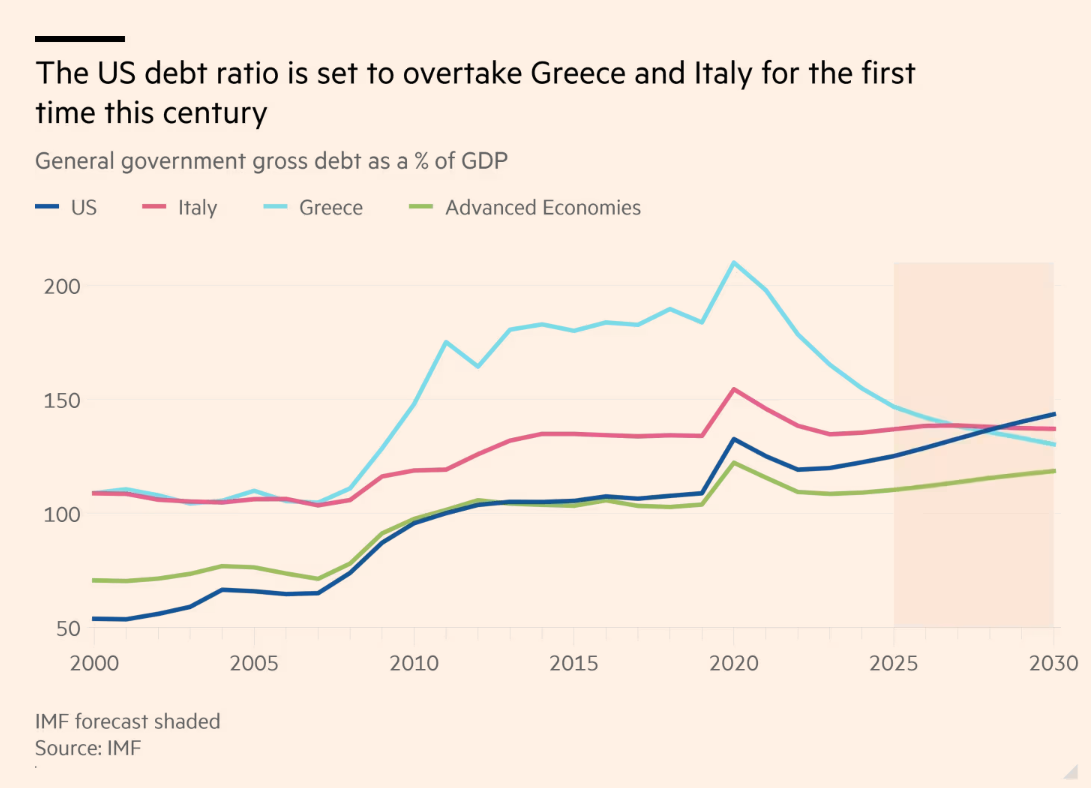
Group 1 - The total amount of gold futures at the Shanghai Futures Exchange is 87,015 kilograms, with no change from the previous day [1] - On October 28, gold futures opened at 926.92 yuan per gram, reaching a high of 928.56 yuan and a low of 900.62 yuan, closing at 901.38 yuan, down 4.20% [1] - The trading volume for the day was 474,483 contracts, with open interest decreasing by 4,899 contracts to 175,916 contracts [1] Group 2 - The International Monetary Fund (IMF) predicts that by 2030, the U.S. government debt as a percentage of GDP will rise by over 20 percentage points to 143.4%, setting a new post-pandemic record [2] - The IMF estimates that the U.S. budget deficit will remain above 7% of GDP annually until 2030, making it the highest among all wealthy countries tracked by the organization [2] - In contrast, Italy and Greece are expected to see a decline in government debt ratios by the end of the century, as both countries are strictly controlling their budget deficits [2]
IMF拉响警报:到2030年,美国债务状况将比意大利和希腊更糟
Jin Shi Shu Ju· 2025-10-27 06:33
Core Viewpoint - The International Monetary Fund (IMF) predicts that the U.S. government debt burden will surpass that of Italy and Greece for the first time this century, highlighting the poor state of U.S. public finances [1][4]. Summary by Sections U.S. Debt Forecast - The IMF forecasts that by the end of the 2020s, the total government debt in the U.S. will rise by over 20 percentage points, reaching 143.4% of GDP, exceeding the previous record set post-pandemic [1]. - The U.S. budget deficit is expected to remain above 7% of GDP annually until 2030, the highest level among all wealthy countries tracked by the IMF [1]. Comparison with Italy and Greece - Italy and Greece, historically scrutinized for their weak public finances, are projected to see a decline in their government debt burdens by the end of this decade due to strict budget control [1]. - In contrast, the U.S. debt-to-GDP ratio is expected to continue rising, with projections from the Congressional Budget Office (CBO) indicating this trend will persist for decades [1][4]. Economic Context - Despite a low unemployment rate, the federal deficit in the U.S. has rapidly expanded during the Biden administration, with the IMF suggesting minimal action taken by the previous Trump administration to address this issue [4]. - The U.S. has a significant borrowing capacity due to its status as the issuer of the global reserve currency, which contrasts with the economic challenges faced by European nations [4]. Debt Measurement Metrics - The total government debt metric, which includes both central and local government debts, has been lower for the U.S. compared to Italy and Greece since the early 21st century [5]. - A net debt measure, excluding financial assets, indicates that U.S. debt levels will still be about 10 percentage points lower than Italy's by the end of the decade, although this net debt is also on the rise [5]. Italy's Fiscal Improvement - Italy's government, under Prime Minister Giorgia Meloni, has received praise from foreign investors for its efforts to reduce the budget deficit, with a projected basic surplus of 0.9% of GDP this year, up from an initial forecast of 0.5% [8][10]. - Italy's fiscal deficit is expected to be 3% of GDP this year, down from 8.1% when Meloni took office in 2022, allowing Italy to exit the EU's excessive deficit procedure a year ahead of schedule [9]. Political Challenges in the U.S. - The political landscape in the U.S. complicates efforts to reduce the significant deficit, with both Democrats and Republicans resistant to spending cuts or tax increases [11]. - Future predictions regarding the sustainability of U.S. fiscal conditions are deemed optimistic, relying on uncertain factors such as productivity growth, tariff revenues, demographic changes, or interest rates [11].
英国9月份预算赤字202亿英镑
Mei Ri Jing Ji Xin Wen· 2025-10-21 06:13
Core Viewpoint - The UK reported a budget deficit of £20.2 billion in September, indicating a significant financial shortfall for the month [1] Group 1 - The budget deficit figure of £20.2 billion reflects the financial challenges faced by the UK government [1]