
光伏反内卷

Search documents
无锡老板柳敬麒,再度冲击A股
3 6 Ke· 2025-08-06 00:26
Core Viewpoint - The acquisition of control by Boda He Yi over San Chao New Materials marks a significant shift in the company's ownership structure, with implications for its future operations and financial health [1][2][10]. Group 1: Company Ownership and Financial Moves - San Chao New Materials announced a share transfer agreement with Boda He Yi, resulting in a change of controlling shareholder and actual controller to Liu Jingqi [1]. - The company plans to issue 12.475 million A-shares to Boda He Yi, raising up to 250 million yuan for working capital and bank loan repayment, which will increase Boda He Yi's stake to 24.83% [1][2]. - Following the announcement, San Chao New Materials' stock price surged by 7.10% on August 5, closing at 25.80 yuan per share [2]. Group 2: Business Performance and Growth Areas - San Chao New Materials has seen revenue growth from 248 million yuan in 2021 to 481 million yuan in 2023, with a turnaround from a net loss of 75.01 million yuan to a profit of 26.91 million yuan [3]. - The company has invested in domestic equipment for silicon cutting production, expanding its capacity significantly, with a new project producing 150 million kilometers of silicon cutting wire in 2023 [3]. - The semiconductor precision diamond tool business of its subsidiary Jiangsu Sanjing achieved revenue of 38.86 million yuan in 2024, marking a 67.54% increase [6]. Group 3: Industry Challenges and Future Outlook - The photovoltaic industry is facing significant challenges, with many companies experiencing losses due to oversupply and falling prices, particularly in the silicon cutting wire segment [6][9]. - San Chao New Materials reported a revenue decline of 27.49% in 2024, with a net loss of 141 million yuan, indicating the impact of the industry's downturn [6]. - The company plans to deepen its involvement in the semiconductor industry, focusing on consumables and equipment, as a potential new growth area [7].

8月光伏玻璃报价上调,"反内卷"下价格触底反弹可期
Jin Rong Jie· 2025-08-05 04:43
Core Viewpoint - The price of 2.0mm single-layer coated photovoltaic glass has been slightly adjusted upwards, with current quotes ranging from 10.5 to 11.0 yuan per square meter, and some leading companies quoting above 11 yuan per square meter, indicating a potential price rebound in the photovoltaic glass market [1] Industry Summary - As of August 4, the price of 2.0mm single-layer coated photovoltaic glass is reported to be between 10.5 and 11.0 yuan per square meter, with leading companies consistently quoting above 11 yuan per square meter, and some companies with strong order backlogs quoting as high as 11.5 yuan per square meter [1] - The Ministry of Industry and Information Technology held a meeting on July 31 to discuss the photovoltaic glass industry, resulting in a price adjustment to 11 yuan per square meter for new orders in August, with companies previously quoting below this price required to withdraw and re-quote [1] - The industry is experiencing a trend of production reduction, with the cumulative cold repair capacity of domestic photovoltaic glass reaching 7,750 tons per day, and effective capacity dropping below 90,000 tons per day [1] - The industry is expected to continue implementing cold repair plans, leading to a reduction in inventory levels and a potential rebound in photovoltaic glass prices as capacity is cleared [1]
本轮光伏反内卷不一样在哪里?
2025-08-05 03:20
Summary of the Conference Call on the Photovoltaic Industry Industry Overview - The conference call focuses on the photovoltaic (PV) industry, specifically discussing recent government interventions and industry responses to curb low-price competition and enhance market stability [1][3][4]. Key Points and Arguments Government Actions - The government has shifted from emphasizing industry self-discipline to implementing legal interventions to control low-price competition, aiming to phase out outdated production capacity [1][3][4]. - A significant meeting in July 2023 highlighted the government's commitment to regulating the industry, with a focus on orderly exit of inefficient capacity [5]. - New regulations are set to be introduced in 2024, with stricter standards expected in 2025, targeting production capacity and output control [1][8]. Industry Response - Companies are actively participating in the restructuring process, proposing silicon material mergers and acquisitions (M&A) to stabilize prices [1][6]. - The price control measures have shown quicker price increases compared to previous years, indicating enhanced compliance from companies [6][9]. - Recent M&A activities, such as the acquisition of 6 to 7 companies, aim to address supply-demand imbalances [6]. Price Trends - The price of silicon materials has risen significantly, from approximately 30,000 RMB to around 47,000 RMB, with downstream prices also increasing in an orderly manner [9]. - The photovoltaic component prices are under bottom constraints, with industry associations providing guidance prices to stabilize cash costs for component manufacturers [9]. Policy Support - The government has introduced various supportive measures, including adjustments to export tax and the application of futures tools to stabilize the market [10]. - Regular quality inspections are planned to ensure product quality and market stability [10]. Demand-Side Initiatives - New initiatives such as photovoltaic desertification control, green electricity direct connection, zero-carbon parks, and photovoltaic hydrogen production are expected to boost mid-term demand and reduce the impact of new installations [2][11]. Future Outlook - The current round of anti-involution policies is seen as more pragmatic and reliable, with a higher likelihood of success compared to previous efforts [12]. - Key upcoming events include the finalization of M&A plans by the end of September 2023, which could lead to significant developments in the industry [15]. Additional Important Content - The photovoltaic industry is recognized as a critical sector for China's manufacturing reputation, receiving substantial attention at the national level [13]. - Investment opportunities are identified across three main areas: silicon material sector, battery and component sector, and energy storage sector, with specific companies highlighted for their potential [16]. - Recent market performance has exceeded expectations in terms of price, demand, and capacity, indicating a positive outlook for the ongoing market trend [17][18].
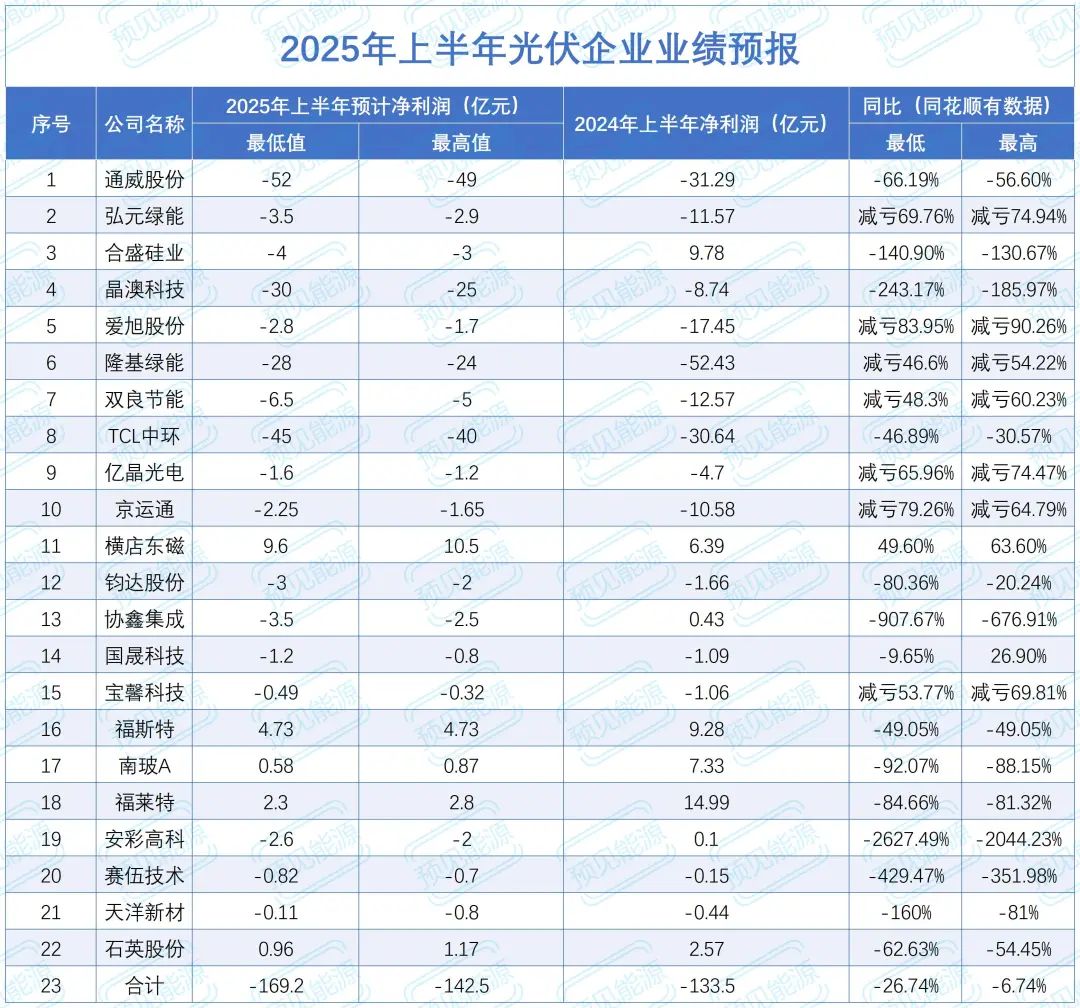
22家企业上半年合计亏损超142.5亿元
3 6 Ke· 2025-08-05 01:23
Core Viewpoint - The photovoltaic industry is experiencing significant losses in the first half of 2025, with 18 out of 23 companies reporting losses totaling between 142.5 billion to 169.2 billion yuan, indicating a year-on-year increase in losses by 6.74% to 26.74% [1][2]. Group 1: Company Performance - Among the 23 photovoltaic companies, only 5 reported profits, while 18 faced losses, with the total loss amounting to 142.5-169.2 billion yuan [1][2]. - Tongwei Co., Ltd. is projected to incur a net loss of 49-52 billion yuan in the first half of 2025, a significant increase from a loss of 31.29 billion yuan in the same period last year, reflecting a year-on-year decline of 55.60%-66.19% [3]. - Hoshine Silicon Industry is expected to report a loss of 3-4 billion yuan, marking its first significant loss since its listing in 2012, with a year-on-year decline of 130.67%-140.90% [3][4]. - Hongyuan Green Energy is projected to lose 2.9-3.5 billion yuan, but this represents a reduction in losses compared to 11.57 billion yuan in the previous year, showing a year-on-year improvement of 69.76%-74.94% [5]. - JA Solar Technology is expected to report a loss of 25-30 billion yuan, a significant increase from the previous year's loss of 8.74 billion yuan, indicating a year-on-year decline of 185.97%-243.17% [7]. Group 2: Market Trends - The photovoltaic industry is witnessing a divergence in performance, with some companies continuing to expand losses while others are reducing them [1]. - Despite the poor performance of several companies, the capital market is thriving, with rising prices for polysilicon futures and stocks, indicating market optimism about the future recovery of the photovoltaic sector [6]. - The polysilicon futures market has seen a significant increase, rising from a low of 30,400 points to a high of 55,605 points [5]. - Companies like Tongwei Co., Ltd. have seen their stock prices rise significantly, from a low of 14.89 yuan to over 22 yuan, reflecting a nearly 50% increase [5]. Group 3: Industry Segments - In the photovoltaic auxiliary materials sector, only Foster maintained profitability with a net profit of 4.73 billion yuan, although this is a decline from 9.28 billion yuan in the previous year [10]. - Other companies in the photovoltaic auxiliary materials sector, such as Tianyang New Materials and Saiwu Technology, reported significant losses, with declines of 81%-160% and 351.98%-429.47% respectively [10]. - In the photovoltaic glass sector, companies like Nanbo A and Fulaite reported profits, but their earnings have significantly decreased compared to the previous year [11].

“反内卷”下价格触底反弹,8月光伏玻璃报价上调
Xuan Gu Bao· 2025-08-04 14:49
Industry Insights - As of August 4, the price of 2.0mm single-layer coated photovoltaic glass is quoted at 10.5-11.0 yuan per square meter, showing a slight increase from the previous week [1] - Leading companies have set their prices consistently above 11 yuan per square meter, with some firms reporting prices as high as 11.5 yuan per square meter due to strong order volumes [1] - The Ministry of Industry and Information Technology held a meeting on July 31, raising the new order price for photovoltaic glass to 11 yuan per square meter, prompting companies with lower prices to revise their quotes [1] - The industry is experiencing a trend of production cuts, with the cumulative cold repair capacity of domestic photovoltaic glass reaching 7,750 tons per day, and effective capacity dropping below 90,000 tons per day [1] - It is anticipated that as the industry continues to implement cold repair plans, inventory levels will decrease, leading to a potential rebound in photovoltaic glass prices [1] Company Highlights - Yamaton is recognized as a leader in domestic photovoltaic coated glass and large-sized ultra-thin photovoltaic glass products, maintaining a strong position in R&D and technological innovation within the industry [2] - Qibin Group is projected to achieve a 68.6% year-on-year increase in photovoltaic glass revenue to 5.75 billion yuan in 2024, with production capacity expected to rise to 10,600 tons per day following the commissioning of new lines [2] - The company anticipates a 124% increase in sales volume to 435 million square meters in 2024, driven by enhanced production capacity [2]


光伏“反内卷”!一图梳理产业链个股
天天基金网· 2025-08-04 11:17
Core Viewpoint - The article highlights the recent surge in the photovoltaic sector, driven by rising silicon wafer prices, strong earnings forecasts from key companies, and government initiatives aimed at energy efficiency in the polysilicon industry [4][5][6]. Group 1: Market Performance - On Friday, photovoltaic concept stocks experienced a significant rise, with manufacturing equipment stocks leading the gains. Notable individual stock performances included Jiejia Weichuang hitting a 20% limit up, Haiyou New Materials rising nearly 13%, and Shuangliang Energy also reaching the limit up [4]. - The photovoltaic sector saw a total of three major positive developments contributing to this market performance [4]. Group 2: Price Trends - On July 31, the China Nonferrous Metals Industry Association's Silicon Industry Branch reported that silicon wafer prices continued to rise, with average prices increasing by approximately 0.1 yuan per piece. Specific price increases included a 9.09% rise for N-type G10L monocrystalline silicon wafers, 8% for N-type G12R, and 7.64% for N-type G12 wafers [5]. - The increase in raw material prices has led to higher costs and an uptick in downstream purchasing orders, which are the main reasons for the sustained rise in silicon wafer prices [5]. Group 3: Company Earnings Forecasts - Jiejia Weichuang disclosed its mid-year earnings forecast, expecting a net profit attributable to shareholders of 1.7 billion to 1.96 billion yuan for the first half of 2025, representing a year-on-year growth of 38.65% to 59.85%. The non-recurring net profit is projected to be between 1.549 billion and 1.809 billion yuan, reflecting a growth of 31.37% to 53.41% [5]. Group 4: Government Initiatives - The Ministry of Industry and Information Technology announced a special energy-saving inspection task list for the polysilicon industry, covering 41 enterprises in regions such as Inner Mongolia, Sichuan, Yunnan, and Qinghai [5]. Group 5: Industry Outlook - CITIC Securities stated that the "anti-involution" strategy has reached a national strategic level in China, with the photovoltaic industry being a key area for addressing issues of homogenized low-price competition. The industry is expected to see a return to normalized competition and potential supply-side reforms, which could lead to a recovery in prices and profitability [6]. - Technological innovation is identified as a fundamental path for the photovoltaic sector to overcome homogenized competition, with companies that have product differentiation and brand advantages likely to experience early performance recovery and long-term growth [6].



光伏“反内卷”:如何走出价格战“泥潭”︱重阳来信2025年8月
重阳投资· 2025-08-04 07:32
致尊敬的您: 当硅料价格在2025年7月突破4.9万元/吨,较年初上涨超30%时,光伏 行业终于迎来了久违的喘息。这场被《人民日报》多次点名的"内卷 式"竞争,曾让全产业链陷入亏损泥潭——2023年至2024年,光伏主材 各环节单瓦净利跌幅超80%,头部企业毛利率腰斩。如今, 在政策强 力介入与行业自律协同下,光伏行业正经历一场自上而下的供给侧变 革,不仅关乎光伏产业自身兴衰,更为中国制造业突破同质化竞争的 困局提供重要参考。 ▲向上滑动阅览 【免责声明】 本材料由上海重阳投资管理股份有限公司(简称"重阳投资")原创并编辑发布,仅限于提供信息和投资者 教育的目的。本材料所依据信息和资料来源于公开渠道(例如:万得、彭博)和内部研究成果,相关信息 被认为是可靠的,但重阳投资不对其完整性或准确性作出任何明示或默示的陈述或保证。相关信息仅供参 考,不构成广告、销售要约,或交易任何证券、基金或投资产品的建议。本材料中引用的任何实体、品 牌、商品等仅作为研究分析对象使用,不代表重阳投资的实际操作。因基金产品投资限制、投资组合调整 和交易成本等多种因素,重阳投资的实际操作有可能与本材料中得出的结论不同。 最低成本价,以供全 ...

光伏硅片价格持续上涨,节能政策与需求共振驱动板块热
Jin Rong Jie· 2025-08-04 05:55
Core Insights - The photovoltaic sector is experiencing increased activity, particularly in manufacturing equipment and BC batteries, driven by recent policy updates and rising silicon prices [1][2] - The Ministry of Industry and Information Technology has issued a notice for energy conservation inspections in the polysilicon industry, aiming to reduce the burden on enterprises [1] - The average price of silicon wafers has continued to rise, with N-type G10L, G12R, and G12 single crystal silicon wafers seeing price increases of 9.09%, 8%, and 7.64% respectively [1] - In the first half of the year, China's cumulative photovoltaic power generation reached 559.1 billion kilowatt-hours, a year-on-year increase of 42.9% [1] Industry Analysis - The photovoltaic industry is characterized by low-price competition and temporary overcapacity, making it a focal point for the current "anti-involution" movement [2] - As the industry moves towards standardized and orderly competition, potential supply-side reform policies are expected to lead to a recovery in prices and profitability [2] - Technological innovation is identified as a key strategy for overcoming homogenized competition, with companies that achieve product differentiation and brand recognition likely to see improved performance [2]
2025年二季度机构持仓点评:持仓分化,风储、新技术增配
Changjiang Securities· 2025-08-04 05:13
Investment Rating - The investment rating for the electrical equipment industry is "Positive" and maintained [10] Core Insights - The report highlights a divergence in holdings among public funds in Q2 2025, with increased allocations in wind energy, storage, and new technologies [2][4] - The overall heavy holdings in the electrical equipment and new energy sector decreased, with a notable decline in the proportion of electric vehicles, power grids, and photovoltaics [5][6] - Key stocks favored by funds include CATL and Sungrow, while Jinlang Technology and Aisuo shares saw significant increases in allocation [7][8] Industry Dimension Summary - In Q2 2025, the heavy holdings in the new energy sector accounted for approximately 12.31% of the total heavy holdings in A-shares, a decrease of 1.6 percentage points from the previous quarter [5][18] - The total market value of heavy holdings in the new energy sector was about 318.6 billion yuan, reflecting an 11.1% decrease [18] - The number of stocks held by institutions in the new energy sector increased to 176, while the total market value of the top ten heavy holdings decreased by 12.16% to 244.2 billion yuan [26] Sector Dimension Summary - The electric vehicle sector saw a 10.2% decrease in heavy holdings, with significant reductions in battery, vehicle, and robotics segments [6][30] - The wind energy sector experienced a 0.15 percentage point increase in heavy holdings, attributed to accelerated construction in Q2 [6][35] - The photovoltaic sector faced a decline due to the end of domestic rush installations and unclear demand and policy expectations for the second half of the year [6][35] Stock Dimension Summary - The top five stocks by fund heavy holdings as a percentage of total shares were Keda Li (21.6%), Zhejiang Rongtai (19.2%), Sungrow (16.6%), CATL (14.5%), and Yiwei Lithium Energy (13.8%) [7][47] - The top five stocks by total market value of heavy holdings were CATL, BYD, Sungrow, Huichuan Technology, and Yiwei Lithium Energy [7][47] - Stocks with increased institutional holdings included Jinlang Technology, Aisuo, and others, primarily driven by the positive outlook in storage, wind energy, and photovoltaic technologies [7][47] Investment Recommendations - The report recommends focusing on storage performance exceeding expectations, photovoltaic sector recovery, and ongoing large-scale engineering projects [8][52] - In the photovoltaic sector, it suggests benefiting from the anti-involution trend, particularly in polysilicon and BC battery segments [8][52] - For the wind energy sector, it emphasizes the importance of accelerated offshore wind construction and price recovery in wind turbines [8][54] - The electrical equipment sector is advised to focus on high-voltage approvals and large-scale projects, while also considering opportunities in AI and virtual power plants [8][54]
机构继续看好光伏盈利边际改善,光伏ETF基金(516180)盘中蓄势
Xin Lang Cai Jing· 2025-08-04 02:56
Group 1 - The recent photovoltaic market has cooled down, but institutions remain optimistic about the marginal improvement in industry profitability [1] - The Ministry of Industry and Information Technology will conduct energy-saving inspections on 41 polysilicon companies, reflecting the government's commitment to "anti-involution" measures in the photovoltaic sector [1] - The photovoltaic industry chain prices are steadily rising, and the profitability of the main chain, especially in the polysilicon segment, is expected to reverse as industry consolidation plans become clearer [1] Group 2 - As of July 31, 2025, the CSI Photovoltaic Industry Index (931151) includes a maximum of 50 representative listed companies from the photovoltaic industry chain, reflecting the overall performance of these securities [2] - The top ten weighted stocks in the CSI Photovoltaic Industry Index account for 56.16% of the index, including companies like Sungrow Power Supply (300274) and LONGi Green Energy (601012) [2]