
太空数据中心

Search documents
太空成为AI算力的新战场 相关产业链有望迎来爆发
Xin Lang Cai Jing· 2025-11-09 23:56
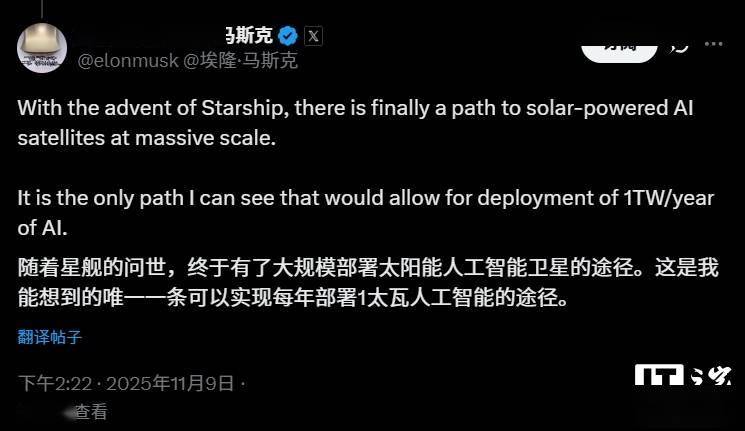
Core Viewpoint - Elon Musk's statement on X platform highlights the potential of "space data centers" as a global tech focus, emphasizing the role of Starship technology in deploying solar-powered AI satellites to achieve "1 terawatt (1TW) of AI computing power" annually [1] Group 1: Industry Insights - Space data centers are identified as a solution to the energy bottleneck in AI data centers (AIDC), offering low operational costs, high power generation, and rapid deployment as key advantages [1] - The transition from "ground-based computing" to "space-based computing" is underway, with plans for a global space computing network as part of the ongoing development [1] Group 2: Company Developments - Putian Technology is actively involved in the "Trinity Computing Constellation," a pioneering in-orbit AI computing project, contributing to key areas such as inter-satellite and ground station construction [1] - Cape Cloud has signed a strategic cooperation agreement with Guoxing Aerospace to jointly develop AI satellite products equipped with advanced models and establish a ground computing center for satellite data processing [1]


把数据中心建在太空,无需冷却也不缺能源,马斯克重大宣布:我们能做到!中国企业也传来好消息
Mei Ri Jing Ji Xin Wen· 2025-11-09 11:44
Core Insights - Elon Musk announced that the advent of Starship paves the way for large-scale deployment of solar-powered AI satellites, which he believes is the only path to achieve 1 terawatt (1TW) of AI computing power annually [1] - The energy supply shortage is a critical bottleneck for AI data center construction, with FTI Consulting predicting that energy demand for data centers in the U.S. will nearly double by 2027 [4] - Companies are increasingly considering building data centers in space due to the limitations of terrestrial power supply [4] Group 1: Space Data Centers - StarCloud successfully launched a satellite equipped with NVIDIA H100 chips and Google Gemini models, which will provide 100 times the GPU computing power of previous space computing facilities [4] - StarCloud plans to construct a 5-gigawatt orbital data center with large solar and cooling battery panels, measuring approximately 4 kilometers in width and length [4] - The space data center will not require water for cooling and will not depend on batteries or backup power, potentially offering unlimited low-cost renewable energy [4] Group 2: Google’s Initiatives - Google is exploring the idea of equipping its Tensor Processing Units (TPUs) on satellites with solar panels that can generate power almost continuously, with an efficiency eight times that of similar panels on Earth [5] - This initiative, named "Project Suncatcher," aims to establish the first space data center, with plans to launch prototype satellites by 2027 in collaboration with Planet [5] Group 3: Industry Trends - The U.S. has launched over 10,000 satellites, with significant implications for the ongoing conflict in Ukraine, prompting expectations for accelerated launch schedules in China [6] - The commercial aerospace sector is anticipated to experience significant growth in the coming years, with strong performance observed in the A-share commercial aerospace sector recently [6]



马斯克:星舰为大规模部署太阳能 AI 卫星开辟路径
Sou Hu Cai Jing· 2025-11-09 07:32
Core Insights - Elon Musk announced that the advent of Starship paves the way for the large-scale deployment of solar-powered AI satellites, which he believes is the only path to achieve an annual deployment of 1 terawatt of AI computing power [1] Group 1: SpaceX and Launch Capabilities - SpaceX is projected to handle over 90% of global orbital payload launch tasks this year, with China accounting for approximately 5% and the remaining 5% shared among other U.S. companies and countries [3] - Musk predicts that once Starship achieves high-frequency launches, SpaceX could take on over 99% of global orbital transportation tasks, which is crucial for the Mars colonization plan [3] Group 2: AI and Computing Infrastructure - Musk's xAI company is constructing a supercomputing center in Tennessee equipped with a million GPUs but faces significant power shortages, necessitating additional power generation facilities [5] - Several space startups are planning to deploy data centers in orbit to utilize solar energy to address the substantial energy demands of AI computing. Companies like Starcloud aim to operate simplified AI models from space data centers, with future goals of establishing gigawatt-level orbital data centers [6] Group 3: Mars Mission Timeline - The Starship program is expected to land the Optimus robot on Mars by the end of 2026, with potential crewed Mars missions planned between 2029 and 2031 [6]

谷歌、英伟达开始将算力运上太空
Di Yi Cai Jing· 2025-11-07 00:36
Core Insights - The construction of data centers in space is becoming a viable solution for addressing the energy supply constraints faced by terrestrial data centers, with predictions indicating that energy demand for U.S. data centers will nearly double by 2027 [1][3] Group 1: Industry Trends - Major tech companies, including Google and SpaceX, are exploring the feasibility of building scalable machine learning computing systems in space, with Google's "Suncatcher" initiative leading the charge [3][5] - SpaceX plans to expand its Starlink V3 satellite capabilities to facilitate the construction of data centers in space, while Jeff Bezos anticipates that within the next 10 to 20 years, humans will be able to build gigawatt-scale data centers in space [3][4] Group 2: Technological Advancements - Starcloud is set to launch a satellite equipped with NVIDIA H100 GPUs, marking the first instance of advanced data center GPUs being deployed in space, with the satellite expected to provide 100 times the GPU computing power of previous space computing facilities [4] - The potential for unlimited low-cost renewable energy in space is highlighted as a significant advantage, with Starcloud's data center projected to save 10 times the carbon dioxide emissions compared to terrestrial data centers [4][5] Group 3: Future Projections - Industry experts predict that within the next decade, space could emerge as a primary location for new data centers, with the cost of building these facilities expected to decrease significantly [6][7] - Historical data suggests that by the mid-2030s, launch costs could drop below $200 per kilogram, making the operational costs of space data centers comparable to those of ground-based facilities [6][7]

谷歌、英伟达开始将算力运上太空
第一财经· 2025-11-07 00:35
Core Viewpoint - The article discusses the increasing energy demands of AI data centers and the potential shift towards building data centers in space as a solution to energy constraints on Earth [3][4]. Group 1: Energy Demand and Constraints - FTI Consulting predicts that energy demand for data centers in the U.S. will nearly double by 2027, leading to significant strain on utility companies and grid capacity [3]. - The construction of data centers in space is being considered by several Silicon Valley tech companies due to the limited availability of power on Earth [4]. Group 2: Initiatives by Tech Companies - Google has launched a project called "Suncatcher" to explore scalable machine learning computing systems in space, as announced by CEO Sundar Pichai [6]. - SpaceX, led by Elon Musk, plans to build data centers in space using Starlink V3 satellites equipped with high-speed laser links [7]. - Jeff Bezos has indicated that within the next 10 to 20 years, humanity will be able to construct gigawatt-scale data centers in space [7]. Group 3: Technological Developments - Google and Planet Labs are collaborating to launch two satellites in early 2027 to explore the feasibility of large-scale space data center clusters [7]. - Starcloud plans to launch a satellite carrying NVIDIA H100 GPUs, marking the first advanced data center GPUs to enter space, with a projected performance increase of 100 times compared to previous space computing facilities [7]. Group 4: Advantages of Space Data Centers - Space data centers will benefit from abundant renewable energy, eliminating the need for water cooling and backup power sources [8]. - The lifecycle carbon emissions of space data centers could be ten times lower than those of terrestrial data centers [9]. - Solar energy in space can produce eight times more output than on Earth, providing continuous power without weather interruptions [9]. Group 5: Cost Considerations and Feasibility - High launch costs have historically been a barrier to large-scale space systems, but costs may drop below $200 per kilogram by the mid-2030s, making space data centers potentially cost-competitive with terrestrial counterparts [10]. - Google has conducted preliminary studies indicating that their next-generation TPUs have strong radiation resistance, although challenges such as thermal management and system reliability remain [10].
地球电力不够用?谷歌、英伟达开始将算力运上太空
Di Yi Cai Jing· 2025-11-06 13:06
Core Insights - The future of space is seen as a promising venue for expanding AI computing capabilities due to limitations in power supply on Earth [1][5] - Major tech companies, including Google, SpaceX, and Amazon, are exploring the construction of data centers in space to leverage abundant solar energy [3][5] Group 1: Industry Trends - The energy demand for data centers in the U.S. is projected to nearly double by 2027, creating a critical bottleneck for power supply [1] - Companies are increasingly considering space as a viable option for data center construction due to the limitations of terrestrial power sources [1][5] Group 2: Company Initiatives - Google has launched the "Suncatcher" project to explore scalable machine learning computing systems in space, with plans to test TPU hardware in orbit [3][6] - SpaceX plans to build data centers in space using Starlink V3 satellites equipped with high-speed laser links [3] - Starcloud aims to launch a satellite carrying NVIDIA H100 GPUs, marking the first advanced data center GPUs in space, with plans for a 5 GW orbital data center [4] Group 3: Advantages of Space Data Centers - Space data centers can utilize nearly unlimited low-cost renewable energy, significantly reducing carbon emissions compared to Earth-based data centers [4] - Solar energy in space can produce eight times more output than on Earth, providing a continuous power supply without weather interruptions [4][5] Group 4: Cost Considerations - The cost of launching large-scale space systems has been a major barrier, but projections suggest that by the mid-2030s, costs could drop below $200 per kilogram, making space data centers more economically viable [5] - The construction costs for space data centers are expected to decrease over the coming decades, potentially aligning with Earth-based data center energy costs [5] Group 5: Technical Challenges - While initial tests show promising results for Google's TPU in space, significant engineering challenges remain, including thermal management and system reliability [5][6] - Ongoing research is focused on satellite design, control, and communication to address these challenges [6]
地球快养不起AI了,谷歌英伟达被逼上太空,结果便宜了马斯克
创业邦· 2025-11-06 10:13
Core Viewpoint - Google has launched Project Suncatcher, aiming to establish a space-based AI infrastructure powered by solar energy, addressing the increasing energy demands of data centers on Earth [5][7][11]. Group 1: Energy and Resource Challenges - The global energy consumption of data infrastructure is projected to match Japan's total energy consumption by 2030, highlighting the urgent need for energy breakthroughs in AI [9]. - A 1 MW data center consumes as much water daily as approximately 1,000 residents in developed countries, emphasizing the resource-intensive nature of current data centers [9]. - Google’s plan involves launching a satellite constellation powered by solar energy and equipped with its TPU chips to create an "orbital AI data center" [11][12]. Group 2: Advantages of Space-Based Data Centers - Solar panels in space can achieve 8 times the efficiency compared to those on Earth, and they can provide continuous power without interruptions from night or weather [12]. - Space-based data centers do not consume Earth's limited land resources or require significant water for cooling, making them a more sustainable option [13]. Group 3: Technical Challenges - Google faces three main challenges: establishing a high-bandwidth local network in space, protecting chips from cosmic radiation, and ensuring efficient data transmission back to Earth [16][20][23]. - The proposed solution for inter-satellite communication involves flying satellites in close proximity and using laser communication to achieve high-speed data transfer, with a successful demonstration of 1.6 Tbps achieved [19]. - Google’s TPU chips have shown remarkable resistance to radiation, allowing them to operate in low Earth orbit for up to five years without permanent damage [21]. Group 4: Cost Considerations - The cost of launching payloads into space remains a significant barrier, with current prices being ten times higher than the ideal target of $200/kg [28]. - If SpaceX can reduce launch costs to $200/kg by around 2035, the cost of power for space data centers could become competitive with terrestrial data centers [27][32]. Group 5: Competitive Landscape - SpaceX is positioned to play a crucial role in enabling Google's space data center model, potentially dominating the space computing market as it has in terrestrial GPU markets [30][32]. - The emergence of companies like Starcloud, which aims to process data in orbit using powerful GPUs, indicates a shift in how data is handled in space, relying on reduced launch costs from SpaceX [36][39].
「美股盘前」三大期指涨跌不一,美国联邦政府“停摆”创纪录;Palantir因被做空跌超2%;马斯克:特斯拉AI5芯片预计2027年量产,由台积电、三星代...
Mei Ri Jing Ji Xin Wen· 2025-11-05 10:39
Group 1 - Dow futures rose by 0.10%, while S&P 500 futures fell by 0.15% and Nasdaq futures decreased by 0.30% [1] - Palantir's stock dropped over 2% after investor Michael Burry disclosed a significant position in put options, with a nominal value of $912 million [1] - Chinese stocks experienced a decline, with Alibaba down 2.02%, Pinduoduo down 0.62%, NetEase down 1.92%, Ctrip down 2.06%, and JD.com down 2.93% [1] Group 2 - Tesla's CEO Elon Musk announced that the AI5 chip is expected to begin mass production in 2027, with TSMC and Samsung as manufacturers, while the AI6 chip is set for release in 2028 [1] Group 3 - Google proposed a new concept of building AI data centers in space to address resource limitations on Earth, utilizing solar-powered satellites with eight times the efficiency of similar panels on Earth [2] - Stellantis announced a global recall of 375,000 plug-in hybrid Jeep Wrangler and Grand Cherokee SUVs due to battery-related fire incidents, with the batteries produced by Samsung SDI [2] Group 4 - Alphabet's $32 billion acquisition of cybersecurity firm Wiz has passed the U.S. Department of Justice antitrust review, with plans to integrate Wiz into Google Cloud [3] - Novo Nordisk lowered its growth outlook for obesity and diabetes treatment drugs due to increased competition and pricing pressure, despite strong sales growth in the first nine months of 2025 [3]
【美股盘前】三大期指涨跌不一,美国联邦政府“停摆”创纪录;Palantir因被做空跌超2%; 马斯克:特斯拉AI5芯片预计2027年量产,由台积电、三星代工
Mei Ri Jing Ji Xin Wen· 2025-11-05 10:34
Market Performance - Dow futures increased by 0.10%, while S&P 500 futures decreased by 0.15% and Nasdaq futures fell by 0.30% [1] Company-Specific Developments - Palantir shares dropped over 2% after investor Michael Burry disclosed a significant position in put options against the company, with a nominal value of $912 million [1] - Tesla's CEO Elon Musk announced that the AI5 chip is expected to begin mass production in 2027, with TSMC and Samsung as manufacturers, while the AI6 chip is set for release in 2028 [1] - Google proposed a new concept of building AI data centers in space to address resource limitations on Earth, utilizing solar-powered satellites with efficiency eight times greater than terrestrial counterparts [2] - Stellantis announced a global recall of 375,000 plug-in hybrid Jeep Wrangler and Grand Cherokee SUVs due to battery-related fire incidents, with the batteries produced by Samsung SDI [2] - Alphabet's acquisition of cybersecurity firm Wiz for $32 billion has passed the U.S. Department of Justice antitrust review, with plans to integrate Wiz into Google Cloud [3] - Novo Nordisk has lowered its growth outlook for its obesity and diabetes treatment drugs due to increased competition and pricing pressures in the market [3]
【美股盘前】三大期指涨跌不一,美国联邦政府“停摆”创纪录;Palantir因被做空跌超2%; 马斯克:特斯拉AI5芯片预计2027年量产,由台积电、三星...
Mei Ri Jing Ji Xin Wen· 2025-11-05 10:32
Group 1 - Major stock index futures show mixed performance, with Dow futures up 0.10%, S&P 500 futures down 0.15%, and Nasdaq futures down 0.30% [1] - Palantir shares fell over 2% after investor Michael Burry disclosed a significant position in put options, with a nominal value of $912 million, leading to a nearly 8% drop on the day [1] - Chinese concept stocks experienced a broad decline, with Alibaba down 2.02%, Pinduoduo down 0.62%, NetEase down 1.92%, Ctrip down 2.06%, and JD.com down 2.93% [1] Group 2 - Tesla CEO Elon Musk announced that the AI5 chip is expected to begin mass production in 2027, with TSMC and Samsung as manufacturers, while the AI6 chip is set to launch in 2028 [1] Group 3 - Google proposed a new concept of building AI data centers in space to address resource limitations on Earth, utilizing solar-powered satellites with efficiency eight times that of similar panels on Earth [2] - Stellantis announced a global recall of 375,000 plug-in hybrid Jeep Wrangler and Grand Cherokee SUVs due to battery-related fire incidents, with the batteries produced by Samsung SDI [2] - The U.S. government shutdown has reached a record duration of 36 days, surpassing the previous record of 35 days from late 2018 to early 2019 [2] Group 4 - Alphabet's $32 billion acquisition of cybersecurity firm Wiz has passed antitrust review by the U.S. Department of Justice, with plans to integrate Wiz into Google Cloud [3] - Novo Nordisk has lowered its growth outlook for obesity and diabetes treatment drugs due to increased competition and pricing pressure, despite strong sales growth in the first nine months of 2025 [3]


