火星殖民计划

Search documents
马斯克宣布重大战略调整
Xin Lang Cai Jing· 2026-02-09 11:17
Core Viewpoint - SpaceX has decided to temporarily shelve its long-term goal of sending humans to Mars, prioritizing the establishment of a self-sustaining city on the Moon instead, which is projected to be achievable in less than 10 years [1][2]. Group 1 - Elon Musk announced the shift in focus on social media, stating that the Moon project is more feasible within a decade compared to the Mars plan, which would take over 20 years [1][2]. - This decision aligns Musk's stance with that of former President Trump, who has also shifted the focus of U.S. space policy away from Mars [2]. - SpaceX has achieved significant success as a contractor for NASA, despite criticism regarding the ambitious nature of its Mars colonization plans [1].
120倍回报、千亿美元浮盈,SpaceX上市的隐藏大赢家竟是它
华尔街见闻· 2026-02-04 11:56
Core Viewpoint - A controversial investment made ten years ago is evolving into one of the most profitable bets in Silicon Valley's history, particularly for Google, which stands to gain significantly from its stake in SpaceX following the acquisition of AI company xAI [2][3][4]. Investment Overview - Google holds approximately 7.4% of SpaceX, with an initial investment of $900 million now potentially valued at $111 billion, representing a return of over 120 times [6][10]. - The investment was made in January 2015 when SpaceX was valued at only $12 billion, and the company faced skepticism regarding its technology and financial viability [7][8]. Growth Trajectory - SpaceX's valuation has skyrocketed from $36 billion in 2020 to a projected $1.5 trillion by the time of its IPO, significantly increasing the value of Google's investment [9]. - Google's financial reports have already reflected an $8 billion gain from the revaluation of its SpaceX stake, which constituted 25% of its net profit in the first quarter [10]. Future Considerations - There is speculation about the potential separate IPO of SpaceX's Starlink division, which could allow investors to benefit from its profitability without the financial burden of SpaceX's Mars colonization plans [11][12][13]. - Regardless of the eventual listing format, Google's investment in SpaceX is poised to be one of the most successful venture capital investments in history [14].



SpaceX 募资材料
美股IPO· 2025-12-28 06:56
Core Viewpoint - The article emphasizes SpaceX's ambitious financial goals, aiming for $100 billion in revenue and $26 billion in net profit by 2035, highlighting its unique position in the space industry and the potential for significant growth in the coming years [1]. Investment Highlights Overview - SpaceX is positioned as a unique and scarce asset, aiming to capture the high ground of the space industry [6]. - The company has the potential to reshape human civilization with a growth potential of $10 trillion [6]. - Elon Musk is recognized as a leading entrepreneur with long-term investments in various technology ventures [6]. - SpaceX has a strong ecosystem supported by Tesla, xAI, Neuralink, and other ventures [6]. - The company has established a mature reusable rocket system, holding a relative monopoly in the launch market [6]. - SpaceX is building the largest low Earth orbit satellite constellation, Starlink, leveraging its first-mover advantage [6]. - The company possesses extreme industrial manufacturing capabilities and vertical integration efficiency, providing it with scale advantages [6]. Financial and Operational Data Forecast - SpaceX's projected total revenue is expected to reach $103.7 billion by 2030 and $141.9 billion by 2040, with a compound annual growth rate (CAGR) of 53.5% from 2023 to 2024 [66]. - The share of Starlink in total revenue is anticipated to increase from 51.1% in 2023 to 74.6% by 2040, while the launch business's share is expected to decrease from 48.9% to 25.4% over the same period [66]. - The company aims to achieve a total of 453 launches by 2030, with an average of 1.2 launches per day by 2035 [66]. - Starlink's total subscription user base is projected to grow significantly, reaching approximately 1,032 million by 2040 [66].
史上最大IPO将至!估值8000亿美元只是起点,碾压OpenAI!SpaceX只谈“天文数字”!
雪球· 2025-12-14 07:08
Group 1 - The core viewpoint of the article is that SpaceX is preparing for an IPO in 2026 with a target valuation of $1.5 trillion, significantly higher than its current valuation of $800 billion [2][5][6]. - SpaceX's stock price has surged to $421 per share, doubling from $212 in July, and has surpassed OpenAI's valuation, reclaiming its title as the world's most valuable unicorn [7][8]. - The anticipated IPO could raise $30 billion, potentially setting a record for the largest IPO in history, surpassing Saudi Aramco's $29.4 billion [7]. Group 2 - The urgency for the IPO is driven by the need for substantial funding for ambitious projects, including Mars colonization, lunar base construction, and a space-based AI data center [10][12]. - Analysts express concerns that the IPO may lead to the integration of Tesla and SpaceX, raising risks of related party transactions [12][13]. - Despite the potential for significant returns, there are worries about investor patience, as SpaceX remains a capital-intensive company focused on long-term projects [13][14].

“木头姐”的ARK公开Space X“估值模型”:2030年,2.5万亿美元!
Sou Hu Cai Jing· 2025-12-08 06:49
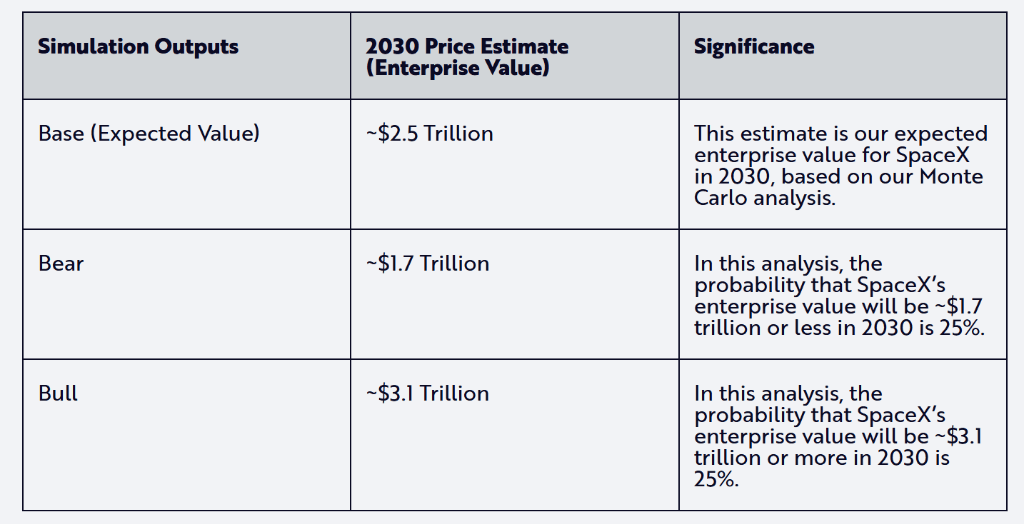
Core Insights - SpaceX is currently valued at $800 billion, doubling its valuation from $400 billion just seven months ago, and is on track to become the highest-valued private company in the U.S. [1] - The company is considering an IPO in 2026, marking a potential significant milestone in its nearly 25-year history [1]. - ARK Investment Management predicts that SpaceX's enterprise value could reach approximately $2.5 trillion by 2030, with a compound annual return rate of about 38% starting from a valuation of $350 billion in December 2024 [1][3]. Valuation Predictions - The ARK report outlines three scenarios for SpaceX's valuation by 2030: a base case of $2.5 trillion, a bull case of $3.1 trillion (75th percentile), and a bear case of $1.7 trillion (25th percentile) [4][3]. - The predictions are based on a Monte Carlo simulation that incorporates 17 key variables affecting SpaceX's potential outcomes [5][42]. Business Model and Cash Flow - The report emphasizes a "flywheel" logic where cash flow from the Starlink business supports the iteration of Starship technology, ultimately laying the groundwork for Mars colonization [2][12]. - SpaceX's revenue from Starlink is projected to be around $300 billion annually by 2035, capturing approximately 15% of global communication spending [19]. Technological Assumptions - The valuation heavily relies on the successful rapid reusability of the Starship and the performance of the Optimus humanoid robot [2][42]. - Satellite performance is a critical input variable in the model, influencing revenue generation and capital expenditure [23][24]. Market Dynamics - The ARK model suggests that as Starship reusability improves, the marginal cost of satellite deployment will decrease, enhancing the economic viability of SpaceX's operations [31][28]. - The completion of the Starlink constellation is expected to shift SpaceX's focus and resources towards Mars development [36]. Long-term Vision - SpaceX aims to facilitate multi-planetary living, particularly through the development of infrastructure on Mars, supported by technologies from its other ventures [34]. - The model anticipates that the contribution of Mars-related activities to SpaceX's enterprise value will grow over time, although initial cash flows from these activities may be speculative [36].
“木头姐”的ARK公开Space X“估值模型”:2030年A,2.5万亿美元!
美股IPO· 2025-12-08 04:35
Core Viewpoint - SpaceX's valuation has surged to $800 billion due to market optimism, with ARK's model predicting a potential valuation of $2.5 trillion by 2030, driven by the "flywheel effect" of Starlink cash flow supporting Starship iterations for Mars colonization [1][3][4]. Valuation Dynamics - SpaceX's current valuation of $800 billion represents a doubling from approximately $400 billion just seven months prior, surpassing OpenAI to become the highest-valued private company in the U.S. [3] - The management is considering an IPO in 2026, marking a potential path for the nearly 25-year-old company [3]. ARK's Long-term Predictions - ARK Investment Management's report suggests that if SpaceX's valuation starts from $350 billion in December 2024, investors could see a compound annual return of about 38% [3][5]. - The Monte Carlo simulation indicates a bullish scenario with a valuation of approximately $3.1 trillion and a bearish scenario at about $1.7 trillion by 2030 [3][6]. Model Logic and Flywheel Effect - The ARK model operates on a self-reinforcing "flywheel" logic, where cash generated from Starlink is reinvested into Starship technology, ultimately supporting Mars colonization efforts [13][4]. - The model's predictions are highly dependent on the rapid reusability of Starship and the success of other key technologies [4][42]. Market Potential and Revenue Generation - The potential market size for Starlink is projected to generate around $300 billion in annual revenue by 2035, capturing about 15% of global communication spending [21]. - The average bandwidth is expected to reach approximately 130 million Gbps at maturity, with a breakeven point of about $0.20 per Mbps, significantly lower than current U.S. averages [19]. Satellite Performance and Cost Structure - Satellite performance is a critical input variable in the model, with the marginal cost structure indicating that as Starship reusability improves, satellite costs will increasingly dominate total costs [24][26]. - The transition from V1 to V2 Mini Optimized satellites shows adherence to Wright's Law, suggesting significant performance improvements [27]. Mars Colonization Plans - SpaceX's long-term goal includes establishing a human presence on Mars, with plans to utilize Optimus robots and other technologies for infrastructure development [35]. - The model anticipates that the value attributed to Mars-related activities will grow over time, although cash flows from these initiatives are expected to be more speculative compared to Starlink [35][39]. Risks and Limitations - The model incorporates 17 key independent variables, acknowledging that unexpected events, such as leadership changes or natural disasters, could significantly impact outcomes [42]. - Execution risks in the space industry, particularly regarding Starship's reusability and the timely development of infrastructure on Mars, are highlighted as critical factors influencing valuation [42].

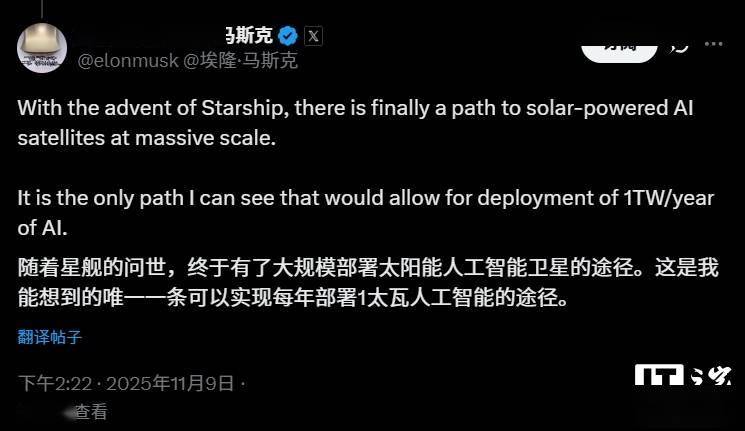
马斯克:星舰为大规模部署太阳能 AI 卫星开辟路径
Sou Hu Cai Jing· 2025-11-09 07:32
Core Insights - Elon Musk announced that the advent of Starship paves the way for the large-scale deployment of solar-powered AI satellites, which he believes is the only path to achieve an annual deployment of 1 terawatt of AI computing power [1] Group 1: SpaceX and Launch Capabilities - SpaceX is projected to handle over 90% of global orbital payload launch tasks this year, with China accounting for approximately 5% and the remaining 5% shared among other U.S. companies and countries [3] - Musk predicts that once Starship achieves high-frequency launches, SpaceX could take on over 99% of global orbital transportation tasks, which is crucial for the Mars colonization plan [3] Group 2: AI and Computing Infrastructure - Musk's xAI company is constructing a supercomputing center in Tennessee equipped with a million GPUs but faces significant power shortages, necessitating additional power generation facilities [5] - Several space startups are planning to deploy data centers in orbit to utilize solar energy to address the substantial energy demands of AI computing. Companies like Starcloud aim to operate simplified AI models from space data centers, with future goals of establishing gigawatt-level orbital data centers [6] Group 3: Mars Mission Timeline - The Starship program is expected to land the Optimus robot on Mars by the end of 2026, with potential crewed Mars missions planned between 2029 and 2031 [6]