数字化转型

Search documents
Gates(GTES) - 2025 Q4 - Earnings Call Transcript
2026-02-12 16:00
Financial Data and Key Metrics Changes - Gates Corporation reported nearly 1% core growth in 2025, outperforming many end markets that remain in contraction [5] - Adjusted EBITDA dollars reached an all-time record, with adjusted EPS growing 9% year-over-year to $1.52, the top end of guidance [7][8] - The net leverage ratio improved to 1.85x at year-end 2025, a decrease of almost 0.4 turns compared to the previous year [6][14] Business Line Data and Key Metrics Changes - The Personal Mobility business experienced over 25% core growth in 2025, while the Data Center business grew 4x compared to 2024 [5] - In the Power Transmission segment, revenues were $537 million with flat core growth, while the Fluid Power segment generated $320 million with approximately 1% core growth [10] - Automotive OEM sales decreased, but Industrial OEM sales grew solid double digits year-over-year [10] Market Data and Key Metrics Changes - North America saw a core sales decrease of about 2.5% in Q4, influenced by distributor inventory management [11] - EMEA experienced a core sales growth of 5.8% in Q4, with double-digit growth in industrial markets [12] - Core sales in China grew about 3.5% year-over-year, while East Asia and India saw slight decreases [12] Company Strategy and Development Direction - The company is focused on strategic revenue initiatives to generate market outgrowth and is optimistic about 2026 top-line potential [20] - Investments are being made in personal mobility and data center markets, with expectations for these sectors to grow significantly [21] - The company plans to pursue logical and non-transformational M&A opportunities to enhance its portfolio [55] Management's Comments on Operating Environment and Future Outlook - Management expressed cautious optimism about an industrial demand recovery entering 2026, with a book-to-bill ratio above 1x [6][20] - The company anticipates core sales growth in a range of 1%-4% for 2026, with adjusted EBITDA forecasted between $775 million and $835 million [15] - Management noted that while there are positive signs, they do not expect a sharp recovery in 2026 [20] Other Important Information - Free cash flow conversion was 238% of adjusted net income for Q4, bringing the full-year conversion to 92% [14] - The company repurchased over $100 million of its shares in Q4 at an attractive valuation [6] - S&P upgraded the company's credit rating to double B from double B minus with a stable outlook [14] Q&A Session Summary Question: Can you elaborate on the book-to-bill over one in Q4 and January orders? - Management noted the most positive order trend in two to three years, particularly in the industrial OEM segment, indicating a strong recovery [26][28] Question: What impacted the Adjusted EBITDA margin in Q4? - Management indicated that managing output and inventory levels contributed to the margin dynamics, alongside a focus on working capital [31][32] Question: What is the expected EBITDA contribution in the first half of the year? - Management expects about 100 basis points of headwind in the first half due to ERP implementation and footprint optimization [37] Question: How sustainable is the growth in the Personal Mobility business? - Management anticipates continued high growth in the Personal Mobility business, projecting a compound annual growth rate of 30% through 2028 [51] Question: What are the implications of the S&P upgrade? - Management indicated that while there may be some upside from the upgrade, the impact on interest rates is uncertain [63] Question: How does the company view its M&A strategy? - Management is focused on non-transformational M&A opportunities that could enhance the portfolio without significant changes [55]

终结“一肩挑”!浙商证券新总裁落定,程景东搭档钱文海划清分工
Xin Lang Cai Jing· 2026-02-12 13:03
Core Viewpoint - The appointment of Cheng Jingdong as the new president of Zheshang Securities marks a significant leadership transition, establishing a dual-core management structure alongside Chairman Qian Wenhai, aimed at enhancing the company's development strategy and operational efficiency [3][12][17] Group 1: Leadership Transition - Cheng Jingdong has been nominated as the new president and vice secretary of the party committee of Zheshang Securities, following a decision by the actual controller, Zhejiang Transportation Investment Group [2][11] - This transition ends the previous arrangement where Chairman Qian Wenhai held both the chairman and president roles, allowing for a clearer division of responsibilities between strategic leadership and operational execution [3][7] Group 2: Background of Cheng Jingdong - Cheng Jingdong, aged 56, holds a doctoral degree and has over 30 years of experience in the financial sector, with a diverse background that includes roles in financial regulation, commercial banking, investment banking, and legal services [4][13][14] - His career includes significant positions at the People's Bank of China, the China Securities Regulatory Commission, and various banks, providing him with a comprehensive understanding of risk control, compliance, and capital market operations [4][14] Group 3: Performance and Achievements - Since joining Zheshang Securities in April 2019 as vice president, Cheng has overseen a substantial increase in the investment banking division's performance, completing 64 equity financing projects and 1,537 bond underwriting projects, with a total financing scale exceeding 740 billion yuan [5][15] - In 2025, the company achieved notable results, including 7 equity financing projects and 334 bond underwriting projects, with the underwriting scale surpassing 100 billion yuan, solidifying its leading position in the province [5][15] Group 4: Future Development Strategy - The leadership change is part of Zheshang Securities' strategic focus on high-quality development, with net profits showing steady growth from 1.754 billion yuan in 2023 to 1.149 billion yuan in the first half of 2025 [8][17] - The company aims to become a leading investment bank, with plans to implement its "14th Five-Year Plan," enhance operational efficiency, and integrate with Guodu Securities, targeting the goal of becoming a mid-to-large-sized brokerage [8][17]

证券公司学习宣传贯彻党的二十届四中全会精神 | 财通证券党委书记、董事长章启诚:以“四型五化”战略,践行金融报国使命
Zhong Guo Zheng Quan Bao· 2026-02-12 12:49
Core Viewpoint - The article highlights the strategic initiatives and achievements of Caitong Securities in enhancing its role as a leading investment bank while focusing on serving the real economy and promoting high-quality economic development [1][2]. Group 1: Strategic Development - Caitong Securities aims to build a "Four-Type Caitong" model, focusing on being innovative, service-oriented, platform-based, and transformative to support high-quality economic growth [2][4]. - The company is committed to deepening the "Four-Type Caitong" construction during the 14th Five-Year Plan period, translating top-level financial design into practical actions in Zhejiang [3][4]. Group 2: Service to the Real Economy - The company is accelerating its "Science and Technology Innovation-Type Caitong" construction by enhancing investment banking services for innovative enterprises and expanding its bond financing capabilities [4][5]. - Caitong Securities has achieved significant milestones, including underwriting a total of 75 billion yuan in science and technology bonds by 2025, representing nearly a threefold increase [4]. Group 3: Financial Inclusion and Community Welfare - The company emphasizes its commitment to inclusive finance, having supported over 500 billion yuan in direct financing for local enterprises and maintaining a leading market share in IPO services in Zhejiang [5][6]. - Caitong Securities has implemented a "3510" common prosperity initiative to enhance wealth management capabilities for residents, targeting an 11% increase in customer numbers and a 28% increase in asset scale by 2025 [6]. Group 4: Platform Development - The company is expanding its "Platform-Type Caitong" framework by establishing a comprehensive financial service ecosystem that covers both domestic and international markets [6][7]. - Caitong Securities has achieved full coverage of city cooperation within Zhejiang and is accelerating the establishment of business headquarters in major cities like Beijing and Shanghai [7]. Group 5: Innovation and Digital Transformation - The company is focusing on green finance and digital transformation, having launched the first nationwide clean energy ABS and developed an "AI*(1+4+N)" digital innovation system [7][14]. - Caitong Securities aims to enhance operational efficiency through technology integration, targeting improvements in service effectiveness and management efficiency [14]. Group 6: Financial Performance - For the first three quarters of 2025, Caitong Securities reported a consolidated revenue of 5.063 billion yuan, a year-on-year increase of 13.99%, and a net profit of 2.038 billion yuan, up 38.42% [8]. - The company achieved a significant growth in brokerage fee income, with a year-on-year increase of 66.32% [8]. Group 7: Global Expansion - Caitong Securities is building a multi-layered cross-border financial service system, focusing on international investment banking and financing needs of domestic enterprises [9][10]. - The company has successfully facilitated several IPOs and bond issuances in international markets, enhancing its role as a bridge for local enterprises to access global capital [10][11]. Group 8: Future Vision - The company is committed to a "Five Transformation" strategy, aiming to enhance governance, service capabilities, and professional strength in alignment with national strategies [12][15]. - Caitong Securities plans to deepen its integration with local economic development while expanding its international presence, striving to become a first-class modern investment bank [15].

变局中的“超级连接器”:重新定义广州金融新角色 | “投资广州”全球合伙人说
Xin Lang Cai Jing· 2026-02-12 12:13
Group 1: Insights on Trends - The banking industry is currently facing a macro environment filled with uncertainty, making digital transformation a top priority for development [1][10] - Customers are increasingly demanding efficiency and flexibility in financial services, prompting significant investments by Standard Chartered in advanced technologies like artificial intelligence and digital assets [1][10] - Standard Chartered is establishing a group-level AI technology research and development center in Guangzhou to optimize operations and enhance customer experience [1][10] - Financial technology is reshaping the boundaries of banking, with Standard Chartered actively collaborating with leading tech companies to support Chinese enterprises going global and achieve efficient global treasury management [1][10] Group 2: Addressing Demand - There is a notable shift in customer demand, with Chinese enterprises accelerating their overseas expansion and seeking high-quality banking services abroad [2][12] - Chinese residents are increasingly interested in asset diversification and global allocation, leading Standard Chartered to launch targeted solutions [2][12] - The bank has upgraded its "Outreach" program for SMEs to provide smarter service models addressing cross-border settlement, financing, and exchange rate risks [2][12] - The "GBA Affluence Membership Program" has been introduced to connect internal and external resources, offering multidimensional empowerment across finance, business, and lifestyle experiences [2][12] Group 3: Redefining Roles - In response to intensified competition in the Chinese financial market, Standard Chartered aims to pursue a differentiated and specialized development path [3][14] - The bank positions itself as a "super connector," leveraging its unique international network, business expertise, and partnerships to provide innovative products and services safely, efficiently, and conveniently [3][14] - This role is crucial in key national strategic areas such as the new economy, the Belt and Road Initiative, the Greater Bay Area development, green finance, and RMB internationalization [3][14] - Standard Chartered's unique positioning in Guangzhou aligns with the city's development needs during the 14th Five-Year Plan, facilitating systematic overseas expansion for enterprises and global wealth allocation for residents [3][14]

上交所发布2026年为市场办实事项目 预计全年向市场让利约11.13亿元
Zheng Quan Ri Bao Wang· 2026-02-12 11:07
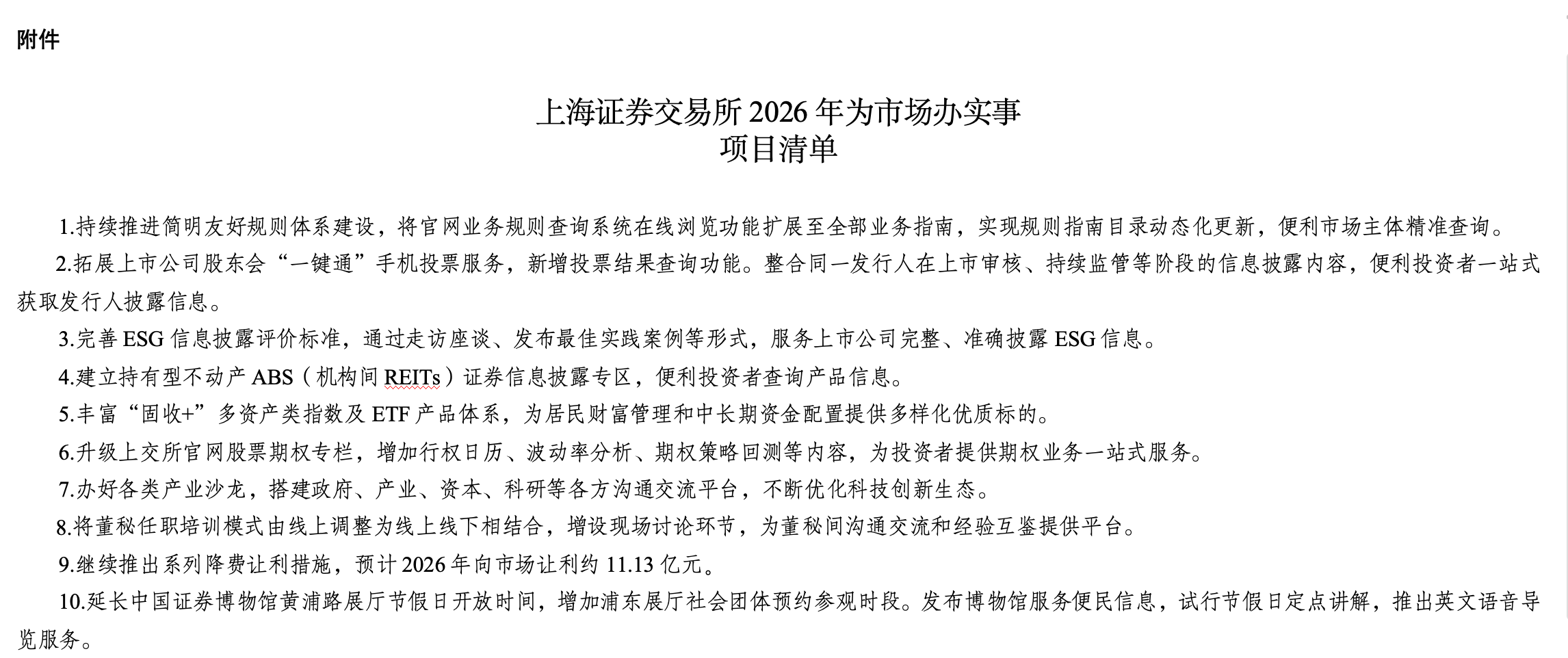
Core Viewpoint - The Shanghai Stock Exchange (SSE) has released a "2026 Market Service Project List" aimed at implementing the spirit of the Central Eight Regulations and enhancing market services, governance, and digital transformation to support high-quality development of the capital market [1][2]. Group 1: Project List Overview - The project list includes ten initiatives across five main areas: listing review, frontline regulation, product innovation, market services, investor protection, and information technology [2]. - Key initiatives include optimizing information disclosure channels, enhancing regulatory service quality, enriching index investment options, deepening comprehensive service supply, and continuing to reduce market operating costs [2]. Group 2: Specific Initiatives - Information disclosure will be improved by expanding online browsing capabilities for all business guidelines and creating a dedicated section for real estate ABS securities information [2]. - Regulatory services will be enhanced through improved ESG disclosure standards and the introduction of a mobile voting service for shareholder meetings [2]. - The index investment landscape will be diversified with the development of a multi-asset index system and increased promotion of index and ETF products [2]. - Comprehensive services will be strengthened by organizing industry salons and upgrading the stock options section on the SSE website [2]. - The SSE anticipates a market benefit of approximately 1.113 billion yuan by 2026 through cost reductions [2]. Group 3: Commitment to Stakeholders - The SSE emphasizes a people-centered approach and aims to address market concerns through practical measures, receiving positive feedback for its ongoing efforts to serve the market [3]. - The SSE invites feedback from market participants on the project list to ensure effective implementation of each initiative [3].
苏丹卫生部拟推进数字化转型
Shang Wu Bu Wang Zhan· 2026-02-12 10:42
2月10日,苏丹通讯社报道,苏丹卫生部长海瑟姆.穆罕默德.易卜拉欣宣布,2026年将是苏丹卫生部门 的"全面数字化转型年"。 ...
三峡新材:尚未设立财务共享中心
Zheng Quan Ri Bao Wang· 2026-02-12 09:47
Core Viewpoint - The company has established a modern financial management system covering the entire business process, achieving refined, process-oriented, and systematic daily financial management [1] Group 1 - The company has not yet set up a financial shared service center but has included it in its work planning [1] - Future construction of the financial shared service center will closely align with digital transformation and refined management needs [1]

2026年,上交所这么干!十大实事项目清单发布
证券时报· 2026-02-12 09:19
Core Viewpoint - The Shanghai Stock Exchange (SSE) has released a project list aimed at enhancing market services and reducing costs, with an expected market benefit of approximately 1.113 billion yuan by 2026 [1][4]. Group 1: Project List Overview - The SSE's project list includes ten specific initiatives across five main areas: listing review, frontline regulation, product innovation, market services, investor protection, and information technology [2]. - The initiatives are designed to support high-quality development in the capital market, aligning with the directives from the 20th National Congress and other key economic meetings [2]. Group 2: Specific Initiatives - The SSE aims to optimize information disclosure channels to improve accessibility, including expanding online browsing capabilities for all business guidelines and creating a dedicated information disclosure area for real estate ABS securities [4]. - Enhancements in regulatory services are planned to improve corporate governance, including refining ESG disclosure standards and introducing a mobile voting service for shareholder meetings [4]. - The SSE will diversify investment options by enhancing the "fixed income+" multi-asset index system and promoting index and ETF products [4]. - The exchange will deepen comprehensive service offerings to enhance participant satisfaction, including hosting industry salons and upgrading the stock options section on its website [4]. - A continuous effort to reduce operational costs is highlighted, with an estimated market benefit of around 1.113 billion yuan by 2026 [1][4].

独家:中国移动集团总经理何飚调走 另有重用!
Xin Lang Cai Jing· 2026-02-12 09:13
Core Viewpoint - The leadership of China Mobile has undergone a significant change, with General Manager He Biao being reassigned to a new role as Deputy Director of the National Radio and Television Administration [1][3]. Group 1: Leadership Changes - He Biao, a prominent figure in the telecommunications industry, has held senior positions at both China Unicom and China Mobile, earning widespread recognition for his contributions [3]. - His previous role at China Unicom involved overseeing the largest provincial company, Guangdong Unicom, where he significantly improved performance and led the company to new heights [3]. - During his tenure as Vice General Manager at China Unicom, he was instrumental in digital transformation initiatives, focusing on optimizing computing infrastructure and advancing key areas such as industrial internet and smart cities [3]. Group 2: Contributions to Digital Transformation - At China Mobile, He Biao played a crucial role in the company's transition from a "telecommunications operator" to a "technology service enterprise," contributing to its digital transformation and innovative development [3]. - His leadership is expected to yield positive results in his new position at the National Radio and Television Administration, reflecting his capability to excel in various roles [3].


中联重科(000157) - 000157中联重科投资者关系管理信息20260212
2026-02-12 09:06
Group 1: Company Overview and Strategy - Zhonglian Heavy Industry has established a comprehensive high-end equipment business system covering engineering machinery, agricultural machinery, and mining machinery, with a strong operational capability [1] - The company has built over 30 primary business aviation ports and more than 430 secondary and tertiary outlets globally, with overseas revenue continuously increasing [1] - Key strategic focuses include accelerating globalization and localization integration, promoting diversified industrial development, enhancing product greening and intelligence upgrades, and speeding up digital transformation [2] Group 2: Market Insights and Projections - The market strategy for small excavators in 2026 includes the establishment of a new production line for compact models, which is expected to significantly enhance product quality and reduce manufacturing costs [2] - Overseas business has experienced five consecutive years of rapid growth, with overseas revenue projected to increase fivefold from 2020 to 2024, focusing on high-end markets in Western Europe and Australia [3][4] - The agricultural machinery market is valued at approximately 1 trillion RMB, with the company leveraging its global operational experience and focus on new energy and intelligent products to gain a competitive edge [5] Group 3: Financial Management and Performance - The company has implemented a digital inventory management platform, resulting in a reduction of inventory balance by 1.286 billion RMB (5.70%) as of Q3 2025 [6] - The company’s mining machinery market growth has outpaced the industry, with a focus on high-end products and lifecycle value [4][5] Group 4: Robotics Development - The company is developing humanoid robots and has established a dedicated research center, collaborating with universities and AI companies to advance key technologies [7][8] - The product matrix includes various humanoid robots and robotic dogs, with a focus on meeting specific scene demands and gradually expanding applications [8]