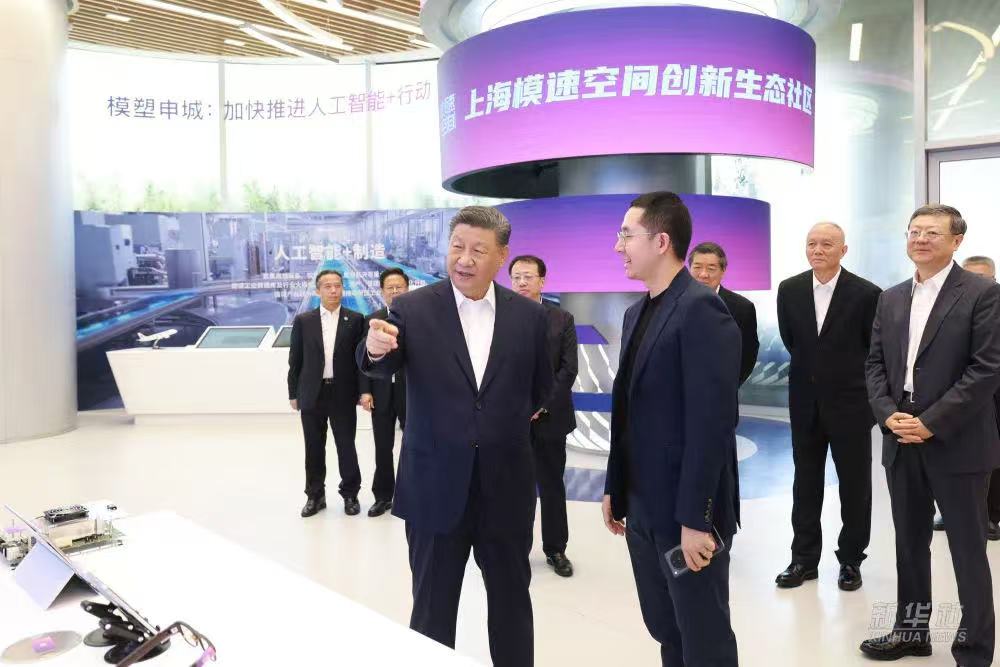
君弘灵犀大模型

Search documents
从“辅助”到“引擎”:互联网分公司成券商转型胜负手
Zheng Quan Ri Bao Zhi Sheng· 2026-01-12 17:08
Core Viewpoint - The securities industry is undergoing a significant transformation, marked by the closure of over 180 offline branches and the rapid rise of internet subsidiaries, indicating a trend towards digitalization and smart transformation in the sector [1][2]. Group 1: Industry Trends - The establishment of internet subsidiaries is becoming a new strategy for securities firms to capture online market share and expand customer bases, driven by favorable market conditions and increased trading activity [2][6]. - By 2025, the total number of new investor accounts in the capital market is expected to reach 30.0571 million, providing ample opportunities for securities firms to enhance their internet business [2]. - Major firms like China Galaxy Securities and Dongwu Securities are actively setting up internet subsidiaries, reflecting a broader trend of digital transformation in the industry [2][3]. Group 2: Differences Between Internet Subsidiaries and Traditional Branches - Internet subsidiaries differ from traditional branches in strategic focus, targeting a broader customer base through standardized and centralized operations, while traditional branches primarily serve high-net-worth and corporate clients [3]. - The operational logic of internet subsidiaries is data and algorithm-driven, contrasting with the reliance on personal experience and social networks in traditional branches [3][4]. - Internet subsidiaries operate as independent units with unified rights, responsibilities, and benefits, allowing for quicker decision-making and a full-cycle approach to customer acquisition and revenue generation [3][4]. Group 3: Functional Roles of Internet Subsidiaries - The core functions of internet subsidiaries include conducting targeted marketing and lead generation on external platforms, managing daily operations of various online platforms, providing refined customer service, and acting as a "smart brain" for data monitoring and AI application across all business processes [4][5]. - Internet subsidiaries aim to address traditional pain points in the securities industry, such as inadequate service for long-tail customers and low operational efficiency due to dispersed operations [5][6]. Group 4: Performance and Effectiveness - The effectiveness of internet subsidiaries is being validated through various practices, with firms like Guotai Junan and Dongwu Securities reporting significant growth in customer acquisition and asset management [6][7]. - Guotai Junan's internet subsidiary has doubled its customer acquisition on new media platforms in 2025 compared to 2024, while Dongwu Securities has successfully attracted nearly 3 million followers and accumulated 150 million yuan in assets [6][7]. Group 5: Challenges and Future Outlook - Despite the progress, internet subsidiaries face challenges such as internal collaboration barriers and the need for alignment with headquarters on operational strategies [8][9]. - Not all securities firms are suited to establish internet subsidiaries, as some leading firms have already integrated internet capabilities into their operations, while smaller firms may prefer to focus resources on key business areas [8][9]. - The future of internet business in the securities industry will depend on advancements in technology, business models, and organizational structures, with a focus on creating long-term customer engagement and breaking down traditional departmental barriers [9][10].



证券公司学习宣传贯彻党的二十届四中全会精神 | 国泰海通党委书记、董事长朱健:强化使命担当,加快建设一流投资银行
Zhong Guo Zheng Quan Bao· 2026-01-09 08:33
Core Viewpoint - The article emphasizes the strategic importance of the securities industry in China's modernization and financial strength, highlighting the need for firms to focus on core functions, governance, and differentiated development to seize opportunities in the evolving capital market [1]. Group 1: Company Performance and Strategy - Guotai Junan Securities has achieved a total asset milestone of over 2 trillion yuan, marking it as the largest "A+H" dual-listing merger in China's securities history [2]. - For the first three quarters of 2025, Guotai Junan reported a cumulative operating income of 45.892 billion yuan and a net profit attributable to shareholders of 22.074 billion yuan, maintaining a leading position in the industry [2]. - The company aims to leverage the new round of capital market reforms to enhance its development quality and efficiency, aspiring to become a first-class investment bank with international competitiveness [2][3]. Group 2: Functional Focus and Innovation - The company prioritizes functionality over mere scale, emphasizing the importance of high-quality development and focusing on hard technology investments [3]. - Guotai Junan has facilitated over 100 hard technology companies to list on the Sci-Tech Innovation Board, showcasing its commitment to supporting innovation [3]. - The firm is advancing its wealth management transformation, aiming to enhance its asset allocation capabilities and introduce innovative digital operating models [4]. Group 3: Market Position and Internationalization - Guotai Junan has played a significant role in bridging domestic and international capital flows, completing 39 equity financing deals in Hong Kong and ranking high in bond issuance [6]. - The company is focused on enhancing its global service network, covering 17 countries and regions, to better serve both domestic and international clients [9]. - The firm aims to strengthen its international business capabilities and enhance its influence in global capital allocation and asset pricing [6][9]. Group 4: Organizational Development and Cultural Integration - The merger of Guotai Junan and Haitong Securities is seen as a critical step towards building a first-class investment bank, with a focus on integrating resources and enhancing operational efficiency [7][8]. - The company emphasizes a strong corporate culture that aligns with its strategic goals, promoting values such as compliance, integrity, and long-term partnership [11]. - Guotai Junan is committed to high-quality talent management, ensuring that its workforce is well-equipped to meet the challenges of the evolving financial landscape [12].

券商CIO密集“换新”:数字化从后勤变引擎 复合型人才成香饽饽
Shang Hai Zheng Quan Bao· 2025-11-30 18:29
Core Insights - The role of Chief Information Officers (CIOs) in the securities industry is evolving from a support function to a strategic engine driving business innovation [2][4][5] - There has been a significant increase in the hiring of new CIOs across various brokerages, indicating a heightened emphasis on information technology [3][4] - The trend reflects a broader digital transformation within the industry, moving from traditional cost-driven competition to value-driven strategies [5][6] Group 1: CIO Role Evolution - The recent wave of CIO appointments signifies a fundamental shift in the operational logic of brokerages, with digital transformation becoming a top strategic priority [4] - New CIOs often possess a hybrid background in both technology and business, which is increasingly favored in the hiring process [3][4] - The responsibilities of CIOs are shifting from traditional technical support to becoming central to business innovation strategies [4][5] Group 2: Increased Technology Investment - The securities industry is expected to see a 19.7% growth in IT investment by 2025, with the overall market size projected to exceed 74 billion yuan by 2027 [5] - Digital transformation is now viewed as a key variable for breaking through industry challenges, moving away from a focus on cost control [5][6] - Brokerages are accelerating their financial technology initiatives, with companies like Zhejiang Securities and Northeast Securities outlining strategic plans for technology integration [5][6] Group 3: Internet Subsidiaries and Digital Services - Several brokerages are establishing internet subsidiaries to create a digital service framework, with firms like China Galaxy and Dongwu Securities leading the way [7][8] - These internet subsidiaries are expected to become key platforms for AI technology application and customer engagement upgrades within the next three to five years [8]




“迈向人工智能+时代” 2025年大湾区交易所科技大会11月28日-29日举行
Xin Lang Zheng Quan· 2025-11-28 06:39
Core Insights - The Shenzhen Stock Exchange, in collaboration with the Hong Kong Stock Exchange and the Guangzhou Futures Exchange, hosted the 2025 Greater Bay Area Technology Conference focusing on "Entering the Era of Artificial Intelligence+" [1][3] - Key figures from various sectors, including government, financial markets, technology companies, and academic institutions, participated to share experiences and build consensus on the application of AI in capital markets [1][3] Agenda Summary November 28 Agenda - Keynote speeches included topics such as "Implementing the 'Artificial Intelligence+' Initiative for High-Quality Development of Capital Markets" and "Entering a New Era of Artificial Intelligence" [3] - A high-level dialogue on industry applications and governance of large models was also scheduled [3] November 29 Agenda - The agenda featured technical sharing sessions on various topics, including "Exploration and Practice of Observability in Trading Systems" and "Low-Latency Communication Optimization for Securities Trading Systems" [7][9] - Additional sessions covered the construction practices of core trading systems and the research on multi-level custody in clearing and settlement platforms [7][9] Financial AI Sub-Forum - The sub-forum included discussions on regulatory innovations and the practical applications of large models in the financial sector [8][10] - Presentations focused on the integration of AI in financial data management and the development of intelligent applications in the industry [10][11] Digital Transformation Sub-Forum - The forum addressed the transformation practices in core business and institutional services, emphasizing the role of digitalization in wealth management [12][14] - Topics included the application of digital solutions in inclusive finance and the management of customer classification [12][14]



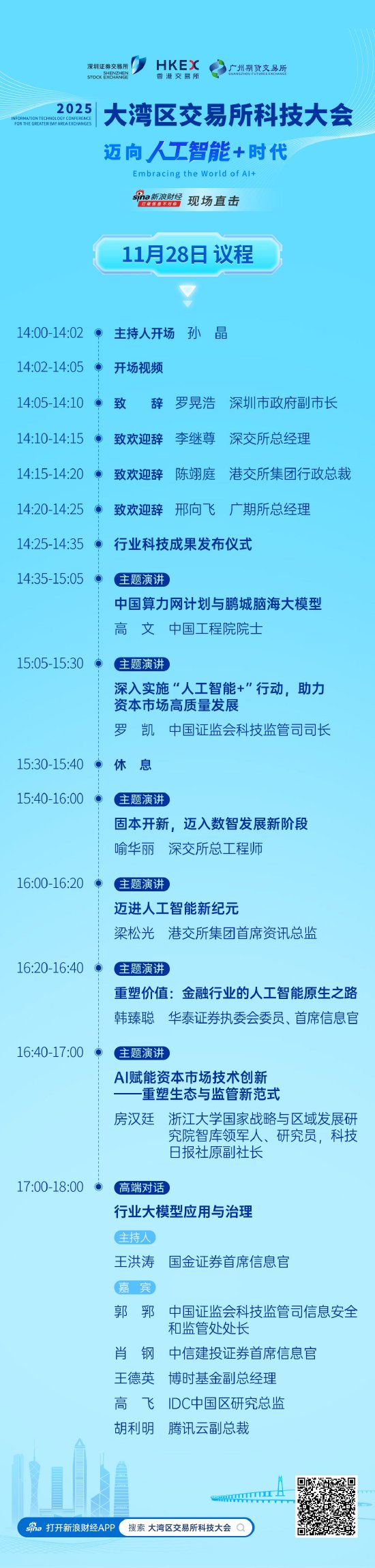
2025大湾区交易所科技大会11月28日至29日举行
Xin Lang Zheng Quan· 2025-11-28 06:07
Core Insights - The 2025 Greater Bay Area Exchange Technology Conference will be held on November 28-29, focusing on the theme of "Entering the Era of Artificial Intelligence+" [1] - The event is organized by Shenzhen Stock Exchange, Hong Kong Stock Exchange, and Guangzhou Futures Exchange [1] Agenda Summary - The first day includes a high-level seminar with various keynote speeches from industry leaders, including topics on China's computing network plan and the role of AI in capital market development [2][3] - Keynote speakers include prominent figures such as Gao Wen from the Chinese Academy of Engineering and Luo Kai from the China Securities Regulatory Commission [2][3] - The second day features sub-forums on trading settlement technology and financial AI, with technical sharing sessions from various experts in the field [6][7][8] - Topics covered in the sub-forums include low-latency communication optimization, AI integration in financial data, and digital transformation in brokerage services [6][7][8][9]

人工智能在资产管理业务的实践探索和应用研究
Zhong Zheng Wang· 2025-11-25 09:40
Core Insights - The article discusses the transformative impact of artificial intelligence (AI) on the asset management industry, highlighting the shift from human-driven decision-making to AI-driven processes [1] - It emphasizes the need for addressing challenges such as model hallucination, funding and talent shortages, and industry-specific limitations in AI adoption [5][6][8] Group 1: Current Development of AI in Asset Management - AI has rapidly penetrated various business segments in asset management due to the industry's rich data, high accessibility, and clear evaluation standards, transitioning from "human brain experience-driven" to "AI-driven" [1] - National policies are guiding the industry, with initiatives like the State Council's 2025 plan promoting AI applications in finance, and local governments providing financial subsidies and tax incentives to support AI integration in asset management [2] - Domestic institutions are significantly increasing investments in AI, with projections indicating that related investments will soar to 41.548 billion by 2027, marking a 111% increase from 2024 [3] Group 2: Applications and Benefits of AI - AI enhances operational efficiency by automating repetitive tasks, reducing operational risks, and providing real-time support for risk management and strategic decision-making [4] - It improves customer experience through personalized services, enabling zero-wait business processing and reducing communication costs, thus broadening the client base [4] - AI boosts research efficiency by processing vast amounts of structured and unstructured data, alleviating information overload, and offering new pathways for quantitative investment strategies [4] Group 3: Challenges in AI Adoption - The industry faces risks of model hallucination and homogenization, where AI models may produce illogical conclusions due to overfitting, particularly in the context of rare events [5] - There is a significant challenge in funding and talent scarcity, as substantial investments are required for computational resources, data governance, and model training, compounded by a lack of professionals with both AI and asset management expertise [6][7] - Industry-specific characteristics limit the depth of AI model deployment, as AI struggles with new business scenarios lacking historical data, leading to hesitance among research personnel to fully embrace AI [8] Group 4: Recommendations and Future Outlook - The article suggests improving model classification management and establishing a robust data governance framework to mitigate risks and enhance regulatory compliance [9] - It advocates for exploring data-sharing mechanisms to improve data utilization efficiency and enhance the training of AI models with high-quality financial knowledge [10] - The industry should focus on multi-channel talent development and collaboration among institutions to build a skilled workforce capable of integrating AI into asset management [11] - A gradual, pilot-based approach to AI implementation is recommended, starting with low-risk scenarios and progressively expanding to core asset management functions [12]
万字长文 | AI落地的十大问题
Tai Mei Ti A P P· 2025-09-18 05:24
Core Viewpoint - The year 2025 is seen as a critical juncture for the practical application of enterprise-level AI, transitioning from experimental tools to essential components of business operations, despite challenges in scaling and execution [1][5]. Group 1: AI Implementation Challenges - Companies face significant gaps between AI technology awareness and practical application, with discrepancies in understanding and goals between management and execution teams [8]. - A majority of AI projects (90%) fail to meet expectations, with 70% of executives reporting unsatisfactory results, primarily due to viewing AI merely as a tool rather than a collaborative partner [16][18]. Group 2: Data Quality and Management - Data quality issues span the entire data lifecycle, affecting AI implementation outcomes, with many CIOs questioning the value of accumulated data [31][33]. - The Hong Kong Hospital Authority has accumulated nearly 6 billion high-quality medical data points over 30 years, emphasizing the importance of structured data for effective AI application [36]. Group 3: AI Reliability and Interpretability - As AI becomes more widely adopted, ensuring the reliability and interpretability of AI technologies is crucial, particularly in high-stakes environments like finance [21][24]. - The "model hallucination" issue, where AI generates incorrect information, poses significant challenges for trust and compliance in sectors requiring high accuracy [23][28]. Group 4: Scene Selection for AI Projects - Companies often struggle with selecting appropriate AI application scenarios, caught between the allure of technology and practical business needs [44]. - The case of Yixin demonstrates how AI can transform financial services by providing tailored solutions to underserved markets, highlighting the importance of aligning technology with user needs [46][48]. Group 5: Knowledge Base Development - A dynamic and continuously updated knowledge base is essential for maximizing the value of AI applications, moving from static information storage to knowledge-driven processes [78][80]. - The Eastern Airlines' approach to knowledge management illustrates the shift towards integrating AI into operational processes, enhancing efficiency and service quality [83]. Group 6: Human-Machine Collaboration - The evolution of AI agents from simple task executors to collaborative participants in complex business scenarios is critical for digital transformation [87]. - Companies like Midea are leveraging AI to enhance production efficiency and redefine operational models, demonstrating the potential of AI in driving business innovation [89][91]. Group 7: Talent Acquisition and Development - The competition for AI talent is intensifying, with a significant mismatch between the demand for skilled professionals and the available talent pool, highlighting the need for strategic talent management [97][99].

财跃星辰携四大成果亮相外滩大会,以AI创新重塑金融科技新图景
Xin Lang Cai Jing· 2025-09-11 12:45
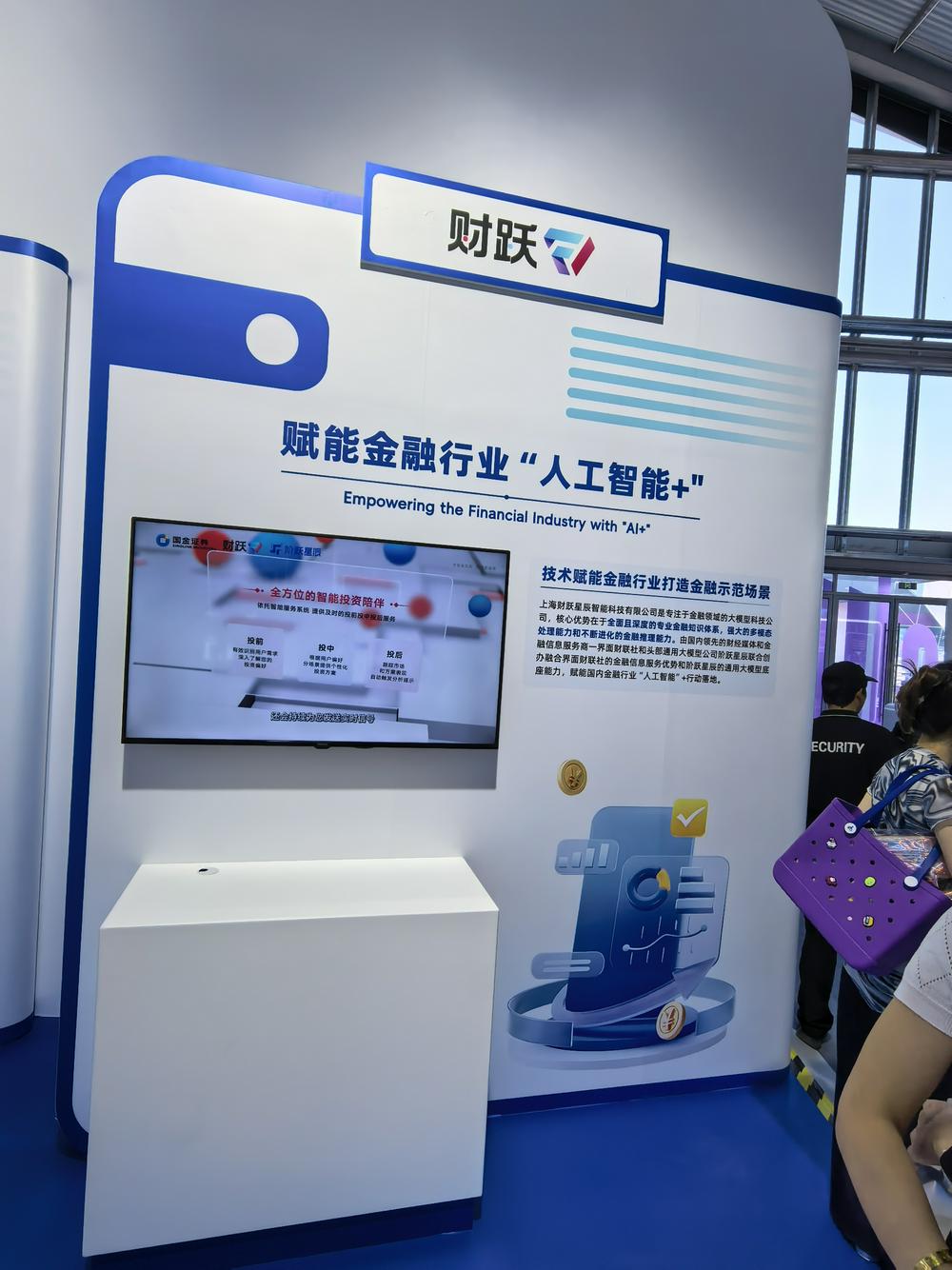
Core Viewpoint - The "2025 Inclusion·Bund Conference" in Shanghai focuses on "reshaping innovative growth" and showcases advancements in financial AI technology, emphasizing the role of Shanghai in global financial innovation [1] Group 1: Financial AI Innovations - The conference highlighted four major financial AI achievements from Caiyue Xingchen, showcasing its breakthroughs in intelligent financial services [3] - The AI Xiaocaishen Pro product, known for its exceptional financial research capabilities, can generate professional financial reports in just half an hour, integrating exclusive data and analysis tools [3] - AI Xiaocaishen Pro ranked first in China and among the top three globally in the FinResearchBench evaluation for financial research report writing [3] Group 2: Collaborative Models - The Junhong Lingxi model, developed in collaboration with Guotai Junan, is the first multimodal large model with a scale of over 100 billion parameters, capable of processing text, images, and voice data [4] - This model enhances data perception and intelligent analysis, providing precise and efficient support in complex financial scenarios, thus creating a new paradigm in smart finance [4] Group 3: Inclusive Financial Services - The Shanghai Bank AI Mobile Banking, developed with Shanghai Bank, successfully addresses dialect recognition and synthesis, offering a seamless financial service experience for local elderly populations [5] - The Guojin AI Investment Advisory, created with Guojin Securities, merges strategy and service to lower the barriers for professional investment, making personalized advisory services accessible to a broader audience [5] - Caiyue Xingchen's innovations reflect the integration of cutting-edge technology with industry practices, contributing to the development of Shanghai as a global financial technology center [5]
国泰海通:合并驱动业绩大增,扣非利润增速放缓及信用减值风险需关注
Hua Er Jie Jian Wen· 2025-08-29 13:27
Financial Performance - The company reported operating revenue of 23.872 billion yuan, a year-on-year increase of 77.71% [1] - Net profit attributable to the parent company reached 15.737 billion yuan, up 213.74% year-on-year [1] - Non-recurring net profit was 7.279 billion yuan, reflecting a growth of 59.76%, significantly lower than the overall net profit growth [2] Business Development - Wealth management business contributed the most, accounting for 40.94% of total revenue [3] - The company achieved a market share of 9.78% in the financing and securities lending sector, ranking first in the industry [3] - In investment banking, the company ranked second with a total underwriting amount of 708.182 billion yuan, and an 18.6% market share in equity underwriting [3] Merger Impact - The completion of the merger with Haitong Securities on March 14, 2025, resulted in a significant asset scale increase to 1.8 trillion yuan, a growth of 72.24% [1] - The merger's effects are evident, but concerns remain regarding the sustainability and quality of this growth [2] Credit Quality Concerns - Credit impairment losses surged from 237 million yuan to 1.194 billion yuan, an increase of 404.71% [3] - The company attributed this to new leasing business and accounting standards post-merger, indicating potential asset quality risks [3] Digital Transformation - The company has made significant investments in digitalization, launching the first multimodal securities model with over 100 billion parameters [4] - Monthly active users of the merged app reached 15.58 million, leading the industry [4] - However, the sustainability of these technological advantages in translating to commercial value remains uncertain [4] Financial Structure - Post-merger, total assets reached 1.8 trillion yuan, with a debt-to-asset ratio of 75.68%, an improvement from 77.69% at the end of the previous year [5] - Cash and cash equivalents amounted to 393.662 billion yuan, representing 21.81% of total assets, indicating ample liquidity [5] - The balance of bonds payable increased by 105.07% to 274.796 billion yuan, raising concerns about rapid debt expansion [5] Dividend Policy - The company plans to distribute 1.5 yuan per 10 shares, with total dividends and share buybacks accounting for 24.39% of net profit [7] - This dividend ratio is considered moderate within the brokerage industry, reflecting a balance between shareholder returns and capital retention for future growth [7] Market Outlook - The new "Guo Jiu Tiao" policy continues to positively impact the capital market, with the company positioned as an industry leader post-merger [8] - Key concerns for investors include the sustainability of merger synergies, maintaining market position amid increasing industry concentration, and the cost-effectiveness of digital investments [8] - Future focus should be on the quality of non-recurring net profit growth, control of credit impairment losses, and operational efficiency post-business integration [8]

牢记总书记嘱托 人工智能要为老百姓创造好的生活
news flash· 2025-04-30 01:28
Group 1 - The core viewpoint emphasizes the importance of artificial intelligence (AI) in improving the quality of life for ordinary citizens, as highlighted by General Secretary Xi Jinping during his visit to Shanghai [1] - Shanghai has completed the registration of 60 generative AI service models by the end of 2024, showcasing its commitment to AI development [1] - The city is recognized as a leader in AI, with notable companies like Jiyue Xingchen accelerating the iteration of multimodal models and forming strategic partnerships across various industries [1] Group 2 - Jiyue Xingchen has established a deep strategic partnership with Jiemian Zhitong Finance to co-found a new company, Caiyue Xingchen, focusing on the application of large models in the financial sector [2] - The company has launched "AI Xiaocaishen," a reliable wealth assistant aimed at providing ordinary investors with AI-driven data mining, dialogue, and financial report interpretation [2] - Jiyue Xingchen, in collaboration with Guotai Junan and Jiemian Zhitong Finance, has introduced the first trillion-parameter multimodal securities model, Junhong Lingxi, integrating large model capabilities into user intelligent service systems [2]