价值投资

Search documents
融资保证金不能低于100%了?深交所新规背后藏着什么信号!
Sou Hu Cai Jing· 2026-01-14 16:43
Core Viewpoint - The recent adjustment in the Shanghai Composite Index and the announcement from the Shenzhen Stock Exchange to raise the margin requirement for financing transactions to a minimum of 100% indicates a significant regulatory shift aimed at stabilizing the market and reducing leverage risks [1][3][4]. Group 1: Regulatory Changes - The new regulation requires investors to provide at least an equal amount of cash or securities as collateral for financing transactions, effectively raising the entry barrier for leveraged trading [3][4]. - This change is perceived as a measure to lower the overall market leverage, which has been a contributing factor to market volatility in recent years [3][4][7]. Group 2: Market Impact - In the short term, the new margin requirement may suppress active capital flow, leading to potential downward pressure on the index [4][8]. - Over the long term, a healthier leverage level and reduced speculative atmosphere could stabilize the market foundation, akin to reinforcing a building's foundation [4][10]. Group 3: Investment Strategy - Investors are encouraged to reassess their investment habits, moving from speculative trading to value discovery, as reliance on financing to amplify positions will become more challenging and costly [6][7]. - The focus should shift towards understanding the core competitiveness, management quality, and industry position of companies, as these factors will determine long-term value [7][8]. Group 4: Market Sentiment - The timing of the new regulation amidst significant market fluctuations has heightened uncertainty, leading to emotional responses among investors [3][4]. - The adjustment serves as a strong signal for investors to maintain patience and focus on long-term strategies rather than short-term gains [8][10].

适时降温是好事
Bei Jing Shang Bao· 2026-01-14 15:22
Core Viewpoint - The increase of the minimum margin ratio for financing from 80% to 100% by the Shanghai and Shenzhen Stock Exchanges is expected to lower the leverage ratio for investors, thereby reducing investment risks and enhancing the safety of value investment in the stock market [1][2]. Group 1: Impact on Investment Behavior - The new margin requirement means investors will need to use more of their own funds for the same scale of trading, which will lower investment risks and enhance the safety margin of financing activities [1][2]. - With reduced leverage, investors are likely to trade more cautiously, decreasing blind trading and helping to mitigate irrational market fluctuations, allowing stock prices to better reflect the fundamentals of companies and market supply-demand relationships [1][2]. Group 2: Regulatory Perspective - The adjustment to increase the financing margin ratio is seen as a proactive measure by regulators to prevent potential risks in the market, especially in light of the recent rapid recovery of the A-share market driven by policy support and economic recovery expectations [2][3]. - The tightening of leverage is intended to prevent investors from excessively using leverage during optimistic market conditions, thereby avoiding the accumulation of potential irrational bubbles [2]. Group 3: Long-term Market Implications - The increase in the margin ratio is significant for a value investment-oriented market, as it encourages long-term and rational investment strategies focused on the intrinsic value and long-term growth potential of companies [2]. - Lower leverage rates are expected to guide investors away from short-term speculation and towards a focus on the fundamentals of listed companies, promoting investment in firms with strong performance, stable growth, and sustainable development capabilities [2]. Group 4: Transitional Measures - The three major exchanges have implemented transitional measures, where new financing contracts will adopt the new margin ratio standards, while existing contracts will continue under the previous regulations, encouraging the holding of existing financing positions for a longer duration [3].
适度提高融资保证金比例有利于降风险
Xin Lang Cai Jing· 2026-01-14 14:14
Core Viewpoint - The increase of the financing margin ratio from a minimum of 80% to a maximum of 100% by the Shanghai, Shenzhen, and Beijing Stock Exchanges is aimed at reducing the leverage for investors when purchasing stocks through financing, thereby lowering investment risks and enhancing the safety of value investment in the stock market [1][4][6] Group 1: Impact on Investment Risks - The adjustment in the financing margin ratio directly affects the amount of funds investors can obtain through financing, which previously allowed for larger-scale transactions with less own capital, amplifying both potential profits and risks [1][5] - By raising the margin ratio to a maximum of 100%, the leverage for investors is reduced, requiring them to invest more of their own funds for the same scale of transactions, thus lowering investment risks and enhancing the safety of financing operations [1][6] - A lower leverage ratio encourages investors to be more cautious in their trading, reducing blind trading and helping to minimize irrational market fluctuations, allowing stock prices to better reflect the fundamentals of companies and market supply and demand [1][6] Group 2: Regulatory Perspective - From a risk prevention standpoint, the current increase in the financing margin ratio is a proactive measure by regulators to mitigate potential risks [6] - The tightening of leverage is seen as a safety measure for the A-share market, which has been experiencing rapid recovery due to favorable policies and economic recovery expectations, helping to prevent excessive leverage use and potential irrational bubbles [2][6] - While this may lead to short-term market fluctuations and some profit-taking, it significantly enhances the safety and resilience of the A-share market in the long term, contributing to its stable development [2][6] Group 3: Implications for Value Investment - The increase in the financing margin ratio is particularly significant for value investment, which emphasizes long-term and rational investment, focusing on the intrinsic value and long-term potential of companies [2][6] - A lower leverage ratio helps guide investors away from short-term speculative thinking, encouraging a focus on the fundamentals and long-term development of companies [2][6] - This shift in focus is expected to direct funds towards high-quality enterprises, optimizing resource allocation and improving the overall quality of the stock market [2][6] Group 4: Transitional Measures - The three major exchanges have implemented transitional measures, where new financing contracts will adopt the new margin ratio standards, while existing contracts will continue under the previous regulations, encouraging the holding of existing financing positions for a longer duration [3][7]
北京商报侃股:适度提高融资保证金比例有利于降风险
Bei Jing Shang Bao· 2026-01-14 14:07
Core Viewpoint - The increase of the financing margin ratio from a minimum of 80% to a maximum of 100% by the Shanghai and Shenzhen Stock Exchanges is expected to reduce the leverage for investors purchasing stocks through financing, thereby lowering investment risks and enhancing the safety of value investment in the stock market [1][2]. Group 1: Impact on Investment Behavior - The adjustment in the financing margin ratio directly lowers the leverage that investors can use, requiring them to invest more of their own funds for the same scale of transactions, which reduces investment risks and increases the safety margin of financing activities [1][2]. - With lower leverage, investors are likely to trade more cautiously, reducing blind trading and helping to minimize irrational market fluctuations, allowing stock prices to better reflect the fundamentals of companies and market supply and demand [1][2]. Group 2: Regulatory Perspective - From a risk prevention standpoint, the moderate increase in the financing margin ratio is a proactive regulatory measure aimed at preventing excessive leverage usage by investors during optimistic market conditions, thereby avoiding potential irrational bubbles [2]. - The tightening of leverage is seen as adding a safety belt to the A-share market, which may lead to short-term profit-taking and slight market fluctuations, but will significantly enhance the market's safety and resilience in the long term [2]. Group 3: Implications for Value Investment - The increase in the financing margin ratio is significant for a value investment-oriented market, as it encourages long-term and rational investment, focusing on the intrinsic value and long-term growth potential of companies [2]. - A lower leverage ratio will guide investors to abandon short-term speculative thinking and focus on the fundamentals and long-term development of companies, promoting capital flow towards high-quality enterprises and optimizing resource allocation [2]. Group 4: Transitional Measures - The three major exchanges have implemented transitional measures, where new financing contracts will adopt the new margin ratio standards, while existing contracts will continue under the previous regulations, encouraging the holding of existing financing positions for a longer duration [3].
侃股:适度提高融资保证金比例有利于降风险
Bei Jing Shang Bao· 2026-01-14 12:29
Group 1 - The core viewpoint of the articles is that the increase in the financing margin ratio from a minimum of 80% to a maximum of 100% will reduce the leverage for investors purchasing stocks through financing, thereby lowering investment risks and enhancing the safety of value investment in the stock market [1][2] - The adjustment in the financing margin ratio directly affects the amount of funds investors can obtain through financing transactions, leading to a decrease in leverage and requiring investors to use more of their own funds for the same scale of trading, which reduces investment risks [1][2] - The increase in the financing margin ratio is seen as a preventive measure by regulators to mitigate risks, especially in a market that has shown signs of rapid recovery and rising investor sentiment, which could lead to excessive leverage and irrational bubbles [2] Group 2 - The tightening of leverage is expected to encourage more cautious trading behavior among investors, reducing blind trading and helping to stabilize the market by ensuring stock prices more accurately reflect the fundamentals of companies and market supply and demand [1][2] - The new margin ratio policy is significant for a value investment-oriented market, as it promotes long-term and rational investment strategies, encouraging investors to focus on the intrinsic value and long-term potential of companies [2] - The three major exchanges have implemented transitional measures, allowing new financing contracts to adopt the new margin ratio standards while existing contracts will continue under the previous regulations, which may encourage the holding of existing financing positions for a longer duration [3]
A股重要调整!沪深北交易所提高融资保证金比例
Sou Hu Cai Jing· 2026-01-14 09:09
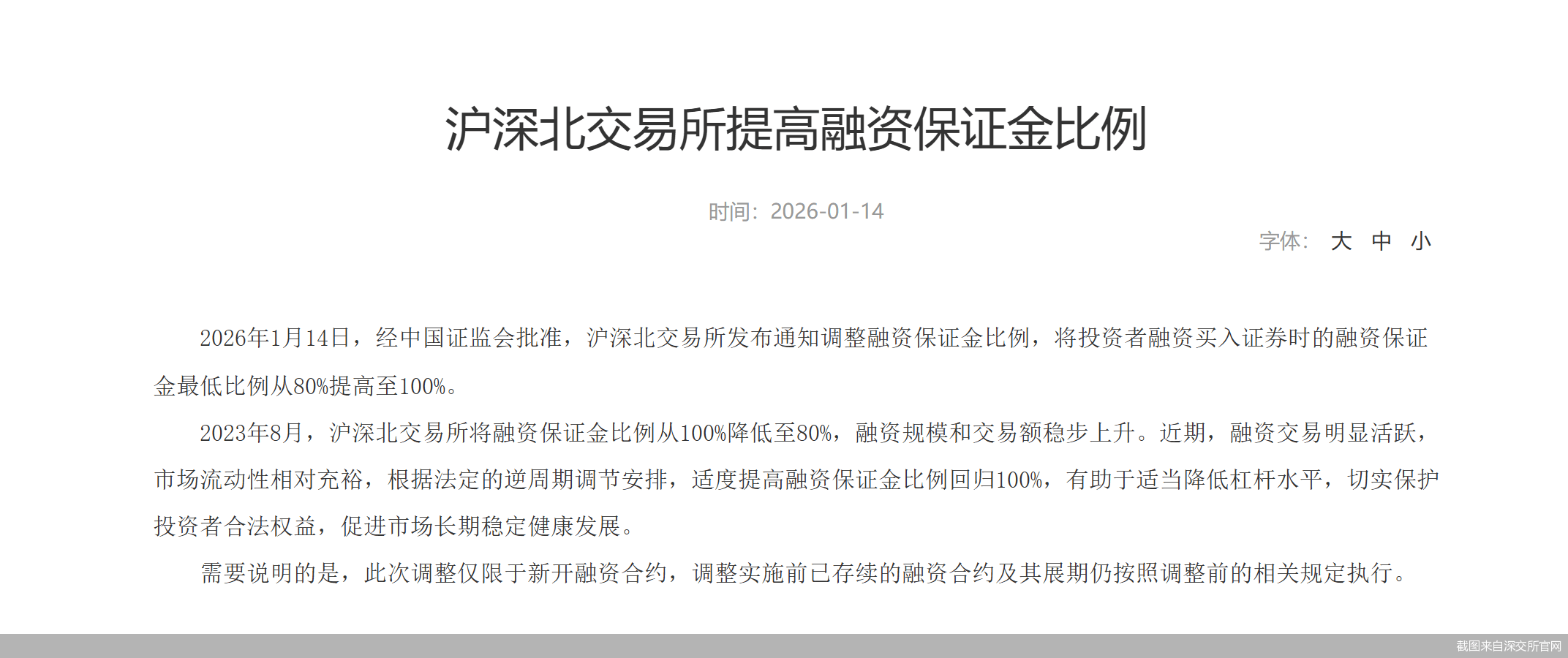
时隔10年,融资保证金比例再度调至100%。1月14日,经中国证监会批准,沪深北交易所发布通知调整融资保证金比例,将投资者融资买入证券时的融资保 证金最低比例从80%提高至100%。这一逆周期调节举措落地于两融余额突破2.68万亿元的历史高位节点。业内人士指出,这既是对市场过热杠杆资金的精准 降温,也是推动资本市场长期稳健发展的重要举措。 此次比例上调并非偶然,而是监管层基于当前市场态势的预防性逆周期调节,是对融资交易过热风险的提前化解。 从市场背景来看,近期融资交易活跃度已远超常态水平。开年以来,两融余额持续攀升并创下历史新高,截至1月13日已达2.68万亿元。此外,A股成交额也 在持续放大,连续四个交易日超3万亿元,1月14日更是逼近4万亿元,续创历史新高。 尤为值得关注的是"新老划断"的执行方式,此次调整仅限于新开融资合约,调整实施前已存续的融资合约及其展期仍按照原80%比例执行。业内人士指出, 这意味着存量融资投资者无需追加保证金,也不会面临强制平仓压力,有效避免了对存量市场的剧烈冲击,彰显了监管层"温和调控、平稳过渡"的政策导 向。 据介绍,2023年8月,沪深北交易所将融资保证金比例从100%降低 ...
杨德龙:不忘初心 坚定价值投资理念
Xin Lang Cai Jing· 2026-01-14 08:34
Market Overview - The market has experienced continuous growth at the beginning of 2026, with trading volume reaching a historical record of 3.6 trillion yuan [1][6] - Margin trading balances have surpassed 2.6 trillion yuan, indicating increased market activity [1][6] - January is typically the month with the highest credit issuance, estimated between 3 trillion to 4 trillion yuan, which may contribute to capital market growth [1][6] Monetary and Fiscal Policy - China's monetary policy is expected to remain moderately accommodative, with measures such as interest rate cuts and reserve requirement ratio reductions to support low interest rates and liquidity [2][7] - The fiscal policy will be more proactive, with initiatives to boost investment and consumption, including a new subsidy policy for replacing old consumer goods [2][7] - A 12 trillion yuan local government debt relief plan is set to be implemented, easing interest payment pressures and allowing more funds for public welfare and growth [2][7] International Economic Context - The U.S. Federal Reserve is likely to continue its rate-cutting cycle in 2026, with expectations of at least two 25 basis point cuts due to weak economic data [2][8] - The U.S. inflation rate has fallen below 3%, indicating a shift in focus towards stabilizing employment rather than solely controlling inflation [2][8] Currency and Investment Trends - The dollar index has shown a downward trend, raising concerns about U.S. dollar credit, especially with the national debt exceeding 38 trillion dollars and annual interest payments over 1 trillion dollars [9] - China's central bank is reducing U.S. Treasury holdings while increasing gold reserves as a strategy to mitigate dollar credit risks [4][9] - The international influence of the dollar is expected to decline, while the internationalization of the renminbi is anticipated to progress, potentially leading to a renminbi appreciation against the dollar [10] Stock Market Dynamics - The U.S. stock market is experiencing high valuations, with major indices near historical peaks, but the AI technology revolution is supporting genuine business models [11] - Volatility in the U.S. stock market is expected to increase in 2026, with potential short-term corrections in tech stocks, but significant downturns similar to the 2001 internet bubble are unlikely [11] - A-shares and Hong Kong stocks are viewed as attractive investment opportunities due to their valuation advantages, independent of U.S. market fluctuations [11]
上银基金卢扬:2026年金属投资的三大关键词
Zheng Quan Shi Bao Wang· 2026-01-14 03:36
Group 1: Core Insights - The current rally in the non-ferrous metals sector is driven by "supply scarcity, structural differentiation, and reasonable valuation," indicating significant medium to long-term investment value [1] - Gold is viewed not only as a safe-haven asset but also as a stabilizing force for currency credit, reflecting long-term concerns over sovereign credit, particularly the US dollar [2] - The investment logic for copper has shifted from being a traditional cyclical commodity to a strategic growth asset, with supply constraints likely to maintain high prices over the long term [3] Group 2: Market Dynamics - The overall health of the non-ferrous metals sector remains intact, with current valuations not being inflated, as most companies in the sector have a price-to-earnings ratio (PE) around 10-12 times, which is relatively low compared to other high-valuation sectors [4] - The investment perspective has evolved, with investors now focusing on long-term growth rather than short-term cyclical fluctuations, enhancing the sustainability of profits for copper companies [3][4] - The ability of upstream price increases to be transmitted downstream is crucial for the sustainability of the current market trend, with potential risks if downstream sectors cannot adjust to price changes [5] Group 3: Future Strategies - Investors are advised to adopt a "bottom-up" stock selection strategy, focusing on varieties with tight supply-demand dynamics and structural shortages, such as copper, aluminum, and lithium, which benefit from trends in new energy and AI infrastructure [4] - The non-ferrous metals sector is expected to experience a phase of differentiation in performance, moving away from broad market rallies to more selective opportunities [4][5] - The fundamental support for the metal market's continuation lies in the rigid scarcity of supply, emphasizing the importance of maintaining focus on quality assets amid market volatility [5]
2026年A股首家,德邦股份拟主动退市!
Zheng Quan Ri Bao Wang· 2026-01-14 02:19
"从保护投资者的角度来看,上市公司在筹划重大事项的过程中,要强化信息披露,对拟进行的重大事 项对主业的影响、协同效应等信息进行说明,保障投资者的知情权。此外,也要加强投资者教育,引导 市场树立长期投资、价值投资理念。"上海明伦律师事务所律师王智斌说。 在1月13日晚间的公告中,德邦股份提及,为了更好地顺应物流行业的发展趋势,更为高效、有力地统 筹协调与整合JDLogistics,Inc.(京东物流股份有限公司,以下简称"京东物流")体系内的物流资源, 亦考虑积极践行公司间接控股股东京东卓风于收购德邦股份时作出的关于同业竞争的承诺,根据相关法 律、法规及规范性文件的规定,经京东卓风提议,并经公司董事会审议通过,决定以股东会决议方式主 动撤回A股股票在上海证券交易所的上市交易。 在宣布停牌筹划重大事项之后,德邦股份(603056)于1月13日晚间揭开了"重大事项"的盖头:公司拟 以股东会决议方式主动撤回A股股票在上海证券交易所的上市交易,并在取得上海证券交易所终止上市 决定后申请在全国中小企业股份转让系统退市板块继续交易。现金选择权的行权价格为19.00元/股。这 也是2026年首家主动终止上市的A股公司,公司股 ...

Are Investors Undervaluing UTD PARKS&RESRT (PRKS) Right Now?
ZACKS· 2026-01-13 15:41
Core Insights - The article emphasizes the importance of value investing as a strategy to identify strong stocks in various market conditions [2] - UTD PARKS&RESRT (PRKS) is highlighted as a notable investment opportunity, currently holding a Zacks Rank of 2 (Buy) and a Value grade of A [4][7] Valuation Metrics - PRKS has a P/E ratio of 11.13, significantly lower than the industry average of 17.87, indicating potential undervaluation [4] - The P/S ratio for PRKS stands at 1.22, compared to the industry average of 1.39, suggesting it may be undervalued based on sales performance [5] - PRKS's P/CF ratio is 7.38, which is attractive relative to the industry's average P/CF of 13.85, further supporting the notion of undervaluation [6] Earnings Outlook - The earnings outlook for PRKS is strong, reinforcing its position as one of the market's strongest value stocks [7]