
PPI

Search documents
10月核心CPI同比增长1.2%,涨幅连续第6个月扩大 | 高频看宏观
Sou Hu Cai Jing· 2025-11-14 07:20
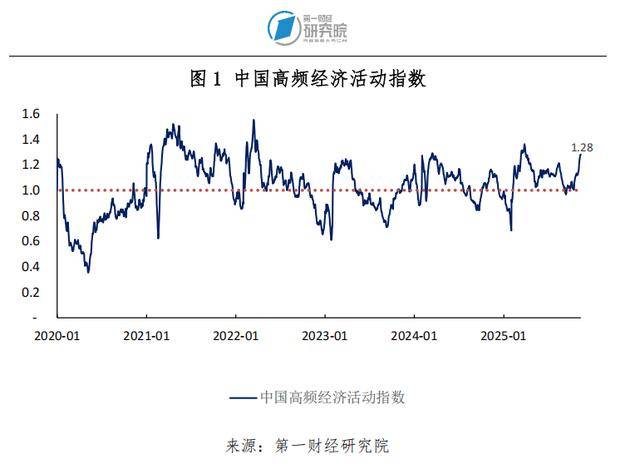
Group 1: Economic Activity Index - The China High-Frequency Economic Activity Index (YHEI) reached 1.28 on November 11, 2025, an increase of 0.09 from November 4 [1][4] - Industrial indicators such as the "Coastal Coal Freight Index" and "Imported Dry Bulk Freight Index" rose by 0.26 and 0.14 respectively, contributing significantly to the YHEI increase [1][4] Group 2: Price Indices - In October, the Consumer Price Index (CPI) increased by 0.2% year-on-year, up 0.5 percentage points from the previous month [2][41] - Core CPI rose by 1.2% year-on-year, marking the sixth consecutive month of growth [2][41] - The Producer Price Index (PPI) fell by 2.1% year-on-year, with the decline narrowing by 0.2 percentage points compared to the previous month [3][42] Group 3: Monetary Policy - As of November 11, the central bank net withdrew 627.5 billion yuan through open market operations [6][7] - The central bank's reverse repurchase operations amounted to 823.7 billion yuan, with 1-week reverse repo rates at 1.4% [6][7] Group 4: Interest Rates and Financing - The overnight interbank rate rose by 19 basis points to 1.55% over the past week [11][12] - The 1-year and 10-year government bond yields increased by 1.22 and 1.35 basis points to 1.4% and 1.81% respectively [11][17] Group 5: Real Estate Market - New housing transaction areas in first, second, and third-tier cities decreased by 0.31%, 22.66%, and 0.54% respectively [33][35] - Second-hand housing transactions showed a divergence, with first and second-tier cities declining while third-tier cities increased by 16.93% [33][37] Group 6: Global Economic Indicators - The US dollar index fell by 0.73 points to 99.48, while the RMB appreciated by 26 basis points to 7.1207 against the dollar [44][45] - The S&P Commodity Index rose by 1.79% to 4004.03, with energy and industrial metals indices increasing by 2.52% and 0.86% respectively [44]

国家统计局:10月份PPI环比首次上涨,同比降幅收窄
Zhong Guo Xin Wen Wang· 2025-11-14 06:35
Core Viewpoint - The Producer Price Index (PPI) in October showed a month-on-month increase for the first time this year, with a year-on-year decline narrowing, indicating positive changes in industrial producer prices due to various factors including domestic demand policies and seasonal energy needs [1][2]. Group 1: PPI Changes - In October, the PPI decreased by 2.1% year-on-year, a reduction of 0.2 percentage points compared to the previous month, while it increased by 0.1% month-on-month, marking the first increase of the year [1]. - The month-on-month increase in PPI is attributed to improved market competition, increased seasonal energy demand, and rising international prices of non-ferrous metals [1]. Group 2: Factors Influencing PPI - Measures to boost consumption have shown effectiveness, with prices in certain sectors rising significantly: - Prices for arts and crafts and ceremonial goods increased by 18.4% - Prices for sports balls rose by 3.3% - Prices for nutritional food manufacturing increased by 2.1% [1]. - The growth of new economic drivers, particularly in the renewable energy sector, has led to increased demand for raw materials, resulting in price increases: - Prices in non-ferrous metal smelting and rolling industries rose by 6.8% - Prices for electronic materials increased by 2.3% [2]. - The effects of capacity governance in key industries are becoming evident, with improved market competition leading to reduced price declines in sectors such as photovoltaic equipment and automotive manufacturing [2]. Group 3: Future Outlook - The overall positive changes in PPI are expected to improve business operations and promote economic circulation. Future strategies include continuing to expand domestic demand, releasing consumption potential, increasing effective investment, and enhancing innovation [2].
四川10月电力、热力生产和供应业价格环比下降
Si Chuan Ri Bao· 2025-11-13 02:51
Group 1: CPI Trends - In October, Sichuan's Consumer Price Index (CPI) decreased by 0.6% year-on-year, with a narrowing decline of 0.3 percentage points compared to the previous month, and a month-on-month increase of 0.4% [1][2] - The average CPI from January to October in Sichuan fell by 0.4% compared to the same period last year [1] Group 2: Price Movements - Fresh vegetable and fruit prices increased by 5.7% and 2.2% month-on-month in October, primarily due to seasonal factors and the demand surge during the National Day and Mid-Autumn Festival [2][3] - Pork prices continued to decline, with a month-on-month decrease of 1.9% and a year-on-year drop of 20.2%, attributed to sufficient market supply and the timing of seasonal consumption [3] - Egg prices also fell by 1.3% month-on-month due to temporary oversupply and post-holiday demand drop [4] Group 3: Core CPI Insights - The core CPI, which excludes volatile food and energy prices, rose by 0.9% year-on-year in October, marking a 0.3 percentage point increase from the previous month, the highest since February 2023 [4] - Service prices contributed to the core CPI increase, with notable rises in air ticket prices (10.8%), travel agency fees (7.3%), and accommodation costs (3.4%) [4] Group 4: PPI Trends - The Producer Price Index (PPI) in Sichuan fell by 2.5% year-on-year in October, with a month-on-month decrease of 0.3%, reflecting a shift from previous increases [7] - The automotive manufacturing sector saw a month-on-month price drop of 0.5%, while electricity and heat production prices decreased by 1.5% month-on-month [7] - Despite the overall decline, some industries, such as computer manufacturing and non-ferrous metal processing, showed signs of price recovery [7] Group 5: Future Outlook - For the fourth quarter, the PPI is expected to continue operating at low levels, but the rate of decline may narrow due to improved market demand and ongoing policy support [8] - The "anti-involution" policies are positively impacting certain industries, leading to a reduction in price declines in sectors like coal and metal processing [8]
中国_10 月 CPI 与 PPI 双双改善-Asia Insights - China_ Both CPI and PPI improved in October
2025-11-12 11:15
Summary of Key Points from the Conference Call Industry Overview - **Industry**: Economics in Asia, specifically focusing on China - **Key Metrics**: Consumer Price Index (CPI) and Producer Price Index (PPI) trends Core Insights 1. **CPI and PPI Trends**: - CPI inflation rose to 0.2% year-on-year (y-o-y) in October from -0.3% in September, exceeding expectations (Consensus: -0.1%; Nomura: 0.0%) [1][4] - PPI deflation improved to -2.1% y-o-y in October from -2.3% in September, aligning with market expectations (Consensus: -2.1%; Nomura: -2.3%) [1][9] 2. **Drivers of CPI Increase**: - The CPI increase was primarily driven by food prices due to lunar calendar effects and elevated gold prices contributing to core prices [1] - Sequential CPI inflation increased to 0.2% month-on-month (m-o-m) in October from 0.1% in September [4] 3. **PPI Deflation Factors**: - The improvement in PPI was influenced by rising global prices of non-ferrous metals, such as copper, while factory gate prices for durable goods remained low [1] - Sequential PPI inflation recorded at 0.1% m-o-m in October, marking the first positive reading in a year [9] 4. **Future Expectations**: - CPI is expected to rise to 0.6% y-o-y in November, supported by favorable base effects and food price increases [3] - PPI deflation is anticipated to ease to -1.9% y-o-y in November due to improvements in domestic commodity prices and global oil prices [3] 5. **Food Price Dynamics**: - Food inflation moderated, with negative inflation for pork, vegetables, eggs, and fruit narrowing in October [5][6] - Gasoline prices fell by 5.5% y-o-y in October, contributing to a drag on headline CPI [6] 6. **Service Sector Performance**: - Strong travel demand during the extended Golden Week holiday led to significant price increases in hotel accommodation, airline tickets, and tourism services [7] Additional Considerations 1. **Economic Challenges**: - The ongoing anti-involution campaign may not sufficiently reflate the economy due to demand-side headwinds and lack of mega stimulus programs [2] - Local governments' excessive investment in manufacturing may not be effectively contained, potentially leading to overcapacity issues [2] 2. **Investment Outlook**: - The recent stock market boom may provide new funding opportunities for corporations in sectors facing overcapacity [2] 3. **Sector-Specific Insights**: - PPI inflation in upstream sectors remained unchanged, while processing manufacturing sector deflation worsened slightly [10] - Notable improvements in PPI readings attributed to better regulation of production capacity in certain industries [11] Conclusion - The economic indicators suggest a cautious optimism with improvements in CPI and PPI, but underlying challenges remain that could hinder sustainable growth. The focus on food prices and service sector performance will be critical in the coming months as the economy navigates these complexities.
10月通胀数据点评:通胀正在温和回升
Xiangcai Securities· 2025-11-12 09:17
Group 1: Inflation Data - In October, China's CPI increased by 0.2% year-on-year, up by 0.5 percentage points from the previous value[3] - The year-on-year growth rate of food items in CPI recorded a decline of -2.9%, narrowing the drop by 1.5 percentage points compared to the previous value[3] - The core CPI, excluding food and energy, showed a year-on-year growth of 1.2%, an increase of 0.2 percentage points from the previous value[3] Group 2: PPI Trends - The PPI decreased by -2.1% year-on-year in October, improving by 0.2 percentage points from the previous value, with a month-on-month increase of 0.1%[16] - From July to October, the PPI year-on-year declines were -3.6%, -2.9%, -2.3%, and -2.1%, indicating a trend of monthly recovery[4] - The overall industrial product PPI decreased by -2.7% from January to October[16] Group 3: Investment Recommendations - The rise in both CPI and the narrowing decline in PPI suggest a potential need for further stimulus policies to boost domestic demand and sustain inflation recovery[5] - The PPI is expected to continue to recover, supported by policies aimed at reducing internal competition and improving upstream prices[5] - Monitoring marginal changes in indicators such as food prices, oil prices, and coal prices is recommended[5] Group 4: Risks - Risks include potential underperformance in consumer recovery, unexpected economic recession, and unforeseen impacts from tariffs on related industries[20]
怎么看PPI和市场变化?
2025-11-12 02:18
Summary of Conference Call Records Industry Overview - The records primarily discuss the economic indicators related to the Consumer Price Index (CPI) and Producer Price Index (PPI), focusing on the implications for the broader economy and specific sectors such as manufacturing and real estate. Key Points and Arguments Economic Indicators - October CPI increased month-on-month, with a core CPI rising for six consecutive months, indicating improved service demand and input inflation as key drivers [1][2] - PPI saw its first month-on-month increase, but year-on-year decline narrowed due to international oil prices, with new price factors contributing minimally [1][2] - The central bank's monetary policy report emphasizes a moderately loose stance, focusing on price recovery and total demand improvement [1][4] Future Economic Growth - Economic growth in Guangdong for the first three quarters was approximately 4.1%, lower than the national average, but this gradual decline is deemed acceptable by decision-makers [2] - National economic growth is expected to transition from 5% to a range of 4%-4.5% over the next few years, with a focus on quality rather than speed [2] PPI and CPI Projections - Input inflation is anticipated to be a significant source of price changes next year, with PPI potentially rising above 0% in Q3 or Q4 of next year [1][9] - Pork prices are expected to rebound in Q3 of next year, which will positively impact CPI [10] Export Trends - October exports showed a year-on-year decline of 1.1%, influenced by high base effects and global economic slowdown, but are expected to stabilize in Q4 due to easing trade tensions and Fed rate cuts [11] Investment Outlook - Global capital expenditure and manufacturing investment are projected to rise, driven by trade chain restructuring and a rebound in emerging markets due to lower interest rates [7] - The focus for investors should be on sectors benefiting from potential policy changes, such as real estate, and cyclical sectors like coal [3][17] Sector-Specific Insights - The real estate sector remains under pressure, with a need for lower loan rates to stimulate recovery, while the Hong Kong market shows strong activity due to favorable loan conditions [20] - The consumer sector is expected to see breakthroughs in service consumption, with policies supporting high-quality automotive development [20] Long-term Economic Expectations - The fiscal deficit and special bonds are likely to increase next year, with GDP growth targets remaining around 5% [21] - The Chinese stock market is viewed as having long-term bullish potential, with current levels presenting reasonable investment opportunities [21] Additional Important Insights - The impact of anti-involution policies on price improvement is limited, with weak terminal demand hindering effective price transmission from upstream to downstream [5] - The central bank's flexible policy approach indicates a readiness to adapt to changing economic conditions, which could influence market dynamics [15][16] This summary encapsulates the essential insights from the conference call records, highlighting the economic indicators, projections, and sector-specific analyses that inform investment strategies and market expectations.
2025年10月价格数据点评:重视通胀数据上行的可能性
KAIYUAN SECURITIES· 2025-11-11 07:42
Report Industry Investment Rating No relevant information provided. Core Viewpoints of the Report - The inflation reading is likely to rise in the next six months, considering factors such as base dislocation and anti - involution policies. The market, especially the bond market, has not priced in the possibility of a significant inflation rebound. There are risks in the judgment that "inflation is difficult to maintain an upward trend." In the bond market, economic expectations are being revised, and bond yields are expected to rise trend - wise. For stock and bond allocation, it is advisable to pay attention to the potential for a rebound in bond yields and the potential upside of pro - cyclical sectors in the stock market [5][6]. Summary According to Related Contents Event Review - In October 2025, the CPI rose 0.2% month - on - month (previous value: 0.1%) and 0.2% year - on - year (- 0.3% previously); the core CPI rose 0.2% month - on - month (0.0%) and 1.2% year - on - year (1.0%); the PPI rose 0.1% month - on - month (0.0%) and fell 2.1% year - on - year (- 2.3%). The CPI year - on - year increase was significantly higher than the market expectation, with the median forecast of 21 institutions surveyed by Wind being - 0.1% and the maximum only 0.1% [3]. Factors Affecting Inflation CPI Factors - Gold price changes have a relatively large impact on the current CPI year - on - year increase, with gold and platinum jewelry price changes roughly contributing a 0.3% pull to the CPI year - on - year. Gold prices may remain at a high level year - on - year in the next few months [3]. - The anti - seasonal rise in vegetable prices has led to base dislocation. The impact of vegetable prices on the CPI year - on - year may continue to increase, potentially adding an extra 0.2% to the November CPI year - on - year [4]. - Pork prices are still at historical lows, but there are signs of a bottom, and the base is starting to decline, so the negative drag on the CPI may gradually decrease. The situation of eggs is similar. The price of high - priced protein such as beef has risen significantly since April, and the beef CPI year - on - year in October was 5.6% [4]. PPI Factors - The PPI turning positive month - on - month is a positive signal. The improvement in supply - demand relations and input factors led to the first positive month - on - month PPI in October 2025 since November 2024. Future PPI trends depend on oil prices (which may have bottomed out as OPEC's production increase may end) and the effectiveness of anti - involution policies, as prices of coal, lithium, etc. have already risen [4]. Market Implications Bond Market - If inflation returns to 2% in 2026, bond yields will rise. Currently, most bond market investors are skeptical about a significant inflation rebound. If inflation readings rise, market expectations may reverse, which could lead to a 1 - 2 - month impact on the bond market and a yield increase of about 20bp, as seen in 2016 Q2 and 2019 [5]. Stock Market - The logic of paying attention to the possibility of inflation data rising also applies to the stock market. Believing in the "normalization of inflation" in advance can help capture the potential upside of pro - cyclical sectors [6]. Data Tables Table 1: CPI and PPI Data in October 2025 - It shows the month - on - month and year - on - year data of CPI and PPI from January to October 2025, including breakdowns of food, non - food, services, production materials, and living materials [40]. Table 2: Price Changes in Various Industries in October 2025 - It presents the month - on - month and year - on - year price changes of different industries such as mining, manufacturing, and public utilities in October 2025, and compares them with September data [41].
10月CPI和PPI点评:“投资于人”背景下预计核心CPI涨幅延续
Changjiang Securities· 2025-11-11 06:13
Report Industry Investment Rating No information provided in the document. Core View of the Report - In October 2025, CPI turned positive year-on-year for the first time this year, and PPI increased 0.1% month-on-month. Core CPI continued to rise, potentially driven by the "Investing in People" policy, supported by both service and industrial consumer prices. The drag from food and energy weakened. The prices of upstream extraction and processing and key manufacturing industries for capacity management in PPI stabilized and rebounded, with marginal improvement in the supply-demand relationship. The low-price environment continued to improve, but due to the holiday demand in October, the transmission from industrial products to consumer goods needed further observation. Prices were expected to continue a mild improvement, but the bond market had already priced in price expectations to a certain extent, so the impact of prices on the bond market within the year might be limited. The yield of the active 10-year Treasury bond (tax-free) was expected to decline to 1.65%-1.7%, and the yield of the taxable bond to 1.7%-1.75% [2]. Summary by Relevant Catalog Event Description - In October 2025, CPI rose 0.2% month-on-month and 0.2% year-on-year, higher than the consensus forecast of -0.05%. Core CPI rose 1.2% year-on-year, with the increase expanding for the sixth consecutive month. PPI increased 0.1% month-on-month, turning from flat in the previous month, and decreased 2.1% year-on-year, with the decline narrowing by 0.2 percentage points compared to the previous month, higher than the consensus forecast of -2.3% [6]. Event Review - **Core CPI Continued to Rise**: In October, core CPI rose 1.2% year-on-year, reaching a new high since March 2024. Service prices increased 0.8% year-on-year, with travel-related consumption strong and tourism prices rising 2.5% month-on-month above the seasonal level. Medical and household service prices rose 2.4% and 2.3% year-on-year respectively. Industrial consumer goods (excluding energy) prices continued to improve, rising 2.0% year-on-year. With the government emphasizing "Investing in People" policies, core CPI might maintain its resilience [10]. - **Food and Energy Drag Weakened, CPI Turned Positive Year-on-Year**: In October, CPI turned positive year-on-year to 0.2%, rising 0.2% month-on-month slightly above the seasonal level. Food prices decreased 2.9% year-on-year, but the decline narrowed by 1.5 percentage points compared to the previous month, with a 0.3% month-on-month increase stronger than the seasonal level. Energy prices decreased 2.4% year-on-year, and the drag on the overall CPI weakened compared to the previous month [10]. - **PPI Turned Positive Month-on-Month, Upstream and Key Manufacturing Prices Rebounded**: In October, PPI increased 0.1% month-on-month, the first positive growth this year, and the year-on-year decline narrowed to 2.1%, improving for the third consecutive month. Production material prices stabilized, with coal, non-ferrous metals and other upstream industries showing obvious price rebounds. Under the promotion of key industry capacity management, the year-on-year decline in prices of photovoltaic equipment, battery manufacturing, and automobile manufacturing narrowed [10]. - **High - end Manufacturing Showed Resilience, but Downstream Pressure Remained**: The prices of computer整机 manufacturing, lithium - ion battery manufacturing, and integrated circuit manufacturing all turned from decline to increase month-on-month. However, the prices of consumer durables and clothing remained weak, and traditional chemical and non-metallic product industries were still under pressure due to factors such as the decline in international oil prices and the adjustment of the real estate market [10]. - **Low - price Environment Improved, but Transmission Needed Observation**: The improvement in October data was partly driven by the temporary demand during the National Day and Mid - Autumn Festival holidays. Prices were expected to continue a mild improvement within the year. The bond market had already priced in price expectations to a certain extent, so the impact of prices on the bond market within the year might be limited [10].
CPI由降转涨 PPI降幅收窄
Jing Ji Wang· 2025-11-11 05:53
Group 1: Consumer Price Index (CPI) - In October, the national Consumer Price Index (CPI) increased by 0.2% both month-on-month and year-on-year, driven by effective domestic demand policies and holiday-related consumption [1][2] - The core CPI, excluding food and energy, rose by 1.2% year-on-year, marking the highest increase since March 2024 and continuing a six-month upward trend [1][2] - Service prices turned from a 0.3% decline to a 0.2% increase, influenced by strong travel demand during the National Day and Mid-Autumn Festival, with hotel accommodation, airfare, and tourism prices rising by 8.6%, 4.5%, and 2.5% respectively [2] Group 2: Producer Price Index (PPI) - The Producer Price Index (PPI) saw a month-on-month increase of 0.1%, marking the first rise of the year, with improvements in supply-demand relationships contributing to price increases in several industries [3] - The PPI year-on-year decreased by 2.1%, but the decline narrowed by 0.2 percentage points compared to the previous month, indicating a continuous trend of narrowing declines for three consecutive months [3] - Key industries such as coal mining, photovoltaic equipment manufacturing, and cement manufacturing experienced price increases, while international commodity prices influenced domestic prices in the non-ferrous metals and petroleum sectors [3]
利率固收定期报告:利率PPI超预期,有色能否全面拉动PPI?
CAITONG SECURITIES· 2025-11-11 01:27
Report Industry Investment Rating No information about the industry investment rating is provided in the report. Core Viewpoints - After the release of October inflation data, the month-on-month PPI unexpectedly turned positive, with non-ferrous metals performing prominently. However, the month-on-month PPI is not expected to continuously exceed expectations, and the rise in non-ferrous metal prices alone is insufficient to drive a significant increase in PPI. The year-on-year recovery of PPI next year is mainly due to the base effect, and the recovery of non-ferrous metal prices alone cannot support the year-on-year PPI to significantly exceed 0 [2]. - The reasons for the unexpected positive month-on-month PPI in October include the continuous deviation of the prediction results of PMI ex-factory prices and purchase prices since August, the lag effect of the recovery of upstream prices in the third quarter due to poor demand, and the support of coal and non-ferrous metals at the industry level. It is also expected that the year-on-year PPI may remain volatile within the year [2]. - Although the weight of non-ferrous related industries in PPI has increased, oil, black metals, and coal still dominate. A 10% increase in the month-on-month price of the non-ferrous metal industry will drive a 0.6 percentage point increase in the month-on-month PPI, and a 10% increase in the 3-month moving average of copper prices will lead to a 0.135 percentage point recovery in the month-on-month PPI [2]. - Regarding the conditions for the year-on-year PPI to turn positive next year, only in scenarios where the month-on-month PPI remains at 0.1% or follows the seasonal pattern will the year-on-year PPI turn positive in the middle of next year. Based on the assumption of commodity price trends, the year-on-year PPI will turn positive in August next year [2]. Summary by Directory 1. Why did the month-on-month PPI exceed expectations? - Since August, the prediction results of PMI ex-factory prices and purchase prices have continuously deviated, and the performance of purchase prices is significantly better than that of ex-factory prices, which led to the deviation of the October prediction results [5]. - Poor demand caused a lag effect in the recovery of upstream prices in the third quarter. From July to September, the month-on-month PPI of production materials showed an obvious recovery trend [5]. - At the industry level, coal and non-ferrous metals supported the unexpected positive month-on-month PPI in October. The coal price increase was driven by anti-involution policies, and the sharp rise in copper prices was due to global supply disruptions and increased demand from AI enterprise capital expenditures [5]. 2. Has the weight of non-ferrous metals in PPI increased? 2.1 From an industry perspective, the proportion of non-ferrous metals has increased, but oil and black metals are still the main contributors - The weight of non-ferrous related industries has increased. Compared with 2020, the revenue share of the non-ferrous metal smelting and processing industry in 2024 increased by 1.24 percentage points to 6.24%. However, since 2020, the industries with the largest contributions have still been oil, black metals, coal, non-ferrous metals, and chemicals [2][11]. - The revenue share of each industry in 2024 did not show obvious structural changes compared with 2020. The top ten industries remained the same, only with slight changes in the ranking order [12]. - The industry concentration has increased, and the industries with a significant increase in proportion are those with high weights. The top five industries with an increase in proportion are the electrical machinery and equipment manufacturing industry, non-ferrous metal smelting and rolling processing industry, power and heat production and supply industry, chemical raw materials and chemical products manufacturing industry, and gas production and supply industry [13]. - A 10 percentage point month-on-month increase in the non-ferrous metal industry will drive a 0.6 percentage point increase in the month-on-month PPI. Assuming the prices of other industries remain unchanged, a moderate recovery in non-ferrous metal prices will drive the year-on-year PPI to turn positive in June next year [16]. 2.2 From the perspective of underlying commodities, the predictive role of copper prices has increased - Using the combination of oil and steel for prediction had good results before 2020, but the prediction effect weakened significantly after 2020 [18]. - Adding copper improved the prediction effect for the period after 2022, and replacing copper with aluminum also improved the prediction effect, but not as effectively as copper [18]. - Adding coal improved the overall prediction effect, and the combination of oil, steel, copper, and coal had the best prediction effect [19]. - A 10% increase in the 3-month moving average of copper prices will drive a 0.135 percentage point increase in the month-on-month PPI. Assuming the prices of oil, steel, and coal remain unchanged, a moderate month-on-month increase in copper prices can support the year-on-year PPI to turn positive in July next year [20]. 3. Conditions for the year-on-year PPI to turn positive 3.1 Even if prices remain unchanged, the year-on-year PPI will be around 0 next year - Assuming the month-on-month PPI remains around 0%, the year-on-year PPI will be difficult to turn positive next year [26]. - Assuming the month-on-month PPI remains at 0.1%, the year-on-year PPI will turn positive in June next year [27]. - Assuming the month-on-month PPI follows the seasonal pattern, the year-on-year PPI will turn positive in July next year, and by the end of 2026, the year-on-year PPI will recover to around 0.9% [29]. 3.2 From the perspective of anti-involution - One method is to predict each major industry category based on the understanding of anti-involution policies and then estimate the overall month-on-month PPI based on weights. However, this method has two problems: anti-involution does not necessarily lead to price increases, and it only focuses on the supply side while ignoring the demand side [31]. - Another method is to estimate the recovery trend of PPI based on historical experience. Referring to the previous round of supply-side reforms, it took 9 months for the year-on-year PPI to turn positive. Based on this, the year-on-year PPI is expected to turn positive around mid-2026 [32]. 3.3 Based on the price prediction model of oil, steel, copper, and coal - It is expected that the Brent crude oil price will decline slightly to $60 per barrel, the price of rebar will first decline and then rise slightly to 3,400 yuan per ton, the LME copper price will rise moderately to around $11,000 per ton, and the coking coal price will recover moderately to 1,300 yuan per ton. Based on this, the year-on-year PPI will turn positive in August next year [33].