耐心资本

Search documents
保险板块大涨!风险因子再度下调,壮大“耐心资本”,险资入市进一步打开空间
Hua Er Jie Jian Wen· 2025-12-05 07:45
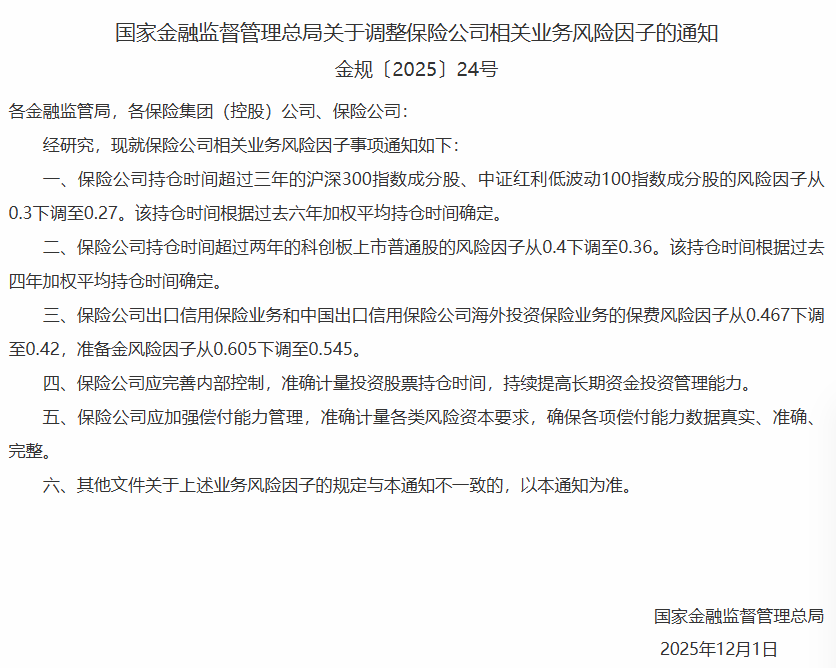
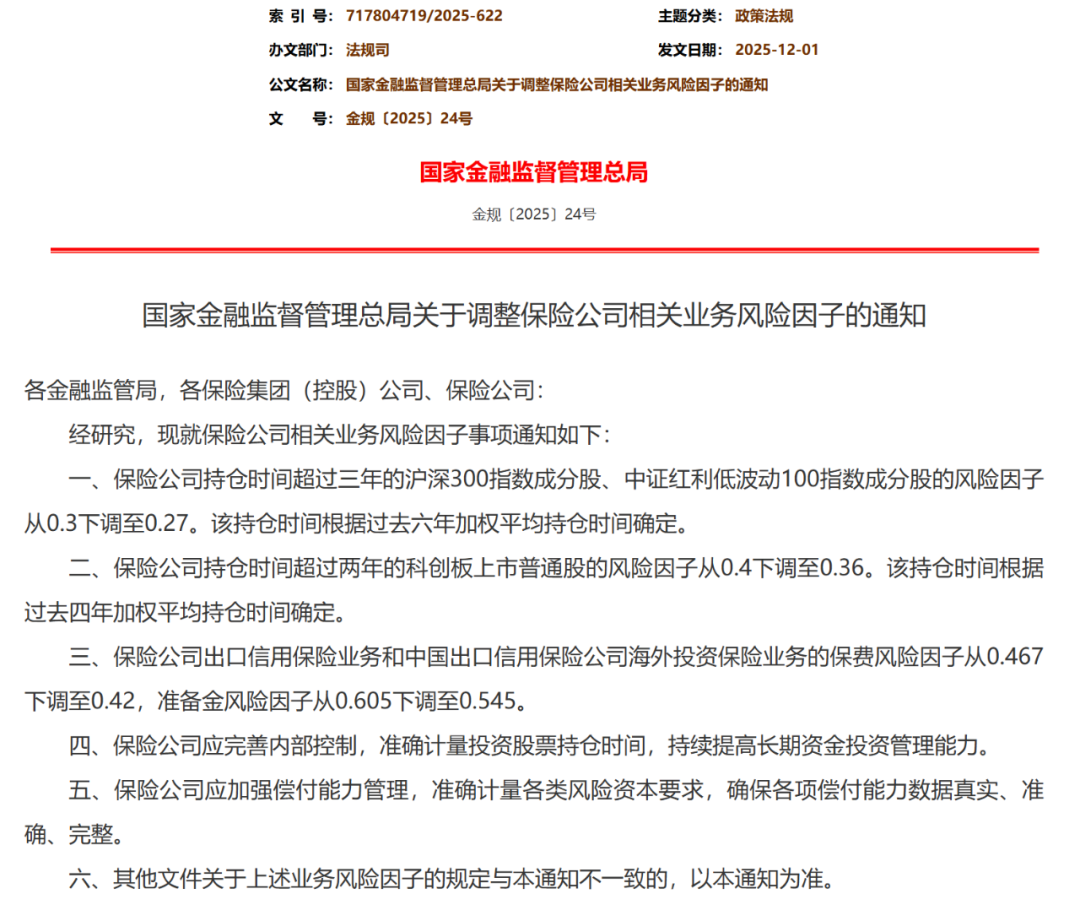
Core Viewpoint - The National Financial Regulatory Administration has announced a second reduction in risk factors for insurance companies' related business, enhancing the capital efficiency of equity asset allocation, thereby continuously opening up space for insurance capital to enter the market [1][4]. Group 1: Regulatory Adjustments - The adjustment includes a reduction in risk factors for long-term holdings of stocks in the CSI 300 Index and the CSI Dividend Low Volatility 100 Index from 0.3 to 0.27 [1]. - The risk factor for common stocks on the Sci-Tech Innovation Board has been lowered from 0.4 to 0.36 [1]. - The risk factors for premiums and reserves in export credit insurance have also been reduced [1]. Group 2: Impact on the Real Economy - The notification aims to support the real economy by differentiating risk factors based on holding periods for investments in the CSI 300 Index, CSI Dividend Low Volatility 100 Index, and Sci-Tech Innovation Board stocks, fostering patient capital and supporting technological innovation [4]. - The adjustments in risk factors for export credit insurance and overseas investment insurance are intended to encourage insurance companies to increase support for foreign trade enterprises, effectively serving national strategies [4].

国家金融监督管理总局:风险因子根据持仓时间进行了差异化设置,以培育壮大耐心资本
Xin Lang Cai Jing· 2025-12-05 07:45
Core Viewpoint - The Financial Regulatory Bureau has issued a notification to adjust risk factors related to insurance companies' business, aiming to enhance long-term investment management and better serve the real economy [1][7]. Group 1: Background of the Notification - The notification was introduced to effectively prevent risks, guide insurance companies in improving long-term investment management capabilities, and strengthen asset-liability matching management [2][8]. - The goal is to enhance the role of insurance capital as patient capital and to support the sustainable and stable operation of insurance companies [2][8]. Group 2: Impact on the Insurance Industry - The notification differentiates risk factors for investments in the CSI 300 Index, the China Securities Dividend Low Volatility 100 Index, and stocks listed on the Sci-Tech Innovation Board based on holding periods, promoting the growth of patient capital and supporting technological innovation [3][9]. - Adjustments were made to the premium risk factors and reserve risk factors for export credit insurance and overseas investment insurance, encouraging insurance companies to increase support for foreign trade enterprises and effectively serve national strategies [3][9]. Group 3: Holding Period Calculation - For example, the holding period for stocks listed on the Sci-Tech Innovation Board is calculated using a first-in-first-out principle, with a weighted average method applied to the past four years of holding time [4][10]. - If the holding period exceeds two years, a risk factor of 0.36 is applicable [4][11]. Group 4: Specific Adjustments to Risk Factors - Adjustments to stock investment risk factors include maintaining the basic factor unchanged while modifying the characteristic coefficient K2 for stocks held for over three years in the CSI 300 Index and the China Securities Dividend Low Volatility 100 Index, as well as for Sci-Tech Innovation Board stocks held for over two years [5][11]. - Adjustments were also made to the risk factors for export credit insurance and overseas investment insurance, while the relevant characteristic coefficients remain unchanged [5][11]. Group 5: System Adjustments - The insurance company's solvency regulatory information system will be adjusted accordingly to reflect these changes [6][12].
利好来了!国家金融监督管理总局,重磅发布!
Mei Ri Jing Ji Xin Wen· 2025-12-05 07:32
Core Viewpoint - The recent notification from the Financial Regulatory Bureau aims to enhance the solvency regulation standards for insurance companies, promoting the effective use of insurance funds as patient capital to better serve the real economy [1]. Group 1: Adjustments to Risk Factors - The risk factor for stocks held by insurance companies for over three years in the CSI 300 Index and the CSI Dividend Low Volatility 100 Index has been reduced from 0.3 to 0.27 [2]. - The risk factor for ordinary shares listed on the Sci-Tech Innovation Board held for over two years has been decreased from 0.4 to 0.36 [2]. - The premium risk factor for export credit insurance and overseas investment insurance by the China Export & Credit Insurance Corporation has been lowered from 0.467 to 0.42, while the reserve risk factor has been adjusted from 0.605 to 0.545 [3]. Group 2: Management and Compliance - Insurance companies are required to improve internal controls to accurately measure the holding period of investment stocks and continuously enhance their long-term capital investment management capabilities [4]. - There is an emphasis on strengthening solvency management, ensuring accurate measurement of various risk capital requirements, and guaranteeing that solvency data is true, accurate, and complete [5]. - Any previous documents that conflict with the current notification regarding the aforementioned business risk factors will be superseded by this notification [6].
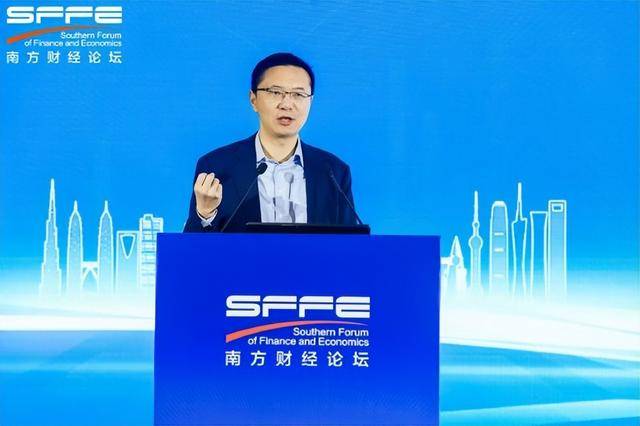
清华大学五道口金融学院副院长田轩:支持科技创新,创投市场需要耐心资本,需包容像马斯克一样的疯子与天才
Sou Hu Cai Jing· 2025-12-05 04:53
Core Viewpoint - The South Finance Forum 2025 emphasizes the need for a more inclusive venture capital market and a less aggressive secondary market to support technological innovation and achieve high-level self-reliance in technology [1][3]. Group 1: Venture Capital Market - A more inclusive venture capital market is necessary, which requires acceptance of diverse entrepreneurial traits, including those that may be seen as negative, such as being eccentric or difficult to work with [3]. - The characteristics of "super entrepreneurs" are essential for innovation, as they often think outside the box and drive technological advancements [3]. - The current venture capital market in China is characterized by a shorter fund lifespan of approximately 5-7 years compared to the 10-12 years typical in the U.S., limiting the ability to invest in early-stage and high-risk projects [3][4]. Group 2: Limited Patience Capital - The composition of Limited Partners (LPs) in China has shifted from individual investors to state-owned entities, which tend to be more risk-averse due to concerns over state asset preservation [4]. - The lack of "patient capital" in China's venture capital landscape hinders the ability to support early-stage investments necessary for technological innovation [4]. Group 3: Secondary Market - A less aggressive secondary market is needed, characterized by strong anti-takeover provisions, limited stock liquidity, a focus on long-term institutional investors, fewer analysts tracking stocks, and less frequent information disclosure [4]. - The combination of a more inclusive venture capital market and a less aggressive secondary market is essential for leveraging technology and finance to support innovation and achieve technological self-reliance [4].
清华大学五道口金融学院副院长田轩:支持科技创新,创投市场需要耐心资本,需包容像马斯克一样的“疯子与天才”
Sou Hu Cai Jing· 2025-12-05 04:35
Core Viewpoint - The South Finance Forum 2025 emphasizes the need for a more inclusive venture capital market and a less aggressive secondary market to support technological innovation and achieve high-level self-reliance in technology [1][3]. Group 1: Venture Capital Market - A more inclusive venture capital market is necessary, which should be open to diverse entrepreneurs, including those with unconventional traits that drive innovation [3]. - The characteristics of "super unicorn" entrepreneurs often include traits that are typically seen as negative, such as being eccentric or difficult to work with, which are essential for groundbreaking innovation [3]. - The current structure of venture capital in China, with a typical fund lifespan of "5+2" years, is significantly shorter than the "10+2" model in the U.S., limiting the ability to invest in early-stage and high-risk projects [3][4]. Group 2: Limited Patience Capital - The composition of Limited Partners (LPs) in China has shifted from individual investors to state-owned entities, which tend to be more risk-averse due to concerns over state asset preservation [4][5]. - The lack of "patient capital" in China's venture capital market results in insufficient support for early-stage investments, which are crucial for fostering technological innovation [5]. Group 3: Secondary Market - A less aggressive secondary market is needed, characterized by strong anti-takeover provisions, limited stock liquidity, and a focus on long-term institutional investors [5]. - The secondary market should also have fewer analysts tracking stocks and less frequent information disclosure to create a stable investment environment [5].
清华大学田轩:支持科技创新,创投市场需包容像马斯克一样的“疯子与天才”
Xin Lang Cai Jing· 2025-12-05 04:24
Core Viewpoint - The South Finance Forum 2025 emphasizes the need for a more inclusive venture capital market and a less aggressive secondary market to support technological innovation and achieve high-level self-reliance in technology [1][5]. Group 1: Venture Capital Market - A more inclusive venture capital market is necessary, which should be accommodating to the unique traits of "super unicorn" entrepreneurs, who often possess unconventional characteristics that drive innovation [3][7]. - The current venture capital market in China lacks "patient capital," with fund lifespans averaging 5-7 years compared to the 10-12 years typical in the U.S., limiting investments in early-stage projects [8][9]. - The composition of Limited Partners (LPs) in China has shifted from individual investors to state-owned entities, which, despite being patient capital, exhibit risk-averse behavior due to concerns over state asset preservation [4][9]. Group 2: Secondary Market - The secondary market in China needs to be less aggressive, requiring strong anti-takeover provisions, reduced stock liquidity, and a focus on long-term institutional investors [4][9]. - There should be fewer analysts tracking stocks and less frequent information disclosure to create a more stable investment environment [9]. - A combination of a more inclusive venture capital market and a less aggressive secondary market is essential for leveraging technology and financial power to support innovation [4][9].
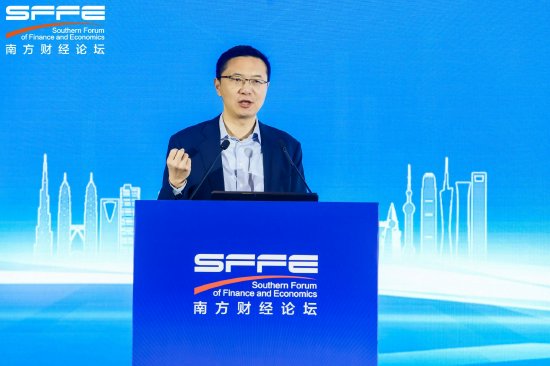
资本市场如何推动科技创新?清华大学田轩:需要“更加包容”的创投市场与“不太积极”的二级市场
Xin Lang Cai Jing· 2025-12-05 04:19
Core Viewpoint - The South Finance Forum 2025 emphasizes the need for a more inclusive venture capital market and a less aggressive secondary market to support technological innovation and achieve high-level self-reliance in technology [1][5]. Group 1: Venture Capital Market - A more inclusive venture capital market is necessary, which should be accommodating to the unique traits of "super unicorn" entrepreneurs, who often possess unconventional characteristics that drive innovation [3][7]. - The current venture capital market in China lacks "patient capital," with fund durations averaging 5-7 years compared to the 10-12 years typical in the U.S., limiting investments in early-stage projects [8][9]. - The composition of Limited Partners (LPs) in China has shifted from individual investors to state-owned entities, which tend to be risk-averse and less willing to invest in early-stage ventures due to concerns over state asset preservation [4][9]. Group 2: Secondary Market - The secondary market in China needs to be less aggressive, requiring strong anti-takeover provisions, reduced stock liquidity, and a focus on long-term institutional investors [4][9]. - There should be fewer analysts tracking stocks and less frequent information disclosure to create a more stable investment environment [9].
清华大学田轩:LP结构导致中国缺乏真正的“耐心资本”
Xin Lang Cai Jing· 2025-12-05 04:19
Core Viewpoint - The South Finance Forum 2025 emphasizes the need for a more inclusive venture capital market and a less aggressive secondary market to support technological innovation and achieve high-level self-reliance in technology [1][5]. Group 1: Venture Capital Market - A more inclusive venture capital market is necessary, which should be open to diverse entrepreneurs, including those with unconventional traits that drive innovation [3][7]. - The characteristics of "super unicorn" entrepreneurs often include traits that are typically seen as negative, such as being eccentric or difficult to work with, which are essential for groundbreaking innovation [3][7]. - The current venture capital market in China lacks "patient capital," with fund lifespans averaging 5-7 years compared to the 10-12 years typical in the U.S., limiting investments in early-stage projects [8][9]. Group 2: Limited Partners (LPs) - The composition of LPs in China has shifted from individual investors to state-owned entities, which, while inherently patient, are often risk-averse due to concerns over state asset preservation [4][9]. - The risk-averse nature of state-backed venture capital institutions leads to insufficient support for early-stage investments, hindering technological innovation [4][9]. Group 3: Secondary Market - A less aggressive secondary market is needed, characterized by strong anti-takeover provisions, limited stock liquidity, a focus on long-term institutional investors, fewer analysts tracking stocks, and less frequent information disclosure [4][9]. - The combination of a more inclusive venture capital market and a less aggressive secondary market is essential for leveraging technology and finance to support innovation and achieve technological self-reliance [4][9].
刚刚,吴清对私募股权和创投基金重磅发声
母基金研究中心· 2025-12-05 03:14
Core Viewpoint - The article emphasizes the importance of private equity and venture capital funds in supporting innovation and the need for a more inclusive and adaptable capital market system in China [2][3]. Group 1: Support for Private Equity and Venture Capital - The article highlights the Chinese Securities Regulatory Commission's (CSRC) recognition of the significant role of private equity and venture capital funds, indicating a favorable signal for the entire fundraising, investment, management, and exit chain [2]. - CSRC Chairman Wu Qing has stressed the necessity for larger and more patient capital investments to support new industries and business models, which aligns with the characteristics of private equity and venture capital [2][3]. - The focus on "patient capital" is crucial, as it refers to capital that can provide long-term support and is tolerant of risks and failures, which is essential for the long cycles and uncertainties associated with technological innovation [3][4]. Group 2: Development of Patient Capital - The article discusses the need to cultivate and expand patient and long-term capital, addressing the bottlenecks in the fundraising, investment, management, and exit processes of private equity funds [3]. - It mentions that the current investment return logic does not align with the typical five to two-year fund duration, necessitating a shift towards longer-term investment strategies [4]. - The role of state-owned limited partners (LPs) is highlighted as a key player in building patient and long-term capital in China [4]. Group 3: Policy Environment and Support - Since 2024, the policy environment for the venture capital industry has seen significant improvements, with the government increasingly supporting the sector through various measures [6]. - The article references multiple government initiatives aimed at promoting venture capital, including the "17 Measures for Promoting High-Quality Development of Venture Capital" and the emphasis on developing patient capital in the Central Economic Work Conference [6][8]. - The establishment of a national venture capital guidance fund is expected to mobilize nearly 1 trillion yuan in local and social capital, further enhancing the venture capital landscape [11].

申万宏源杨成长:以培育耐心资本为核心的政府投行招商模式
申万宏源证券上海北京西路营业部· 2025-12-05 02:37
Core Viewpoint - The article emphasizes the importance of enhancing the evaluation mechanism for local funds and improving the tolerance for investment losses to better leverage government funds in supporting foundational research, common technology breakthroughs, and future industry development [1][3]. Group 1: Government Fund Utilization - Local governments are increasingly establishing industrial and guiding funds to attract emerging industries and quality enterprises through equity investment and project recruitment [3]. - The effective interaction between local equity investment and attracting investment is still limited, necessitating further exploration of the government investment banking model [3]. - Key factors for developing the government investment banking model include enhancing the risk investment role of government funds and introducing market-oriented professional management institutions to attract more market funds [3][4]. Group 2: Major Project and Industry Chain Development - Government funds should play a leading role in promoting major projects and industry chain development, focusing on core and weak links within the industry chain [4]. - Local governments need to identify key industries for support and prioritize funding for leading enterprises and critical projects, especially in areas where social capital is hesitant to invest [4][5]. Group 3: Traditional and Emerging Industry Coordination - There is a need for a comprehensive industrial development philosophy that promotes the transformation of traditional industries while also fostering emerging and future industries [5][6]. - Investments should not only target new and early-stage projects but also enhance traditional industries through technological upgrades and digital transformation [5][6]. Group 4: Hefei's Experience in Government Investment Banking - Hefei has adopted a government investment banking approach to attract strategic emerging industries, resulting in a cluster effect by linking capital with industry [7][8]. - The city has established a risk tolerance and accountability mechanism to encourage investment, allowing for a loss tolerance of 15% to 50% for different fund types [8]. - Hefei's "Creative Investment City" initiative aims to shift from government-led investment to attracting proactive capital, linking over 200 funds with a total scale of 400 billion yuan [9].