
创新

Search documents
Graphic Packaging(GPK) - 2025 Q3 - Earnings Call Transcript
2025-11-04 16:00
Financial Data and Key Metrics Changes - Graphic Packaging's sales for Q3 2025 were $2.2 billion, with adjusted EBITDA of $383 million and an adjusted EBITDA margin of 17.5%. Adjusted EPS was $0.58 [4][10][22] - Year-on-year volumes were down 2%, but the company outperformed most markets served [10][14] Business Line Data and Key Metrics Changes - The innovation platform has opened new markets for paperboard packaging, contributing an additional $52 million in the quarter, roughly 2% of total sales [31] - Food and household products remained steady, while beverage and food service sectors showed weakness [12][18] - Health and beauty, primarily a European business, continued to perform solidly [12] Market Data and Key Metrics Changes - The consumer market has bifurcated, with upper-income consumers spending differently and lower-income consumers cutting back due to rising food prices [10] - Grocery volumes have been impacted, with CPG customers timing purchases to manage cash, leading to less predictable order flows [10][12] Company Strategy and Development Direction - The Waco facility is a critical investment that enhances supply chain efficiency and reduces waste, expected to ramp up to full production in 12-18 months [8][9] - The company is transitioning from Vision 2025 to Vision 2030, focusing on free cash flow generation [8][22] - Graphic Packaging aims to leverage its competitive advantages in innovation, cost efficiency, and quality to drive long-term growth [22][29] Management's Comments on Operating Environment and Future Outlook - Management acknowledged the challenging consumer packaging environment but expressed confidence in improving margins as demand normalizes [23][25] - The company is focused on controlling costs and inventory, with plans to further reduce SG&A expenses [24][25] - Management expects a significant free cash flow inflection in 2026, targeting $700-$800 million [26][28] Other Important Information - The company repurchased approximately 6.8 million shares year-to-date, reducing shares outstanding by 2.3% in 2025 [23] - The Waco facility's startup costs are estimated at $65-$75 million, with two-thirds incurred in 2025 and one-third in 2026 [46][54] Q&A Session Summary Question: Did the end markets track as expected, and what about share shifts due to bleached board conversion? - Management clarified that there was no share loss; customer purchasing patterns affected volumetric performance, with innovation helping to outperform challenges [31] Question: Confidence in Waco's EBITDA contribution for next year? - Management expressed high confidence in Waco delivering the expected $80 million EBITDA contribution [32] Question: Opportunities for further productivity improvements? - Management highlighted the focus on cost control and efficiency, with a return to normalized CapEx expected to generate significant free cash flow [35] Question: Trends in the food service market? - Management noted that fast casual dining is under pressure, while quick service restaurants are gaining traction, with innovation expected to support volume growth [39] Question: Impact of competitive price pressure on SBS and CUK? - Management confirmed no share loss and emphasized the cost advantages of coated recycled paperboard over bleached alternatives [41] Question: Update on Pacesetter Rene Premium CRB and pricing? - Management indicated that while Rene is a competitive product, pricing may be impacted by market dynamics, but they have the capabilities to manage this [49] Question: Expectations for year-end leverage? - Management projected a net debt range of 3.5-3.7 times by year-end, influenced by reduced EBITDA and share repurchases [50]

“剧透”来了 今年进博会有哪些特色和亮点?
Yang Shi Xin Wen· 2025-11-04 06:41
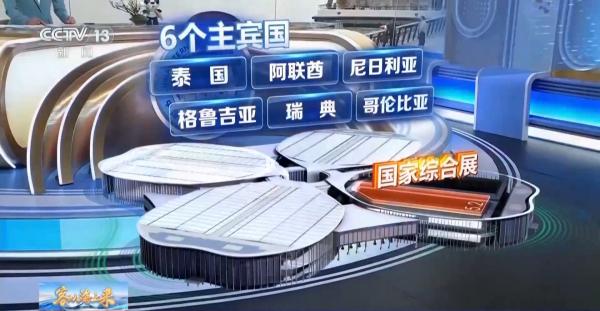
Core Points - The 8th China International Import Expo (CIIE) will officially open on November 5, showcasing new products and technologies from around the world, facilitating interactions between exhibitors and buyers, and promoting open cooperation and mutual benefits [1] Group 1: Event Overview - A total of 4,108 foreign enterprises will participate in the expo, covering an exhibition area of over 430,000 square meters, marking a new record in scale [2] - The national exhibitions will feature six guest countries: Thailand, UAE, Nigeria, Georgia, Sweden, and Colombia [4] - The enterprise exhibition will include six major sectors: medical devices and healthcare, automotive and smart mobility, technology equipment, consumer goods, agricultural products, and service trade, along with an innovation incubation area [6] Group 2: Participation and Innovation - This year's enterprise exhibition area exceeds 367,000 square meters, with over 600 new participating companies compared to last year, including 290 Fortune 500 and industry-leading firms, achieving historical highs in both exhibition area and total number of companies [8] - The expo will showcase 461 new products, technologies, and services, with nearly half being global debuts [14] Group 3: Highlights and Themes - The expo reflects China's commitment to high-level opening up, with participation from 155 countries, regions, and international organizations, and the U.S. maintaining the largest exhibition area for seven consecutive years [11] - The event will feature innovative themes, such as the "CIIE Sports Park" in the consumer goods sector, aimed at promoting sports consumption through interactive experiences [14] - Over 80 supporting activities will be held, including trade negotiations and investment promotion, fostering deeper cooperation between China and foreign localities [16]

资金逢低布局意图明显!医疗器械ETF(562600)单日吸金超千万
Mei Ri Jing Ji Xin Wen· 2025-11-04 02:15
Group 1 - The A-share market showed a rebound with all three major indices turning positive, with the Shanghai Composite Index rising by 0.55% at the close [1] - The medical device sector maintained a volatile trend, with the medical device ETF (562600) slightly declining by 0.11% but attracting over 10 million in net inflows for the day, marking five consecutive trading days of net inflows totaling over 30 million, which accounted for 40% of the trading volume, indicating a clear intention of capital to buy on dips [1] - The Beijing Inclusive Health Insurance for 2026 was announced, highlighting a continuous increase in insured individuals over the past four years, with a cumulative total exceeding 15 million, and the renewal rate rising from 65% in 2023 to 80% in 2025. The new policy will expand the coverage of innovative drugs outside the medical insurance catalog and increase the reimbursement ratio for special drugs [1] Group 2 - CITIC Securities indicated that the fluctuations in the medical device sector are related to Q3 performance disclosures. In the short term, it is recommended to seize opportunities for performance and valuation recovery in companies expected to improve in 2026, as several leading companies in the medical device sector are anticipated to experience accelerated growth in 2026 [1] - Long-term investment opportunities in the medical device industry stem from innovation, international expansion, and mergers and acquisitions, with the sector's innovation and international capabilities being recognized and valuations undergoing reassessment [1]
看好中国市场创新活力与潜力,辉瑞亮相第八届进博会
Guo Ji Jin Rong Bao· 2025-11-03 15:50
Core Insights - Pfizer is showcasing its commitment to the Chinese market at the 8th China International Import Expo (CIIE) with the theme "Towards the Future with China" [1] - The company emphasizes its alignment with China's 14th Five-Year Plan and the upcoming 15th Five-Year Plan, focusing on innovation and patient care [3][4] - Pfizer's "China 2030 Strategy" aims to accelerate innovation and enhance healthcare accessibility, with significant progress reported in the past year [4][11] Innovation and Product Development - Pfizer's innovative products are expected to benefit over 42 million patients in China by 2024, with a goal of introducing 60 innovative drugs and new indications by 2030 [4] - The company has already achieved over half of this target, with several products receiving NDA approval in China [4] - The global first acute migraine nasal spray, ZavzpretTM, will be showcased at the expo, highlighting Pfizer's commitment to providing new treatment options [5] Collaboration and Ecosystem Development - Pfizer is focused on fostering local scientific innovation and has established partnerships with nearly ten local collaborators in the past year [7][8] - The launch of the Pfizer R&D Open Innovation Center aims to support local partners throughout the drug development process [8] - Strategic agreements, such as the one with 3SBio, enhance Pfizer's oncology pipeline and demonstrate the global competitiveness of local innovations [7] Commitment to Patient Care - Pfizer is dedicated to improving healthcare quality in China, particularly in rural areas, by promoting standardized treatment protocols [11][12] - The company is actively working to ensure that innovative drugs are accessible to patients, collaborating with government and industry partners to reduce medication costs [12] - Initiatives during the expo will focus on enhancing treatment standards for specific patient groups and exploring sustainable patient support ecosystems [12][13]


开放惠全球
Xin Hua She· 2025-11-03 08:13
Group 1 - The 8th China International Import Expo (CIIE) will be held from November 5 to 10 in Shanghai, showcasing China's role in providing stability and certainty in a world filled with uncertainties [1][3] - This year's exhibition area exceeds 367,000 square meters, with over 600 new exhibitors added to last year's 3,496, marking a historical high in both exhibition space and total number of participating companies [1] - A total of 290 Fortune Global 500 and industry-leading companies will participate, highlighting the significance of the event in the global market [1] Group 2 - The expo emphasizes innovation, featuring 461 new products, technologies, and services, with a focus on future industries such as low-altitude economy and humanoid robots [1] - The event aims to foster shared innovation outcomes and showcases advancements in next-generation information technology, artificial intelligence, and green low-carbon sectors [1] - The expo also promotes win-win cooperation, with participation from 123 countries involved in the Belt and Road Initiative, representing a year-on-year increase of 23.1% [3]
中国队在2025年FIRST全球机器人挑战赛获三个奖项
Xin Hua She· 2025-11-03 06:31
新华社巴拿马城11月2日电(记者许咏政)2025年FIRST全球机器人挑战赛10月29日至11月1日在巴拿马 首都巴拿马城举行。中国队在本届赛事中获得了FIRST全球排位赛第三名、FIRST技能挑战赛第三名以 及乌斯塔德·艾哈迈德·拉霍里工程创新奖银牌。 FIRST全球机器人挑战赛是面向14岁至18岁青少年的国际比赛项目,每年举办一次。赛事通过团队协作 搭建机器人,在比赛中利用机器人模拟解决全球性的环境问题。 中国队领队范爽表示,中国队在该项赛事中首次赢得工程创新奖,这表明"中国青少年在创新方面做出 了更杰出的表现"。 本次赛事共颁发20余个奖项,以表彰各支队伍在机器人表现、STEM(科学、技术、工程和数学)推广 以及国际合作等方向的努力。(完) 巴拿马旅游局局长格洛丽亚·德莱昂表示,赛事超越竞技本身,将激励新一代投身科学与机器人事业。 中国队队员在领奖时说,希望将参赛经历分享出去,激励更多中国学生参与机器人赛事。 ...

段永平2025年初对话:回到事情的本源上,很多答案就清楚了
雪球· 2025-11-02 13:00
Group 1 - The article discusses the insights shared by Duan Yongping during a recent talk at Zhejiang University, focusing on investment strategies and personal development in the context of current market trends [3][4]. - Duan emphasizes the importance of long-term thinking in decision-making, whether in learning, entrepreneurship, or investment [6][10]. - He warns against the misuse of AI tools, particularly in academic settings, advocating for a balanced approach to technology [6][9]. Group 2 - Duan highlights the necessity of taking risks that one can afford, suggesting that aspiring investors should not chase quick profits but rather focus on sustainable growth [12][14]. - He asserts that good business models do not lead to low-margin markets, indicating that entrepreneurs should carefully consider their market entry strategies [24][25]. - The discussion includes the importance of understanding the essence of business and making informed decisions based on long-term perspectives [29][30]. Group 3 - Duan addresses the challenges of entrepreneurship, stating that those who are meant to start businesses will do so without needing encouragement, and emphasizes the need for genuine passion in entrepreneurial endeavors [18][36]. - He discusses the impact of economic downturns on young people, suggesting that good companies continue to thrive even in tough times, and advises seeking opportunities in reputable firms [93][95]. - The conversation touches on the global expansion of Chinese companies, with Duan noting that successful globalization often depends on the right timing and product-market fit [97]. Group 4 - Duan critiques the notion of blindly following trends, emphasizing that innovation should be purposeful and address real user needs [51][55]. - He discusses the balance between risk and reward in investment, particularly in high-risk scenarios, advocating for a thorough understanding of the business model before investing [84][90]. - The article concludes with reflections on the nature of value investing, stressing that it is fundamentally about investing in value rather than speculative gains [79][81].





企业即人:人盘活了,事就对了
Sou Hu Cai Jing· 2025-11-02 08:51
Core Viewpoint - The article emphasizes the importance of managing people effectively within organizations to combat internal chaos and ensure growth and success [3][4][8]. Group 1: Recruitment - Companies must upgrade their recruitment processes by hiring individuals who exceed the current average skill level to foster growth [12][13][17]. - Involvement of higher management in the recruitment process is crucial to ensure quality hires [18][21]. - A system should be established where repeated hiring mistakes lead to consequences for managers, promoting accountability [20]. Group 2: Training - Training should focus not only on skills but also on cultivating a culture centered around hard work and ambition [23][24][30]. - Employees should be categorized into self-motivated, supervised, and unmotivated types, with a preference for self-motivated individuals [26][29]. Group 3: Assessment - Performance assessments should be clear and distinct, following a structured scoring system to differentiate between various levels of employee performance [31][32][36]. - The assessment process should aim to help employees improve rather than merely serve as a punitive measure [37][38]. Group 4: Talent Management - Regular talent reviews are essential to ensure that the right individuals are placed in the right positions within the organization [39][40]. - Identifying key personnel, including direct reports and top performers, is critical for organizational success [42][44]. Group 5: Values and Culture - Organizations must adhere to their core values and not compromise on ethical standards, as this can lead to long-term detrimental effects [46][53][54]. - A strong value system is necessary to maintain integrity and prevent corruption within the organization [47][52]. Group 6: Innovation - Companies should foster innovation by allowing new projects to operate independently from the main organization to avoid bureaucratic constraints [59]. - Emphasizing a culture of learning and adaptation is vital for successful innovation [60][62]. Group 7: Continuous Learning - Continuous learning is essential for both individual and organizational growth, encouraging knowledge sharing and collaboration [66][70][72]. - Organizations should create an environment where questions are welcomed and knowledge is freely exchanged to enhance overall effectiveness [71].
【深圳特区报】企业与城市一起拔节生长写在第七届“深圳企业家日”到来之际
Sou Hu Cai Jing· 2025-11-01 00:44
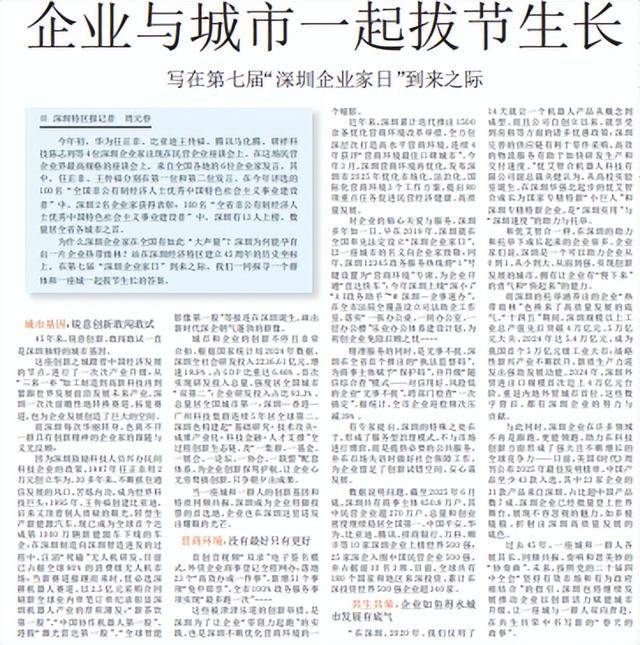
Core Viewpoint - Shenzhen has become a hub for innovation and entrepreneurship, fostering a unique ecosystem that supports the growth of private enterprises and contributes significantly to the national economy [1][4][12]. Group 1: Innovation and Entrepreneurship - Shenzhen's unique urban gene of innovation and risk-taking has driven multiple industrial upgrades over the past 45 years, transitioning from manufacturing to high-tech and future industries [4]. - The city has produced notable entrepreneurs like Ren Zhengfei of Huawei and Wang Chuanfu of BYD, who have successfully navigated industry shifts and established global leadership in their respective fields [6][11]. - Shenzhen's R&D investment reached 223.66 billion yuan in 2024, with a growth rate of 18.9%, accounting for 6.46% of its GDP, marking it as a leader in both total and intensity of R&D investment among Chinese cities [7]. Group 2: Business Environment - Shenzhen has implemented over 1,500 measures to optimize its business environment, earning the title of "Best Business Environment City" for four consecutive years [8]. - The city has introduced innovative practices such as electronic signatures and streamlined business registration processes to facilitate easier market entry for enterprises [8][9]. - As of mid-2025, Shenzhen had 4.508 million business entities, with over 2.7 million being private enterprises, maintaining the highest total and entrepreneurial density in the country [9]. Group 3: Economic Growth and Global Competitiveness - Shenzhen's industrial output surpassed 5 trillion yuan in 2024, making it the first city in China to achieve this milestone, with significant contributions from strategic emerging industries [11]. - The city has seen its foreign trade volume exceed 4 trillion yuan for the first time, reclaiming its position as the leading city for foreign trade in mainland China [11]. - Shenzhen's enterprises are increasingly leading in various sectors, with 31 products from 23 local companies featured in Time magazine's list of the best inventions of 2025, showcasing their global competitiveness [11].
(粤港澳大湾区)截至今年6月粤港澳大湾区有效发明专利达81.7万件
Zhong Guo Xin Wen Wang· 2025-10-31 13:19
Core Insights - The Guangdong-Hong Kong-Macao Greater Bay Area has achieved a total of 817,000 valid invention patents and 8.524 million valid registered trademarks as of June this year, showcasing its strong innovation capabilities [1][2] - The Shenzhen-Hong Kong-Guangzhou cluster has ranked first globally in the World Intellectual Property Organization's 2025 Global Innovation Index, while the Macao-Zhuhai cluster has maintained its position in the top 100 for two consecutive years [1] - The region has seen a significant increase in PCT international patent applications, with 13,500 submissions in the first half of the year, reflecting over a 30% year-on-year growth [1] Summary by Sections Patent and Trademark Statistics - As of June 2023, the Greater Bay Area has 817,000 valid invention patents and 8.524 million valid registered trademarks [1] Global Innovation Ranking - The Shenzhen-Hong Kong-Guangzhou cluster has achieved the top position in the global innovation cluster ranking, while the Macao-Zhuhai cluster remains in the top 100 for the second year [1] International Patent Applications - The region's innovation entities submitted 13,500 PCT international patent applications in the first half of the year, marking a growth of over 30% compared to the previous year [1] Cross-Border Cooperation - Guangdong has established mechanisms for cross-border knowledge transfer and innovation element flow, including the formation of a cross-regional patent conversion cooperation alliance, resulting in 776 instances of patent conversion across the region [1]