
财政赤字

Search documents
美国会机构:“大漂亮”税法将十年让政府赤字增加3.4万亿美元
Hua Er Jie Jian Wen· 2025-07-21 19:13
Core Points - The "Big Beautiful" Act (OBBBA) is projected to increase the U.S. federal deficit by $3.4 trillion over the next decade according to the Congressional Budget Office (CBO) [1][2] - The act is expected to reduce federal revenue by $4.5 trillion and decrease spending by $1.1 trillion by 2034 [1] - The legislation is anticipated to result in approximately 10 million Americans losing their health insurance by 2034 [1] - The CBO's estimates indicate that the deficit increase surpasses previous predictions, and the analysis does not account for potential dynamic effects on economic growth or interest rates [1] Financial Implications - The act is expected to add $3.4 trillion to the already high U.S. government debt, which stands at $36.2 trillion [2] - The act includes a provision to raise the federal debt ceiling by $5 trillion and makes the tax cuts from 2017 permanent [3] - The Medicaid program is projected to face nearly $1 trillion in cuts over the next decade [3] Socioeconomic Impact - The act is controversial due to its potential to increase long-term debt and provide tax cuts primarily benefiting the wealthy and large corporations [3] - The CBO estimates that the act will exacerbate income inequality, with the poorest Americans losing about $1,600 annually while the wealthiest families could see an average income increase of $12,000 [3] - The act's cuts to healthcare and federal assistance are expected to negate any minor tax relief for many families [3] Inflation and Cost of Living - Rising tariffs are contributing to increased prices, which disproportionately affect low-income households [4] - Recent inflation data indicates that costs are rising, particularly impacting essential goods for low-income Americans [4]
日本选举加剧赤字担忧 分析师送上定心丸:两大因素为日债“保驾护航”
智通财经网· 2025-07-21 11:27
在正常情况下,这应该会导致日本债券价格下跌以及收益率上升,因为投资者要求获得更高的回报。日 本债务超过8万亿美元,几乎相当于其经济规模的2.5倍。 尽管日本长期债券收益率一直在上升,但远未达到反映政府挥霍无度的水平。日本30年期债券的收益率 仅为3%。 日元疲软、低利率的遗留影响、日本重回通胀、庞大的国内储蓄以及日本央行政策等因素共同支撑了日 本政府债券收益率。分析人士预计,这种对债券的支持作用还将持续。 三菱日联金融集团高级货币分析师Michael Wan表示:"随着一些提案的提出以及政治动态的变化,未来 可能会有更多人呼吁财政支持,包括消费税。" 但Wan和其他分析师指出,日本过去三年的经济增长以及摆脱通缩,是其债务负担可控且未来几年可能 下降的原因。 凯投宏观亚太区首席经济学家Marcel Thieliant在一份报告中称:"日本的财政状况并没有很多人认为的 那么糟糕。"他表示,尽管日本的债务与国内生产总值(GDP)之比在所有主要经济体中是最高的,但净 债务水平要低得多。 三菱日联金融集团的Wan表示:"与其他国家相比,日本是一个净债权国。因此,理论上来说,日本拥 有大量闲置资金,这些资金来自本土机构的 ...
瑞达期货贵金属产业日报-20250721
Rui Da Qi Huo· 2025-07-21 10:06
1. Report Industry Investment Rating - No relevant content provided 2. Core Viewpoints of the Report - The precious metals market may continue to fluctuate within a range in the short - term. The increase in tariffs by Trump has raised corporate costs, and if the tariff scope expands or negotiations fail, it will accelerate inflation and strengthen the inflation - hedging property of gold. Although the market focuses on the September interest rate cut expectation, the core inflation has not continuously heated up, and the real interest rate is difficult to decline, so the gold price may be trapped in a range - bound oscillation in the short - term. In the long - term, the transmission of tariffs to the end - user will increase inflation stickiness, and the recovery of easing expectations will be beneficial to the gold price. The expansion of the US fiscal and trade double deficits and the protracted frictions will weaken the US dollar's credit and support the central bank's gold - buying demand. It is recommended to buy gold on dips and be cautious about the correction risk of silver [2] 3. Summary by Relevant Catalogs 3.1 Futures Market - The closing price of the Shanghai gold main contract is 781.7 yuan/gram, with a month - on - month increase of 4.68; the closing price of the Shanghai silver main contract is 9271 yuan/kg, with a month - on - month decrease of 2. The main contract positions of Shanghai gold are 211,239 lots, with a month - on - month increase of 8952; the main contract positions of Shanghai silver are 467,534 lots, with a month - on - month decrease of 12,142. The net positions of the top 20 in the Shanghai gold main contract are 147,538 lots, with a month - on - month increase of 4931; the net positions of the top 20 in the Shanghai silver main contract are 135,033 lots, with a month - on - month decrease of 8235. The warehouse receipt quantity of gold is 28,857 kg, with no change; the warehouse receipt quantity of silver is 1,204,466 kg, with a month - on - month decrease of 6610 [2] 3.2 Spot Market - The spot price of gold on the Shanghai Non - ferrous Metals Network is 775.7 yuan/gram, with a month - on - month increase of 4; the spot price of silver is 9200 yuan/kg, with a month - on - month increase of 31. The basis of the Shanghai gold main contract is - 6 yuan/gram, with a month - on - month decrease of 0.68; the basis of the Shanghai silver main contract is - 71 yuan/kg, with a month - on - month increase of 33 [2] 3.3 Supply and Demand Situation - The gold ETF holdings are 948.5 tons, with a month - on - month decrease of 2.29; the silver ETF holdings are 14,694.95 tons, with a month - on - month decrease of 124.34. The non - commercial net positions of gold in CFTC are 202,968 contracts, with a week - on - week increase of 988; the non - commercial net positions of silver in CTFC are 58,521 contracts, with a week - on - week decrease of 4879. The total supply of gold in the quarter is 1313.01 tons, with an increase of 54.84; the total annual supply of silver is 987.8 million troy ounces, with a decrease of 21.4. The total demand for gold in the quarter is 1313.01 tons, with an increase of 54.83; the global total annual demand for silver is 1195 million ounces, with a decrease of 47.4 [2] 3.4 Option Market - The 20 - day historical volatility of gold is 11.25%, with a month - on - month increase of 0.14; the 40 - day historical volatility of gold is 11.21%, with a month - on - month increase of 0.11. The implied volatility of at - the - money call options for gold is 19.24%, with a month - on - month decrease of 1.26; the implied volatility of at - the - money put options for gold is 19.24%, with a month - on - month decrease of 1.28 [2] 3.5 Industry News - An informed source said that US Treasury Secretary Bessent privately advised President Trump not to try to fire Federal Reserve Chairman Powell. Bessent believes that apart from the overall economic factors, Fed officials have signaled that they may cut interest rates twice by the end of the year. The US House of Representatives passed the 2026 fiscal year defense appropriation bill with 221 votes in favor and 209 against, with a total amount of about $832 billion. President Trump posted on social media that three Iranian nuclear facilities had been "completely destroyed". US Treasury Secretary Bessent, who is visiting Japan, said that the two countries could reach a "good" trade agreement, but hinted that the process might take more time. The probability that the Fed will keep interest rates unchanged in July is 95.3%, and the probability of a 25 - basis - point rate cut is 4.7%. The probability that the Fed will keep interest rates unchanged in September is 39.3%, the probability of a cumulative 25 - basis - point rate cut is 58%, and the probability of a cumulative 50 - basis - point rate cut is 2.7% [2]
“大而美”法案下的多重撕裂镜像
Di Yi Cai Jing· 2025-07-20 12:40
Group 1: Economic Growth and Tax Policy - The "Big and Beautiful" Act significantly reduces corporate tax rates from 35% to 21%, allowing for immediate tax deductions on qualified production property and extending other tax incentives for business investments [2] - The Act aims to stimulate economic growth by increasing the actual GDP growth rate by 3% and creating over 7 million jobs, particularly benefiting small businesses and innovation [3][4] - However, the sustainability of economic growth from tax cuts is questionable, with potential diminishing returns and strict time limits on personal income tax reductions [4] Group 2: Fiscal Deficit and Government Spending - The Act plans to cut at least $1.5 trillion in spending over the next decade, primarily targeting social welfare programs to offset the increased fiscal deficit caused by tax cuts [5][6] - The projected increase in government deficit due to tax cuts is estimated at $4.5 trillion over the next ten years, raising concerns about the government's ability to manage its debt [6][7] - The Act raises the debt ceiling by $5 trillion, leading to an accelerated expansion of U.S. debt, with projections indicating a debt-to-GDP ratio increase from 122% to over 125% [7][8] Group 3: Social Welfare and Income Distribution - The Act proposes significant cuts to social welfare programs, including nearly $1 trillion from Medicaid, which may disproportionately affect low-income individuals while favoring wealthier taxpayers [10][11] - The changes in tax policy are expected to exacerbate income inequality, with lower-income groups facing net losses while higher-income groups benefit from substantial tax reductions [11][12] - The cancellation of renewable energy tax credits may lead to increased energy costs, further straining low-income households already affected by welfare cuts [12]
6张图,看清我们身处的经济拐点
虎嗅APP· 2025-07-20 09:24
Core Viewpoint - The article discusses the current economic turning point, highlighting the failure of traditional economic theories and the implications of persistent fiscal deficits in the U.S. economy, which affect asset prices and investment strategies [3][4]. Group 1: Fiscal Deficit Expansion - The U.S. fiscal deficit has historically aligned with economic cycles, expanding during recessions and contracting during recoveries. However, since 2017, this pattern has broken down, with the deficit continuing to grow even as unemployment rates decline [6][7][8]. - The current fiscal deficit has reached 7% of GDP, indicating a shift where the government no longer relies on economic downturns to trigger fiscal expansion [8][10]. Group 2: Unusual Gold Market Dynamics - The article emphasizes the importance of the U.S. fiscal deficit on asset prices, particularly high-scarcity assets like gold and Bitcoin. Traditionally, rising real interest rates would lead to falling gold prices, but since 2022, gold prices have increased despite rising rates [12][13][14]. - This shift suggests a new market environment driven by fiscal policy rather than traditional monetary policy, where the focus is on the sustainability of credit and fiscal control [13][14]. Group 3: Federal Reserve's Ineffective Rate Control - The article outlines a transition from a market-driven credit expansion model to a fiscal-driven one, where government debt growth outpaces private sector borrowing. This change has rendered traditional monetary policy tools, like interest rate adjustments, ineffective [16][21][22]. - As government debt exceeds 100% of GDP, attempts to raise interest rates lead to increased fiscal interest payments, further exacerbating the deficit [22][24]. Group 4: Structural Challenges to Fiscal Correction - The article discusses the structural issues preventing timely government intervention to correct fiscal imbalances. Since the 1980s, a long-term decline in interest rates has allowed rising debt levels to remain manageable, but with rates now at zero, the situation has become untenable [25][27][28]. - The increasing proportion of interest payments in the federal budget creates a vicious cycle, where rising deficits lead to higher interest costs, further straining fiscal resources [32][34]. Group 5: Demographic Changes and Social Security Pressures - The article highlights the impending depletion of the Social Security Trust Fund, which has been primarily funded by the "baby boomer" generation. As this generation retires, the fund will need to draw from general fiscal resources, increasing the deficit [36][41][43]. - The political sensitivity surrounding Social Security reform complicates efforts to address these fiscal challenges, as both major political parties avoid making significant changes to the program [42][43]. Group 6: Debt Dynamics and Systemic Constraints - The article asserts that the current monetary system inherently prevents debt reduction, with total U.S. debt surpassing $100 trillion. Historical data shows that debt levels have only decreased during significant crises, leading to a reliance on continuous debt issuance [45][46][47]. - The systemic nature of the fiat currency and central banking system means that debt expansion is the norm, with limited options for deleveraging without severe economic consequences [47]. Group 7: High Scarcity Assets as a Solution - The article concludes that in the current economic environment, characterized by persistent fiscal deficits and systemic constraints, high-scarcity assets provide a viable alternative for investors seeking stability [49][50]. - These assets operate outside the traditional debt-driven framework, offering a means to hedge against the ongoing fiscal challenges and inflationary pressures [51][52].


关税收入首次超千亿美元!对美国来说,“噩梦”才刚刚开始
Sou Hu Cai Jing· 2025-07-20 02:48
Group 1 - The core viewpoint of the article highlights that the surge in U.S. tariff revenue, which reached $27 billion in June and a total of $113 billion for the fiscal year, ultimately burdens consumers as they bear the cost of these tariffs [1][14] - The increase in tariff revenue has led to a fiscal surplus of $27 billion in June, contrasting with a $71 billion deficit in the same month last year, indicating a potential positive impact of Trump's tariff policies on reducing the fiscal deficit [1][12] - The article discusses the implications of Trump's "America First" policy, suggesting that while it aims to bring jobs and dollars back to the U.S., it may also lead to a decline in U.S. international influence and creditworthiness over time [10][15] Group 2 - The article explains the historical context of globalization and the Bretton Woods system, emphasizing how the U.S. dollar's status as a reserve currency has evolved and the challenges it faces, particularly the Triffin Dilemma [5][6][7] - It notes that Trump's tariffs can be seen as a form of "dollar tax" on the global economy, which may not be sustainable in the long run as it could provoke resistance from other countries [8][10] - The article points out that while tariffs may provide short-term revenue benefits, they ultimately lead to increased costs for American consumers, as importers pass on the tariff costs [12][14]
美国信用评级下降,900亿国债受影响,中国先见之明提早拿下一局
Sou Hu Cai Jing· 2025-07-19 10:39
Core Viewpoint - Fitch Ratings unexpectedly downgraded the U.S. credit rating from "AAA" to "AA", raising concerns in global financial markets about the stability of the U.S. economy and its long-term fiscal health [1][10]. Economic Factors - The downgrade is attributed to the rising fiscal deficit and national debt, which have exceeded the country's GDP, posing significant challenges to the stability and debt repayment capacity of the U.S. government [5][12]. - Political polarization and policy uncertainty have further complicated economic management, hindering coherent economic policies and potentially exacerbating fiscal deficits [6][10]. Global Economic Context - Global economic volatility, including trade tensions and geopolitical conflicts such as the Russia-Ukraine war, poses additional risks to the U.S. economy and fiscal situation [8][10]. Market Reactions - Following the downgrade, U.S. stock markets experienced significant declines, and there was a notable lack of interest in a recent issuance of over $90 billion in U.S. Treasury bonds, indicating waning investor confidence [12][14]. - Countries, particularly China, have begun to sell off U.S. Treasury bonds, which could increase borrowing costs for the U.S. government and signal a shift in global investment strategies [17][21].
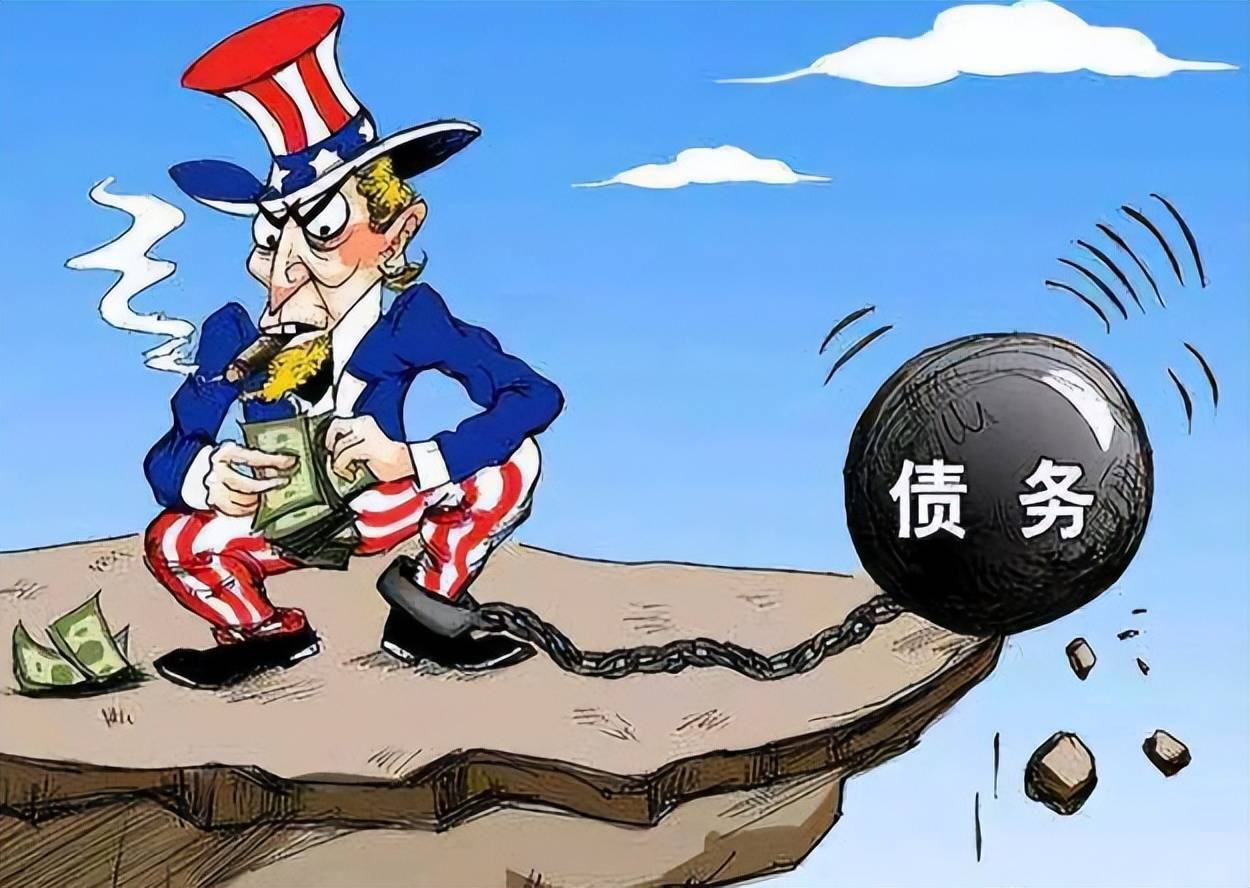
日本参议院选举前夕,对冲基金四个月来首次做空日元
Hua Er Jie Jian Wen· 2025-07-19 03:18
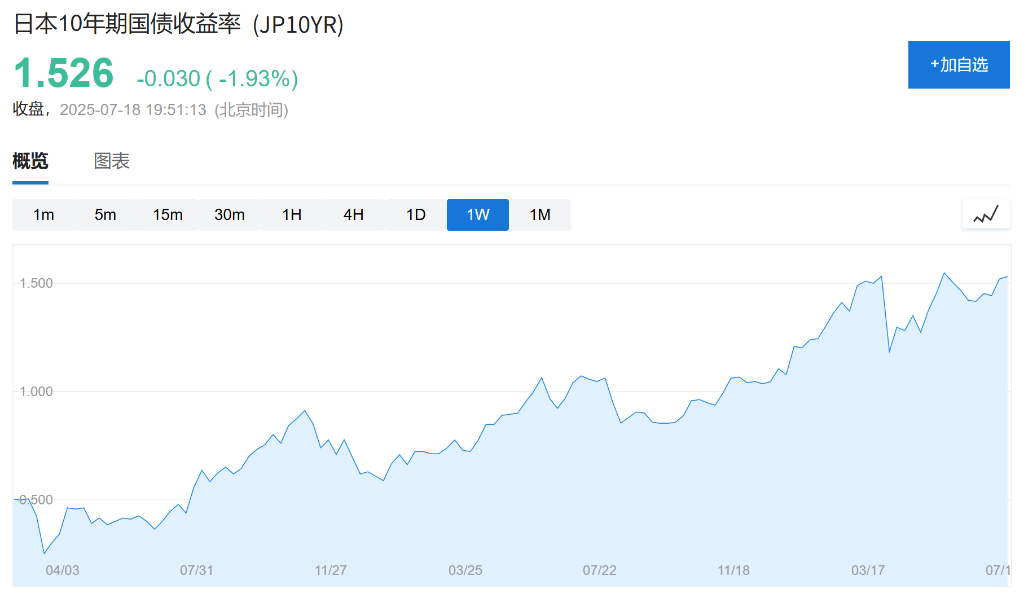
Group 1 - Hedge funds have turned bearish on the Japanese yen for the first time in four months, driven by concerns over the ruling coalition's election prospects and potential negative impacts on Japan's fiscal outlook and economic policy stability [1] - Speculative traders currently hold approximately $1.1 billion in short yen futures and options contracts, totaling around 12,606 contracts, marking the first bearish stance since the end of March [1] - Recent polls indicate that the ruling coalition, consisting of the Liberal Democratic Party (LDP) and Komeito, may struggle to maintain a majority in the upcoming elections, prompting investors to reassess the investment value of the yen and Japanese government bonds [1] Group 2 - Wall Street strategists generally have a pessimistic outlook on the yen's performance post-election, with Wells Fargo's currency strategy team suggesting that a defeat for the LDP could lead to increased fiscal spending and larger budget deficits, putting pressure on long-term Japanese government bonds [2] - If the opposition party wins, the yen is expected to weaken further, potentially reaching 150 yen per dollar [2] - Analysts from TD Securities noted that previous long positions on the yen appeared excessive and fragile, predicting continued pressure on the yen in the short term [5] Group 3 - Concerns over fiscal prospects ahead of the elections and ongoing uncertainties regarding tariffs imposed by the Trump administration have exerted pressure on both Japanese bonds and the yen [6] - The sell-off in Japanese government bonds has spread to the 10-year maturity, with yields reaching their highest level since 2008, close to 1.6%, while 20-year and 30-year bond yields have hit their highest levels since 1999 [6] - The yen has declined approximately 3% in July, following a nearly 10% increase in the first half of the year due to the weakening of the dollar amid the initiation of the U.S.-China trade war [9]
特朗普骂美联储主席鲍威尔“很糟糕”,却又不解雇,为了啥?
Sou Hu Cai Jing· 2025-07-19 03:10
Core Viewpoint - The article discusses the complex dynamics between President Trump and Federal Reserve Chairman Jerome Powell, highlighting Trump's public criticism of Powell while refraining from dismissing him due to legal and political constraints [1][2][15]. Group 1: Trump's Criticism of Powell - Trump has openly criticized Powell, calling him names and expressing dissatisfaction with the Federal Reserve's high interest rates, which he believes are detrimental to the economy [1][3]. - The President's main grievance revolves around the high interest rates, which he argues increase government debt servicing costs significantly, especially with the national debt at $36 trillion [3][7]. - Trump's recent focus on the Federal Reserve's $2.5 billion renovation project is seen as an attempt to create a narrative against Powell, labeling it as wasteful spending [10][11]. Group 2: Legal and Political Constraints - The Federal Reserve operates under strict legal protections, making it difficult for Trump to dismiss Powell without substantial legal justification [1][2]. - Republican figures, including House Financial Services Committee Chairman Hill, have cautioned Trump against attempting to remove Powell, warning of potential legal repercussions and damage to the Fed's independence [2]. - Trump's political maneuvering is complicated by the need to maintain a stable economic environment, as any instability could backfire on his administration [13][15]. Group 3: Economic Implications - The article emphasizes the tension between Trump's push for lower interest rates and the Federal Reserve's mandate to control inflation, which remains above the target [3][5]. - Trump's tax cuts, while aimed at stimulating the economy, have contributed to rising inflation and increased fiscal pressure, complicating the Fed's decision-making [5][15]. - The ongoing debate over interest rates and fiscal policy reflects deeper issues within the U.S. economic governance, highlighting the risks of political interference in monetary policy [15][16].
美国前财长:特朗普施压美联储或引发通胀预期上升 加剧长期借贷成本
智通财经网· 2025-07-17 22:30
Core Viewpoint - Former U.S. Treasury Secretary Lawrence Summers warns that President Trump's attempts to influence the Federal Reserve and push for interest rate cuts could lead to a sharp rise in inflation expectations, increasing long-term borrowing costs and exacerbating fiscal risks [1][2]. Group 1: Interest Rate and Monetary Policy - Summers notes that no mainstream economists support lowering interest rates to 1% in the current environment, suggesting that while it may bring short-term economic benefits, it would create strong inflationary expectations [1]. - The current target range for the Federal Reserve's benchmark interest rate is 4.25% to 4.5%, while Trump has called for a reduction of up to 3 percentage points [1]. - Most Federal Reserve officials have indicated that they will not consider rate cuts until the impact of Trump's new tariff policies on inflation is more clearly assessed [1]. Group 2: Market Reactions and Signals - Summers highlights a recent market reaction to reports of Trump considering dismissing Fed Chair Powell, which led to a drop in 2-year Treasury yields and an increase in 10-year yields, indicating a shift in market expectations towards looser monetary policy [1]. - He warns that the current policy mix from the Trump administration is sowing the seeds of a dangerous vicious cycle, where large fiscal deficits push up long-term borrowing costs, further exacerbating budget deficits [2]. Group 3: Long-term Fiscal Outlook - Summers points out that the bond market is sending concerning signals, with long-term U.S. Treasury yield expectations remaining high, which poses a serious warning for the U.S. medium-term fiscal credibility [2]. - Recent market data shows that the one-year forward yield on 10-year inflation-protected Treasury bonds has recently surpassed 3%, compared to an average of about 2% since 2000 [2]. - The Congressional Budget Office (CBO) has not fully accounted for the high market interest rate expectations in its forecasts for future borrowing costs, indicating that the government will face significant challenges in long-term debt issuance [2]. Group 4: Economic Indicators and Concerns - Summers expresses concern over the U.S. fiscal situation, noting that the dollar index has experienced its largest decline since 1973 in the first half of this year [3]. - Regarding the recent U.S. inflation data for June, Summers indicates that while some indicators rose less than expected, the impact of tariffs on inflation may still be delayed and should not be dismissed [3].