资产证券化

Search documents
白云山:广州医药向兴证资管出售第四次新增基础资产
Zhi Tong Cai Jing· 2025-08-28 09:09
白云山(600332)(00874)发布公告,于2025年8月28日,广州医药与兴证资管根据基础资产买卖协议(第 四期)签订《新增基础资产交割确认函》,确认向兴证资管出售第四次新增基础资产(其为账面值人民币 5.08亿元的应收账款),并收到购买价款人民币5.02亿元。 广州医药通过该等交易项下的交易利用应收账款进行资产证券化,可以将应收账款转变为流动性较高的 现金资产,达到盘活资产存量的目的。鉴于上述原因及本公告所披露的该等交易的条款,董事会认为该 等交易的条款属公平合理,符合集团及公司股东的整体权益。 ...
规模10亿元,票面利率创同主体评级最低
Nan Jing Ri Bao· 2025-08-28 02:04
Core Insights - The national asset securitization market has experienced rapid development this year, with Yangzi Guotou successfully issuing the first data asset-enabled water ABS in China, amounting to 1 billion yuan and achieving a record low interest rate of 2% for the same entity rating in the water ABS sector [1] - The transformation of enterprise data from "resource" to "product" and then to "asset" is a key focus, enabling companies to activate dormant data resources and convert them into tradable capital [2] Group 1 - Yangzi Guotou has positioned itself as a pioneer in the water sector by becoming the first company to list data assets, specifically analyzing water usage behavior data from enterprises in Nanjing, which has been traded on the Nanjing data trading platform [2] - The cash flow security for the ABS is supported by transitioning from traditional experience-driven revenue to data-driven insights, utilizing water usage data as a critical asset [2] - The underlying assets for the ABS are based on water supply revenue rights, with technical support from the Nanjing Digital Financial Industry Research Institute, marking a significant innovation in public utility financing [2] Group 2 - Future plans for Yangzi Guotou include focusing on three main business sectors: financial investment, new city development, and business travel operations, leveraging green low-carbon projects and innovative financial practices [3] - The company aims to deepen the exploration and application of data assets, creating a virtuous cycle of "assets - activation - capital - investment - assets" to contribute to the development of a science and technology innovation financial demonstration zone in Jiangbei New District [3]
企业资产支持证券产品报告(2025年7月):发行节奏放缓,融资成本进一步下行,二级市场活跃度环比下降但同比上升明显
Zhong Cheng Xin Guo Ji· 2025-08-27 09:13
Group 1: Report Overview - The report is titled "Enterprise Asset-Backed Securities Product Report (July 2025)" and is a regular report by Zhongchengxin International [5]. Group 2: Industry Investment Rating - No information provided on industry investment rating. Group 3: Core Viewpoints - In July 2025, the issuance rhythm of enterprise asset-backed securities slowed down, the financing cost further decreased, the secondary market activity decreased month-on-month but increased significantly year-on-year [5]. Group 4: Issuance Situation - In July 2025, 123 enterprise asset-backed securities were issued, with a total issuance scale of 130.342 billion yuan. Compared with the previous month, the number of issuances decreased by 29, and the issuance scale decreased by 2.36%. Compared with the same period last year, the number of issuances decreased by 9, but the issuance scale increased by 20.50% [5][6][22]. - The top five original equity holders in terms of issuance scale were China CITIC Financial Asset Management Co., Ltd., China Railway Capital Co., Ltd., China Railway Trust Co., Ltd., Runze Technology Development Co., Ltd., and Ping An International Financial Leasing Co., Ltd., with a combined issuance scale of 31.425 billion yuan, accounting for 24.11% [7]. - The top five managers in terms of new management scale were CITIC Securities Co., Ltd., CITIC Construction Investment Securities Co., Ltd., Huatai Securities (Shanghai) Asset Management Co., Ltd., Tianfeng (Shanghai) Securities Asset Management Co., Ltd., and Ping An Securities Co., Ltd., with a combined new management scale of 60.789 billion yuan, accounting for 46.64% [10]. - The underlying asset types mainly included accounts receivable, enterprise financial leasing, personal consumer finance, public REITs, and supply chains [5][22]. - The highest single-product issuance scale was 10.01 billion yuan, and the lowest was 0.94 billion yuan. The most issuance orders were in the (5, 10] billion yuan range, with 45 orders and an amount accounting for 27.13% [15]. - The shortest product term was 0.50 years, and the longest was 59.97 years. The most products were in the (1, 3] - year range, with 49 orders and a scale accounting for 27.49% [16][17]. - According to the issuance scale of each level of securities, AAAsf - level securities accounted for 83.22% [17]. - The lowest issuance interest rate of one - year - around AAAsf - level securities was 1.68%, and the highest was 2.58%. The interest rate center was approximately between 1.60% and 1.80%, with the median decreasing by about 30BP month - on - month and about 7BP year - on - year [20]. Group 5: Filing Situation - In July 2025, 153 enterprise asset - backed securities were filed with the Asset Management Association of China, with a total scale of 144.002 billion yuan [5][23]. Group 6: Secondary Market Transaction - In July 2025, enterprise asset - backed securities had 4,309 transactions on the exchange market, with a total transaction amount of 101.986 billion yuan. The number of transactions decreased by 146 month - on - month and increased by 1,236 year - on - year. The transaction amount decreased by 9.09% month - on - month and increased by 50.55% year - on - year [5][24]. - The more active underlying asset types in the secondary market were class REITs, accounts receivable, CMBS, enterprise financial leasing, and supply chains, with transaction amount accounting for 22.49%, 18.87%, 12.43%, 10.77%, and 10.14% respectively [24]. Group 7: August 2025 Maturity Analysis - As of the end of July 2025, 154 outstanding enterprise asset - backed securities were due for repayment in August 2025, with a total scale of 36.4 billion yuan [26]. - The underlying assets of the due securities were mainly accounts receivable, personal consumer finance, supply chains, and policy loan pledges, with due scale accounting for 36.19%, 19.06%, 15.91%, and 11.63% respectively [26]. - China Railway Trust Co., Ltd. had 5 due securities with a repayment scale of 9.08 billion yuan, accounting for 24.95%, and China Pacific Life Insurance Co., Ltd. had 6 due securities with a repayment scale of 4.234 billion yuan, accounting for 11.63% [26].
兆新股份(002256.SZ)2025年上半年营业收入同比增长30% 拟向轻资产运营转型
Xin Lang Cai Jing· 2025-08-27 02:31
Group 1 - The company reported a revenue of 208 million yuan, a year-on-year increase of 29.99%, and a net profit of 3.07 million yuan, with a growth rate of 47.06% [1] - The main business focuses on fine chemicals and new energy, with a strategy to adopt a "light asset operation" model to enhance profitability in the competitive new energy sector [1] - The company aims to transform its existing assets into digital tokens to improve cash flow and operational efficiency, thereby evolving from an "asset holder" to a "comprehensive energy operator" [2] Group 2 - The company implemented a stock incentive plan to enhance internal growth dynamics, linking individual performance with company development [3] - After excluding the impact of share payments, the net profit attributable to shareholders reached 18.65 million yuan, reflecting a significant year-on-year increase of 1120.2% [3] - The incentive plan aims to retain key technical personnel and activate organizational vitality, thereby mitigating the risk of talent loss [3]

河南平美盐化启动IPO!中国平煤神马集团为控股股东
Sou Hu Cai Jing· 2025-08-27 01:36
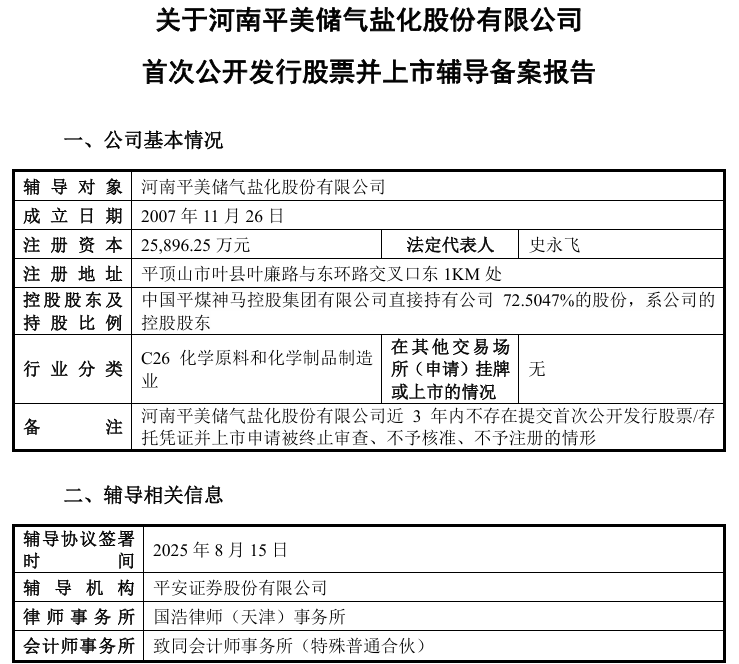
Group 1 - The core point of the news is that Henan Pingmei Storage Salt Chemical Co., Ltd. has initiated the listing guidance process with Ping An Securities as the advisory institution [1][3] - China Pingmei Shenma Group holds 72.5047% of the shares in Pingmei Salt Chemical, making it the controlling shareholder, while Henan Shengying Salt Industry Sales Co., Ltd. holds 27.4953% [1] - The company was established in 2007 with a registered capital of approximately 259 million yuan, and its business scope includes the production of feed additives and non-coal mining resource extraction [3][5] Group 2 - China Pingmei Shenma Group is actively promoting the listing processes of its other subsidiaries, including Pingmei Superhard Materials Co., Ltd., which has initiated the Hong Kong listing process expected to complete by September 2026 [3][4] - The group aims to have 6 to 7 listed companies by the end of the current party committee's term before 2028, currently having 4 listed companies [4] - The group also has 6 companies listed on the New Third Board, accelerating the process of asset capitalization and securities [5]

易点云20250826
2025-08-26 15:02
Summary of the Conference Call for Yidian Cloud Company Overview - Yidian Cloud operates an IT cloud service model that reduces enterprise personnel costs and enhances customer satisfaction and process performance. As of the first half of 2025, the company has over 52,000 active customers, a year-on-year growth of 5%, and service devices totaling 1.48 million, up 11.3% year-on-year. The core customer retention rate is 86%, with a net retention rate close to 97% [2][6]. Financial Performance - In the first half of 2025, Yidian Cloud achieved approximately 700 million yuan in revenue, an 8% increase year-on-year, and a net profit exceeding 50 million yuan, a 67% increase year-on-year. The expected annual net cash retention rate is close to 100%. The gross margin remains stable at 48%-49%, with a sales expense ratio of only 11.6%, significantly lower than the industry average of 30%-40% [2][7]. Growth Strategy - Yidian Cloud plans to expand its market through a grid marketing model, currently covering about 50,000 small and medium-sized enterprises (SMEs) in China, which has a total of approximately 1.5 million SMEs, indicating substantial growth potential. The company expects a 30% annual growth rate in the number of devices over the next five years, driven by grid marketing and improved sales efficiency [2][8][11]. Marketing and Sales Efficiency - The grid marketing strategy, implemented in 2022, involves dividing cities into regions, with each sales representative responsible for 200 core customers with over 50 employees. This strategy has led to a threefold increase in sales efficiency, with each sales representative signing three new core customers per month by the first half of 2025, compared to one per month in 2023 [9][10]. Product Development - In the first half of 2025, Yidian Cloud launched its self-developed AP series workstations to meet the demand for localized deployment of large AI models. The self-developed devices are priced 30% lower than externally sourced counterparts, significantly reducing customer subscription costs [3][13]. Future Product Plans - The company plans to launch its own brand of laptops in 2026, aiming to further increase market share. The self-developed brand is expected to enhance market competitiveness and improve financial metrics, including net profit and gross margin [5][15]. Asset Management and Blockchain Initiatives - Yidian Cloud is actively pursuing the issuance of asset securitization products and exploring tokenization financing through blockchain technology. The company has received preliminary intentions for a 3A credit enhancement from Zhongdai and aims to complete fixed-income financing by the first quarter of the following year [16]. Strategic Partnerships - Yidian Cloud has established a strategic partnership with Huawei to explore hardware promotion and deep participation in the Hongmeng ecosystem. Specific product collaborations are under discussion [18]. Market Demand for AI Solutions - The demand for AI large model solutions among SMEs is still developing, with many companies only beginning to explore localized deployment. However, some clients have made significant purchases, indicating a growing interest in AI solutions [19][20]. Production Capacity and Supply Chain - Yidian Cloud's production capacity includes a remanufacturing factory capable of refurbishing up to 1 million devices annually. The company has secured bulk procurement rights for CPUs from Intel and is collaborating with well-known manufacturers to ensure smooth production [21]. International Expansion Plans - Yidian Cloud's international expansion will occur in stages, starting with the sale of second-hand computers in Southeast Asia. The company plans to establish its brand before expanding its main business overseas, potentially by 2030 [22][23].
ST联合: 国旅文化投资集团股份有限公司简式权益变动报告书(金开资本)
Zheng Quan Zhi Xing· 2025-08-25 17:14
国旅文化投资集团股份有限公司 简式权益变动报告书 上市公司名称:国旅文化投资集团股份有限公司 上市地点:上海证券交易所 股票简称:ST 联合 股票代码:600358 信息披露义务人:南昌金开资本管理有限公司 住所:江西省南昌市南昌经济技术开发区榴云路商业街 A 栋 311 室 通讯地址:江西省南昌市新建区河下路 99 号金赣服务中心 3 号楼南昌经开产业控股集 团有限公司 4 层 权益变动性质:增加(以资产认购上市公司发行的股份) 一、信息披露义务人依据《中华人民共和国公司法》《中华人民共和国证券法》《上 市公司收购管理办法》《公开发行证券的公司信息披露内容与格式准则第 15 号—权益 变动报告书》及相关法律、法规和规范性文件编写本报告书。 二、信息披露义务人签署本报告书已获得必要的授权和批准,其履行亦不违反信息 披露义务人公司章程或内部规则中的任何条款,或与之相冲突。 签署日期:二零二五年八月 信息披露义务人声明 三、依据《中华人民共和国公司法》《中华人民共和国证券法》《上市公司收购管 理办法》及《公开发行证券的公司信息披露内容与格式准则第 15 号—权益变动报告书》 的规定,本报告书已全面披露信息披露义务 ...

融资租赁ABS市场运行稳健,证券兑付情况良好:2025 年融资租赁 ABS 存续期表现
Lian He Zi Xin· 2025-08-25 13:54
Investment Rating - The report indicates a stable performance of the financing lease ABS market with good repayment conditions [2][8]. Core Insights - The financing lease ABS market has shown a positive trend in 2025, with an increase in issuance volume and a decline in issuance rates, reflecting strong support for the real economy and small and micro enterprises [7][39]. - The issuance of financing lease ABS reached 135.88 billion, a year-on-year increase of 13.30%, while the overall asset-backed securities market saw a 22.47% increase [9][8]. - The report highlights the ongoing policy support for small and micro enterprises, which has led to a steady growth in the issuance scale of small micro lease ABS [6][39]. Policy Overview - In the first half of 2025, policies continued to encourage financing lease companies to support the real economy and small and micro enterprises [4]. - The Shanghai Stock Exchange revised guidelines to enhance the efficiency of issuing corporate bonds and asset-backed securities [5]. - A joint announcement from multiple regulatory bodies emphasized measures to support financing for small and micro enterprises, focusing on increasing financing supply and reducing costs [6]. Market Performance - From January to July 2025, the financing lease ABS market saw a total issuance of 140 deals, with a total scale of 135.88 billion, marking a 9.38% increase in the number of deals and a 13.30% increase in scale compared to the previous year [9][8]. - The trading market remains the primary venue for financing lease ABS issuance, accounting for 91.63% of the total issuance scale [12]. - The issuance structure remains stable, with public lease ABS dominating the market [13]. Issuance Rates and Credit Quality - The average issuance rates for AAAsf and AA+sf rated securities were 2.35% and 3.42%, respectively, showing a decline of 46bps and 53bps year-on-year [24]. - The report notes that the asset quality of financing lease ABS has remained stable, with no downgrades in credit ratings during the period [36]. - The proportion of high-rated securities (AAAsf and AA+sf) remains high, accounting for 98.73% of the newly issued financing lease ABS [30]. Future Outlook - The financing lease ABS market is expected to continue expanding, driven by ongoing policy support and increasing financing needs from small and micro enterprises [39]. - The report anticipates that the issuance scale of specific field-marked financing lease ABS will grow, covering a broader range of industries [39]. - The market is likely to see a continued focus on supporting the real economy and promoting industrial upgrades [39].
险资盯上荟聚商场,泰康人寿领投80亿基金“扫货”商业地产
Xin Lang Cai Jing· 2025-08-25 05:45
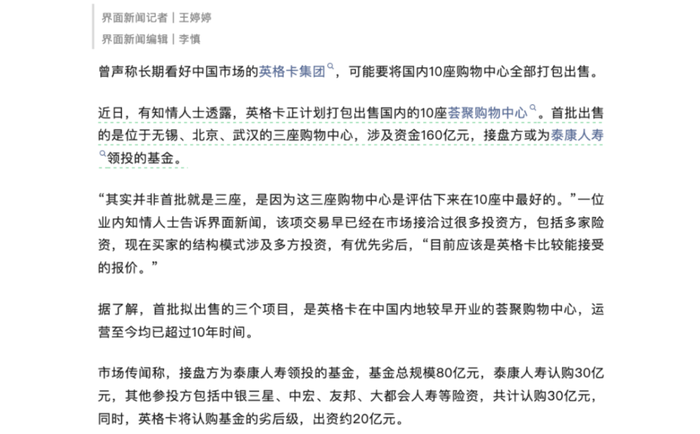
Core Viewpoint - Insurance capital, led by Taikang Life, is increasingly investing in real estate, with a significant transaction involving the sale of 10 shopping centers in China by Ingka Centres, valued at 16 billion yuan [1][4]. Group 1: Investment Trends - Taikang Life is leading an 8 billion yuan fund to acquire three prominent shopping centers in Wuxi, Beijing, and Wuhan, with a total valuation of 16 billion yuan [1][4]. - The fund includes contributions from other major insurers, with Taikang Life investing 3 billion yuan and additional investments from other insurance companies totaling 3 billion yuan [4]. - The overall investment in real estate by Taikang Life has nearly doubled from 22.68 billion yuan in 2020 to 41.08 billion yuan in 2024 [2][8]. Group 2: Strategic Moves - Ingka Group's decision to sell its shopping centers is seen as a strategy to alleviate short-term financial pressure and optimize asset structure [4][9]. - The trend of insurance capital investing in commercial real estate aligns with the need for stable cash flow and potential appreciation, which suits the risk appetite of insurance funds [11][18]. - Taikang Life's strategy includes a shift towards online sales and service, reducing operational costs while expanding its real estate portfolio [15][18]. Group 3: Market Dynamics - The insurance sector has been actively acquiring commercial properties, with significant transactions involving Wanda Plaza and other major assets [10][11]. - From 2022 to 2024, direct investments by insurance companies in China's commercial real estate reached 9.3 billion USD, positioning them as key players in the market [11]. - The ongoing urbanization and economic development in China enhance the attractiveness of commercial real estate for insurance capital [11][18].
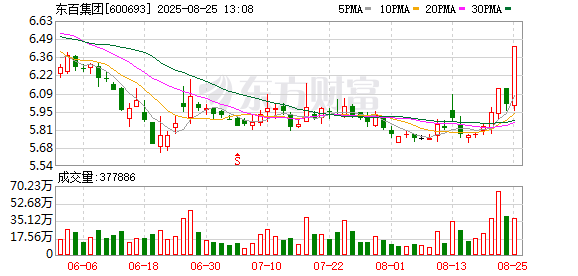
东百集团仓储物流收入增近三成 11个自持项目全部竣工
Zheng Quan Shi Bao Wang· 2025-08-25 05:07
Core Viewpoint - Dongbai Group's logistics segment has shown strong growth, with a main business revenue of 83.48 million yuan, representing a year-on-year increase of 29.52%, becoming a core driver of performance growth [2] Group 1: Business Performance - The company has strategically focused on asset operation efficiency and value release since entering the logistics sector, acquiring 18 logistics projects with a total construction area of approximately 1.8 million square meters [2] - Currently, 11 high-quality logistics projects owned by the company, covering a total area of 1.1 million square meters, have all been completed and are in efficient operation [2] Group 2: Strategic Partnerships and Client Diversification - The company has enhanced its operational efforts by leveraging its synergy with retail business, connecting with over a thousand end commercial clients to meet diverse warehousing needs [2] - Strategic partnerships have been deepened with major players like JD.com, SF Express, SHEIN, and China Post, while also capturing emerging industry opportunities by attracting leading companies in new energy, new retail, and fast-moving consumer goods sectors [2] Group 3: Asset Light Strategy and Future Development - The company has made significant progress in its asset-light strategy, submitting an application for an asset-backed securities plan for its logistics properties, which could enhance asset liquidity and activate existing assets [3] - Dongbai Group aims to continue strengthening its "commercial retail + logistics" strategic synergy, focusing on digital upgrades and innovative consumer scenarios in retail, while promoting full rental operations of existing projects and the establishment of an asset-light platform in logistics [3]