区块链技术

Search documents
诺娃RWA丨加密货币核心三大支柱技术
Sou Hu Cai Jing· 2025-09-29 14:49
Group 1: Core Characteristics of Cryptocurrencies - Cryptocurrencies are characterized by decentralization and anonymity, with no single entity controlling the network and transactions being conducted without revealing personal identities [2] - The security of cryptocurrencies relies on cryptographic technology, specifically the "public-private key pair" system, where the public key serves as a receiving address and the private key is the unique proof of asset ownership [2] - Blockchain technology acts as the underlying ledger for cryptocurrencies, utilizing distributed storage to ensure transaction information is recorded across numerous global nodes, making it both transparent and immutable [2] Group 2: Types of Cryptocurrencies - Native cryptocurrencies, such as Bitcoin and Ethereum, have no specific issuer and their supply is typically predetermined by algorithms, serving as value carriers or transaction fee payments within their respective networks [3] - Stablecoins are pegged to fiat currencies or physical assets, exhibiting minimal price volatility, and are used to mitigate risks associated with the fluctuating cryptocurrency market [3] - Platform tokens are issued by specific blockchain platforms for functional use or governance voting, allowing holders to pay service fees or participate in platform upgrades [3] - Application tokens are designed for specific use cases, with their value dependent on the success and user adoption of the corresponding applications [3] Group 3: Key Risks Associated with Cryptocurrencies - Regulatory risks arise from varying attitudes towards cryptocurrencies across countries, with some nations outright banning their circulation, which can directly impact their legality [2] - Price volatility is a significant concern, with daily fluctuations exceeding 20% being common, influenced by market sentiment and policy changes [4] - Technical risks include vulnerabilities in blockchain technology, such as smart contract flaws and potential hacking incidents, which can lead to asset losses [4]


亦辰集团(08365.HK)拟收购Esperanza Fintech (Commodities...
Xin Lang Cai Jing· 2025-09-29 14:19
Core Viewpoint - Yicheng Group (08365.HK) has announced a conditional agreement to acquire a 2% stake in Esperanza Fintech (Commodities) Limited, which will be paid through convertible bonds at a conversion price of HKD 1.5 per share, marking a strategic move into the digital asset sector [1] Group 1: Acquisition Details - The acquisition agreement was signed on September 29, 2025, with Esperanza Fintech Holdings Limited as the seller [1] - The payment for the acquisition will be made via the issuance of convertible bonds, with a conversion price set at HKD 1.5 per share [1] - This acquisition follows a memorandum of understanding signed on August 18, 2025, indicating a deepening business relationship between the parties involved [1] Group 2: Target Company Overview - Esperanza Fintech operates the proprietary "Espetopia" platform, which integrates institutional-grade compliance with blockchain technology [1] - The team behind Esperanza includes professionals with extensive expertise in financial regulation, including government advisors and licensed digital asset management professionals [1] - Esperanza has a track record of establishing Hong Kong's first regulator-approved tokenized real estate fund, demonstrating its capability to combine traditional finance with innovative tokenization models while adhering to strict regulatory standards [1] Group 3: Strategic Implications - The equity investment aims to support Yicheng Group's ongoing strategy to expand into new revenue sources within the digital asset space [1] - This move is intended to complement the existing financial services business of Yicheng Group [1]
亦辰集团(08365.HK)拟收购Esperanza Fintech (Commodities)2%股本
Ge Long Hui· 2025-09-29 14:14
Group 1 - The core point of the article is that Yicheng Group (08365.HK) has announced a conditional agreement to acquire a 2% stake in Esperanza Fintech (Commodities) Limited, with the payment to be made through convertible bonds at a price of HKD 1.5 per share upon completion [1] - The target company operates the proprietary "Espetopia" platform, which combines institutional-grade compliance with blockchain technology [1] - Esperanza is supported by a team with extensive expertise in financial regulation, including government advisors and professionals holding a digital asset management license from the Securities and Futures Commission [1] Group 2 - The acquisition follows a memorandum of understanding signed on August 18, 2025, indicating a deepening business relationship between the parties [1] - This equity investment aims to support the group's strategy of expanding new revenue sources in the digital asset sector, complementing its existing financial services business [1]
彭波:美英科技协议价值几何
Jing Ji Ri Bao· 2025-09-29 00:21
Core Points - The signing of the "Technology Prosperity Agreement" between the US and UK aims to deepen strategic cooperation in cutting-edge technology fields, including AI, quantum computing, and civil nuclear energy [1][2] - The agreement is expected to help both countries dominate the global AI landscape, with US tech companies committing £31 billion (approximately $42 billion) to enhance the UK's AI infrastructure [1][2] Group 1: Economic and Political Implications - The agreement is seen as a potential economic boost for the UK government, which is facing declining public support, by showcasing its ability to attract foreign investment and develop high-tech industries [2][3] - The Northeast region of England is projected to become a new AI growth area, potentially creating over 5,000 jobs and attracting billions in private investment [2] Group 2: Challenges and Concerns - There are significant disparities in the technological capabilities of the US and UK, with the US holding a dominant position in funding, corporate strength, and market size, which may lead to the UK facing risks of technological dependency [3] - The differing regulatory and ethical standards between the two countries could pose challenges for the implementation of the agreement, particularly in areas like data flow and AI ethics [3][4] Group 3: Strategic Direction and Criticism - The agreement has been criticized for overemphasizing military and national security applications, potentially distorting the priorities of scientific research [4] - The absence of blockchain technology from the agreement raises concerns about the UK's long-term strategic development in the fintech sector, as it risks falling behind in digital asset innovation [4] - The agreement reflects strong political motives, aiming to solidify the US-UK special relationship while promoting a "US first" technology strategy [4][5] Group 4: Institutional Framework - The agreement seeks to establish a formal US-UK technology cooperation alliance, emphasizing collaboration in international standard organizations and the development of technology rules [5] - It aims to create AI systems that align with democratic values, thereby fostering a technology cooperation network based on shared values and countering the technological advancements of non-Western countries [5]
美英科技协议价值几何
Jing Ji Ri Bao· 2025-09-28 21:49
Core Viewpoint - The signing of the "Technology Prosperity Agreement" between the US and UK aims to deepen strategic cooperation in cutting-edge technology fields, particularly in AI, quantum computing, and civil nuclear energy, although the actual impact on the tech industries of both countries remains to be seen [1][2]. Group 1: Agreement Details - The agreement focuses on collaboration in rapidly developing technologies such as AI, quantum computing, and civil nuclear energy [1]. - Major US tech companies, including Microsoft, Google, NVIDIA, and OpenAI, have committed to invest £31 billion (approximately $42 billion) to enhance the UK's AI infrastructure and advanced technologies [1]. Group 2: Market Reactions - Some analysts believe the agreement will create an alternative supply chain from design to manufacturing, reducing reliance on foreign technology and enhancing the technological strength of both nations [2]. - The agreement could provide much-needed economic support and political capital for the UK government, potentially creating over 5,000 jobs and attracting billions in private investment in the Northeast of England [2]. Group 3: Challenges and Concerns - There is a significant power imbalance, with the US holding advantages in funding, corporate strength, and market size, which may lead to the US dominating the collaboration [3]. - The UK faces risks of technological dependency and potential loss of sovereignty, as UK startups are often acquired by US tech companies [3]. - Discrepancies in regulatory and ethical standards between the US and UK could pose obstacles to the implementation of the agreement [3]. Group 4: Controversies - The agreement has been criticized for overemphasizing military and national security applications, potentially distorting research priorities [4]. - The absence of blockchain technology from the agreement raises concerns about the UK's long-term strategic development in the fintech sector [4]. - The agreement reflects strong political motives, aiming to solidify the US-UK special relationship and support the "America First" technology strategy [4]. Group 5: Institutional Framework - The agreement aims to establish a formal US-UK technology cooperation alliance to strengthen their leading position in global tech competition [5]. - It emphasizes collaboration in international standard organizations and the development of AI systems that align with democratic values, potentially creating a technology network based on shared values [5].
稳定币狂飙!全球银行面临 “生死劫”,降维打击正在上演?未来支付方式,或将大变!
Sou Hu Cai Jing· 2025-09-28 14:51
Group 1 - The rise of stablecoins is creating unprecedented challenges for the global banking system, indicating a potential shift away from traditional banking [1][11] - In Argentina, hyperinflation exceeding 100% has led to a significant loss of confidence in the national currency, with bank savings decreasing by 20% in one year as people turn to stablecoins [4][12] - In Turkey, merchants are increasingly accepting stablecoins due to the rapid devaluation of the lira, highlighting a trend among small vendors to prefer stablecoins for transactions [6][12] Group 2 - In Africa, stablecoins are facilitating financial inclusion, with Nigeria having the second-highest cryptocurrency adoption rate globally, and 30% of daily transactions in Nigeria using stablecoins [8][9] - The traditional banking model is facing a triple crisis: loss of deposits, disruption in payment services, and the erosion of banks' intermediary roles due to the rise of stablecoins [11][14] - Stablecoins are appealing due to their inflation resistance, low entry barriers, and high efficiency, making them attractive alternatives to traditional banking services [17][19] Group 3 - The emergence of stablecoins is part of a broader trend of technological advancement disrupting traditional industries, similar to the impact of e-commerce on wholesale markets [21][23] - Major Wall Street banks are beginning to adapt by developing their own stablecoin offerings, with regulatory frameworks like the STABLE Act being established to guide this transition [25][27] - The market for stablecoins is projected to grow significantly, with estimates suggesting a potential market value of $2 trillion by 2028, prompting banks to reassess their strategies [29][30] Group 4 - The competition between stablecoins and traditional banks is expected to reshape the financial landscape, emphasizing the need for banks to leverage their existing advantages while adapting to new market dynamics [33][30] - The ongoing transformation in the financial sector is not just a challenge for banks but also an opportunity for broader economic development, influencing consumer behavior and financial practices [33][30]
文章推荐:2025年美国寿险行业统计概述|保险学术前沿
13个精算师· 2025-09-28 09:57
Core Insights - The article highlights the stability of life insurance coverage in the U.S., with 58% of Americans owning at least one life insurance policy, while approximately 108 million adults remain uninsured or underinsured by 2025 [3][5]. Group 1: Life Insurance Coverage - Currently, 52% of Americans have life insurance, reflecting an increased awareness of financial planning needs [7]. - Among the uninsured, 47% cite affordability as a primary barrier, while 20% believe they do not need insurance due to other investments or savings [7]. - The millennial generation (ages 27-42) is a significant market for new policy purchases, accounting for 30% of sold policies [7]. - Family responsibility is the main motivation for purchasing life insurance, with 74% of parents indicating they buy it to provide financial protection for dependents in the event of their death [7]. - Employer-provided life insurance remains a crucial source of coverage, with 55% of insured employees relying on workplace benefits [7]. - Awareness of policy terms is generally low, with 40% of policyholders admitting they are unclear about death benefits and various policy details [7]. - Despite economic pressures, more policyholders are maintaining their coverage, with the lapse rate for life insurance policies decreasing by 5% year-over-year [7]. Group 2: Policy Structure and Trends - Whole life insurance remains the most prevalent type, comprising 61% of active personal policies [10]. - By 2025, term life insurance is expected to grow by 8%, driven by younger consumers seeking cost-effective short-term coverage [10]. - Policies with critical illness and long-term care riders have increased by 17%, indicating a heightened awareness of medical financial risks [10]. - Guaranteed universal life insurance policies have seen an 11% increase, as consumers value premium stability and lifelong coverage [10]. - The average coverage amount for life insurance policies has risen to $178,000, up from $170,000 in recent years [10]. - Simplified underwriting policies account for 35% of new policies, favored for their convenience [10]. Group 3: Claims and Payouts - In 2025, U.S. life insurance companies paid out $89 billion in claims, a 4% increase from the previous year [14]. - The average claims processing time has been reduced to 9 days, with 92% of claims approved and paid within the same year they are submitted [14]. - Death benefit payouts totaled $82 billion, providing essential financial support to families [14]. - The use of terminal illness advance payments has increased by 22%, indicating a growing demand among critically ill policyholders [14]. - Only 0.04% of claims were flagged as fraudulent, demonstrating effective risk control mechanisms [14]. Group 4: Market Dynamics and Financial Impact - The U.S. life insurance industry contributes $382 billion annually to the GDP, reinforcing its role in national economic growth [26]. - Life insurance companies hold $6.3 trillion in investment assets, primarily allocated to long-term national development projects [26]. - One-fifth of Americans rely on life insurance income, highlighting its importance in household financial stability [26]. - The industry supports over 2.1 million jobs, contributing to national employment stability [26]. - Life insurance companies invest over $315 billion in municipal bonds, aiding state and local infrastructure development [26]. Group 5: Technological Adoption and Innovation - By 2025, digital policy applications have increased by 44%, driven by demand for faster, mobile-first insurance services [29]. - Insurance companies using AI for underwriting have reduced processing times by an average of 33%, enhancing speed and accuracy [29]. - The use of chatbots in life insurance platforms has expanded by 27%, streamlining service processes and providing 24/7 assistance [29]. - Total investment in insurtech reached $4.3 billion in 2025, reflecting ongoing innovation in the sector [29]. - Mobile app usage for policy management has grown by 35%, offering users real-time access and updates [29]. Group 6: Challenges Facing the Industry - The industry faces challenges from low interest rates affecting profitability, as life insurance companies rely on investment returns to fund expenses [34]. - The lapse rate among younger policyholders is rising, with 15% of millennials allowing their policies to lapse within the first three years [34]. - Regulatory changes are creating complexities, with 70% of insurers struggling to keep up with evolving compliance standards [34]. - Rising healthcare costs are increasing risk factors, leading to higher premiums for health-related life insurance products [34]. - Climate change is beginning to impact underwriting models, prompting insurers to adjust risk assessments for climate-related health risks [34]. - Cybersecurity threats are a concern for 80% of life insurance companies, necessitating robust protection for increasing digital data [34].

比特币年内涨幅近80%,渣打银行预测2025年底冲击20万美元
Sou Hu Cai Jing· 2025-09-28 03:15
Core Insights - Bitcoin has experienced a significant price increase of nearly 80% this year, attracting widespread attention and discussion in the market [1][2] - Standard Chartered Bank predicts that Bitcoin could reach $200,000 by the end of 2025, which has stirred considerable market interest [1][7] Market Performance - Bitcoin's price has shown a strong upward trend after a period of consolidation, with varying rates of increase influenced by market conditions [2] - The trading volume on platforms has surged as more investors, both individual and institutional, seek opportunities in Bitcoin [4] Comparison with Other Cryptocurrencies - Bitcoin maintains a dominant position in the cryptocurrency market, with higher recognition and market share compared to other cryptocurrencies like Ethereum [5] Predictions and Analysis - Standard Chartered's prediction is based on Bitcoin's scarcity, increasing market demand, and the participation of institutional investors [7] - The total supply of Bitcoin is capped at 21 million, and as mining becomes more difficult, its scarcity is expected to increase [7] Market Reactions - The prediction from Standard Chartered has elicited mixed reactions; some investors are optimistic about Bitcoin's future price, while others remain cautious due to uncertainties [8] Factors Influencing Bitcoin Prices - Macroeconomic factors such as global economic growth, inflation, and interest rates significantly impact Bitcoin's price and investor behavior [13][14] - Industry dynamics and regulatory policies also play a crucial role in shaping Bitcoin's market performance [14]

资产交易上链也能电商化,从钢筋水泥到数字资产,房企涌入RWA背后的挑战与迷雾
Hua Xia Shi Bao· 2025-09-27 12:05
Core Insights - The establishment of ALMAD Group by Zheng Zhigang marks a strategic shift towards investing in digital assets and RWA tokenization, reflecting a broader trend among the new generation of wealthy families in Hong Kong [2] - RWA tokenization is gaining traction in the real estate sector, addressing liquidity issues and enabling fractional ownership of high-value assets through blockchain technology [3][4] - The global RWA market is projected to reach $26.7 billion by August 2025, with a significant increase of over 50% compared to the previous year [4] Group 1: RWA Tokenization Developments - New City Development has launched a digital asset research institute in Hong Kong to explore RWA product issuance [3] - Greenland Group has successfully completed its first RWA project, tokenizing a high-end office asset in Hong Kong valued at HKD 2.9 billion [3][4] - RWA tokenization allows for the division of large assets into smaller, tradable digital shares, significantly lowering investment thresholds for retail investors [4][5] Group 2: Market Dynamics and Opportunities - The RWA market is seen as a solution to the liquidity challenges in the traditional real estate market, particularly for large operational real estate projects [3][4] - The entry of companies like Kaisa Capital and New City Development into the RWA space indicates a strategic pivot towards digital financial innovation within a compliant regulatory framework [8][9] - The RWA market is characterized by a diverse range of participants, including technology firms, financial institutions, and real estate companies, all leveraging their unique strengths to capitalize on this emerging trend [10] Group 3: Challenges and Considerations - The RWA market faces challenges related to the quality of asset supply, with a need for stringent selection mechanisms to ensure asset quality and investor confidence [12][13] - The dual role of asset owners and sellers in the RWA space raises concerns about the objectivity and fairness of asset pricing [11][12] - The market's current stage requires enhanced investor education and a robust regulatory framework to foster trust and facilitate growth [13]

“以太坊超级周期”?多头“画大饼”,华尔街存疑
Hua Er Jie Jian Wen· 2025-09-26 12:55
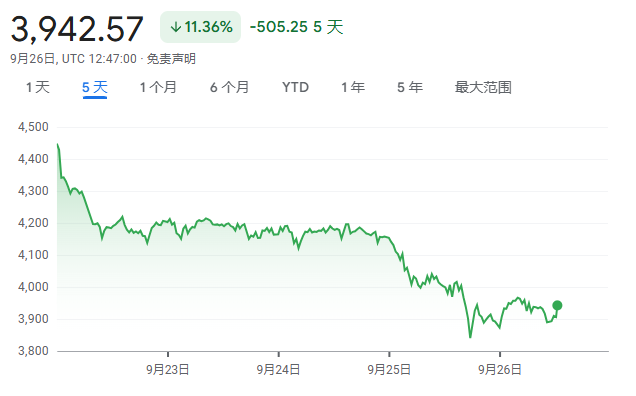
Group 1 - The market's optimistic expectations for a "super cycle" have faced reality, with Ethereum dropping below $4,000, reflecting a disconnect between bullish expectations and market realities [1] - Ethereum's price has seen a significant decline, with a 24-hour drop of over 3% and a weekly decline exceeding 11%, marking a halt to its recent upward momentum [1] - Citigroup has set a year-end target price for Ethereum at $4,300, significantly lower than its historical high of $4,953 reached on August 24, indicating concerns about current valuations being driven by recent buying pressure and excitement over use cases [3] Group 2 - BitMine, as the largest corporate holder of Ethereum, believes that increased institutional capital and the proliferation of Web3 trading products could break the traditional four-year Bitcoin halving cycle, potentially leading to an unprecedented "super cycle" for digital assets [3][4] - There is skepticism among mainstream Wall Street institutions regarding the sustainability of Ethereum's recent price surge, despite a remarkable 87.94% increase in the past six months [4] - The rise of AI agents is viewed as a potential second catalyst for Ethereum's super cycle, with BitMine suggesting that AI agents require neutral platforms like public blockchains, which could enhance Ethereum's application [5] Group 3 - There is a divergence of opinions regarding the role of AI agents in the blockchain space, with some experts cautioning that while many projects are being built on Ethereum, it does not guarantee that Ethereum will be the dominant player in the future [6] - The competitive landscape is intensifying, with projects like Virtuals and others being developed on alternative chains such as Base and Solana, indicating a growing likelihood of cross-chain competition rather than a single chain dominating [6] - Major fintech companies are investing in the AI agent sector, exemplified by PayPal Ventures leading a $18 million Series A funding round for decentralized AI infrastructure provider Kite AI, bringing its total funding to $33 million [6]