
数字资产

Search documents
陈茂波:美商希望通过香港开拓内地市场
证券时报· 2025-10-20 07:56
Core Viewpoint - The article highlights the growing recognition of China's innovation and technology capabilities by the local business community in Hong Kong, emphasizing the potential for collaboration through Hong Kong as a gateway to mainland China and the broader Asian market [1][4]. Group 1: Economic Outlook - During the recent IMF and World Bank meetings, concerns were raised about the global economic outlook, with the IMF revising its growth forecast for 2023 to 3.2%, a decrease of 0.1 percentage points from the previous year, and predicting a further slowdown to 3.1% in 2024 [3]. - Many economies are facing rising debt pressures, with advanced and emerging markets increasingly burdened by high-interest rates, raising concerns about the sustainability of public finances and limiting government spending [3][4]. Group 2: Opportunities Amid Challenges - Despite challenges such as trade conflicts, there are emerging opportunities, particularly in Asia, where countries are adjusting their economic structures and enhancing intra-regional trade, potentially increasing the region's GDP by 1.4% in the long term [4]. - The article notes that Hong Kong is actively promoting financial and technological development, integrating regional supply chains, and attracting businesses and talent, which positions it as a strategic hub for collaboration [4]. Group 3: Investment Landscape - The Hong Kong investment management company has invested in over 130 projects, with each HKD invested attracting approximately 6 HKD in market co-investment, indicating a robust investment environment [6]. - The Hong Kong financial market has seen significant activity, with daily trading volumes and foreign capital inflows surpassing previous records, reflecting international investors' confidence in the region [6]. Group 4: Trade Policy - Hong Kong maintains its status as a free port with a commitment to open and predictable trade policies, despite recent escalations in trade tensions [7].


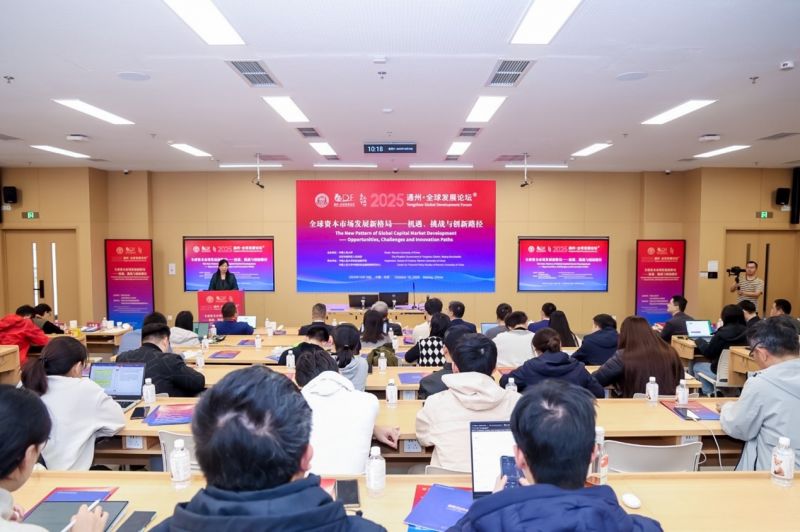
通州·全球发展论坛分论坛三隆重举行,专家热议全球资本市场发展新格局
Zhong Guo Fa Zhan Wang· 2025-10-20 05:33
Group 1 - The forum focuses on the new pattern of global capital market development, emphasizing opportunities, challenges, and innovative paths [2][22] - The strategic positioning of China's capital market has been elevated, shifting its core function from traditional financing to incentivizing social innovation and wealth management [5] - The need for systematic restructuring of the capital market ecosystem is highlighted, including reforms in the asset side, funding side, and regulatory framework to enhance market transparency and compliance [5] Group 2 - The global financial market is facing challenges of integration and segmentation, particularly due to the impact of the 2008 financial crisis and ongoing geopolitical tensions [7] - The imbalance in financial globalization levels between developed and emerging markets poses significant external pressures on the latter [7] - The importance of balancing openness and security in China's financial strategy is emphasized, advocating for high-quality openness and alignment with international regulatory standards [7] Group 3 - The impact of the US-China trade war on international capital flows is discussed, noting that US funds have shown resilience while non-US funds have reduced exposure to affected companies [12] - The valuation trends of technology companies during the Fourth Industrial Revolution are characterized by high valuations and the need for optimized institutional support for hard technology enterprises [14] - The emergence of digital assets is reshaping the capital market ecosystem, with a focus on the role of stablecoins and their implications for traditional finance [16][17]
港股异动 | 德林控股(01709)现涨超7% 拟向比特大陆收购2995台BM矿机 强化公司比特币挖矿业务
Zhi Tong Cai Jing· 2025-10-20 02:11
Core Viewpoint - Delin Holdings (01709) is experiencing a stock price increase of over 7% following the announcement of its acquisition of 2,995 BM mining machines from Bitmain, aimed at strengthening its Bitcoin mining operations [1] Group 1: Acquisition Details - Delin Holdings plans to acquire 1,900 BM mining machines at a cost of $8.35 million and 1,095 BM mining machines for $10.88 million, with funding sourced from net proceeds of a placement and potential financing from Antalpha Digital [1] - The board believes that signing the formal agreement for the BM acquisition will provide long-term financial returns and value for shareholders [1] Group 2: Strategic Implications - The acquisition is expected to enhance the company's leadership position in Bitcoin mining among Hong Kong-listed companies, diversify revenue sources, and enable the company to capitalize on the rapidly expanding market opportunities in digital assets and blockchain [1] - The board considers the terms of the BM agreement and the proposed transactions to be normal commercial terms that are fair and reasonable, aligning with the overall interests of the company and its shareholders [1]
德林控股现涨超7% 拟向比特大陆收购2995台BM矿机 强化公司比特币挖矿业务
Zhi Tong Cai Jing· 2025-10-20 02:04
Core Viewpoint - Derin Holdings (01709) has seen a stock price increase of over 7%, currently trading at HKD 3.44 with a transaction volume of HKD 115 million, following the announcement of significant acquisitions in Bitcoin mining equipment [1] Group 1: Acquisition Details - Derin Holdings announced the acquisition of 1,900 BM mining machines from Bitmain's subsidiaries BM1 and BM2 for a total cost of USD 8.35 million and 1,095 BM mining machines for USD 10.88 million [1] - The financing for these acquisitions will be sourced from the net proceeds of a placement and potential financing from Antalpha Digital [1] Group 2: Strategic Implications - The board believes that signing the formal agreement with BM will provide long-term financial returns and value for shareholders [1] - The acquisition is expected to strengthen the company's leadership position in the Bitcoin mining business among Hong Kong-listed companies, diversify revenue sources, and enable the company to capitalize on the rapidly expanding market opportunities in digital assets and blockchain [1] - The board considers the terms of the formal agreement and the proposed transactions to be normal commercial terms that are fair and reasonable, aligning with the overall interests of the company and its shareholders [1]
德林控股拟收购2995台矿机
Zhi Tong Cai Jing· 2025-10-19 11:30
Core Viewpoint - Derin Holdings (01709) has signed formal agreements for the acquisition of BM mining machines, aiming to become the first listed "Bitcoin computing power stock" in Hong Kong, with a total hash power of approximately 2.1 million TH and an annual production target of around 350 Bitcoins [1][4]. Group 1: Acquisition Details - The company has entered into agreements for the acquisition of 1,900 units of BM mining machine 1 for a total cost of approximately $8.3491 million (equivalent to HKD 65.1228 million) and 1,095 units of BM mining machine 2 for approximately $10.8766 million (equivalent to HKD 84.8378 million) [1]. - The total expected annual output from the BM mining machines is approximately 175 Bitcoins, based on a total hash power of about 1.06 million TH/s [1]. Group 2: Operational Management - The digital asset department has dedicated operational personnel and utilizes a transparent third-party ASIC mining management platform to monitor hash power, temperature, and performance data in real-time [2]. - The company will sign a framework agreement with designated hosting service providers for the daily operation and maintenance of the BM mining machines, ensuring operational efficiency and uninterrupted mining activities [3]. Group 3: Strategic Partnerships - Bitmain, the parent company of BM1 and BM2, is recognized as the largest and most technologically advanced Bitcoin mining machine manufacturer, providing significant operational efficiency and competitive advantages through its advanced cooling technology [4]. - The board believes that signing the formal agreements will bring long-term financial returns and value to shareholders, reinforcing the company's leadership position in the Bitcoin mining business among Hong Kong listed companies [4].
德林控股(01709)拟收购2995台矿机
智通财经网· 2025-10-19 11:25
Core Viewpoint - The company has signed formal agreements for the acquisition of BM mining machines, aiming to become the first listed "Bitcoin computing power stock" in Hong Kong, with a total hash power of approximately 2.1 million TH and an annual production target of around 350 bitcoins [1][4]. Group 1: Acquisition Details - The total cost for the acquisition of 1,900 BM mining machines 1 and 1,095 BM mining machines 2 is approximately $8.3491 million (equivalent to HKD 65.1228 million) and $10.8766 million (equivalent to HKD 84.8378 million) respectively [1]. - The expected annual output from the BM mining machines is approximately 175 bitcoins, contributing to a total planned reserve of over 1,000 bitcoins [1]. Group 2: Operational Management - The company's digital asset department employs dedicated operational personnel and utilizes a transparent third-party ASIC mining management platform for real-time monitoring of hash power, temperature, and performance data [2]. - The digital asset department is led by a professional with over 10 years of experience in the cryptocurrency and blockchain industry, ensuring effective management and compliance [2]. Group 3: Hosting and Maintenance - The company will sign a hosting service framework agreement with designated service providers for the daily operation and maintenance of the BM mining machines, ensuring a controlled environment and stable power supply [3]. - All mined bitcoins will be securely stored in a custodian wallet, adhering to institutional-grade custody standards for asset protection [3]. Group 4: Strategic Partnerships - Bitmain, the parent company of BM1 and BM2, is recognized as the largest and most technologically advanced bitcoin mining machine manufacturer, providing significant operational efficiency and competitive advantages [4]. - The partnership with Bitmain ensures continuous supply, technical support, and operational expertise, reinforcing the company's technological advantages and resilience in a competitive industry [4]. Group 5: Financial Outlook - The board believes that the signing of the formal agreements will bring long-term financial returns and value to shareholders, enhancing the company's leadership position in the bitcoin mining business among Hong Kong listed companies [4].
联易融科技-W前三季度科技解决方案处理的交易总量为3361.9亿元,同比增长28.2%
Zhi Tong Cai Jing· 2025-10-17 12:34
Core Insights - The company reported a customer retention rate of 99% for its supply chain financial technology solutions in the first nine months of 2025, an increase of 3 percentage points compared to the end of 2024 [1] - The total number of core enterprise partners reached 2,798, reflecting a growth of 29.8% from the end of 2024 [1] - The total transaction volume processed by the company's supply chain financial technology solutions was 329.37 billion yuan, a year-on-year increase of 29.2% [1] - The company is focusing on "AI + industrial finance" and digital assets, aiming for quality growth despite global economic uncertainties [2] - The company achieved significant breakthroughs in emerging technology applications, including winning a project for a Web3.0-based supply chain financial platform for a major state-owned enterprise [2] - The company is actively pursuing a share buyback plan, demonstrating management's confidence in future growth and commitment to long-term shareholder value [2] Financial Performance - The total transaction volume for emerging solutions was 6.8197 billion yuan, showing a year-on-year decrease of 5.1% [1] - The total transaction volume for technology solutions was 336.19 billion yuan, reflecting a year-on-year growth of 28.2% [1] Strategic Initiatives - The company continues to implement its core strategies, focusing on high-value-added businesses and optimizing product structure to maintain market leadership [2] - The collaboration with the state-owned enterprise will enable efficient, low-cost cross-border settlements and tokenized asset circulation, showcasing the company's innovative capabilities in trade finance based on Web3.0 [2] - The company plans to continue leveraging its core strategies of "AI + industrial finance," strategic acquisitions, and digital assets to drive sustainable business growth [2]
联易融科技-W(09959)前三季度科技解决方案处理的交易总量为3361.9亿元,同比增长28.2%
智通财经网· 2025-10-17 12:30
Group 1 - The core viewpoint of the articles highlights the strong performance and strategic initiatives of the company in the supply chain finance technology sector, showcasing significant growth in customer retention and transaction volumes [1][2] Group 2 - As of the first nine months of 2025, the customer retention rate for supply chain finance technology solutions reached 99%, an increase of 3 percentage points compared to the end of 2024 [1] - The total number of core enterprise partners increased to 2,798, reflecting a growth of 29.8% from the end of 2024, while the number of financial institution partners reached 405 [1] - The total transaction volume processed by the company's supply chain finance technology solutions amounted to 329.37 billion, representing a year-on-year growth of 29.2%, while emerging solutions saw a transaction volume of 6.8197 billion, a decrease of 5.1% [1] - The total transaction volume for technology solutions was 336.19 billion, showing a year-on-year increase of 28.2% [1] Group 3 - In Q3 2025, the company continued to execute its core strategy, focusing on "AI + industrial finance" and digital assets, leading to quality business growth despite global economic uncertainties [2] - The multi-level circulation cloud business maintained strong growth, driven by increased penetration among customer groups and a solid market foundation [2] - The company achieved a significant breakthrough in emerging technology applications by winning a project for a Web 3.0-based supply chain finance platform for a major state-owned enterprise, marking a milestone in its "stablecoin +" strategy [2] - The integration of the company's stablecoin application framework into the enterprise's ecosystem will enable efficient, low-cost cross-border settlements and tokenized asset circulation [2] - The company is steadily advancing its share repurchase plan, reflecting management's confidence in future growth and commitment to creating long-term value for shareholders [2] - The company will continue to focus on its three core strategies: "AI + industrial finance," strategic mergers and acquisitions, and digital assets, to seize market opportunities and drive sustainable growth [2]
联易融科技-W(09959.HK)将继续围绕「AI+产业金融」驱动业务可持续增长
Ge Long Hui· 2025-10-17 12:10
Core Insights - The company continues to execute its core strategy in "AI + industrial finance" and digital assets, aiming for quality growth despite global economic uncertainties [1][2] - Strong growth momentum in multi-level circulation cloud business is attributed to increased penetration among customer groups and solid market foundation [1] - Significant breakthrough in emerging technology applications with a major contract win for a Web3.0-based supply chain finance platform project for a large state-owned enterprise [1] Business Developments - The project marks an important milestone under the company's "stablecoin+" strategy, showcasing the application of stablecoin and digital asset solutions in real supply chain scenarios [1] - Integration of the company's stablecoin application framework into the enterprise's ecosystem will enable efficient, low-cost cross-border settlements and tokenized asset circulation [1] - The company is steadily advancing its share buyback plan, reflecting management's confidence in future growth and commitment to long-term shareholder value [2] Strategic Focus - The company will continue to focus on three core strategies: "AI + industrial finance," strategic mergers and acquisitions, and digital assets to seize market opportunities and drive sustainable growth [2]
联易融科技(09959) - 自愿性公告 - 业务发展
2025-10-17 12:00
香港交易及結算所有限公司及香港聯合交易所有限公司對本公告的內容概不負責, 對其準確性或完整性亦不發表任何聲明,並明確表示,概不就因本公告全部或任 何部分內容所產生或因依賴該等內容而引致的任何損失承擔任何責任。 Linklogis Inc. 聯易融科技集團 (於開曼群島註冊成立以不同投票權控制的有限公司) (股份代號:9959) 自願性公告 業務發展 本公告乃聯易融科技集團(「本公司」)自願刊發,以告知本公司股東及潛在投資者 有關本公司連同其附屬公司及關聯併表實體(「本集團」)的最新業務發展資料。 首席執行官寄語 在2025年第三季度,本集團繼續堅定執行核心戰略,在「AI+產業金融」和數字資 產領域深化佈局,推動業務實現有質量的增長。儘管全球宏觀經濟環境依然存在 不確定性,但我們通過持續聚焦高附加值業務、優化產品結構,鞏固了在市場中 的領先地位。第三季度,我們的多級流轉雲業務繼續保持強勁增長勢頭,這主要 得益於產品在客戶群體中的滲透率進一步提升以及市場基礎的持續鞏固。同時, 我們在新興技術應用領域取得重大突破,成功中標某特大型央企的基於Web 3.0的 供應鏈金融平臺項目。此項目是本集團「穩定幣+」戰略下的一個 ...