海洋经济

Search documents
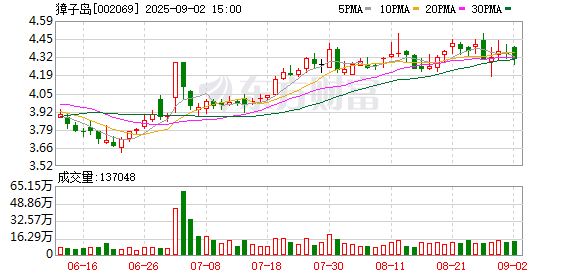
獐子岛2025年上半年扭亏为盈 国资赋能焕发经营新动能
Zheng Quan Ri Bao· 2025-09-02 13:40
Core Viewpoint - The company has successfully turned a profit in the first half of 2025, achieving a net profit of 10.15 million yuan, driven by improved operational efficiency and market expansion efforts [2]. Financial Performance - The company reported a revenue of 772 million yuan for the first half of 2025, marking a significant recovery [2]. - The net profit attributable to shareholders was 10.15 million yuan, indicating a successful turnaround from previous losses [2]. Strategic Initiatives - The company is focusing on "internal management enhancement and external market expansion" to improve operational quality [2]. - A private placement plan was disclosed in May, aiming to raise up to 522 million yuan to optimize capital structure and alleviate historical financial burdens [2]. - The company is enhancing its governance and business integration through a new board of directors, which is expected to drive high-quality development in the marine economy [3]. Market Expansion and Product Development - The company is actively expanding its domestic and international markets, successfully entering high-end supermarket channels and enhancing its product offerings [3][4]. - The sales of floating raft scallops have reached historical highs, and the company has made significant inroads into the high-end restaurant supply chain [3]. Brand and Technology Strategy - The company is implementing a dual strategy of brand and technology development, unifying product packaging and enhancing partnerships with strategic allies [4]. - The company has been awarded the title of "National Agricultural Technology Enterprise" and continues to innovate through research and development collaborations [4]. Future Outlook - With the support of state-owned assets and a modern governance system, the company aims to strengthen its full industry chain advantage from seed industry to brand sales [5]. - The company is positioned to become a leading marine industry group in China, contributing significantly to the high-quality development of the regional marine economy [5].


研判2025!中国自主式水下机器人(AUV)行业发展历程、发展现状、市场投融资、竞争格局及发展趋势分析:深海蓝海市场有待深度开拓,自主式水下机器人行业前景可期[图]
Chan Ye Xin Xi Wang· 2025-09-01 01:16
Core Insights - The Chinese autonomous underwater vehicle (AUV) industry is experiencing a dual leap in technology and industry, moving from early models to leading positions in deep-sea exploration over the past 40 years [1][6] - The market size of the underwater robot industry is expected to grow from 5.28 billion yuan in 2020 to 20.88 billion yuan by 2025, with a compound annual growth rate (CAGR) exceeding 33% [1][13] - AUVs with autonomous navigation and intelligent decision-making capabilities are accelerating from the technology validation phase to large-scale applications, becoming a crucial support for the trillion-level deep-sea economy [1][13] Industry Overview - Autonomous underwater vehicles (AUVs) are intelligent systems that operate underwater without real-time human intervention, relying on pre-set programs or artificial intelligence for decision-making [2] - AUVs differ from remotely operated vehicles (ROVs) as they possess complete autonomous navigation capabilities, allowing them to perform various underwater tasks independently [2][5] Development History - The development of AUV technology in China has progressed through several stages: initial development in the 1980s-1990s, system construction from 2000-2010, breakthroughs in deep-sea and intelligent technology from 2011-2020, and accelerated industrialization from 2021 to present [6][12] Driving Factors - The demand for deep-sea resource development is surging, making AUVs essential for deep-sea exploration, especially in mining and oil and gas sectors [8] - Continuous policy support and strategic positioning have been established, with AUVs recognized as "national key equipment" under China's marine power strategy [9] - Technological integration, including advancements in AI and 5G, is significantly enhancing AUV performance [11] Current Industry Status - The underwater robot industry is projected to grow rapidly, with market size expected to reach 16.7 billion yuan by 2024 and 20.88 billion yuan by 2025 [13][14] - The industry is still in its nascent stage, with significant capital inflow expected as the marine power strategy accelerates [14][16] Competitive Landscape - The market features a dual-track competition between consumer-grade and industrial-grade AUVs, with leading companies focusing on diverse applications [17] - Companies like Yunzhou Intelligent and CITIC Heavy Industries are leading in high-end fields such as deep-sea resource development and marine engineering maintenance [17] Future Trends - The AUV industry is expected to see deep technological integration, diversification of application scenarios, and collaborative ecosystem development [18][19] - AUVs will expand their applications beyond traditional marine engineering to include environmental monitoring, consumer entertainment, and space simulation testing [19][20] - The domestic AUV industry chain is rapidly improving, with a significant increase in the localization rate of core components, enhancing global competitiveness [20]


【广发宏观团队】怎么观测流动性与市场定价的关系
郭磊宏观茶座· 2025-08-31 10:01
Group 1 - The article discusses the relationship between liquidity and financial market pricing, emphasizing that liquidity is the ability of an asset to be quickly converted into cash, influenced by factors such as money supply, tradable assets, and risk appetite [1][2][3] - Liquidity is categorized into narrow liquidity (money in the financial system) and broad liquidity (money in the real economy), with narrow liquidity affecting opportunity costs and market valuations, while broad liquidity impacts credit expansion and corporate profitability [2][3] - The article identifies key indicators to observe liquidity conditions, including the difference between the central bank's monetary policy sentiment index and loan demand index, the difference between the enterprise financing environment index and investment outlook index, and the difference between social financing growth and nominal GDP growth [3][4][5] Group 2 - The article notes that liquidity-driven phases have occurred during specific periods, such as mid-2014 to mid-2015, early 2019 to Q1 2020, and Q2 to Q4 of 2021, with a projected liquidity-driven phase starting after May 2025 [5] - Factors that could alter the liquidity-driven logic include changes in money supply or broadening the avenues for money allocation, such as improved corporate profitability and investment demand [5][6] - The article highlights that a favorable scenario would be when broad liquidity can support the asset pricing expansion driven by narrow liquidity, transitioning from a liquidity-driven phase to a profitability-driven phase [6] Group 3 - The article reports increased volatility in major asset classes, with U.S. stocks, gold, and the Chinese yuan experiencing fluctuations, while the domestic stock market continues to outperform globally [6][7] - The article indicates that the U.S. stock market is showing signs of volatility, with the VIX index rising, while the Chinese stock market narrative is becoming more concentrated, with a significant reduction in the number of positive-return sectors [8][12] - The article discusses the performance of commodities, noting that oil prices have risen due to geopolitical uncertainties, while gold prices have also increased amid external risk aversion [9][10] Group 4 - The article mentions that the U.S. Federal Reserve's interest rate expectations and concerns about its independence are influencing U.S. Treasury yields, with a slight decline in 10-year Treasury yields [10][11] - The article highlights the appreciation of the Chinese yuan against the U.S. dollar, with both onshore and offshore yuan showing significant gains [11][12] - The article discusses the performance of the A-share market, noting a decline in market breadth and a concentration of returns among fewer stocks, indicating a shift in market dynamics [12][13] Group 5 - The article outlines the recent U.S. court ruling regarding tariffs imposed by the Trump administration, which may impact future trade policies and economic conditions [16][17][18] - The article emphasizes the resilience of U.S. consumer spending, with upward revisions to GDP growth and personal consumption expenditures, indicating a robust economic backdrop [19][20] - The article discusses the Federal Reserve's dovish stance, with expectations for interest rate cuts in the near future, reflecting concerns about labor market risks and inflation [21][22] Group 6 - The article highlights the expected economic indicators for August, including GDP growth and PPI trends, suggesting a mixed economic outlook with potential for slight improvements in inflation metrics [22][23][24] - The article notes that August's fiscal spending and central bank interventions are expected to lead to a loosening of narrow liquidity conditions, with social financing growth projected to decline [26][27] - The article discusses improvements in funding availability for construction projects, particularly in central and eastern regions of China, indicating a potential boost in infrastructure investment [28][29]

广东掘金深蓝,推动海洋经济高质量发展
2 1 Shi Ji Jing Ji Bao Dao· 2025-08-30 13:53
Core Insights - Guangdong is leading the development of the marine economy in China, with the implementation of local regulations and planning aimed at promoting high-quality growth in this sector [1][3] Group 1: Marine Economy Development - Guangdong has introduced the "Guangdong Province Marine Space Planning (2021-2035)" and the "Guangdong Province Regulation on Promoting High-Quality Development of the Marine Economy," showcasing its proactive approach [1] - The city of Yangjiang is highlighted for its robust marine economy, with a total installed capacity of over 22.8 million kilowatts in various energy sectors, half of which is green energy [1] - Yangjiang's offshore wind power capacity is significant, with a planned capacity of 20 million kilowatts and an operational capacity of over 6 million kilowatts, accounting for half of Guangdong's total [1] Group 2: Emerging Sectors - The marine ranching and offshore wind power sectors are experiencing explosive growth, with potential for AI and automation to enhance marine manufacturing [2] - Guangdong's marine ranching has achieved a production of 1.2291 million tons of aquatic products, with a pre-prepared food capacity exceeding 80,000 tons [2] - The province is home to the largest seawater fish seedling base in China, with a focus on scaling up and intensifying marine aquaculture [2] Group 3: Integration with Local Initiatives - The marine economy is integrated with Guangdong's "Hundred Million Project," emphasizing technological empowerment and ecological priorities in local development [3] - Investment in a modern pre-prepared food industrial park in Raoping County amounts to 212 million yuan, aimed at enhancing product value and market competitiveness [3] - The promotion of marine economy initiatives has also stimulated local consumption, with campaigns encouraging tourism and cultural engagement [3][4] Group 4: Tourism and Cultural Integration - Guangdong's rich island resources and coastal tourism prospects are being leveraged to enhance cultural and tourism consumption [4] - The establishment of the Marine Strong Province Construction Work Committee aims to promote comprehensive development in the marine economy [4] - Various innovative practices are emerging in Guangdong's marine economy, contributing to national high-quality development efforts [4]
城市24小时 | 中部省会“米”字形枢纽最后一笔,动了?
Mei Ri Jing Ji Xin Wen· 2025-08-29 16:42
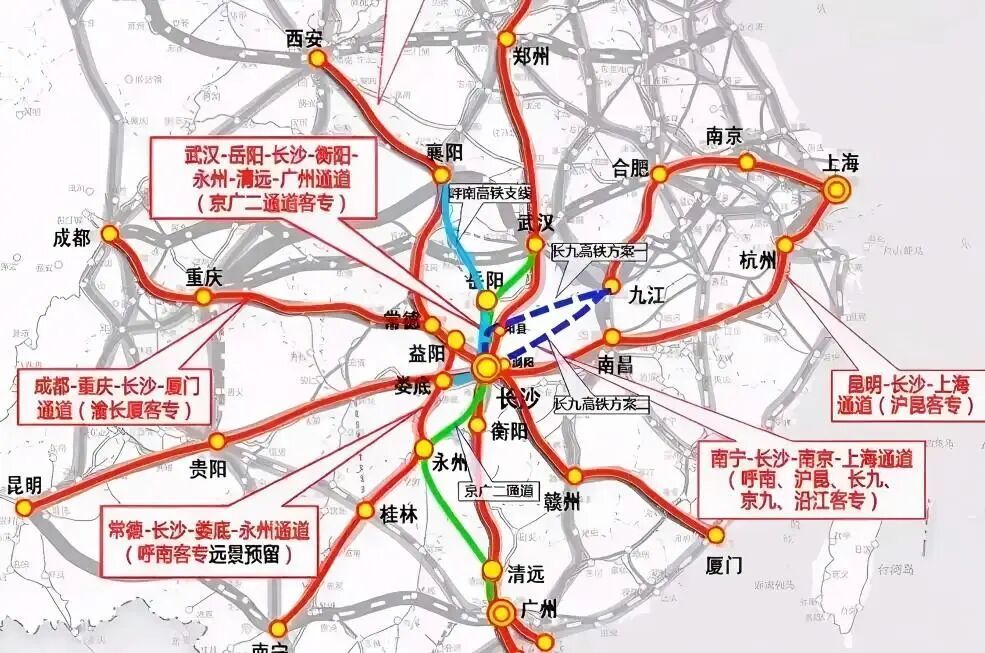
Group 1 - The Hunan Provincial Development and Reform Commission has announced support for six major railway projects, including the Changsha to Jiujiang high-speed railway, which is crucial for establishing a "cross" high-speed rail hub in Changsha [1][2] - The Changsha to Jiujiang high-speed railway is part of a larger network aimed at enhancing connectivity between the Yangtze River Delta and the central and southern regions of China, addressing existing gaps in high-speed rail coverage [2][3] - The Changsha West to Hukun high-speed railway connection line is expected to fill the southwest high-speed rail gap, further solidifying Changsha's position as a key transportation hub [2][3] Group 2 - The construction of the Changsha to Jiujiang high-speed railway has been advocated by representatives from Hunan province during the National People's Congress for several years, emphasizing its importance for regional economic development [3] - The proposed railway is seen as a vital link for the Yangtze River Economic Belt, aiming to enhance transportation efficiency and support national strategies for regional economic coordination [3] - Hunan's representatives are actively seeking to include the Changsha to Jiujiang high-speed railway in the national railway development plan, highlighting its significance for future infrastructure development [3]
海上新广东 · 新气象图集
Nan Fang Nong Cun Bao· 2025-08-29 12:32
Core Viewpoint - Guangdong's coastal areas are experiencing a transformation, integrating tourism, technology, and culture, making the ocean a vibrant stage for various activities and economic growth [11][12]. Group 1: Tourism Growth - In 2024, coastal cities in Guangdong are expected to receive 730 million tourists, generating nearly 1 trillion yuan in tourism revenue, indicating a rapid rise in island tourism [18]. - The unique "one island, one product" concept is being implemented, showcasing diverse attractions across Guangdong's islands [15]. Group 2: Technological Advancements - The low-altitude economy in Guangdong is rapidly developing, with plans for manned drone routes connecting Zhuhai waters and surrounding islands, enhancing the tourism experience [21]. - A logistics drone network has been launched, improving efficiency in medical supply delivery and fresh produce distribution, contributing to the "smart ocean" initiative [22][23]. Group 3: Cultural Integration - The fishing season is a peak time for cultural and tourism integration, with events like the sea worship ceremony and beach music festivals attracting thousands of visitors [28][30]. - Traditional fishing activities are being elevated into cultural celebrations, with various local events promoting community engagement and shared experiences [29].

深水海纳:国资赋能 打造生态环保智慧治理新图景
Zheng Quan Ri Bao Wang· 2025-08-29 07:48
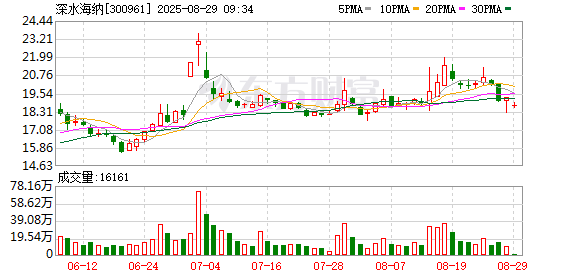
Core Viewpoint - Deepwater Haina Water Group Co., Ltd. is experiencing a pivotal development phase in 2025, driven by state-owned capital investment, the construction of a smart water ecological system, forward-looking layouts in the marine economy, and the continuous release of policy dividends [1] Group 1: State-Owned Capital Investment - In 2025, Deepwater Haina joined the Maoming Development Group system, a local state-owned platform, which provides strong capital backing and opens strategic channels for regional resource collaboration and policy alignment [2] - The deep involvement of state-owned capital is expected to enhance the safety margin of accounts receivable and project payment guarantees for Deepwater Haina as an environmental service provider [3] - The company has established a targeted accounts receivable collection assessment method, implementing a tiered management strategy for local governments based on their financial conditions, along with provisions for bad debt to improve its practical response capabilities in accounts receivable collection [3] Group 2: Technological Transformation - Digital transformation is profoundly reshaping the environmental water service industry, with the company leveraging the KaihongOS technology base to upgrade its existing Hy-Smart smart water platform into a "cloud-edge-end" integrated digital ecosystem [4] - The uniqueness of this layout lies in its self-controllable technology, based on the open-source Harmony operating system, combined with open-source large models like DeepSeek, to develop specialized operating systems and intelligent terminals for the environmental sector [4] - The platform aims to achieve deep integration across all links, covering water plants, sewage plants, pipelines, and watershed water environments, promoting the implementation of "unmanned operation and smart decision-making" [4] Group 3: Marine Economy Layout - While solidifying its water service foundation, Deepwater Haina is also keenly capturing opportunities in the marine industry, planning to expand into eco-friendly related industrial chains and explore new paths for synergistic development with its main business [5] - The company will adopt a dual approach of internal incubation and external cooperation to promote the marine intelligent aquaculture equipment business across design, manufacturing, sales, investment, and operation [5] - This strategy aims to explore diversified profit mechanisms, steadily expand the industrial ecosystem, and enhance the overall resilience and innovation capabilities of the enterprise [5]

中闽能源(600163):限电及来风偏弱导致25H1业绩承压 看好海风远期成长弹性
Xin Lang Cai Jing· 2025-08-29 06:26
Performance Summary - In the first half of 2025, the company achieved a net profit attributable to shareholders of 314 million yuan, a year-on-year decrease of 8.07% [1] - In Q2 2025, the net profit attributable to shareholders was 63 million yuan, a year-on-year decline of 51.11% [1] - The company's revenue for the first half of 2025 was 794 million yuan, down 2.95% year-on-year; Q2 revenue was 280 million yuan, a decrease of 20.58% [1] - The gross margin for the first half of 2025 was 57.51%, a decrease of 1.15 percentage points year-on-year; Q2 gross margin was 37.98%, down 14.78 percentage points year-on-year [1] Operational Data - Total power generation in the first half of 2025 was 1.405 billion kWh, a year-on-year decrease of 0.89%; grid-connected power was 1.366 billion kWh, down 0.71% [2] - Power generation by type included: Fujian wind power (1.284 billion kWh, +2.60%), Heilongjiang wind power (0.088 billion kWh, -28.91%), Heilongjiang biomass (0.024 billion kWh, -14.99%), and Xinjiang Hami photovoltaic (0.010 billion kWh, -34.95%) [2] - The utilization hours for Fujian onshore wind farms were 1,356 hours, and for offshore wind farms, 2,037 hours, both above the national average of 1,087 hours [2] - As of June 30, 2025, the company had a controllable grid-connected installed capacity of 957,300 kW, with onshore wind, offshore wind, photovoltaic, and biomass capacities of 611,300 kW, 296,000 kW, 20,000 kW, and 30,000 kW respectively [2] Future Outlook - The company is focusing on the distribution of offshore wind projects and the realization of asset injections [3] - In 2025, there is potential for new offshore wind allocations in Fujian, which could significantly support the company's future growth [3] - The company plans to initiate asset injection procedures for the Haidian Phase III project within three months after the renewable energy subsidy audit results are confirmed [3] - The government has identified "deep-sea technology" as a key area for strategic emerging industries, indicating potential policy support for offshore wind development [3] - The offshore wind sector has significant growth potential, with only 41 GW of installed capacity as of 2024, representing just 1.2% of total capacity [3] Investment Recommendations - The company has strong regional advantages and good wind resource conditions, indicating broad future growth potential [4] - Profit forecasts for 2025-2027 have been adjusted to 700 million, 740 million, and 830 million yuan respectively, with corresponding EPS of 0.37, 0.39, and 0.43 yuan [4] - The company is assigned a target market value of 13.9 billion yuan based on a 20x PE ratio for 2025, with a target price of 7.3 yuan, representing a 39% upside from the current price [4]

深水海纳:国资入主助力长期发展,开鸿系统技术底座驱动水务变革
Zheng Quan Shi Bao Wang· 2025-08-29 01:33
Core Viewpoint - The company, Deepwater Haina, reported a revenue of 166 million yuan and a loss of 15.68 million yuan in the first half of the year, but shows positive signs of recovery due to state-owned capital support [2][3]. Group 1: State-Owned Capital Involvement - In 2025, Deepwater Haina will undergo a significant transformation by joining the Maoming Development Group, a local state-owned platform, which will provide strong capital backing and open strategic channels for regional resource coordination and policy alignment [3]. - The Maoming State-owned Assets Supervision and Administration Commission possesses rich industrial and governmental resources that can help Deepwater Haina gain advantages in project acquisition, approval, land acquisition, and policy support [3]. - The state-owned background is expected to enable Deepwater Haina to secure more favorable loan conditions from banks, reducing financing costs for new projects in wastewater treatment and water supply [3]. Group 2: Digital Transformation and Technological Innovation - The environmental water service industry is undergoing profound changes due to digital transformation, with Deepwater Haina leveraging the KaihongOS technology to upgrade its Hy-Smart smart water platform into a "cloud-edge-end" integrated digital ecosystem [4]. - The platform aims for full-chain technological autonomy and deep integration of scenarios, covering water plants, sewage plants, pipelines, and watershed environments, promoting "unmanned operation and smart decision-making" [4]. - The company has established a research center for smart environmental energy technology, collaborating with several prestigious universities and research institutions on significant projects related to the removal of difficult-to-degrade organic compounds from reclaimed water [4]. Group 3: Business Strategy and Future Outlook - As accounts receivable pressure eases and the asset-light operation model (such as EPC+O projects) is optimized, the company's asset structure is expected to improve, laying a solid foundation for long-term stable development [5]. - With the support of state-owned capital, the opening of the Hongmeng ecosystem, and strategic expansion into the marine economy, Deepwater Haina is poised to transform from a traditional water service provider into an integrator of ecological environment smart governance [5].
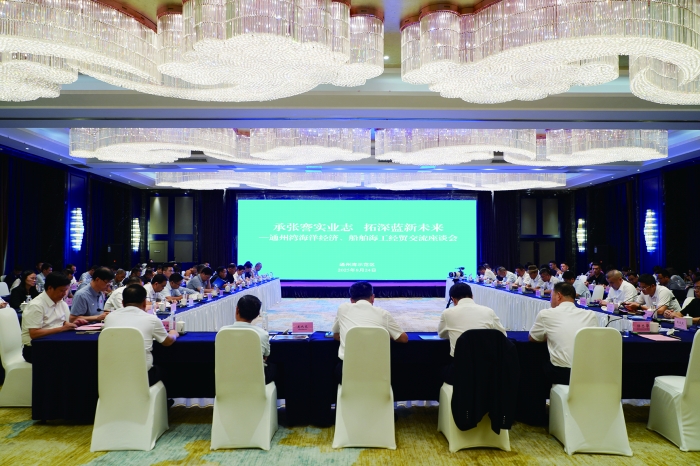
近百家优强企业走进南通共探海洋经济发展新路径
Shang Hai Zheng Quan Bao· 2025-08-28 19:45
Group 1 - The "Tongzhou Bay Marine Economy and Shipbuilding Industry Economic Exchange Symposium" was held in Nantong, focusing on marine economic development opportunities and industry cooperation [3][4] - Nantong has developed six trillion-level industrial clusters, including shipbuilding, electronic information, and high-end equipment, with a total market capitalization of listed companies reaching 400 billion [4][5] - The city aims to enhance its business environment and attract quality enterprises and investment institutions to foster the marine economy and blue economy [4][5] Group 2 - Nantong's GDP is projected to reach 1,242.19 billion in 2024, with a year-on-year growth of 6.2%, ranking second among China's trillion-level cities [5] - The Tongzhou Bay Demonstration Zone has consistently led Nantong's GDP growth, with a remarkable growth rate of 11.8% in the first half of 2025 [5] - The marine economy is expected to contribute 260 billion to Nantong's GDP in 2024, accounting for a quarter of the province's total [5][6] Group 3 - Various companies expressed interest in collaborating with Nantong, highlighting the city's favorable business environment and industrial planning [6][7] - Companies like Taily Technology and Hunan Tianqiao Hoisting emphasized the alignment of their strategic directions with Nantong's industrial strengths [6][7] - Financial representatives suggested leveraging Nantong's fixed asset investment for bond financing and capital operation to support industrial development [8]