产业链协同

Search documents
又一百亿A股大动作!复牌!
中国基金报· 2025-07-10 14:23
Core Viewpoint - Shijia Photon plans to acquire 82.38% equity of Dongguan Fokexima Communication Technology Co., Ltd. through a combination of share issuance and cash payment, while also raising matching funds [5][10]. Group 1: Acquisition Details - The acquisition will make Fokexima a subsidiary of Shijia Photon, and the transaction is expected to constitute a related party transaction but not a major asset restructuring [7][10]. - The company aims to enhance its production capabilities for MT connectors, ensuring stable supply and reducing overall product costs [10][15]. Group 2: Financial Performance - As of the end of Q1 2024, Fokexima reported total assets of 249 million yuan and projected revenue of 270 million yuan with a net profit of approximately 80 million yuan for the year [12][13]. - The financial data shows a significant increase in total assets from 113.64 million yuan in 2023 to 248.79 million yuan in Q1 2025 [13]. Group 3: Strategic Importance - The acquisition is seen as a strategic move to internalize MT connector production capacity, integrate the supply chain, and build technological barriers [15]. - The collaboration is expected to enhance product structure, technical accumulation, and market expansion, ultimately improving competitiveness in the optical communication sector [11][15].



时报观察|中国汽车零部件军团强势崛起的蕴意
证券时报· 2025-07-10 00:00
Core Insights - The rise of China's automotive parts industry is reshaping the global automotive ecosystem, with 15 Chinese companies listed in the 2025 Global Automotive Parts Suppliers Top 100, showcasing China's control over global power battery capacity and technology [1] - The growth of the automotive supply chain in China is closely linked to the booming new energy vehicle (NEV) sector, providing rapid iteration opportunities and favorable policies for local parts manufacturers [1] - Despite the successes, many Chinese companies remain concentrated in midstream manufacturing and specific segments, lacking in foundational materials, underlying software, and original technology accumulation [2] - The competition in the automotive industry is not just about revenue rankings but also about technological influence and supply chain leadership, necessitating the emergence of more "hidden champions" to elevate China's status from a major parts producer to a strong one [2][3] Summary by Sections Automotive Parts Industry - China's automotive parts industry has evolved from traditional mechanical components to intelligent electronic systems, indicating a shift towards multi-domain collaborative development [1] - The presence of companies like CATL and others in the NEV sector highlights China's dominance in battery production and technology [1] Challenges and Opportunities - Chinese companies need to enhance their presence in core components such as engine management systems, high-end transmissions, and advanced chips to compete with established global players [2] - The industry must focus on integrating resources and enhancing scale effects to improve competitiveness in the global market [2] Global Impact - The rise of China's automotive parts and NEV industries is altering the global competitive landscape, contributing to the development and green transformation of the global automotive industry [3]


时报观察 | 中国汽车零部件军团强势崛起的蕴意
Zheng Quan Shi Bao· 2025-07-09 18:40
Group 1 - The core viewpoint highlights the rapid rise of China's automotive parts industry, which is reshaping the global automotive ecosystem, with 15 Chinese companies listed in the 2025 Global Automotive Parts Suppliers Top 100 [1] - The success of Chinese companies in the new energy sector, such as CATL, Honeycomb Energy, and Guoxuan High-Tech, demonstrates China's control over global power battery capacity and technology [1] - The diversification of China's automotive parts industry is evident, with companies excelling in various segments like smart cockpits, seals, and interior components, indicating a shift from a single advantage to multi-field collaborative development [1] Group 2 - Despite the successes, many Chinese companies remain concentrated in midstream manufacturing and specific segments, lacking in foundational materials, underlying software, and original technology accumulation [2] - Chinese enterprises still need to enhance their presence in core component areas such as engine management systems, high-end transmissions, and high-end chips, where German, Japanese, and American giants dominate [2] - The competition in the automotive parts industry is not just about revenue rankings but also about technological influence and industry chain leadership, necessitating the emergence of more "invisible champions" to support China's transition from a major to a strong automotive parts nation [2]
爱旭股份20250706
2025-07-07 00:51
爱旭股份 20250706 摘要 光伏行业目前处于基本面底部,面临供需压力和亏损现金状况,政策鼓 励技术创新以打破内卷,BC 技术路线因其高效率和美观度受到重视,并 与异质结、Topcon 等技术具有兼容性。 BC 产品在效率和美观度方面具有优势,在国内外招标中溢价明显,国内 分布式场景溢价约 10%,海外工商业场景溢价 10%-20%,户用场景溢 价 30%-40%,市场认可度较高。 爱旭股份持续投入研发,占比收入比例保持在 3.5%以上,2024 年超过 6%,拥有大量专利和技术发明,转化效率处于行业领先水平,满屏产品 逐步退出市场,交付效率可达 25%-25.2%。 爱旭股份已投产 ABC 产能 18GW,珠海和义乌均已满产,济南项目逐 步投产,良率、效率及成本均得到优化,电池片良率约 97%-98%,组 件良率 99%以上,与 Topcon 成本差距缩小至 3-5 分钱,济南基地投产 后有望持平。 爱旭股份 2024 年 BC 产品出货量达 6.3GW,2025 年第一季度超 4.5GW,获下游客户认可,尤其在欧洲、日本、澳大利亚等高价值市场, 双面率提升至 80%±5%,国内集中式项目中标增多。 Q ...

负极材料赛道上市公司应三方面入手谋突破
Zheng Quan Ri Bao· 2025-07-06 16:43
Core Viewpoint - The article emphasizes the increasing demand for customized anode materials in lithium batteries and suggests that companies in the industry should focus on three main strategies to achieve breakthroughs in a highly competitive market [1]. Group 1: Technological Innovation - Companies should prioritize technological innovation to forge differentiated competitive advantages, focusing on R&D to develop unique products and maintain generational advantages [1]. - Collaboration with academic institutions and research organizations is essential for accelerating the transformation of technological achievements [1]. - Continuous upgrades in equipment and iterative processes are necessary to reduce production costs and enhance competitiveness [1]. Group 2: Industry Chain Collaboration - Companies should adopt a "vertical integration" supplier management model to create value across the entire supply chain and establish strategic partnerships with upstream suppliers [2]. - Engaging in "business + equity" cooperation models with downstream enterprises can enhance customer loyalty and ensure the absorption of advanced production capacity [2]. - Implementing customized service strategies can help build long-term partnerships with customers, fostering mutual growth [2]. Group 3: Dynamic Capacity Adjustment - Companies need to possess keen market insight and flexibility to dynamically adjust capacity layouts in response to market changes [3]. - A dual strategy of "regional capacity + global market" should be implemented, utilizing energy cost advantages in low electricity price regions for green factory construction and selecting international logistics hubs for overseas operations [3]. - Monitoring policy changes and promoting green and intelligent upgrades of capacity are crucial, along with establishing demand monitoring models for agile adjustments in product structure and capacity deployment [3].
以路成链构筑“黄金走廊”——江西吉安吉州区精心培育电子信息产业
Sou Hu Cai Jing· 2025-07-05 01:26
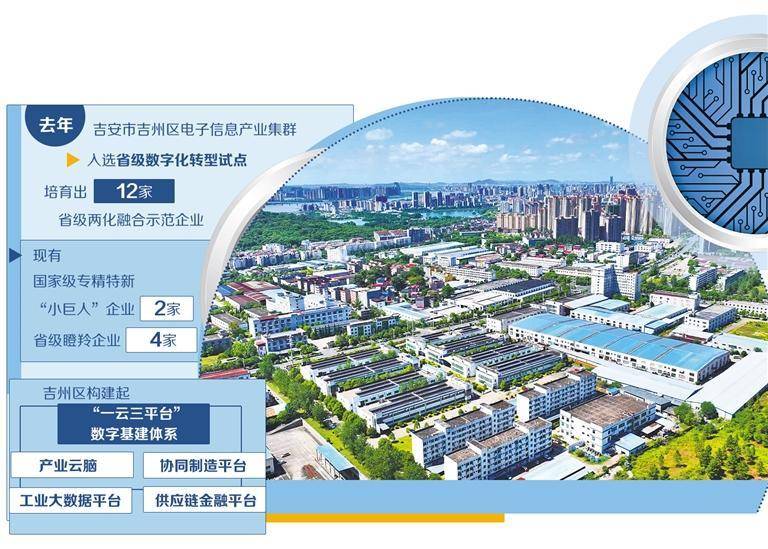
Core Insights - The article highlights the successful development of an industrial ecosystem in Jizhou District, Ji'an City, Jiangxi Province, focusing on the electronic information industry, which has significantly contributed to the local economy [2][9]. Industry Overview - The "Golden Corridor" along Jixian Road, spanning only 3 kilometers, has attracted a full industrial chain of companies from electronic-grade glass fiber cloth to high-end copper-clad laminates and printed circuit boards, accounting for 70% of the district's electronic information industry revenue last year [2][9]. - Jizhou District's electronic information industry has a research and development investment intensity of 5.2%, surpassing the national average, and a 137% year-on-year increase in PCT international patent applications, with 70% related to key common technologies in the industry [9]. Vertical Integration - The district promotes vertical integration through a "chain leader system," extending the industrial chain towards both ends of the "smile curve," focusing on high value-added material research and development [4][9]. - Local companies have transitioned from "remote matching" to "cross-road collaboration," significantly reducing supply chain response times and costs, with local sourcing of materials saving over 10 million yuan annually [3][4]. Digital Empowerment - Digital transformation is identified as a key leap for upgrading the industrial chain, with the establishment of a digital infrastructure system that includes an industrial cloud brain and collaborative manufacturing platforms [6][9]. - Traditional manufacturing companies have achieved significant improvements in production efficiency and cost savings through the adoption of IoT and AI technologies, with one company reporting a product yield rate of 99.6% [6][7]. Innovation Ecosystem - An upcoming 200-acre electronic information industry innovation center aims to create a comprehensive service system from basic material research to end product testing, fostering a "tropical rainforest" style of innovation [8][9]. - The district has successfully attracted R&D teams from major cities to utilize local advantages for rapid industrialization, exemplified by a project that transitioned from lab to mass production in just 11 months [8][9].
光伏行业“反内卷”可从三方面入手
Zheng Quan Ri Bao· 2025-07-04 16:10
Core Viewpoint - Leading photovoltaic glass companies are proactively reducing production to practice industry self-discipline and address "involution" competition, aiming to stabilize market order and adapt supply and demand [1][2] Industry Overview - Global photovoltaic supply-demand mismatch has led to component prices falling below cost, resulting in continued losses for leading companies in 2024. Proactive production cuts are expected to help restore supply-demand balance [1] - Domestic policies promoting the exit of outdated production capacity are expected to support the industry's efforts to adjust supply [1] Strategic Approaches - Photovoltaic companies should focus on technological iteration to build differentiated competitiveness. The rapid evolution of technology is key to breaking the current deadlock, with three main technology routes competing intensely: TOPCon, BC technology, and perovskite tandem technology [1][2] - Companies need to optimize capacity layout, balancing "capacity reduction" with "shortboard supplementation." Expanding production overseas can help avoid trade barriers and capture incremental demand in emerging markets [2] - Deepening industry chain collaboration is essential, transitioning from mere product suppliers to comprehensive energy service providers. Companies can adopt a "vertical integration" model to reduce costs and explore new application scenarios such as "distributed photovoltaics," "photovoltaics + energy storage," and "photovoltaic hydrogen production" [2]
宁东能源化工基地:高质量发展“排头兵”这样练成
Zhong Guo Hua Gong Bao· 2025-06-30 06:43
Core Viewpoint - The Ningdong Energy and Chemical Base has achieved significant industrial growth, with a projected industrial output value exceeding 200 billion yuan in 2024 and an industrial added value growth rate of 20.6%, marking a historical high [1]. Group 1: Economic Performance - The Ningdong base has ranked among the top 10 in China's chemical park high-quality development evaluation for six consecutive years, currently holding the third position in national competitiveness among chemical parks [1]. - The base has implemented 30 measures across six key areas to enhance the business environment, including project approval and infrastructure improvement [2]. Group 2: Business Environment Optimization - Ningdong has achieved a "good" rating in regional business environment assessments for three consecutive years, maintaining its position in the top tier of the region [3]. - The base has streamlined environmental assessment approvals, reducing required materials by 55.56%, cutting down processes by 34.26%, and shortening timelines by 57.81% [2][3]. Group 3: Technological Development - In 2024, Ningdong is investing heavily in technology development, with initiatives including the release of 20 "challenge" projects and signing contracts for seven projects in key sectors like new materials and coal chemical [4]. - The base has established a modern coal chemical pilot base, investing 210 million yuan to facilitate technology transfer and innovation, attracting nearly 30 quality projects [4]. Group 4: Resource Collaboration - Ningdong is enhancing its industrial ecosystem by leveraging its advantages in basic production materials, green electricity, and financing guarantees, aiming for collaborative development across various industries [6]. - The base has developed a high-quality industrial development map, promoting the clustering of modern coal chemical, new materials, and clean energy industries, which has led to reduced transportation costs and increased overall competitiveness [6].
永东股份(002753) - 002753永东股份投资者关系管理信息20250626
2025-06-26 08:48
Group 1: Company Capacity and Product Lines - The current production capacity for carbon black is 410,000 tons/year, coal tar deep processing capacity is 600,000 tons/year, modified asphalt is 200,000 tons/year, and crude phenol refining is 15,000 tons/year [1] - The company plans to expand its product line into new materials through coal chemical deep processing, enhancing the stability of carbon black quality [1] - The "2×100,000 tons/year anthracene oil deep processing project" and "500,000 tons/year coal tar deep processing project" have been approved by the shareholders' meeting, which will enrich the product line in the new materials sector [1] Group 2: Strategic Business Development - The company aims to extend carbon black products into high-end markets, with a project for fine processing of coal tar and special carbon black, targeting 70,000 tons/year of specialty carbon black [2] - The planned "500,000 tons/year coal tar deep processing project" will enhance the company's processing capacity to one million tons, strengthening its market competitiveness [2] - The project for extracting high-value products from anthracene oil is expected to meet the growing demand for mid-to-high-end carbon black, benefiting from the rapid development of downstream industries [2] Group 3: Energy Utilization and Cost Efficiency - The company has implemented a carbon black tail gas power generation system, achieving self-supply of electricity for production and office use, significantly reducing electricity costs [6] - By reusing waste heat from coal tar processing, the company lowers gas consumption and enhances energy efficiency across its operations [6] - The integration of production processes allows for reduced transportation costs and improved safety and efficiency in raw material handling [2] Group 4: Product Applications - Main products include carbon black and coal tar processing products, with carbon black used as a reinforcing filler in rubber and as a pigment in various industries [7] - Coal tar products such as modified asphalt, industrial naphthalene, and phenolic oil are utilized in diverse applications, including the production of high-power electrode blocks and various chemical intermediates [7] - The company’s products serve critical roles in industries such as textiles, pharmaceuticals, and agriculture, with a focus on high-value applications like dyes and pesticides [4][7]

安克创新与ATL达成战略合作,引领移动电源电芯品质升级
Zheng Quan Shi Bao Wang· 2025-06-25 11:28
Core Insights - Anker Innovations has signed a strategic cooperation agreement with Amperex Technology Limited (ATL), a leading company in the global consumer lithium-ion battery sector, to procure an initial batch of 45 million high-energy-density lithium-ion cells [1][3] Group 1: Partnership Details - The partnership marks a significant step in deepening industry chain collaboration and co-creating high-end consumer electronic energy solutions [3] - ATL is recognized for its strong technological capabilities and scale advantages in the high-end consumer electronics battery market, having shipped a total of 5 billion cells by 2019 [3] - The collaboration reflects mutual recognition of advanced technology and leading quality between Anker Innovations and ATL, reinforcing Anker's commitment to providing reliable charging products globally [3] Group 2: Strategic Implications - Anker Innovations emphasizes the philosophy that "extreme innovation requires growth with the supply chain," aiming to accelerate the upgrade of its full-chain quality system [3] - The procurement of 45 million high-energy-density cells is seen as the initial step in establishing a strategic partnership with ATL [3] - This collaboration is expected to enhance the user experience by ensuring the delivery of trustworthy products [3]