成本控制

Search documents
涛涛车业20251023
2025-10-23 15:20
Summary of TaoTao Vehicle's Conference Call Company Overview - **Company**: TaoTao Vehicle - **Industry**: Electric vehicles, specifically golf carts and all-terrain vehicles Key Points Sales Performance - Golf carts are the main growth driver, with Q3 sales exceeding 13,000 units, accounting for approximately 50% of total revenue, with an average price of over 40,000 yuan [2][5][4] - Total sales of golf carts reached over 30,000 units in the first three quarters of 2025 [5] - All-terrain vehicle sales did not meet expectations but remain a focus for future development [2][5] Market Dynamics - North American market demand is continuously growing, with a well-established dealer network covering almost all states [7] - New brands are gaining popularity, and there is increasing media coverage on the use of golf carts in communities [7] - Competitors are shifting production to Southeast Asia due to anti-dumping policies, but TaoTao has a 10-12 month lead in this transition [9][10] Financial Performance - Q3 net profit increased due to rising gross margins, despite a loss of over 10 million yuan compared to a profit of 5-6 million yuan in Q2 [4] - The company has adjusted prices to cover increased costs from a 20% tariff imposed by Vietnam starting August 1, 2025, leading to improved gross margins in July to September [6] Production Capacity and Goals - Internal target for 2026 is to achieve over 50% growth in golf cart sales compared to 2025 [8] - Production capacity plans include: - Vietnam factory: 5,000 units per month - Thailand factory: expected to start production in the second half of 2025 - US factory: aiming for 1,000 units by November 2025 [11] - Total production capacity across all locations is projected to reach 80,000 to 100,000 units [11] Brand Strategy - The second brand, Tacos, is positioned as more fashionable and youthful, with a revamped dealer network to increase density [16] - The company is entering large supermarkets like Lowe's and TSC with the GoCheck brand, expecting to sell between 5,000 to 8,000 units in 2026 [20][22] Cost Management - Localized production in Vietnam is expected to help control costs, with a target local content rate of 35%-40% [29] - Production costs in Vietnam are approximately 10% higher than in China, but improvements have been made to reduce costs [31] Future Outlook - The company is optimistic about the growth of electric bicycles and plans to leverage existing dealer channels for sales [3][25] - Plans to establish a research institute in Chongqing to focus on high-displacement all-terrain vehicle engines [27] - Overall, the company aims to enhance production capacity, achieve sales targets, and invest in technology upgrades over the next two to three years [37] Additional Insights - The company is exploring the robot product market, collaborating with Yuzhu for testing and potential sales through existing dealer channels [32][34] - The ASP (Average Selling Price) is expected to remain stable, with growth anticipated in electric bicycles and potential challenges in other product lines like balance bikes [36] This summary encapsulates the key insights from the conference call, highlighting the company's performance, market dynamics, production strategies, and future outlook.

Tri Pointe Homes(TPH) - 2025 Q3 - Earnings Call Transcript
2025-10-23 15:02
Financial Data and Key Metrics Changes - In Q3 2025, the company closed 1,217 homes at an average sales price of $672,000, generating $817 million in home sales revenue, exceeding delivery guidance [4][11] - Adjusted homebuilding gross margin was 21.6%, excluding $8 million of inventory-related charges, while adjusted net income was $62 million or $0.71 per diluted share [4][11] - The company ended the quarter with $1.6 billion in total liquidity, including $792 million in cash, and a debt-to-capital ratio of 25.1% [6][14] Business Line Data and Key Metrics Changes - Net new home orders in Q3 were 995, with an absorption pace of 2.2 homes per community per month [11][12] - The absorption pace varied regionally, with the West at 2.3, Central at 1.8, and East at 2.8, indicating stronger performance in the DC Metro and Raleigh divisions [12] Market Data and Key Metrics Changes - Market conditions remained soft, with homebuyer interest muted due to slow job growth and economic uncertainty [6][10] - The company anticipates that home shoppers will re-engage when conditions stabilize, leading to normalized absorption rates [6][10] Company Strategy and Development Direction - The company is focused on inventory management, disciplined cost control, and increasing the mix of to-be-built homes over time [7][9] - It aims to grow community count by 10% - 15% by the end of 2026, with significant expansion in central and eastern regions [8][9] - The strategy includes investing in well-located land positions near employment centers and amenities, with over 32,000 lots controlled [8][9] Management's Comments on Operating Environment and Future Outlook - Management expressed confidence in long-term growth despite near-term uncertainties, emphasizing a disciplined approach to capital allocation and shareholder returns [10][16] - The company expects to deliver between 4,800 and 5,000 homes for the full year 2025, with an average sales price of approximately $680,000 [15] Other Important Information - The company repurchased 1.5 million shares for $51 million in Q3, totaling $226 million year-to-date, reducing share count by 7% [4][5] - The company was recognized as one of Fortune's 100 Best Companies to Work For in 2025, reflecting its strong corporate culture [16] Q&A Session Summary Question: Monthly cadence of orders and incentives - The monthly cadence was consistent, with September performing slightly better than August, and incentives on deliveries were 8.2% for the quarter [18][19] Question: Sales pace floor and incentives - The company is focused on maintaining a sales pace between two and two and a half homes per community, with strong community count growth anticipated for 2026 [20] Question: Financial incentives breakdown - About a third of the 8.2% incentives were financing-related, including closing costs [24] Question: Average order ASP and future closings - The average order ASP decreased to approximately $654,000, and it is reasonable to expect closings ASP to align with this level [27] Question: SG&A guidance for Q4 - The SG&A guidance reflects better leverage due to higher revenue from increased deliveries, with no significant one-time items [30] Question: Gross margin expectations - The gross margin guidance is better than expected due to a favorable mix from strong margin divisions [31] Question: Spec inventory strategy - The company reduced total spec inventory by 17% quarter-over-quarter, focusing on a balanced approach moving forward [41] Question: Community count growth and pricing strategy - The company intends to maintain its premium brand positioning without significant initial pricing adjustments, focusing on value [44] Question: Affordable housing push - The company supports the administration's goal of increasing housing supply and is prepared to contribute through its community count growth [47] Question: Q4 starts and inventory management - Q4 starts are expected to be similar to Q3, with a focus on moving through existing inventory before normalizing strategies [59]

PCA(PKG) - 2025 Q3 - Earnings Call Transcript
2025-10-23 14:02
Financial Data and Key Metrics Changes - Third quarter net income for 2025 was $227 million or $2.51 per share, compared to $239 million or $2.65 per share in the third quarter of 2024. Excluding special items, net income was $247 million or $2.73 per share in 2025 [2][3] - Total company EBITDA for the third quarter, excluding special items, was $503 million in 2025, up from $461 million in 2024 [3] - Third quarter net sales increased to $2.3 billion in 2025 from $2.2 billion in 2024 [3] Business Line Data and Key Metrics Changes - In the packaging business, EBITDA, excluding special items, was $492 million with sales of $2.1 billion, resulting in a margin of 23.1%, compared to last year's EBITDA of $446 million and sales of $2 billion, or a 22.2% margin [6] - The paper segment reported EBITDA of $40 million with sales of $161 million, reflecting a margin of 24.9%, down from $43 million and a margin of 27.1% in the third quarter of 2024 [12][13] Market Data and Key Metrics Changes - Domestic containerboard and corrugated products prices and mix were $0.72 per share above the third quarter of 2024, while export containerboard prices were up $0.01 per share compared to last year [9] - Total shipments were down 1.1% in the third quarter of 2025 versus last year, with a noted decrease in shipments per day in corrugated products plants by 2.7% compared to the previous year [10] Company Strategy and Development Direction - The company aims to optimize production capabilities and reduce costs through ongoing investments and operational improvements, particularly following the acquisition of the GRIF containerboard business [7][8] - The integration of GRIF is expected to enhance long-term productivity and efficiency, with a focus on reducing inventory levels and improving customer service [11][34] Management's Comments on Operating Environment and Future Outlook - Management expressed optimism about the operational improvements and synergies expected from the GRIF acquisition, projecting a run-rate EBITDA of approximately $240 million for the combined business [30] - The company anticipates challenges in the first quarter of 2026 due to tough comparisons but expects to see improvements in corrugated shipments and overall performance in the fourth quarter of 2025 [17][18] Other Important Information - Cash provided by operations reached a record $469 million, with free cash flow also at a record $277 million after capital expenditures of $192 million [14] - The company revised its capital expenditure forecast for the year to approximately $800 million, down from a previous estimate of $840 to $870 million [15] Q&A Session Summary Question: How are bookings and billings as the fourth quarter begins? - Management indicated bookings and billings are slightly over 1% up, but noted tough comparisons ahead [22][23] Question: Any insights on the GRIF acquisition and maintenance expectations? - Management highlighted that the acquired business is customer-focused and operationally compatible, with ongoing improvements expected [26][28] Question: Can you discuss the impact of outages on GRIF's performance? - The lower performance was attributed to outages and timing effects, with no economic downtime factored into GRIF's results [47] Question: What are the expectations for energy costs and inflation? - Management noted significant increases in energy costs and indicated plans to make several mills electricity independent [58][66] Question: How is the company managing inventory levels post-acquisition? - The company is actively working to reduce inventory levels and integrate operations to enhance efficiency [34][101]

United Rentals(URI) - 2025 Q3 - Earnings Call Transcript
2025-10-23 13:30
Financial Data and Key Metrics Changes - Total revenue grew by 5.9% year over year to $4.2 billion, with rental revenue increasing by 5.8% to $3.7 billion, both setting third quarter records [5][14] - Adjusted EBITDA reached a record of over $1.9 billion, resulting in a margin of 46%, while adjusted EPS was reported at $11.7 [5][14] - Year-to-date free cash flow was $1.2 billion, with expectations to generate between $2.1 billion and $2.3 billion for the full year [9][21] Business Line Data and Key Metrics Changes - Specialty rental revenue increased by 11% year over year, driven by growth across all product offerings and the opening of 47 cold starts year to date [6][14] - Ancillary and rerent revenue grew over 10%, contributing an additional $69 million to total revenue [15] - Fleet productivity increased by 2%, contributing to an overall equipment rental (OER) growth of 4.7% [5][15] Market Data and Key Metrics Changes - The construction end market saw strong growth in both infrastructure and nonresidential construction, while the industrial end market showed particular strength within power [6][7] - The used equipment market remained healthy, with $619 million of original equipment cost (OEC) sold at a recovery rate of 54% [8][15] Company Strategy and Development Direction - The company is focused on maintaining a customer-centric model, which is seen as a key driver of growth and competitive differentiation [4][12] - Plans to spend over $4 billion on fleet this year to capitalize on current demand and anticipated growth in 2026 [8][9] - The company aims to balance organic growth through capital expenditures with inorganic growth through disciplined M&A, while returning nearly $2.4 billion to shareholders [10][21] Management's Comments on Operating Environment and Future Outlook - Management expressed optimism about the demand environment, expecting momentum to carry into 2026, with a focus on being the partner of choice for large projects [4][12] - The company anticipates continued strong demand, particularly from large projects, and is adjusting its CapEx guidance accordingly [20][21] - Management acknowledged challenges related to cost dynamics, particularly in delivery and fleet repositioning, but remains focused on supporting customer growth efficiently [17][20] Other Important Information - The company returned over $730 million to shareholders in the quarter through share buybacks and dividends, with plans to return nearly $2.4 billion for the full year [10][19] - The leverage ratio remains low at less than 1.9 times, providing flexibility for future M&A opportunities [10][19] Q&A Session Summary Question: Demand and CapEx for 2026 - Management clarified that the accelerated CapEx in Q3 was to meet existing demand and not a pull forward from 2026, with expectations for growth CapEx in 2026 [24][25] Question: Pricing for Ancillary Services - Management acknowledged the need to rethink pricing for ancillary services, which have become a larger part of total rental revenue, but emphasized the importance of being responsive to customer needs [26][28] Question: Local Market Dynamics - Management indicated that local markets are currently flat, with growth primarily driven by large projects, and expressed optimism about potential improvements in the local market in 2026 [46][48] Question: Infrastructure Investment Outlook - Management noted that infrastructure remains a strong market, supported by ongoing demand and funding from various sources, including federal initiatives [99][100] Question: Margin Dynamics and Acquisitions - Management discussed the impact of acquisitions on margins, noting that while they can be dilutive, they are strategically beneficial and necessary for long-term growth [123][124]

麦克莫兰铜金(FCX.US)Q3业绩超预期 印尼运营暂停影响销量但成本控制得力
Zhi Tong Cai Jing· 2025-10-23 13:05
Core Viewpoint - Freeport-McMoRan Copper & Gold (FCX.US) reported third-quarter earnings that exceeded expectations, with revenue of $6.97 billion and a Non-GAAP EPS of $0.50, reflecting a year-over-year revenue growth of 2.7% [1] Group 1: Financial Performance - Revenue for the third quarter was $6.97 billion, surpassing expectations by $240 million [1] - Non-GAAP EPS was reported at $0.50, exceeding the forecast by $0.09 [1] - The company’s operating cash flow totaled $1.7 billion for the third quarter, after deducting $200 million for working capital and other uses [1] Group 2: Production and Sales Data - Copper production was 912 million pounds, while gold production was 287,000 ounces, and molybdenum production was 22 million pounds [1] - Copper sales reached 977 million pounds, gold sales were 336,000 ounces, and molybdenum sales totaled 19 million pounds [1] - Average realized prices were $4.68 per pound for copper, $3,539 per ounce for gold, and $24.07 per pound for molybdenum [1] Group 3: Cost and Guidance - The unit net cash cost for copper in the third quarter was $1.40 per pound, better than the guidance provided in July 2025 [1] - The expected average unit net cash cost for copper for the full year 2025 is projected to be $1.68 per pound [1] - The company adjusted its full-year 2025 capital expenditure forecast, reducing it by approximately $400 million compared to the July 2025 guidance [2]

北京300亿啤酒巨头利润大涨37%,成本控出来的利润,能走多远?
3 6 Ke· 2025-10-23 12:38
Core Viewpoint - Yanjing Beer is experiencing a situation of profit growth without revenue growth, with a need to enhance revenue growth rates while maintaining profitability [1][8]. Group 1: Financial Performance - In the first three quarters of 2025, Yanjing Beer reported revenue of 13.433 billion yuan, a year-on-year increase of 4.57%, and a net profit attributable to shareholders of 1.77 billion yuan, a year-on-year increase of 37.45% [1]. - The revenue for the third quarter was 4.875 billion yuan, a year-on-year increase of 1.55%, while the net profit for the same period was 668 million yuan, a year-on-year increase of 26% [1]. - Revenue growth is projected to decline from 10.38% in 2022 to 3.2% in 2024, despite net profit growth remaining strong [3][8]. Group 2: Product Strategy - Yanjing Beer has focused on high-end product development, with mid-to-high-end product revenue increasing from 7.658 billion yuan in 2022 to 8.865 billion yuan in 2024, although growth has slowed significantly [3]. - The revenue share of mid-to-high-end products increased from 62.86% in 2022 to 67.01% in 2024, indicating a shift in the product mix [3]. - The company has implemented a "big product" marketing strategy, with key products including Yanjing U8 and V10, aimed at enhancing brand image and market presence [2]. Group 3: Market Dynamics - Yanjing Beer relies heavily on the North China region, which accounted for 56.67% of total revenue in the first half of 2025, with a year-on-year growth of 5.61% [4]. - The company is looking to expand its market share in weaker regions to drive future growth [4]. Group 4: Cost Management - Despite slowing revenue growth, Yanjing Beer has maintained double-digit profit growth primarily through cost control measures [5]. - Operating costs increased only slightly by 0.57% year-on-year, while management expenses decreased by 4.59% [6]. - The workforce has also been reduced from 23,708 employees in 2022 to 19,965 by the end of 2024, contributing to cost efficiency [6]. Group 5: Future Outlook - Yanjing Beer is exploring new growth avenues, including the beverage sector with the launch of the Beiste soft drink, although its contribution to revenue remains minimal [7]. - The company faces challenges in sustaining long-term growth and must find ways to enhance revenue alongside profitability to avoid the "profit without revenue" scenario [8].

钧崴电子Q3净利4593.29万元,毛利率提升至52.94%
Ju Chao Zi Xun· 2025-10-23 10:09
Core Viewpoint - Junwei Electronics reported strong financial performance in Q3, with significant year-on-year growth in revenue and net profit, indicating effective cost control and product optimization strategies [2][3]. Financial Performance - In Q3, the company achieved revenue of 219 million yuan, a year-on-year increase of 20.02% [2][3]. - The net profit attributable to shareholders was 45.93 million yuan, reflecting a growth of 26.89% compared to the same period last year [2][3]. - The net profit excluding non-recurring gains and losses was 45.64 million yuan, up 27.95% year-on-year [2][3]. - For the first three quarters of 2025, the company reported total revenue of 573 million yuan, an 18% increase year-on-year [2][3]. - The net profit attributable to shareholders for the first three quarters was 114.17 million yuan, showing a growth of 25.27% [2][3]. - The net profit excluding non-recurring gains and losses for the same period was 112 million yuan, up 25.16% year-on-year [2][3]. Profitability and Efficiency - The gross margin for Q3 improved to 52.94%, an increase of 3.2 percentage points year-on-year and 4.29 percentage points quarter-on-quarter, indicating effective product structure optimization and cost control [2][3]. Business Composition - The main business of Junwei Electronics includes the design, research and development, manufacturing, and sales of precision resistors for current sensing and fuses [4]. - In terms of revenue composition, current sensing precision resistors accounted for 64.82%, fuses for 18.82%, and other businesses for 16.36% [4]. Strategic Developments - The company's wholly-owned subsidiary, Yokohama Electronics, is actively pursuing the acquisition of 100% equity in Flat Electronics, enhancing Junwei Electronics' strategic layout in the thin-film resistor sector and further enriching its product line and technological reserves [4].


“鱼油之王”的烦恼:禹王生物营养8.1%市场份额难抵成本洪流
Zhi Tong Cai Jing· 2025-10-23 05:19
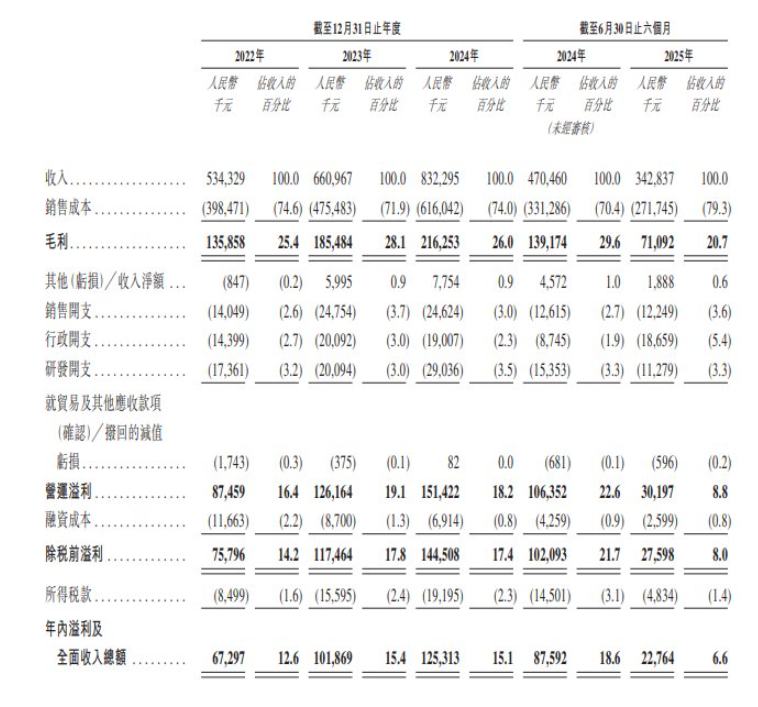
Core Insights - Yuwang Biological Nutrition Co., Ltd. has submitted its IPO application to the Hong Kong Stock Exchange, highlighting its position as the world's largest supplier of refined fish oil with a market share of 8.1% [1] - The company has demonstrated strong revenue growth, with revenues increasing from 534.3 million RMB in 2022 to 661 million RMB in 2023, and projected to reach 832.3 million RMB in 2024, indicating a robust compound annual growth rate [2] - However, the company's profitability has shown volatility, with a significant drop in net profit margin from 15.1% in 2024 to 6.6% in the first half of 2025, despite maintaining substantial revenue levels [3][4] Financial Performance - The core business of Yuwang includes the development, production, and sale of refined fish oil and dietary supplements, which accounted for approximately 97.5% to 98.8% of total revenue from 2022 to mid-2025 [2] - The company's gross profit margin peaked at 28.1% in 2023 but fell to 20.7% in the first half of 2025, primarily due to rising sales costs, which reached a historical high of 79.3% of revenue [3][4] - Administrative expenses increased significantly, with their proportion of revenue rising from about 2-3% to 5.4% in the first half of 2025, contributing to a decline in operating profit margin from 22.6% in 2024 to 8.8% in 2025 [4] Cost Pressures - The company faces significant cost pressures, with raw material costs (mainly fish oil) consistently accounting for over 87% of total sales costs in recent years, making it vulnerable to price fluctuations [6][7] - The lack of pricing power in a competitive market means that rising raw material costs cannot be easily passed on to customers, potentially impacting profitability [6][8] Market Exposure - Yuwang's overseas revenue share increased from 47.3% in 2022 to 60.9% in 2024, indicating a strong reliance on international markets, particularly the U.S., which poses risks due to ongoing trade tensions [8] - The company’s high inventory levels, which reached 210 million RMB at the end of 2023, present a risk of depreciation if market demand does not meet expectations [9] Operational Efficiency - The decline in inventory turnover days from 138 days in 2023 to 92 days in the first half of 2025 may suggest improved operational efficiency, but it could also indicate a strategy to reduce inventory in response to cash flow pressures [9] - The company’s ability to manage costs and maintain profitability amidst external pressures will be critical for its future performance [9]
新股前瞻|“鱼油之王”的烦恼:禹王生物营养8.1%市场份额难抵成本洪流
智通财经网· 2025-10-23 03:51
Core Viewpoint - Yuwang Bio-Nutrition Co., Ltd. has submitted its IPO application to the Hong Kong Stock Exchange, highlighting its position as a leading player in the refined fish oil market with a global market share of 8.1% [1] Financial Performance - The company's main business includes the development, production, and sale of refined fish oil, fish oil soft capsules, and other dietary supplements, which accounted for approximately 97.5% to 98.8% of total revenue from 2022 to mid-2025 [2] - Revenue grew from 534.3 million RMB in 2022 to 661 million RMB in 2023, and is projected to reach 832.3 million RMB in 2024, indicating a strong compound annual growth rate [2] - Profitability improved from 67.3 million RMB in 2022 to 102 million RMB in 2023, peaking at 125.3 million RMB in 2024, with profit margins also increasing during this period [2] Recent Challenges - In the first half of 2025, revenue was 343 million RMB, but net profit plummeted to 22.8 million RMB, resulting in a net profit margin of only 6.6%, a significant drop from 15.1% in 2024 [3] - The gross profit margin fell from a high of 28.1% in 2023 to 20.7% in the first half of 2025, primarily due to soaring sales costs, which accounted for 79.3% of revenue in the same period [3][4] - Administrative expenses surged to 5.4% of revenue in the first half of 2025, up from approximately 2-3% in previous years, contributing to a decline in operating profit margin from 22.6% in 2024 to 8.8% in 2025 [4] Cost Pressures - Raw material costs, particularly fish oil, represent a significant portion of total sales costs, exceeding 87% over the past three years, making the company vulnerable to price fluctuations [6] - The company lacks pricing power in a competitive market, making it difficult to pass on rising costs to customers without risking order loss [6][7] Market Exposure - The company's overseas revenue share increased from 47.3% in 2022 to 60.9% in 2024, indicating a strong reliance on international markets, particularly the U.S., which poses risks due to ongoing trade tensions [8] - High inventory levels, reaching 210 million RMB at the end of 2023, present a risk if market demand falls short or if product obsolescence occurs [8][9] Operational Efficiency - The decline in inventory turnover days from 138 days in 2023 to 92 days in the first half of 2025 may indicate improved operational efficiency, but could also reflect a strategy to reduce inventory in response to rising raw material costs [9] - The company’s ability to maintain profitability amidst rising costs and external pressures is critical for its future performance [9]
Century munities(CCS) - 2025 Q3 - Earnings Call Transcript
2025-10-22 22:02
Financial Data and Key Metrics Changes - In Q3 2025, pre-tax income was $48 million, net income was $37 million, and adjusted net income was $46 million, reflecting increases of 7% and 10% sequentially [13] - Home sales revenues were $955 million, down 2% sequentially, while deliveries of homes declined by 4% [13] - Adjusted home building gross margin improved to 20.1% from 20% in Q2, driven by lower direct costs offsetting higher incentives [14] Business Line Data and Key Metrics Changes - The company delivered 2,486 homes, hitting the high end of guidance, with an average sales price of $384,000, up 2% quarter-over-quarter [4][13] - Net new contracts for Q3 were 2,386 homes, a decline of 6% sequentially, but better than the historical average decline of 9% [8] - The ending community count increased by 5% year-over-year to 321 communities [10] Market Data and Key Metrics Changes - The company holds top 10 positions in 13 of the 50 largest U.S. markets, with expectations for mid-single-digit percentage growth in community count by year-end 2025 [6] - The average cycle time for home deliveries improved to 115 calendar days, with one-third of divisions achieving 100 days or less [7] Company Strategy and Development Direction - The company aims to deepen its market share in existing markets while controlling costs and maintaining an adequate supply of land [18] - The strategy includes investing in people, processes, and systems to drive operational improvements, with expectations for growth to be realized once the market normalizes [6][18] Management's Comments on Operating Environment and Future Outlook - Management noted that while home buyer demand has been muted due to economic uncertainty, there is pent-up demand for affordable homes supported by demographic trends [5] - The company expects that any interest rate relief and improvement in consumer confidence will unlock buyer demand [5] Other Important Information - The company repurchased $20 million of its shares in Q3, totaling 6% of shares outstanding year-to-date [4][17] - The company completed a private offering of $500 million in senior notes, providing flexibility with leverage management [17] Q&A Session Summary Question: Adjusted gross margin performance - Management attributed the adjusted gross margin exceeding guidance to successful cost controls and lower direct costs, despite increased incentives [20] Question: Impact of adjustable-rate mortgages (ARMs) - Management noted a significant increase in ARMs usage among buyers, which helps address affordability challenges, and expects this trend to continue [21] Question: Community count guidance - Management confirmed a mid-single-digit increase in community count by year-end, indicating a significant ramp-up in Q4 [25][26] Question: Consumer behavior and incentives - Management observed cautious consumer behavior, particularly at entry-level price points, and anticipates increased incentives in Q4 due to competition [28] Question: SG&A cost reductions - Management highlighted operational efficiencies and headcount adjustments as key drivers for lower SG&A costs, with a focus on maintaining efficiency going forward [32][33] Question: Lot abandonment and future projects - Management explained that they are underwriting to current market conditions, leading to the exit from certain projects, while maintaining a steady owned lot count [35] Question: Average sales price dynamics - Management clarified that the sequential lift in average sales price was primarily driven by a favorable mix of deliveries rather than incentives [38] Question: Tariff impact for next year - Management stated it is too early to estimate the impact of tariffs for next year, as the situation remains fluid [41]