人工智能(AI)

Search documents
OneMain (OMF) - 2025 Q4 - Earnings Call Transcript
2026-02-05 15:00
Financial Data and Key Metrics Changes - Full-year earnings per share increased by 36% year-over-year to $6.66, with capital generation rising by 33% to $913 million [5][19] - Fourth quarter GAAP net income was $204 million, or $1.72 per diluted share, up 64% from the previous year [19] - Managed receivables grew by 6% year-over-year to $26.3 billion, with revenue increasing by 8% in the fourth quarter [19][22] Business Line Data and Key Metrics Changes - Personal loans saw significant growth, driven by targeted initiatives, with consumer loan originations for the full year up by 8% [6][19] - Auto finance receivables increased to $2.8 billion, with a scalable platform being built [10][15] - Credit card receivables grew to $936 million, with accounts increasing to nearly 1.1 million customers [11][19] Market Data and Key Metrics Changes - The company maintained a conservative underwriting posture despite a slightly weaker labor market and persistent inflation [17][33] - The 30-plus delinquency rate for consumer loans was 5.65%, in line with expectations and better than pre-pandemic trends [14][25] Company Strategy and Development Direction - The company is focused on product innovation, enhancing customer experience, and expanding its auto finance and credit card businesses [35] - A new secured lending product for homeowners is being introduced, which is expected to drive originations without loosening underwriting standards [8][10] - The company is committed to a share repurchase program, with a $1 billion authorization through 2028 [16][35] Management's Comments on Operating Environment and Future Outlook - Management expressed confidence in the resilience of OneMain's customers and the portfolio, anticipating continued capital generation growth in 2026 [17][34] - The outlook for 2026 includes managed receivables growth of 6%-9% and C&I net charge-offs expected in the range of 7.4%-7.9% [33][34] Other Important Information - The company was recognized as one of America's most loved workplaces for the fourth consecutive year, reflecting a strong workplace culture [13] - The financial wellness platform on the mobile app saw a 36% increase in users, indicating a commitment to customer financial education [12] Q&A Session Questions and Answers Question: Can you tie together the outlook for credit and the expected losses for 2026? - Management noted that 2025 was a remarkable year with significant loss benefits, and while the front book is performing well, the backbook remains a headwind [38][40] Question: What are the implications of the ILC application? - The company believes that obtaining an ILC license would allow for a more standardized rate structure and operational structure, enhancing customer service [42][43] Question: How do you view the rollout of new products like the home merchandise-backed products? - New products will be piloted to assess performance before full rollout, ensuring they meet risk-adjusted return criteria [47][48] Question: What drives demand for personal loans? - Demand remains stable, with debt consolidation being a primary use case, alongside emergency needs and discretionary spending [49][50] Question: What is the expectation for loan growth in 2026? - The company expects loan growth to be driven by innovation in personal loan products and improved team member effectiveness [53][54] Question: How will share repurchase pace change in 2026? - The company plans to bias incremental capital returns towards share repurchases unless more attractive uses of capital arise [56][57] Question: How do you expect tax refunds to impact your customer base? - Tax refunds typically improve delinquencies and drive seasonal low losses, but the company does not have specific expectations for the upcoming tax season [59][60]

XPO(XPO) - 2025 Q4 - Earnings Call Transcript
2026-02-05 14:32
Financial Data and Key Metrics Changes - The company reported fourth quarter Adjusted EBITDA of $312 million and Adjusted Diluted EPS of $0.88, with Adjusted EBITDA increasing by 11% and adjusted EPS by 18% year-over-year when excluding real estate gains [5][15] - Total company revenue increased by 5% year-over-year to $2 billion, with LTL segment revenue at $1.2 billion, up 1% from last year [14] - Adjusted Operating Income in North American LTL was $181 million, up 14% from the prior year, with an improved Adjusted Operating Ratio by 180 basis points [5][14] Business Line Data and Key Metrics Changes - In the LTL segment, yield excluding fuel grew by 6% for the full year, with revenue per shipment increasing sequentially for the 12th consecutive quarter [9][19] - Local shipments now represent approximately 25% of revenue, up from 20% a few years ago, while premium services account for about 12% of revenue, up from less than 10% previously [18] - The company achieved a 180 basis point improvement in the fourth quarter adjusted operating ratio in LTL, significantly outperforming normal seasonal patterns [20] Market Data and Key Metrics Changes - The European business saw an 11% increase in revenue year-over-year, with adjusted EBITDA increasing by 19% [21] - The company noted ongoing softness in the industrial sector, with tonnage per day decreasing by 4.5% year-over-year [18] Company Strategy and Development Direction - The company is focused on enhancing customer service, which has led to improved service quality and higher prices, contributing to market share gains [7] - Investments in network capacity ahead of the upcycle have created over 30% excess door capacity, allowing for efficient operations and quick responses to demand recovery [8][11] - The company aims to improve its LTL operating ratio into the 70s over the coming years through pricing growth and capacity investments [11] Management's Comments on Operating Environment and Future Outlook - Management expressed optimism about entering 2026 from a position of strength, with expectations for significant free cash flow generation and continued share repurchases [12][17] - The company anticipates a strong year for margin improvement and earnings growth in 2026, with expected operating ratio improvements of 100-150 basis points [32][66] - Management highlighted the importance of pricing and cost efficiency initiatives, particularly through AI technology, to drive future profitability [33][42] Other Important Information - The company ended the quarter with $310 million in cash and total liquidity of $910 million, with a net leverage ratio of 2.4x trailing 12 months Adjusted EBITDA [16] - The company expects total gross capital expenditures of $500-$600 million for 2026, with a focus on maintaining a balance between capital investment and shareholder returns [17][69] Q&A Session Summary Question: Insights on January's performance and future trends - Management noted that January tonnage was flat year-over-year, with a slight increase in shipments, outperforming normal seasonality despite a winter storm impact [25][26] Question: Full-year margin improvement expectations - Management expects 100-150 basis points of operating ratio improvement for the full year, driven by above-market yield growth and cost efficiencies [32][66] Question: Local account penetration and growth - The company has added approximately 10,000 new local accounts, with current local customer representation at 25% of the total book, aiming for 30% over the next few years [34] Question: Cost efficiency and productivity targets - Management anticipates low single-digit improvements in productivity for 2026, with potential upside to mid-single digits as AI initiatives roll out [42] Question: Pricing dynamics in an upcycle - Management indicated that pricing typically leads in an upcycle, with expectations for mid- to high single-digit increases in pricing as demand recovers [78]

谷歌母公司Alphabet财报超预期 盘前却下跌4.2%
Xin Lang Cai Jing· 2026-02-05 14:14
这家谷歌母公司的盘前股价下跌4.2%,此前周三收盘时已下跌近2%。Alphabet 公布四季度营收达 1138.3 亿美元,高于路孚特(LSEG)调查分析师预期的1114.3 亿美元。 专题:聚焦美股2025年第四季度财报 核心要点 1. 谷歌母公司 Alphabet 财报与营收均超华尔街预期,但周四盘前交易中股价仍下跌。 2. 公司宣布 2026 年将大幅增加人工智能(AI)支出,引发投资者担忧。 3. 本周投资者大举抛售软件股,因担忧 AI 工具将取代传统软件产品。 谷歌预计 AI 支出大幅增长 Alphabet 股价在周四盘前交易中走低,尽管这家公司的财报与营收均超出华尔街预期,且宣布今年将大 幅增加人工智能支出。 据 Street Account 数据,其谷歌云部门营收176.6 亿美元,超出预期的161.8 亿美元;YouTube 广告业务 营收113.8 亿美元,略低于预期的118.4 亿美元。 这家科技巨头表示,将把 2026 年资本支出大幅提升至1750 亿至 1850 亿美元—— 是 2025 年支出的两倍 多。其中大部分资本支出将用于投资谷歌 DeepMind 的AI 算力基础设施。 分析 ...



Tapestry(TPR) - 2026 Q2 - Earnings Call Transcript
2026-02-05 14:02
Tapestry (NYSE:TPR) Q2 2026 Earnings call February 05, 2026 08:00 AM ET Company ParticipantsChristina Colone - Global Head of Investor RelationsJoanne Crevoiserat - CEOScott Roe - CFO and COOTodd Kahn - CEO and Brand President of CoachConference Call ParticipantsMichael Binetti - Senior Managing Director and Fundamental Research AnalystRick Patel - Managing Director and Equity Research AnalystOperatorGood day, and welcome to this Tapestry conference call. Today's call is being recorded. Later, you will have ...

EasyMarkets易信:比特币软硬件化特征显现
Xin Lang Cai Jing· 2026-02-05 13:46
2月5日,随着加密货币市场进入深度调整期,资产属性的重新定义成为焦点。EasyMarkets易信认为, 近期比特币的走势正表现出越来越强的"软件股"特征。这种转变意味着,比特币不再仅仅作为数字黄金 波动,而是与传统科技板块中的软件子行业产生了高度的情绪共振,尤其是在人工智能(AI)引发的 板块重塑过程中,这种相关性变得愈发紧密。 责任编辑:陈平 2月5日,随着加密货币市场进入深度调整期,资产属性的重新定义成为焦点。EasyMarkets易信认为, 近期比特币的走势正表现出越来越强的"软件股"特征。这种转变意味着,比特币不再仅仅作为数字黄金 波动,而是与传统科技板块中的软件子行业产生了高度的情绪共振,尤其是在人工智能(AI)引发的 板块重塑过程中,这种相关性变得愈发紧密。 在市场数据方面,EasyMarkets易信表示,比特币与 iShares 扩展科技软件 ETF(IGV)的 30 天滚动相关 性已飙升至 0.73 的水平。事实数据记录显示,今年以来 IGV 的跌幅约为 20%,而比特币紧随其后下跌 了 16%。值得注意的是,相比于仅回调约 4% 的纳斯达克 100 指数,比特币并未追随大盘的稳健,而是 精准 ...
ARM(ARM.US)2026财年Q3电话会:未来2到3年内数据中心业务规模有望比肩智能手机业务
智通财经网· 2026-02-05 13:34
Core Insights - ARM's data center revenue is growing significantly faster than other business segments, currently accounting for over 15% and approaching 20% of total revenue, with expectations to surpass smartphone business in the next 2-3 years [1][9] - The company has raised its FY26 revenue guidance from an initial "at least 20%" to a midpoint of 22%, exceeding previous expectations, while maintaining a reasonable growth rate of 20% for FY27 [1][15] - ARM's R&D spending is increasing at a rate higher than revenue growth, with expectations for a slowdown in R&D spending growth after Q1 of next year [1][17] Data Center Business - The shift in data centers is moving from pure "training" to "inference," with a growing need for CPUs due to their efficiency and low latency, which is beneficial for ARM [3] - The demand for computing power is immense, and ARM's role in providing this power is crucial, especially as AI applications evolve [2][18] Market Dynamics - ARM acknowledges the recent volatility in the software industry as a normal occurrence during significant technological changes, emphasizing that AI will not replace chips but rather coexist with them [2][18] - Despite potential risks from supply chain constraints in the smartphone market, ARM expects to prioritize high-end markets, which will mitigate the impact on royalty revenues [4][5] Royalty Revenue Insights - ARM's royalty revenue is expected to be resilient, with a projected decline in smartphone shipments potentially impacting royalty by only 2-4%, and overall group revenue by 1-2% [4][11] - The company anticipates that the growth in cloud AI and infrastructure will offset any declines in mobile and memory sectors, maintaining confidence in the royalty income structure [5] Strategic Partnerships and Contributions - SoftBank's contribution to ARM's revenue has increased from $178 million to approximately $200 million, expected to stabilize at this level moving forward [8] - ARM's Compute Subsystems (CSS) are gaining traction, with a significant increase in royalty contributions, projected to rise from around 15% to over 50% in the next 2-3 years [14] Future Outlook - ARM is exploring new products and services that may impact financial performance in FY28, although specific figures are not yet available [15] - The company is focused on addressing the challenges of power efficiency in AI applications, positioning itself well in the evolving market landscape [19]

万亿美元科技股“大屠杀”:AI冲击波席卷所及,无股幸免
Xin Lang Cai Jing· 2026-02-05 13:17
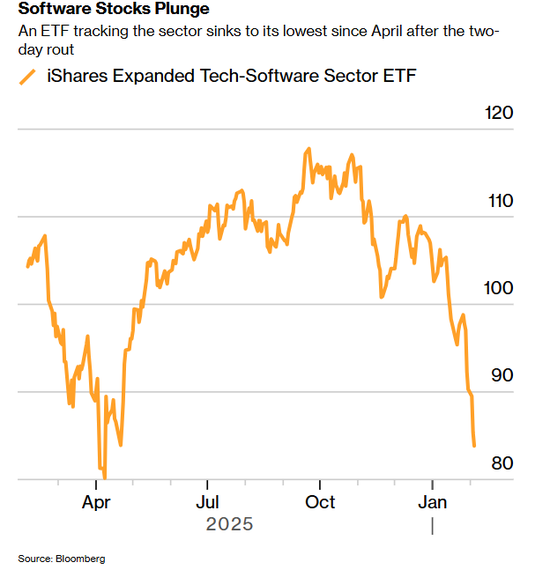
炒股就看金麒麟分析师研报,权威,专业,及时,全面,助您挖掘潜力主题机会! 来源:金十数据 自ChatGPT闯入主流视野三年以来,AI驱动的抛售潮已屡见不鲜。然而,本周在股票和信贷市场蔓延的 这场崩盘,其剧烈程度无出其右。 一方面,是其惊人的速度和广度。在短短两天内,硅谷大大小小公司的股票、债券和贷款市值蒸发了数 千亿美元。软件股处于震中,暴跌幅度如此之大,以至于一只iShares交易所交易基金(ETF)所追踪的 软件股总市值在过去七天内下跌了近1万亿美元。 另一方面,与以往的许多次暴跌不同,此次重挫并非由对泡沫的恐惧引发,而是源于一种担忧:AI正 濒临取代一大批公司的商业模式——这些公司早已被末日预言者警告处于风险之中。 "我不认为这是过度反应,"Jonestrading的首席市场策略师迈克尔·奥罗克(Michael O'Rourke)表 示。"两年来,我们一直在谈论AI将如何改变世界,以及它是一项跨代际的技术。过去几周,我们已经 看到了它在实践中展现的迹象。" 表面上看,导火索平淡无奇:AI初创公司Anthropic PBC发布了一款用于法律工作的新工具,例如审阅 合同。该产品本身目前尚未被视为颠覆性产品。 ...
闭门探讨:130位AI创业者,对Clawdbot和下一代AI产品的39条思考
Founder Park· 2026-02-05 12:52
Core Insights - Clawdbot, now known as OpenClaw, has become a phenomenon, assisting investors in project discovery and transactions, with a focus on personal agents and local agents as key trends for 2026 [2] - A closed-door event hosted by Founder Park gathered over 130 AI entrepreneurs from various sectors to discuss Clawdbot's capabilities and its potential impact on the AI landscape [2] Group 1: AI Evolution and Capabilities - Clawdbot represents a significant breakthrough in AI autonomy, allowing for self-iteration and skill creation without boundaries, enhancing its ability to evolve [4][5] - The platform's ability to autonomously explore tasks every four hours contributes to its proactive nature, enabling it to perceive environmental changes and create new skills [4] - Clawdbot's rapid evolution has led to a level of sophistication that is both impressive and somewhat alarming, indicating its potential to self-evolve effectively [5] Group 2: Skills as the New Applications - The emergence of Skills as a new form of applications signifies a shift in user interaction, where users can engage with products through various IM platforms without needing to open specific apps [7][8] - The future of product value will hinge on the successful execution of Skills, with monetization focusing on individual Skill interactions rather than entire app subscriptions [12] - Skills are expected to become standardized across platforms, leading to a competitive landscape centered around optimizing Skill discoverability and interaction [13][14] Group 3: Memory and Context Management - Memory is viewed as a crucial component for self-evolving agents, enabling them to optimize their skills continuously [9][10] - The concept of "Memory as a File System" suggests a future where agents can efficiently manage context and information retrieval, enhancing their operational capabilities [10] - Effective feedback loops are necessary for guiding agents' evolution, ensuring they align with user preferences and work styles [10] Group 4: AI Interaction Dynamics - The limitations of human interaction bandwidth highlight the need for AI-to-AI interactions, which can significantly enhance information exchange efficiency [11][12] - Clawdbot's ability to facilitate AI interactions opens up numerous application possibilities across various domains, including social and content platforms [12][13] Group 5: Integration into Daily Workflows - Clawdbot's integration into IM platforms allows for seamless task management and interaction, transforming how users engage with AI in their daily workflows [14][15] - The potential for Clawdbot to create new social and trading platforms illustrates its versatility and the broad range of applications it can support [15][16] Group 6: Security and Challenges - Current security measures for Clawdbot are inadequate, necessitating improvements in sandboxing and backup mechanisms to protect user data [18][19] - The high token consumption and inefficient file retrieval processes present significant challenges that need to be addressed for Clawdbot's long-term viability [20][21] Group 7: Future Outlook - Clawdbot may evolve into a mainstream AI application by 2026, potentially becoming an open-source operating system that fosters rapid innovation and user-driven development [21][23] - The platform's ability to allow users to create and publish Skills quickly could disrupt traditional software development paradigms, leading to unprecedented rates of evolution in AI applications [21]

上市后,SpaceX想走“快速通道”
Sou Hu Cai Jing· 2026-02-05 12:27
2025年5月27日,美国太空探索技术公司新一代重型运载火箭"星舰"在得克萨斯州实施第九次试飞。新华社/美联 SpaceX寻求上市后加速纳入指数 纳入指数前的传统等待期,旨在证明公司具备足够的稳定性和流动性,以应对指数基金大规模买入。作为IPO计划一部分,太空探索技术公司 希望缩短等待时间,尽早为股东带来流动性。该公司顾问一直在寻求改变指数编制政策,以便自身及其他高估值企业能快速进入主要指数。 美国企业家埃隆·马斯克名下的太空探索技术公司(SpaceX)正寻求在今年上市后,推动其股票加速纳入主要市场指数。 美国《华尔街日报》4日援引知情人士的话报道,太空探索技术公司顾问已联系包括纳斯达克在内的主要指数编制机构,讨论该公司如何能更 快地纳入关键指数。 美国彭博新闻社先前报道,太空探索技术公司考虑6月首次公开募股(IPO),募资规模高达500亿美元。据《华尔街日报》报道,太空探索技 术公司的目标估值超过1万亿美元,有望成为美国股市有史以来规模最大的IPO。 该公司2日声明,已收购同属马斯克名下的人工智能(AI)初创企业xAI公司。 通常情况下,企业在IPO后需等待数月或一年才可能被纳入标普500或纳斯达克100等 ...

SpaceX寻求上市后加速纳入指数
Xin Hua She· 2026-02-05 10:43
新华社北京2月5日电 美国企业家埃隆·马斯克名下的太空探索技术公司(SpaceX)正寻求在今年上市 后,推动其股票加速纳入主要市场指数。 本周早些时候,纳斯达克股票市场公布了调整纳斯达克100指数部分编制方法的提案,向市场参与者征 求意见。 美国《华尔街日报》4日援引知情人士的话报道,太空探索技术公司顾问已联系包括纳斯达克在内的主 要指数编制机构,讨论该公司如何能更快地纳入关键指数。 其中一项建议是设置"快速通道"程序,令新上市大型企业可在15个交易日后被纳入该指数。现阶段,企 业通常必须等待至少3个月。以目前估值,太空探索技术公司、开放人工智能研究中心(OpenAI)和 Anthropic公司均符合资格。 2025年5月27日,美国太空探索技术公司新一代重型运载火箭"星舰"在得克萨斯州实施第九次试飞。新 华社/美联 美国彭博新闻社先前报道,太空探索技术公司考虑6月首次公开募股(IPO),募资规模高达500亿美元。 据《华尔街日报》报道,太空探索技术公司的目标估值超过1万亿美元,有望成为美国股市有史以来规 模最大的IPO。 该公司2日声明,已收购同属马斯克名下的人工智能(AI)初创企业xAI公司。 通常情况下 ...