
数字金融

Search documents
影响市场重大事件:俄罗斯计划在2036年前建成月球发电站;央行等八部门支持探索推进内地与新加坡数字人民币跨境支付试点
Mei Ri Jing Ji Xin Wen· 2025-12-24 22:17
Group 1 - The People's Bank of China and eight other departments support the exploration of cross-border payment trials with Singapore using digital RMB [1][4] - The new "Encouraging Foreign Investment Industry Catalog (2025 Edition)" has been released, increasing the total entries to 1,679, with a net addition of 205 entries compared to the 2022 version [3] - The production value of China's productive service industry has grown from 19.8 trillion RMB in 2016 to 41.1 trillion RMB in 2024, with a compound annual growth rate of 9.5% [6] Group 2 - The establishment of the Western Land-Sea New Corridor Fund in Chongqing aims to support infrastructure and industrial park construction along the corridor [7] - SMIC has notified customers of a 10% price increase for its 8-inch BCD process platform, with similar price adjustments reported by World Advanced [8]


华鑫证券总经理陈海东: 文化铸魂科技擎旗 打造华鑫特色核心竞争力
Zhong Guo Zheng Quan Bao· 2025-12-24 20:23
"在客户服务中,以适当性管理守护投资者权益。"陈海东表示,公司运用"鑫财富"管理平台建立了有效 的客户适当性管理体系,确保每一笔投资建议客观审慎、每一个产品风险评级都经过严谨评估。通过全 流程诚信监督机制,华鑫证券客户投诉率持续下降,满意度稳步提升,市场信誉成为公司最珍贵的无形 资产。 在新时代金融强国建设的征程中,中国特色金融文化不仅是行业健康发展的精神内核,更是金融服务中 国式现代化的价值基石。华鑫证券总经理陈海东日前在接受中国证券报记者专访时表示,公司深刻把握 中国特色金融文化的内涵,强化党建引领,以"义利相生、守信如金、敬畏风险、金融为民"为核心,将 文化软实力转化为服务实体经济的硬核动力,通过科技赋能、业务创新与党建引领,构建具有华鑫特色 的高质量发展路径。 ● 本报记者徐昭林倩 坚守"义利相生"服务国家战略展现新作为 华鑫证券始终秉持"计利当计天下利"的格局,将服务国家战略作为业务发展的根本导向,在科技金融、 绿色金融、数字金融等领域精准布局,推动金融资源向关键领域汇聚。 据陈海东介绍,在科技金融领域,公司成功落地全国首单技术产权(技术交易)ABS项目,截至2025年9 月末,该项目已发行3期,累 ...
文化铸魂科技擎旗打造华鑫特色核心竞争力
Zhong Guo Zheng Quan Bao· 2025-12-24 20:18
Core Viewpoint - The development of a distinctive financial culture in China is essential for the healthy growth of the financial industry and serves as a foundational value for modernizing financial services in a Chinese context [1]. Group 1: Financial Strategy and Innovation - The company emphasizes the principle of "benefit and righteousness coexist," aligning its business development with national strategies, particularly in technology finance, green finance, and digital finance [1]. - In technology finance, the company successfully launched the first national technology property ABS project, raising 266 million yuan for 32 high-tech enterprises, supporting 88 technology property projects and 21 technology transaction contracts [1]. - The company issued the first knowledge property ABS in Chongqing with a record low interest rate of 1.96%, significantly reducing financing costs for tech enterprises [2]. Group 2: Green Finance Initiatives - The company acted as the plan manager for a green ABS project worth 800 million yuan, covering solar power, waste treatment, and green transportation, which is expected to reduce CO2 emissions by 501.95 tons annually [2]. - The company also issued the first data asset ABS in the country, raising 13.37 million yuan for nine enterprises, marking a breakthrough in the capitalization of data assets [2]. Group 3: Compliance and Trust - The company integrates "integrity as gold" into its governance, customer service, and operations, establishing a trust-centered financial service system [2]. - A customer suitability management system was developed through the "Xin Wealth" platform, ensuring objective investment advice and rigorous risk assessments [2]. Group 4: Operational Management and Risk Control - The company implemented an intelligent management system that binds employee roles with responsibilities, enhancing permission management and risk monitoring [3]. - A comprehensive risk management system is in place, focusing on real-time monitoring and automated management of operations to ensure compliance and risk mitigation [5]. Group 5: Inclusive Finance and Investor Education - The company launched the "Smart ETF" service channel, increasing ETF trading penetration from 3.5% to 4.2% within a year, significantly lowering investment barriers [4]. - The company issued a 300 million yuan bond linked to low-carbon transformation, supporting small and micro enterprises while achieving a record low interest rate for similar issuances in the Northwest region [4]. - The company conducts over 100 public financial literacy events annually to enhance the financial knowledge of the general public [4]. Group 6: Cultural Integration and Future Directions - The company aims to deepen its cultural foundation, enhancing the political and public nature of financial services, and continues to explore ways to inject more financial vitality into the real economy [6].
四方精创递表港交所 为银行业金融科技服务提供商
Zhi Tong Cai Jing· 2025-12-24 14:20
Company Overview - Sifang Jingchuang (300468.SZ) is a fintech service provider based in the Greater Bay Area, focusing on the banking sector, offering software development, consulting, and system integration services to banks, regulatory bodies, and other financial institutions in mainland China, Hong Kong, and Southeast Asia [3] - The company's services are divided into three main segments: fintech software development, consulting services, and system integration services, with a focus on banking technology services, financial infrastructure, and fintech innovation [3] Financial Performance - The company's revenue for the fiscal years 2022, 2023, 2024, and the nine months ending September 30, 2025, were approximately RMB 664 million, RMB 730 million, RMB 740 million, and RMB 454 million respectively [5] - The net profit for the same periods was approximately RMB 41.19 million, RMB 47.38 million, RMB 67.36 million, and RMB 66.58 million [7] - The gross profit margins for these years were 32.5%, 30.2%, 33.1%, and 40.3% respectively [8] Client Concentration - The company has a high client concentration, with revenue from its top five clients accounting for 87.8%, 90.1%, 93.7%, and 89.4% of total revenue for the years 2022, 2023, 2024, and the nine months ending September 30, 2025 [4] Industry Overview - The market for fintech software development services in mainland China and Hong Kong has grown rapidly, from RMB 100.3 billion in 2020 to an expected RMB 158.8 billion by 2024, with a compound annual growth rate (CAGR) of 12.2% [10] - The banking sector is projected to account for 69.6% of the fintech software development services market in 2024, increasing to 73.9% by 2029 [11] - The fintech software development services market in Hong Kong is expected to reach RMB 9 billion by 2024, with a CAGR of 7.8% from 2020 to 2024 [13] Competitive Landscape - The fintech software development services market is fragmented and competitive, with service providers and in-house development teams contributing to the market [18] - In 2024, the company's revenue is expected to represent 1.2% of the total market for fintech software development services in the banking sector in mainland China and Hong Kong, ranking it 15th among competitors [20]


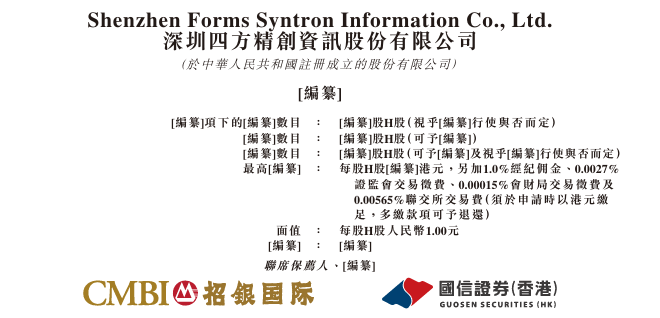
新股消息 | 四方精创递表港交所 为银行业金融科技服务提供商
Zhi Tong Cai Jing· 2025-12-24 14:00
Company Overview - Sifang Precision Technology Co., Ltd. (四方精创) has submitted its listing application to the Hong Kong Stock Exchange, with CMB International and Guosen Securities (Hong Kong) as joint sponsors [1] - The company is a fintech service provider focused on the Greater Bay Area, offering software development, consulting, and system integration services to banks and financial institutions in mainland China, Hong Kong, and Southeast Asia [2][3] Service Offerings - The company provides three main service categories: fintech software development, consulting services, and system integration services [3] - Fintech software development includes banking technology services, financial infrastructure, and fintech innovation services, such as integrated software systems for personal and corporate banking, digital banking solutions, and data services [3] - The company’s revenue primarily comes from fintech software development, utilizing two revenue models: cost-plus pricing and project-based pricing [3] Financial Performance - The company's revenue for the fiscal years 2022, 2023, 2024, and the nine months ending September 30, 2025, were approximately RMB 664 million, RMB 730 million, RMB 740 million, and RMB 454 million, respectively [4] - The net profit for the same periods was approximately RMB 41.19 million, RMB 47.38 million, RMB 67.36 million, and RMB 66.58 million [5] - The gross profit margins for these years were 32.5%, 30.2%, 33.1%, and 40.3% [6] Industry Overview - The fintech software development market in mainland China and Hong Kong has grown rapidly, from RMB 100.3 billion in 2020 to an estimated RMB 158.8 billion by 2024, with a compound annual growth rate (CAGR) of 12.2% [8] - The banking sector is a significant contributor, expected to account for 69.6% of the market share in 2024, increasing to 73.9% by 2029 [9] - The Hong Kong fintech software development market is projected to reach RMB 9 billion by 2024, with a CAGR of 7.8% from 2020 to 2024, and is expected to grow to RMB 36.3 billion by 2029 [12] Competitive Landscape - The fintech software development market is competitive and fragmented, with service providers and in-house development teams contributing to the market [17] - By 2024, fintech software development providers are expected to account for approximately 53% of the total revenue in the banking sector [17] - The company ranks 15th in terms of software development service revenue in the banking sector, with a market share of 1.2% [18]
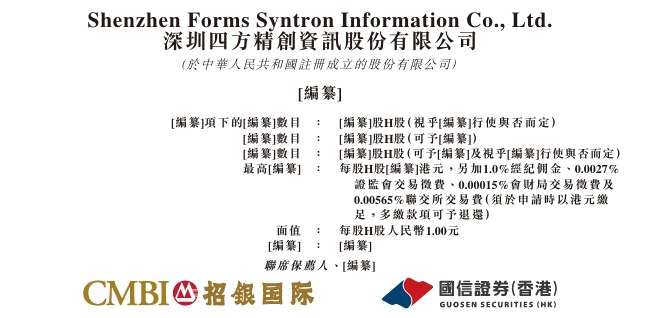
新股消息 | 四方精创(300468.SZ)递表港交所 为银行业金融科技服务提供商
智通财经网· 2025-12-24 13:55
Company Overview - Sifang Precision (Shenzhen) Co., Ltd. is a financial technology service provider focused on the Greater Bay Area, offering software development, consulting, and system integration services to banks and financial institutions in mainland China, Hong Kong, and Southeast Asia [3] - The company operates in three main segments: financial technology software development, consulting services, and system integration services, with a strong emphasis on digital transformation for financial institutions [3] Financial Performance - The company's revenue for the fiscal years 2022, 2023, 2024, and the nine months ending September 30, 2025, were approximately RMB 664 million, RMB 730 million, RMB 740 million, and RMB 454 million, respectively [5] - The net profit for the same periods was approximately RMB 41.19 million, RMB 47.38 million, RMB 67.36 million, and RMB 66.58 million [6] - The gross profit margins for these years were 32.5%, 30.2%, 33.1%, and 40.3% [7] Client Concentration - The company has a high client concentration, with revenue from its top five clients accounting for 87.8%, 90.1%, 93.7%, and 89.4% of total revenue for the years 2022, 2023, 2024, and the nine months ending September 30, 2025, respectively [4] Industry Overview - The market for financial technology software development services in mainland China and Hong Kong has grown rapidly, from RMB 100.3 billion in 2020 to an estimated RMB 158.8 billion by 2024, with a compound annual growth rate (CAGR) of 12.2% [9] - The banking sector is projected to account for 69.6% of the financial technology software development services market in 2024, increasing to 73.9% by 2029 [10] - The Hong Kong financial technology software development services market is expected to grow from RMB 9 billion in 2024 to RMB 36.3 billion by 2029, with a CAGR of 32.3% [12] Competitive Landscape - The financial technology software development services market is fragmented and competitive, with service providers and in-house development teams contributing to the market [17] - In 2024, the company's revenue is expected to represent 1.2% of the total market, ranking it 15th among competitors [19]
“十四五”济南金融业圆满收官:科创金融领跑 五大篇章齐头并进
Zheng Quan Ri Bao Wang· 2025-12-24 13:44
Core Insights - The financial sector in Jinan has significantly strengthened during the "14th Five-Year Plan" period, with multiple indicators ranking first in the province, driven by the establishment of the country's first Sci-tech Financial Reform Pilot Zone [1][2] Group 1: Financial Performance - The financial industry's added value is projected to reach 1,097.5 billion yuan in 2024, becoming a key driver of economic growth [2] - By the end of 2024, the balance of both domestic and foreign currency deposits and loans will exceed 30 trillion yuan, marking increases of 42.2% and 52.7% respectively since the end of 2020 [2] - The new direct financing amount in 2024 is expected to be 3,761.33 billion yuan, a 65.7% increase from 2020 [2] - The non-performing loan ratio is expected to drop to 0.61% by the end of 2024, the best in the province [2] Group 2: Monetary Policy Support - The People's Bank of China has lowered the statutory deposit reserve ratio for Jinan's financial institutions nine times, releasing approximately 79 billion yuan in long-term funds [3] - The average interest rates for new corporate loans and personal housing loans in November 2025 are both at a historical low of 3.05%, reducing the burden on market entities [3] - By the end of November 2025, the social financing scale and the balance of domestic and foreign currency loans are expected to reach 53 trillion yuan and 35 trillion yuan, respectively, with increases of 64.1% and 67.0% since the end of 2020 [3] Group 3: Sci-tech Financial Innovations - Since being approved as the first Sci-tech Financial Reform Pilot Zone in November 2021, Jinan has developed a "six specialized and four pricing" service system, promoting comprehensive development in green, inclusive, elderly, and digital finance [4] - The outstanding loans for sci-tech enterprises reached 3,029 billion yuan by the end of Q3, a 175.8% increase since the pilot zone's approval [4] - The average loan interest rate for sci-tech financing is 2.81%, down by 144 basis points [4] Group 4: Inclusive and Digital Finance - The "泉融科创" financial partner brand has provided financing solutions totaling 967.8 billion yuan to nearly 4,000 enterprises and individual businesses [5] - By the end of November, the balance of inclusive small and micro loans reached 3,292.3 billion yuan, a year-on-year increase of 11.3% [5] - The cumulative transaction amount of digital RMB exceeded 48 billion yuan, with over 550 billion yuan facilitated through the "泉融通" financing service platform [5] Group 5: Capital Market Development - During the "14th Five-Year Plan" period, enterprises in Jinan raised 7,125 billion yuan through stock and bond financing, a 68% increase from the "13th Five-Year Plan" [6] - Bond financing accounted for 6,776 billion yuan, ranking first in Shandong Province, with innovative financing products like sci-tech bonds and green bonds totaling 690 billion yuan [6] - The number of newly listed companies in Jinan reached 15, with nearly 90% being strategic emerging industries, high-tech enterprises, or specialized and innovative firms [6]
低成本服务长尾客户,数字金融助力银行“省钱”又“挣钱”
Hua Xia Shi Bao· 2025-12-24 11:52
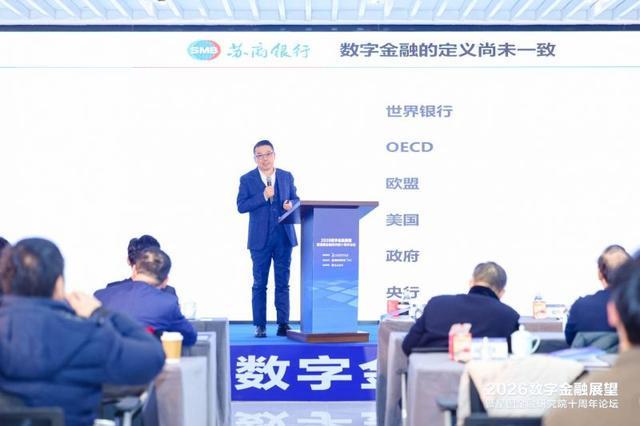
Group 1 - The core viewpoint of the articles emphasizes the transformative impact of digital technologies, such as artificial intelligence, on the financial industry, highlighting the concept of "borderlessness" in digital finance [2][3] - Jiangsu Province is actively promoting digital financial innovation through a systematic approach, including the launch of over 200 specialized digital financial products and the establishment of the first national digital and technology financial research institute [3][6] - SuShang Bank serves as a case study, demonstrating significant efficiency improvements through digital technology, managing 160 billion yuan in assets with only 700 employees, and achieving a revenue growth rate of 18.8% year-on-year for the first half of 2025 [2][4][5] Group 2 - The integration of digital technologies in finance is seen as a systemic transformation, with a focus on enhancing service quality and operational efficiency in the banking sector [3][6] - The bank's commitment to technology investment is notable, with 6% to 8% of annual revenue allocated to R&D, including 10% specifically for AI applications, which are now comprehensively integrated into its credit operations [5][6] - The forum also highlighted the release of the "China Residents Consumption Trend Report (2025)," indicating a stable consumption market with emerging structural trends, and projecting a moderate recovery in total consumption driven by policies aimed at increasing urban and rural residents' income [7]
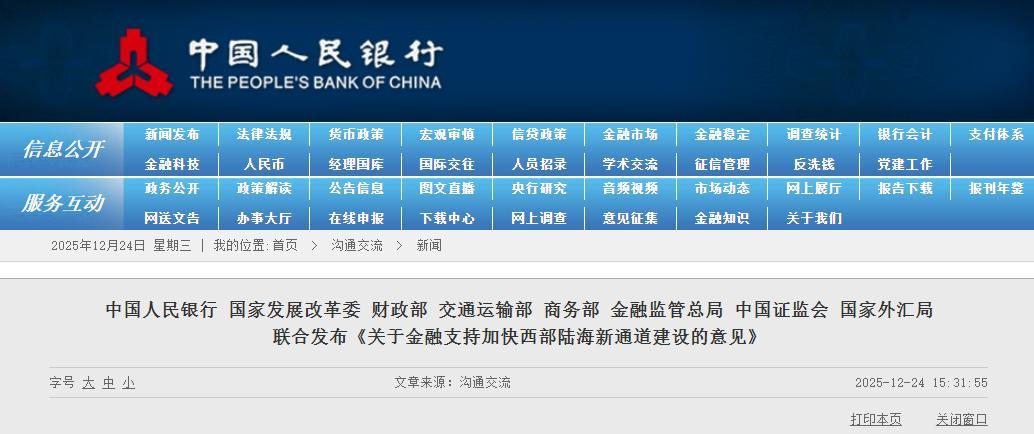
利好!央行等八部门,联合发布→
Zheng Quan Shi Bao· 2025-12-24 11:36
Core Viewpoint - The People's Bank of China and eight other departments have jointly issued an opinion to enhance financial support for the construction of the Western Land-Sea New Corridor, focusing on improving the financial service system and increasing cross-regional and cross-border financial resource allocation [1] Group 1: Financial Resource Coordination - The opinion emphasizes increasing financial resource coordination, encouraging financial institutions to establish special service mechanisms and joint credit mechanisms for the corridor [3] - It supports the establishment of foreign financial institutions in the corridor region and encourages international financial organizations to set up operational centers [3] - The opinion calls for ensuring funding supply for infrastructure construction and enhancing support for logistics enterprises through diversified financial products [3] Group 2: Infrastructure and Trade Financing - Chongqing will establish a fund to support infrastructure and industrial park construction along the corridor, seeking strategic resource support from institutions like the Asian Development Bank [4] - The opinion aims to enhance the inclusiveness of financial services for small and medium-sized trade enterprises by developing specialized credit products and simplifying processes [4] Group 3: Cross-Border RMB Usage - The opinion proposes measures to facilitate cross-border trade settlement and expand the use of RMB, supporting banks in handling compliant trade settlements for quality enterprises [5] - It encourages banks to facilitate new types of offshore international trade settlement and simplifies foreign exchange registration procedures for qualified non-financial enterprises [5][6] Group 4: Digital Financial Services - A comprehensive financial service platform named "Central Bank Western Land-Sea Smart Integration" will be established to support the digital transformation of financial services [7] - The platform will include functions for financial policy promotion, enterprise financing matching, and financial data statistics [8] - The opinion also explores international cooperation in digital finance and supports the construction of cross-border e-commerce digital service platforms [8]
氪星晚报|现代汽车美国公司因安全隐患召回逾5万辆汽车;京东:七鲜小厨在北京已开出30家门店;日本最大核电站将于明年1月20日重启
3 6 Ke· 2025-12-24 11:17
Group 1 - OPPO is in deep cooperation with Alipay and plans to announce another strategic partnership in January [1] - OPPO's ColorOS product development director denied rumors of rejecting collaboration with ByteDance regarding "Doubao AI phone," emphasizing an open attitude towards partnerships [1] Group 2 - JD's restaurant platform, Seven Fresh Kitchen, has opened 30 stores in Beijing within four months, achieving coverage in major urban areas within the Fifth Ring Road [2] Group 3 - Thunderbolt eSports Hotel has signed over 200 locations nationwide, doubling its scale in six months, with high occupancy rates and a young customer demographic [3] Group 4 - Hyundai Motor Company is recalling over 51,000 vehicles in the U.S. due to safety hazards, including issues with trailer lights and potential short circuits [4] Group 5 - "Yisoo Innovation," a tech company focused on desktop laser processing equipment, has completed a Pre-A round financing of 100 million yuan to enhance core technology and expand product lines [5] Group 6 - Alibaba upgraded its voice model family Qwen3-TTS, introducing new models for voice design and cloning, which can generate human-like voices and enhance applications in various fields [6] Group 7 - Tencent Music launched its AI music creation tool "VEMUS" for public testing, offering a comprehensive platform for music creation with low barriers to entry [7] Group 8 - SoundAI released its multi-modal AI fashion headphones on Kickstarter, designed as a "personal perception tool" integrating sound and vision [8] Group 9 - The National Development and Reform Commission and the Ministry of Commerce released the "Encouragement Directory for Foreign Investment Industries (2025 Edition)," increasing the number of entries to 1,679 [9] - The central bank and eight departments are exploring cross-border digital currency payment trials with Singapore [9] Group 10 - Beijing has adjusted housing purchase policies for non-local residents, reducing the required duration of social insurance or income tax payments for home purchases [10] Group 11 - The State Administration for Market Regulation is implementing stricter regulations for live e-commerce, including the establishment of a supervisory framework [11] Group 12 - Japan's Tokyo Electric Power Company plans to restart the Kashiwazaki-Kariwa nuclear power plant on January 20, marking the first restart of a nuclear reactor since the Fukushima disaster [12][13]